

wallslide
Docker app from Stoatworks Labs' Repository
Overview
Readme
View on GitHubWallslide
AI-assisted project. This codebase was created with Claude Code (Anthropic), directed and reviewed by a human author. I've opened the generated packages in a real Microsoft PowerPoint and a real Keynote on macOS, which is the only check that means anything for a file format whose failure mode is a dialog that won't say why. Four decks opened without a repair prompt, and PowerPoint reported their slide widths as 40.00″, 20.00″, 11.25″ and 40.00″, matching the computed values. The
.potxopened as a new untitled presentation, as a template should. Text picked to break things came back through the XML unharmed, and a full-bleed picture measured 2880 × 810 pt against a 2880 × 810 pt slide. Keynote's own slide limits were measured by asking Keynote until it refused, not taken from documentation. Every XML part is parsed byxmllintwhen the tests run on my Mac; the CI runner hasn't gotxmllint, so that one check is skipped there. No deck made with this has been played out to a real LED processor or wall and measured. The slide is the right size; what a playback machine and a processor do with the picture is something this can't tell you.
Live at wallslide.stoatworks-labs.com, with nothing to install.
Type in an LED wall's resolution and get a PowerPoint template that's actually the right size, themed with the event's own colours, fonts, logo and background. If you want one, you also get a deck of test patterns rendered at the wall's native raster.
Everything happens in the browser. There's no backend, so a client's unannounced logo has nowhere to be uploaded to.
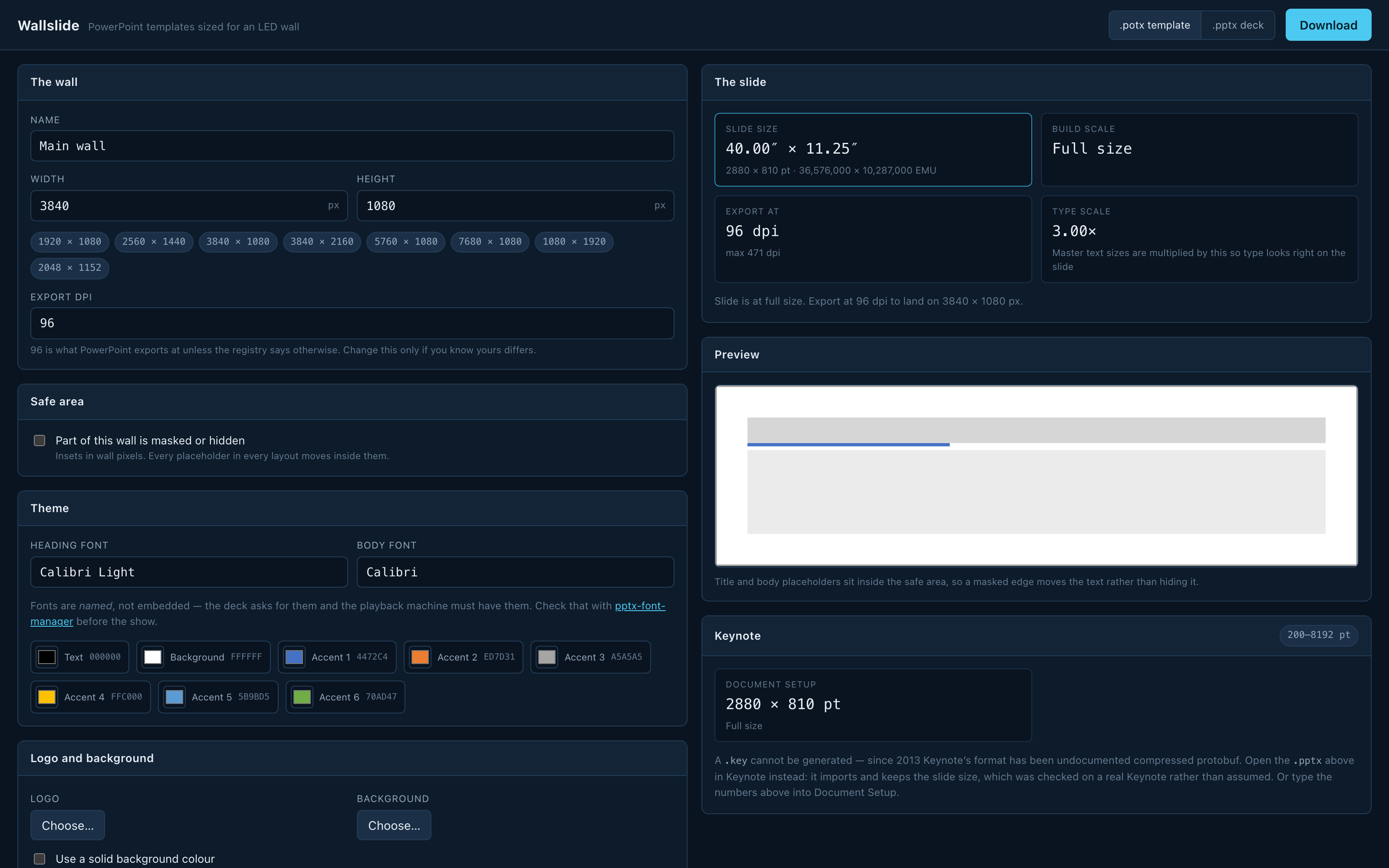
The hosted tool as it opens: a 3840 × 1080 wall at 96 dpi becomes a 40″ × 11.25″ slide at full size with a 3.00× type scale, the safe-area and theme controls sit under it, the slide is previewed on the right, and the Keynote document setup (2880 × 810 pt) is worked out alongside.
The problem it exists for
A 7680 × 1080 wall at 96 dpi wants an 80-inch slide. PowerPoint won't make one. The
format caps a slide edge at 56 inches, and that's a schema limit (ST_SlideSizeCoordinate
tops out at 51,206,400 EMU), not a dialog being fussy. So the deck gets built at 16:9
instead and stretched, or built at "close enough" and letterboxed, and the first anyone
knows about it is at the tech rehearsal.
The answer is to build at half size and export at 2×. That's arithmetic PowerPoint won't do for you, and it's the arithmetic people get wrong the other way round.
| Wall | Slide PowerPoint accepts | Export at |
|---|---|---|
| 1920 × 1080 | 20″ × 11.25″ | 96 dpi |
| 3840 × 1080 | 40″ × 11.25″ | 96 dpi |
| 7680 × 1080 | 40″ × 5.625″ — half size | 192 dpi |
| 1080 × 3840 | 11.25″ × 40″ | 96 dpi |
The build scale is always a whole number or a whole reciprocal. "Build at half and export at 200%" is an instruction a person can follow at 2 a.m.; "build at 1/2.37" isn't.
Keynote is not PowerPoint, and it is not close
Measured from Keynote itself, which helpfully names its own range in the error it raises:
| Minimum | Maximum | |
|---|---|---|
| PowerPoint | 72 pt (1″) | 4032 pt (56″) |
| Keynote | 200 pt (2.78″) | 8192 pt (113.78″) |
Keynote takes a slide more than twice as wide as PowerPoint will. A 7680 px wall is 5760 pt, which PowerPoint has to halve and Keynote just holds at 1:1, with no build scale and no export multiplier to get wrong. That's a proper reason to pick one application over the other for a given wall.
The floor runs the other way: Keynote won't go below 200 pt on either edge, so a 1080 × 160 px ticker strip is legal in PowerPoint and impossible in Keynote at native size.
A .key file isn't generated, and won't be. Since 2013 Keynote's format has been
IWA, which is Snappy-compressed protobuf in an undocumented schema. Wallslide serves Keynote
the two ways that work: open the generated .pptx in it (verified: Keynote imports it and
keeps the slide size), or type the two numbers Wallslide gives you into Document Setup.
What goes in the file
The slide size, as <p:sldSz>, at the build size with the export DPI recorded in the
package's Comments field so the deck still knows what it wants after it's been emailed
twice and renamed once.
A theme: twelve colours and two font names, in ppt/theme/theme1.xml. An organiser
changes the theme and the whole deck follows, which is the whole reason to ship a template
rather than a deck.
A slide master and four layouts (Title Slide, Title and Content, Title Only, Blank), with the event's logo and background on the master, where they can be edited in one place.
Type scaled to the slide. A 40-inch slide with 44 pt titles has titles a third of the size anyone intended. Master text styles are multiplied by the slide's width against PowerPoint's 13.333″ default.
A safe area, if part of the wall is masked. Insets are in wall pixels, because the reason is physical, and "the bottom two cabinets are behind the band" is measured in cabinets. Every placeholder in every layout moves inside them.
Test patterns, optionally, rendered at the wall's native raster and placed full-bleed with the master's shapes suppressed, because a test pattern with a logo on it is a picture of a logo.
Two kinds of test pattern, and the difference matters
Most patterns diagnose the wall. One diagnoses the chain:
Pixel check: a 1 px checkerboard. If this comes out as flat grey, something between PowerPoint and the panels is scaling. That's worth knowing, and it's not a fault in the wall.
A deck that doesn't make that distinction is how somebody spends midnight re-terminating a healthy wall. Every pattern in the UI is labelled with which of the two it reads.
This is not Test Card, and should not become it
Test Card is the serious pattern generator:
SMPTE RP 219 measured against ffmpeg's own smptehdbars, real cabinet maps imported from
Pixel Peeker, PNGs at the exact raster of every physical output. If you want patterns, go
there.
What's here is the subset that survives a trip through a deck. RP 219 is left out on purpose: its whole value is that the fifteen colours are precisely right, and a pattern whose point is exact colour shouldn't be sent down a path that might colour-manage it. The bars here are plain 75% bars and are labelled as such.
Fonts are named, not embedded
The theme asks for a typeface; it doesn't carry one. Font embedding is licence-encumbered and Mac PowerPoint doesn't honour it, so a template that claimed to embed would be lying on one of the two platforms an event runs on. Check the playback machine with pptx-font-manager before the show.
Relatedly, the themes generated here carry no script fallback table. Office writes about
forty <a:font script="..."> entries into every theme whether or not the deck contains a
character of any of them, which is why searching a real deck for typeface= finds 39 fonts
where it uses two. A Wallslide theme names the fonts it uses and nothing else. The cost is
real, though: a deck that will carry Japanese or Devanagari should have its theme fonts set
to a face that covers it, because there's no curated fallback to rescue it.
Where the engine came from
Two of the three hard parts were already written and are vendored unmodified, with the originals named in each file's header:
- Aspect Calc:
slides.ts. The 56-inch cap, the 1-inch floor, the 100 MP bitmap-export ceiling, the whole-fraction build scale and the type scale. Pinned by 100 tests over there. - Test Card:
zip.ts. A store-only ZIP writer checked against the published CRC-32 vector and unpacked with the systemunzip. A.pptxis a ZIP, and OPC permits stored members, so it needed no changes at all.
Fix bugs in those repos and re-copy; don't improve the copies in place.
Development
npm install
npm run dev
npm test
npm run build
node scripts/emit-samples.ts <dir> (run through npm run samples) writes sample decks to
open in the real applications. The unit tests prove the package is a well-formed ZIP of
well-formed XML. They can't prove PowerPoint will open it, and the gap between those two statements is
where every OOXML bug lives.
Run your own copy
Wallslide is a static page, so hosting it yourself is one container serving the built files — the same files the hosted copy serves, running somewhere that still works when the venue has no internet.
Docker. The image is built by this repo's docker.yml workflow on every
push and published as ghcr.io/stoatworks-labs/wallslide:
docker run -d --name wallslide --restart unless-stopped -p 8543:80 ghcr.io/stoatworks-labs/wallslide:latest
Or docker compose up -d with the docker-compose.yml
in this repo, which maps the same port. Either way it is then at
http://localhost:8543/.
Unraid. Search Community Applications for Wallslide — the template is
templates/wallslide.xml
in stoatworks-unraid, which is what the CA feed reads.
Stoatworks Burrow lists it under Self-hosted, with the compose file a click away.
The Dockerfile, docker-compose.yml, docker/ and the workflow are
generated from fleet.json in stoatworks-unraid. Change them there and
regenerate rather than editing them here.
Licence
MIT. See LICENSE.
Categories
Related apps
Explore more like this
Explore allDetails
ghcr.io/stoatworks-labs/wallslide:latestRuntime arguments
- Web UI
http://[IP]:[PORT:80]/- Network
bridge- Shell
sh- Privileged
- false
Template configuration
Host port for the web interface.
- Target
- 80
- Default
- 8543
- Value
- 8543