
All apps · 0 apps
StrawDroid
Docker app from junkerderprovinz's Repository
Overview
Readme
View on GitHub






A real Android emulator on a Selkies desktop, so an app can be installed, driven and broken without an APK ever touching a phone.
A one-knight job: I build it, keep it running, work through the issues and add what people ask for, until nothing is missing. It is free, with no accounts, no telemetry, no ads and no paid tier. No asterisk anywhere. Nothing readable ever leaves your own walls. Forged on evenings and weekends, with heart and stubbornness.
If it has earned a place on your server or computer, toss a coin to your knight: it helps cover the costs and keeps the project alive. It also makes this knight's heart beat a little faster. Three ways below, whichever suits you.



Table of Contents
- What it is
- Screenshots
- Why not Android-in-a-container
- Why not budtmo/docker-android
- Which Android
- Running it
- Using it
- What persists
- Two things worth knowing
- How AI is used here
- Support this project
1. What it is
A straw droid is a practice dummy shaped like an Android phone: built like the real thing so somebody can strike at it without anybody getting hurt.
This container runs the real Android emulator - the same AVD Android Studio starts - headless on a Selkies desktop. The screen arrives in a browser over WebRTC, and adb reaches it over the network, so Android Studio deploys and debugs on it exactly like a phone on a cable.
2. Screenshots
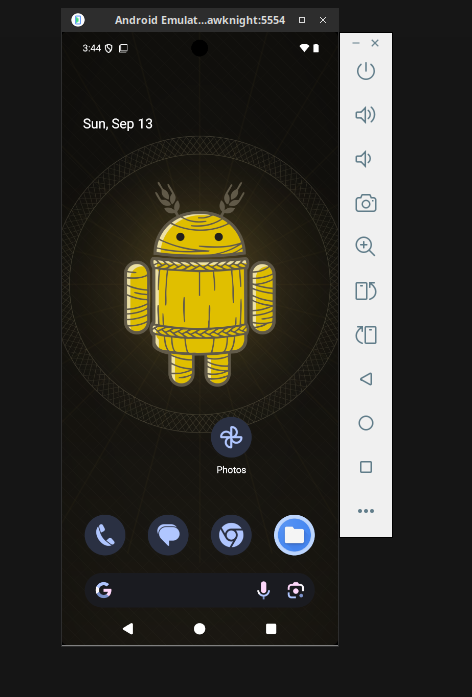
Android 16 on the Selkies desktop, in a browser. The strip on the right is the emulator's own toolbar, not part of the phone.
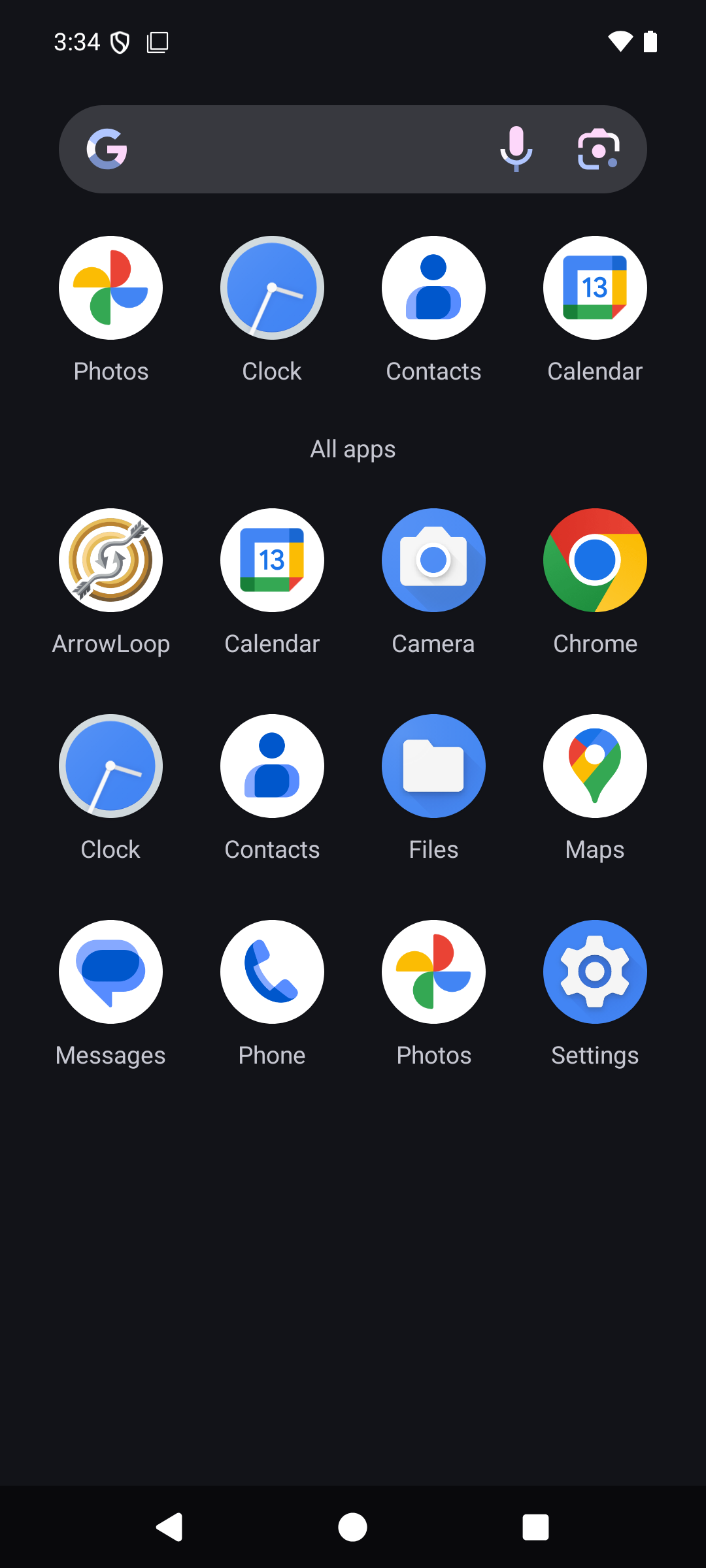
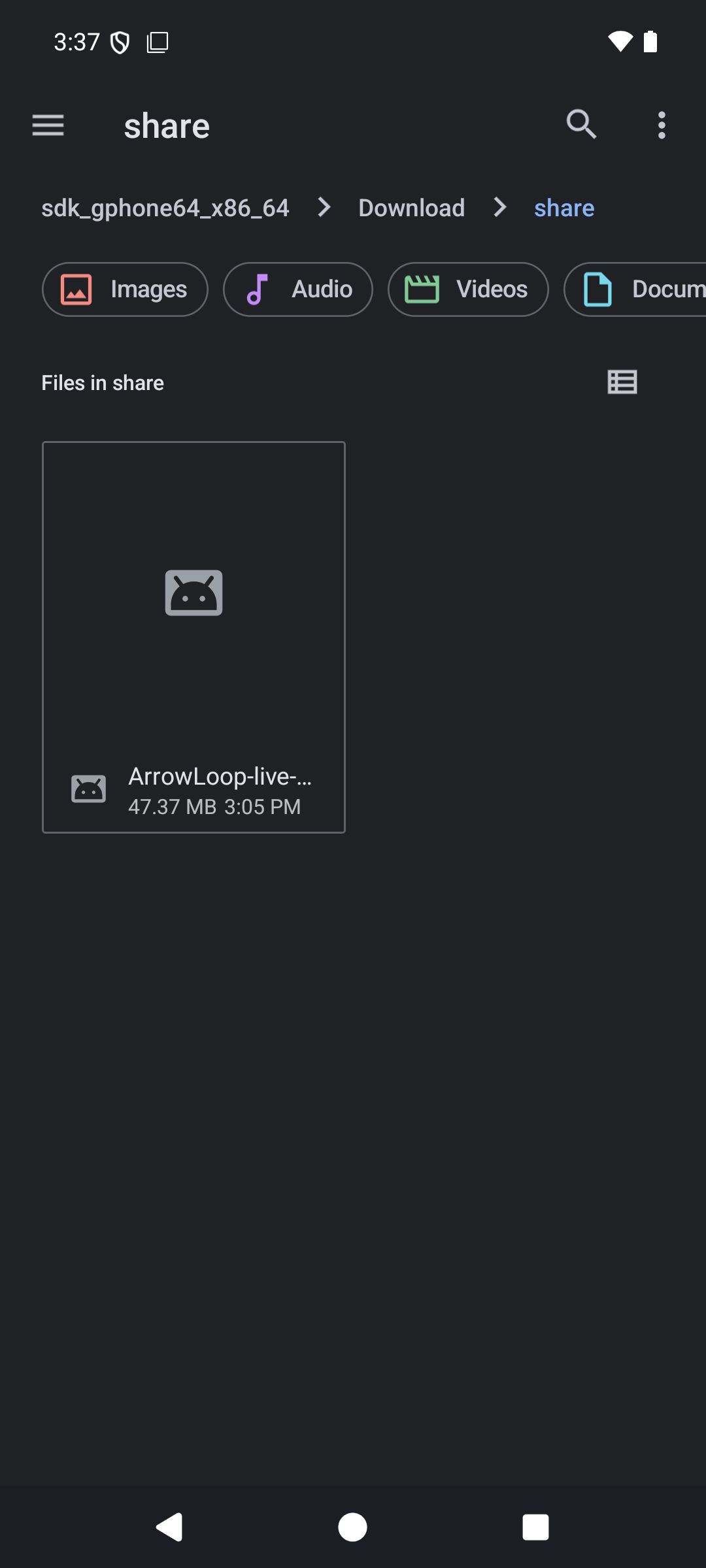
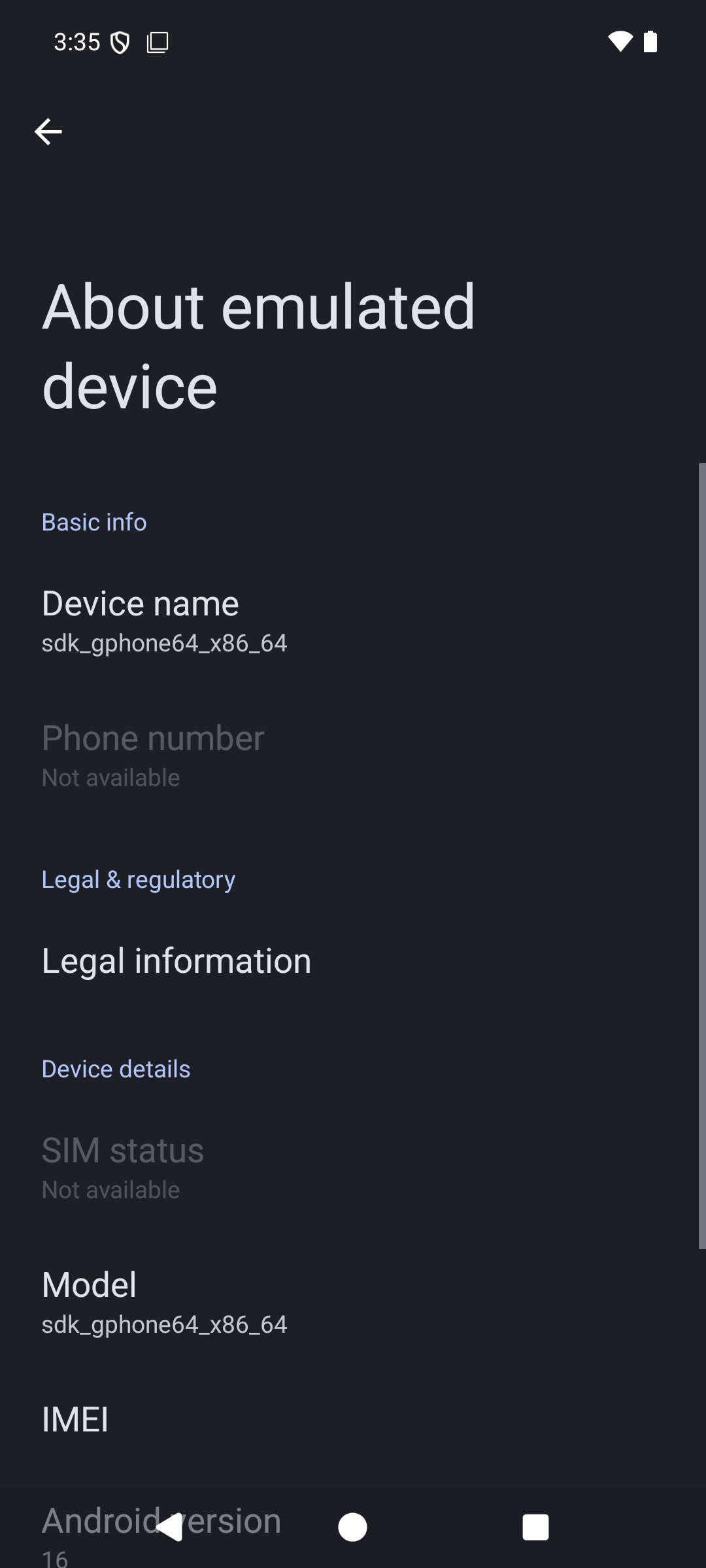
The app drawer, with an APK installed over adb. Anything dropped into /share turns up under Download/share, so a build can be installed by tapping it. And the device says what it is: Android 16, API 36.
3. Why not Android-in-a-container
ReDroid and Waydroid run the Android userspace directly on the host kernel. They are lighter, they need no KVM, and for testing a layout they are fine.
They are the wrong tool for a sync app, and the reason is what they do not have: no battery, no motion sensor, no power HAL. Doze is decided by DeviceIdleController from exactly those signals, so in a container it never fires. WorkManager then runs more eagerly than it ever would on somebody's phone, and Android 14's limits on a dataSync foreground service never kick in either.
A rig that is green because it never asks the question is worse than no rig at all. A real AVD answers, and it answers on demand:
adb shell dumpsys deviceidle force-idle
4. Why not budtmo/docker-android
budtmo/docker-android does the same job and is well kept, on a monthly release cadence. Its screen is x11vnc behind noVNC: a framebuffer diff over websockets, with no hardware encoding.
Judging how an app feels is judging its scrolling and its transitions, which is the part noVNC smears. This image puts the emulator on the same Selkies desktop as the rest of the house, hardware-encoded on the box's own GPU.
5. Which Android
16, API 36, google_apis, x86_64, and the level is the newest on purpose.
This started at 14, reasoning that Android 14 is where the six-hour daily cap on dataSync foreground services landed. That was too cautious: 15 keeps the cap and adds a timeout on top, 16 keeps both, so the newest level is the strictest rather than a different one - and the Play Store wants a recent target level for a new submission anyway. Pinning to 14 would have been testing a rule more lenient than the one the app ships under.
google_apis rather than plain AOSP, because it carries Play services and a real DocumentsUI, which is the SAF folder picker an app asks for a folder with. An image without one cannot answer whether that flow works at all.
Only one level is installed, and that has a consequence: an AVD in the persistent volume names its system image by path, so raising ANDROID_API leaves the existing device pointing at an image the container no longer has. The boot script notices, moves the stale device aside as <name>.avd.old-<stamp>, says in the log that everything installed on it is gone with it, and builds a fresh one.
6. Running it
Needs /dev/kvm. On bare metal that is simply there; no nested virtualisation is involved. Without it the emulator does not start, and the container log says so in as many words rather than leaving a black rectangle.
docker run -d --name StrawDroid \
  --device=/dev/kvm --shm-size=2gb --cpus="4" --memory="8g" \
  -e PUID=99 -e PGID=100 \
  -p 3001:3001 -p 5555:5555 \
  -v /path/to/config:/config \
  ghcr.io/junkerderprovinz/strawdroid:latest
PUID and PGID decide who owns /config, and they should be the user that owns the directory on the host. The defaults above are Unraid's nobody:users; on a plain Linux box $(id -u):$(id -g) is usually what you want.
On Unraid use templates/strawdroid.xml, which puts it on its own IP so no port mapping is needed.
It is deliberately not set to restart on its own. An emulator is a virtual machine and holds its memory whether anybody is testing or not: measured idle, with no app installed, about 6 GB. Start it when it is needed and stop it after.
On Windows and on a desktop Linux
The two start scripts at the top are the short way in. They check the one thing that decides whether this works, start the container, and then get out of the way. They are not the product: the payload is a Linux image that needs KVM, so Docker is required either way.
On Windows the checking is the point. The container runs inside the WSL2 machine, so KVM has to work inside a VM. That needs nestedVirtualization=true in %USERPROFILE%\.wslconfig, a file nothing prompts you to create. Even then the KVM module is not loaded when that machine boots, so /dev/kvm does not exist until something loads it, and when it appears it belongs to root with mode 600 while the emulator runs as an ordinary user. All three are handled on every run, because Docker Desktop rebuilds the WSL machine whenever it restarts.
On Windows, right-click start-windows.ps1 and choose Run with PowerShell; if the execution policy stops it, powershell -ExecutionPolicy Bypass -File start-windows.ps1 runs it once without changing anything. On Linux, chmod +x start-linux.sh && ./start-linux.sh. Both are plain text: read them before you run them.
7. Using it
| Screen | https://<address>:3001/ - self-signed certificate, accept it once. No login. |
| Deploy | adb connect <address>:5555, then Android Studio treats it as an ordinary device. |
| Force Doze | adb -s <address>:5555 shell dumpsys deviceidle force-idle |
| Undo it | adb -s <address>:5555 shell dumpsys deviceidle unforce |
The container's log ends on a banner carrying all three lines with the real address filled in.
From the container's own terminal
Mount a share read-only at /share and an APK dropped into it from anywhere on the network can be installed without leaving the browser. sk is the helper:
sk list                    the APKs on the share, newest first
sk install <name>.apk      install one, keeping the earlier build's data
sk push <file|dir>         copy test files into the device's Downloads
sk doze on | off           force deep idle, or release it
sk shell [...]             a shell on the device
A bare name is taken relative to the share, so sk install arrowloop.apk finds /share/arrowloop.apk.
The share is mounted read-only on purpose: this rig runs unfinished code, and unfinished code has no business writing to a share full of everything else. sk push copies INTO the device instead, and tells the media scanner about it - without that the file is on the disk and absent from every chooser, which looks exactly like the push having silently failed.
sk doze on unplugs the battery before forcing idle, which is not optional: a device that believes it is charging refuses to go idle, and the force then reports success while nothing happens.
The share, on the phone itself
Everything in /share also appears on the device, under Download/share, where the stock Files app and the SAF picker both find it. So an APK dropped into the share from any machine on the network can be installed by tapping it on the phone, without touching a terminal at all.
Mirrored rather than mounted, and that is the only thing available rather than a shortcut. The emulated phone is a virtual machine with its own kernel and its own disk image: a directory on the host is not reachable from inside it by any mount. The emulator has no shared-folder feature, Android's own Files app speaks no SMB, and an SD card image would be a snapshot rather than a live folder. What does cross the boundary is adb, so svc-share-mirror copies - one direction only, host to phone, matching the share's own read-only mount.
It compares timestamps and sizes and sends only what differs, so the steady state costs one comparison every thirty seconds and no traffic. SHARE_MIRROR_SECONDS changes the interval.
There is a cap, and on Unraid it matters: the share this is usually pointed at is the download folder, a place whose whole job is to grow. Above SHARE_MIRROR_MAX_MB (2048 by default) the mirror stops and says so in the log rather than filling the emulator's disk - which would otherwise surface much later as an app that will not install, for reasons that have nothing to do with the app. Refused rather than truncated: a mirror that quietly copies some of a folder is worse than one that says it stopped, because the missing file is the one somebody is looking for. sk install still works either way.
8. What persists
/config only, and it holds the AVD itself: installed apps, granted permissions, anything a test wrote. That is not tidiness. Rebuilding the device on every start would silently reset the folder permission an app was granted through the SAF picker, which is one of the things being tested, and it would look like the app forgetting.
The device profile and the emulated RAM are therefore read on first boot only. Changing them later needs the AVD removed from /config/.android/avd.
The wallpaper and the monochrome icons are set the same way, once, on the first boot of a new AVD. A marker in /config stops them from being written again, so a wallpaper you pick yourself afterwards is yours and stays.
9. Two things worth knowing
The ADB port is forwarded, not bound. The emulator's own adb daemon listens on loopback and nothing else. A forwarder inside the container hands the outside port to it. Without that, the port looks open from a development machine and the handshake never completes, which reads as a network problem and is not one.
The emulator window is kept on screen. Measured on the first working build, it opened at y = -551 on a 768-pixel-tall desktop, so all but its last sixty pixels sat above the visible area - from the browser, indistinguishable from an emulator that never started. Selkies also resizes the desktop to whatever the browser window is, so a one-off placement would not hold either. A small service watches both and puts the window back whenever it has ended up outside, and leaves it alone whenever it has not.
What is on the device, and where it came from
The device is set up once, on the first boot of a new AVD, and then left alone: wallpaper, dark mode, an empty home screen, and a launcher whose icons are monochrome everywhere rather than only on the home screen. A marker in /config stops any of it being written a second time, so a wallpaper or a layout you set yourself is yours and stays.
Two of those pieces are other people's work, shipped unmodified alongside the image and pinned to an exact version, which the build verifies by digest:
- Lawnchair, Apache-2.0. The stock Pixel Launcher has no switch for its search bar, and its themed icons reach the home screen and the dock but not the app drawer. It also reads no icon packs, which is a launcher feature rather than an Android one.
- Arcticons by Donnnno, GPL-3.0. The white line icons, which is what makes the drawer match the rest.
Neither is required to use the emulator. If the launcher fails to install, the log says so and the device keeps the stock one.
10. How AI is used here
One knight builds this, and AI is one of the tools I work with, the same way I work with an editor or a compiler. It helps me write code and documentation and it checks my work, and that saves me a good many evenings. It does not make the decisions, though. I read and understand everything before it ships, and if something here breaks, that is on me and not on the tool.
You do not have to take my word for it. The code is open and every release note is written by hand. The issue tracker shows how problems actually get handled, including the ones I got wrong the first time. If you find something that is not right, open an issue and I will look at it.
11. Support this project
Problems, wishes or suggestions? You're welcome to open an issue.
A one-knight job: I build it, keep it running, work through the issues and add what people ask for, until nothing is missing. It is free, with no accounts, no telemetry, no ads and no paid tier. No asterisk anywhere. Nothing readable ever leaves your own walls. Forged on evenings and weekends, with heart and stubbornness.
If it has earned a place on your server or computer, toss a coin to your knight: it helps cover the costs and keeps the project alive. It also makes this knight's heart beat a little faster. Three ways below, whichever suits you.
Install StrawDroid on Unraid in a few clicks.
Find StrawDroid in Community Apps on your Unraid server, review the template, and click Install. Unraid handles the Docker app or plugin setup from the published template.
Requirements
Categories
Related apps
Explore more like this
Explore allDetails
ghcr.io/junkerderprovinz/strawdroid:latestRuntime arguments
- Web UI
https://[IP]:[PORT:3001]/- Network
br0.20- Shell
bash- Privileged
- false
- Extra Params
--restart=no --device=/dev/kvm --shm-size=2gb --cpus="4" --memory="8g"
Template configuration
The desktop the emulator draws on, over WebRTC. Self-signed certificate - accept it once. HTTPS is the default because browsers only allow seamless clipboard over HTTPS.
- Target
- 3001
- Default
- 3001
- Value
- 3001
Optional fallback. The WebUI defaults to HTTPS on 3001.
- Target
- 3000
- Default
- 3000
- Value
- 3000
Reached from a development machine with: adb connect container-ip:5555 . The emulator's own adb binds to loopback, so a forwarder inside the container hands this port to it; without that the port would appear open and never complete a handshake.
- Target
- 5555
- Default
- 5555
- Value
- 5555
The AVD itself, plus installed apps, granted permissions and anything a test wrote. The ONLY persistent mount by design. Without it every restart is a factory reset, which also throws away the folder permission an app was granted through the SAF picker - one of the things being tested.
- Target
- /config
- Default
- /mnt/user/appdata/strawdroid
- Value
- /mnt/user/appdata/strawdroid
Read-only. Drop an APK into this share from anywhere on the network and it appears ON THE DEVICE under Download/share, where the stock Files app and the SAF picker both find it - so it can be installed by tapping it on the phone, without a terminal. Mirrored rather than mounted, because an emulated phone is a virtual machine and a host directory is not reachable from inside it by any mount; the mirror compares sizes and timestamps and only sends what differs. From the container's terminal instead: sk list to see them, sk install name.apk to put one on the device, sk push file for test files. Read-only on purpose: this rig runs unfinished code, which has no business writing to a share full of everything else.
- Target
- /share
- Default
- /mnt/user/download
- Value
- /mnt/user/download
How the emulator draws. swiftshader_indirect works everywhere, including with no GPU wired in at all. 'host' is faster and is what makes scrolling read honestly, but it needs the nvidia runtime and /dev/dri - set it once the GPU is confirmed.
- Target
- EMULATOR_GPU
- Default
- swiftshader_indirect
- Value
- swiftshader_indirect
Which device the emulator pretends to be. Decides screen size and density, which is what a layout is actually judged against. Read on FIRST boot only: the AVD is created once and then kept, so changing this later needs the AVD removed from /config/.android/avd.
- Target
- EMULATOR_DEVICE
- Default
- pixel_6
- Value
- pixel_6
Memory given to the emulated phone. Read on FIRST boot only, same as the device profile. Below about 1536 Android 14 boots badly or not at all.
- Target
- EMULATOR_RAM
- Default
- 2048
- Value
- 2048
Passed to the emulator verbatim, for the occasional one-off (-writable-system, -dns-server, -netdelay). Empty is the ordinary case.
- Target
- EMULATOR_EXTRA_ARGS
The name of the virtual device inside /config. Changing it creates a SECOND device rather than renaming the first, which is a way to keep two side by side.
- Target
- AVD_NAME
- Default
- strawdroid
- Value
- strawdroid
Optional. Leave EMPTY together with the password for no login. Set both to enable login.
- Target
- CUSTOM_USER
Optional. Leave EMPTY together with the username for no login.
- Target
- PASSWORD
X11 keyboard layout for the streamed desktop (us, de, ...). Typing into the emulator is half of what this rig is for.
- Target
- KEYBOARD_LAYOUT
- Default
- us
- Value
- us
Container timezone. It reaches the emulated Android too, which matters for anything scheduled by the clock.
- Target
- TZ
- Default
- Europe/Vienna
- Value
- Europe/Vienna
User the desktop and the emulator run as. Default 99 (nobody on Unraid).
- Target
- PUID
- Default
- 99
- Value
- 99
Group. Default 100 (users on Unraid).
- Target
- PGID
- Default
- 100
- Value
- 100