
All apps · 0 apps

stagewash
Docker app from Stoatworks Labs' Repository
Overview
Readme
View on GitHubstagewash
AI-assisted project. This codebase was created with Claude Code (Anthropic), directed and reviewed by a human author. The illuminance model is calibrated rather than assumed: eight published photometric rows transcribed from ETC Source Four datasheets are held as tests, and the estimator lands within about 10% given a manufacturer's own field lumens and about 25% from bare lamp lumens alone. The importers are checked against real files — ETC's entire published Source Four bundle, 132 LM-63-02 files, parses with no failures or warnings, and EULUMDAT candela tables integrate back over the sphere to the lamp flux the file declares within 0.1%. 141 tests in total. But this is a direct illuminance calculation only — no inter-reflection, haze, shutter cuts, gobos or shadowing — and nothing here has ever been checked against a light meter on a real stage.
Model a stage and a lighting rig, focus the fixtures, and see the light levels and coverage on the deck — before you get to the venue.
A browser app. Nothing is installed, nothing is uploaded: the whole calculation runs in the tab.
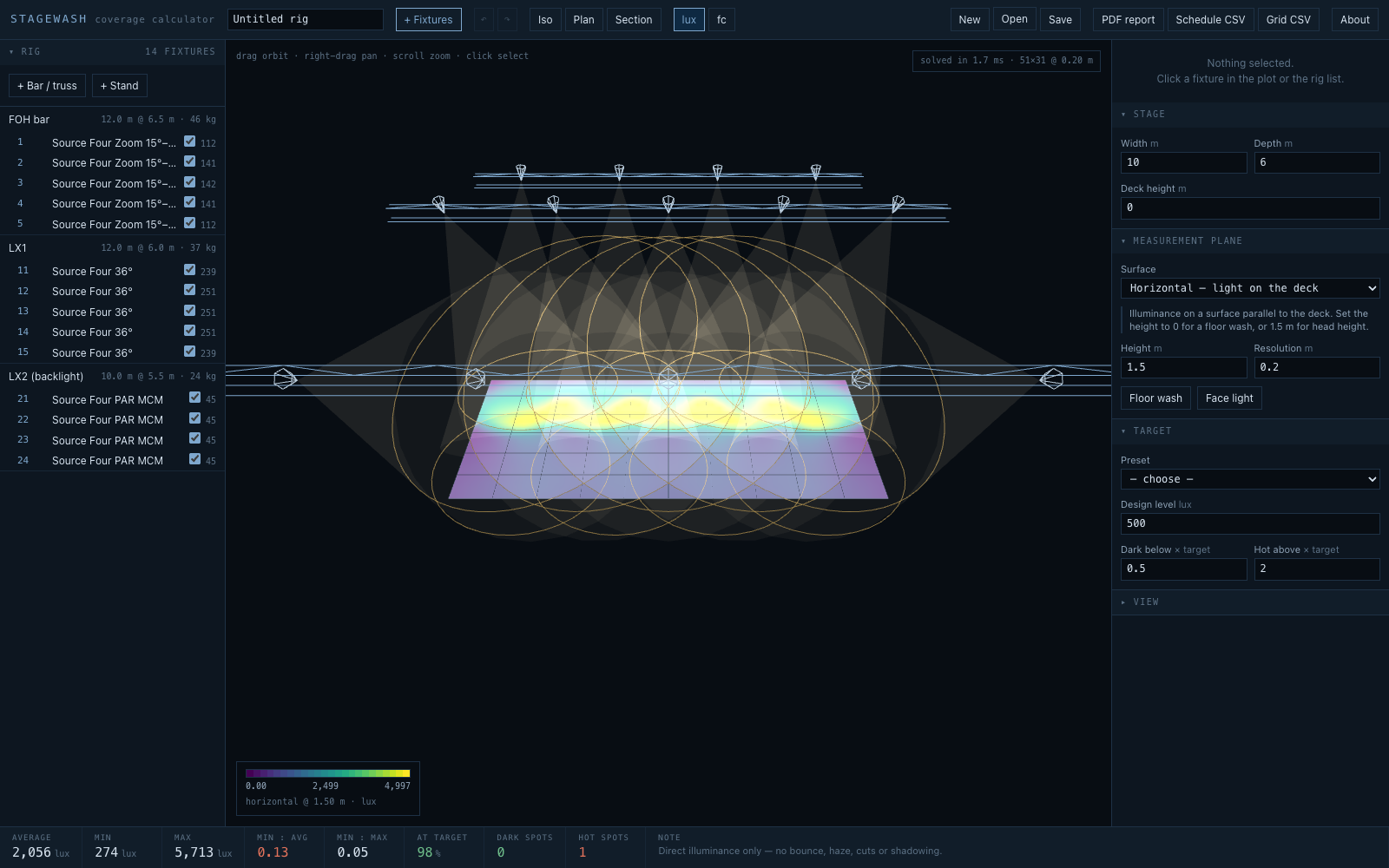
The default rig, captured headless from the live app: the truss and its fixtures drawn over the stage, the direct-illuminance plot on the deck, and the fixture list and controls either side.
What it does
- Build the rig. Truss, scaff, bars and wind-up stands. Hang fixtures along a bar at a spacing, or place them individually.
- Focus. Aim a fixture at a point on the stage and it resolves the pan and tilt for you, or set pan/tilt directly. Zoom fixtures have a zoom; moving heads are checked against their pan and tilt range.
- See the levels. A heatmap on the stage, updated as you drag, with beam cones and footprints in a rotatable wireframe plot.
- Find the problems. Uniformity, coverage against a design level, and contiguous hot and dark spots listed by area with their centres.
- Report. A PDF with the levels, the problem areas, a full fixture schedule with focus and heights, and the structural loading. It carries three plots drawn from the same model: the heatmap in plan with a colour key, an isometric of the rig and its beams, and a wireframe layout by channel that shares the plan's frame, so a pool on the map sits over the fixture that made it. CSV of the schedule and of the raw grid.
The two planes, which is the point
Most of the value is in a single toggle.
- Horizontal — illuminance on a surface parallel to the deck. The classic floor wash.
- Vertical — illuminance on a surface facing the audience, at head height. What a face receives.
A rig can look perfectly even on the floor and be flat and shadowless on faces, because overhead light arrives nearly edge-on to a vertical surface and contributes almost nothing to it. Flip between the two and the ranking of your fixtures inverts: on the default rig the backlight contributes exactly zero to the face plane, and the front-of-house units more than double. That is the calculation catching the most common mistake in a stage rig.
Fixture data, and how much to trust it
Every fixture carries a badge saying where its numbers came from, because a lux figure computed from a guess is worth nothing and you have to be able to tell which is which.
- measured — read from a manufacturer photometric file (
.ies/.ldt) that you imported. As good as this gets. Do this when the answer has to be right. - published — the beam angle, field angle and centre-beam candela are transcribed from a named manufacturer datasheet; only the roll-off between those anchors is modelled. The built-in ETC Source Four entries are these.
- estimated — a generic archetype synthesised from lamp output and beam angle. Useful
for blocking out a rig, not for promising a level. Always named
Generic.
You can also build a custom fixture. If you have its centre-beam candela, or its lux at a stated distance, use that — it assumes nothing. Bare lamp lumens is the weakest option because it has to assume an optical efficiency, and real fixtures of the same class run anywhere from 42% to 65%.
How accurate is the estimator? Checked against eight published photometric rows from ETC Source Four datasheets: within about 10% when given the manufacturer's own field lumens and angles, and within about 25% from bare lamp lumens alone. Those numbers are in the test suite, not marketing.
And the importer? ETC's entire published Source Four photometric bundle — 132 real LM-63-02 files — parses with zero failures and zero warnings. The EULUMDAT reader is checked against real files covering every symmetry case the format defines, by integrating each candela table over the sphere and confirming it comes back to the lamp flux the file declares — within 0.1%, and on a LEDiL street optic it independently recovers that luminaire's own stated 88.63% light output ratio.
Worth knowing what that exercise turned up: for four of eight fixtures ETC's own IES file and ETC's own datasheet agree to within 1%, and for the other four they differ by 5–15%, because the files and the sheets are different revisions. ±15% between two first-party sources for the same fixture is the real floor on accuracy in this business — it is larger than anything the maths in here contributes.
What is not modelled
This is a direct illuminance calculation: inverse square, the cosine law, and each fixture's intensity distribution.
It does not model inter-reflection from the deck, walls or a cyc; atmospheric haze; shutter cuts, gobos or barn doors; or shadowing by people and scenery. On a dark stage that is the right model. In a white studio, inter-reflection can add a third again to these figures.
Nothing here has been checked against a light meter on a real stage.
Running it
npm install
npm run dev
Then open the port it prints. npm test runs the suite; npm run build produces a
static dist/.
Run your own copy
Stagewash is a static page, so hosting it yourself is one container serving the built files — the same files the hosted copy serves, running somewhere that still works when the venue has no internet.
Docker. The image is built by this repo's docker.yml workflow on every
push and published as ghcr.io/stoatworks-labs/stagewash:
docker run -d --name stagewash --restart unless-stopped -p 8524:80 ghcr.io/stoatworks-labs/stagewash:latest
Or docker compose up -d with the docker-compose.yml
in this repo, which maps the same port. Either way it is then at
http://localhost:8524/.
Unraid. Search Community Applications for Stagewash — the template is
templates/stagewash.xml
in stoatworks-unraid, which is what the CA feed reads.
Stoatworks Burrow lists it under Self-hosted, with the compose file a click away.
The Dockerfile, docker-compose.yml, docker/ and the workflow are
generated from fleet.json in stoatworks-unraid. Change them there and
regenerate rather than editing them here.
This project is built on other people's work — see ATTRIBUTIONS.md.
Licence
MIT.
Install Stagewash on Unraid in a few clicks.
Find Stagewash in Community Apps on your Unraid server, review the template, and click Install. Unraid handles the Docker app or plugin setup from the published template.
Categories
Related apps
Explore more like this
Explore allDetails
ghcr.io/stoatworks-labs/stagewash:latestRuntime arguments
- Web UI
http://[IP]:[PORT:80]/- Network
bridge- Shell
sh- Privileged
- false
Template configuration
Host port for the web interface.
- Target
- 80
- Default
- 8524
- Value
- 8524