
All apps · 0 apps
Speakr
Docker app from learnedmachine's Repository
Overview
Speakr is a self-hosted AI transcription and intelligent note-taking platform. Transform your audio recordings into organized, searchable, and intelligent notes with speaker identification, AI chat, semantic search, and collaboration features.
Key Features:
- AI-powered transcription with speaker identification
- Voice profiles for automatic speaker recognition
- Interactive chat with your recordings
- Semantic search across all recordings (Inquire Mode)
- Internal sharing and group collaboration
- Smart tagging with custom AI prompts
- Auto-deletion and retention policies
- Automated export to Obsidian/Logseq
- Full internationalization (EN, ES, FR, DE, ZH)
- Light/dark themes with customizable colors
IMPORTANT: Requires API keys for OpenAI/OpenRouter or local AI services for transcription and text generation.
Readme
View on GitHub
Speakr
Self-hosted AI transcription and intelligent note-taking platform




Documentation • Quick Start • Screenshots • Docker Hub • Releases
Overview
Speakr transforms your audio recordings into organized, searchable, and intelligent notes. Built for privacy-conscious groups and individuals, it runs entirely on your own infrastructure, ensuring your sensitive conversations remain completely private.
Key Features
Speakr turns a recording into organized, searchable, shareable knowledge. Here is the pipeline:
Capture
- Flexible input - record from your microphone, your computer's system or browser-tab audio, or both mixed together; or drag and drop existing files. A per-OS setup guide and a virtual-device picker surface Pulse / PipeWire monitors, BlackHole, VB-Cable, Voicemeeter, and Stereo Mix as inputs.
- Long sessions - in-app recordings stream to the server during capture, so sessions can run for hours and survive a page reload.
- Hands-off intake - a watched "black hole" folder auto-imports and processes any audio dropped into it, with optional per-user subfolders named by user id or username.
Transcribe
- Bring your own engine - self-hosted WhisperX (recommended; it is what enables the speaker features below), OpenAI, Mistral / Voxtral, AssemblyAI, OpenASR, Alibaba FunASR, or any custom ASR webservice. The right connector is auto-detected from your configuration.
- Speaker diarization - automatic who-said-what labeling (WhisperX, or OpenAI's diarizing models).
- Voice profiles - recognize the same person across different recordings via voice embeddings (requires the WhisperX ASR backend).
- Custom vocabulary and hotwords (most effective with the WhisperX backend) - bias the transcriber toward names, jargon, and acronyms it would otherwise mishear; configurable globally, per tag / folder, or right in the upload and in-app recording dialogs, with reusable saved templates.
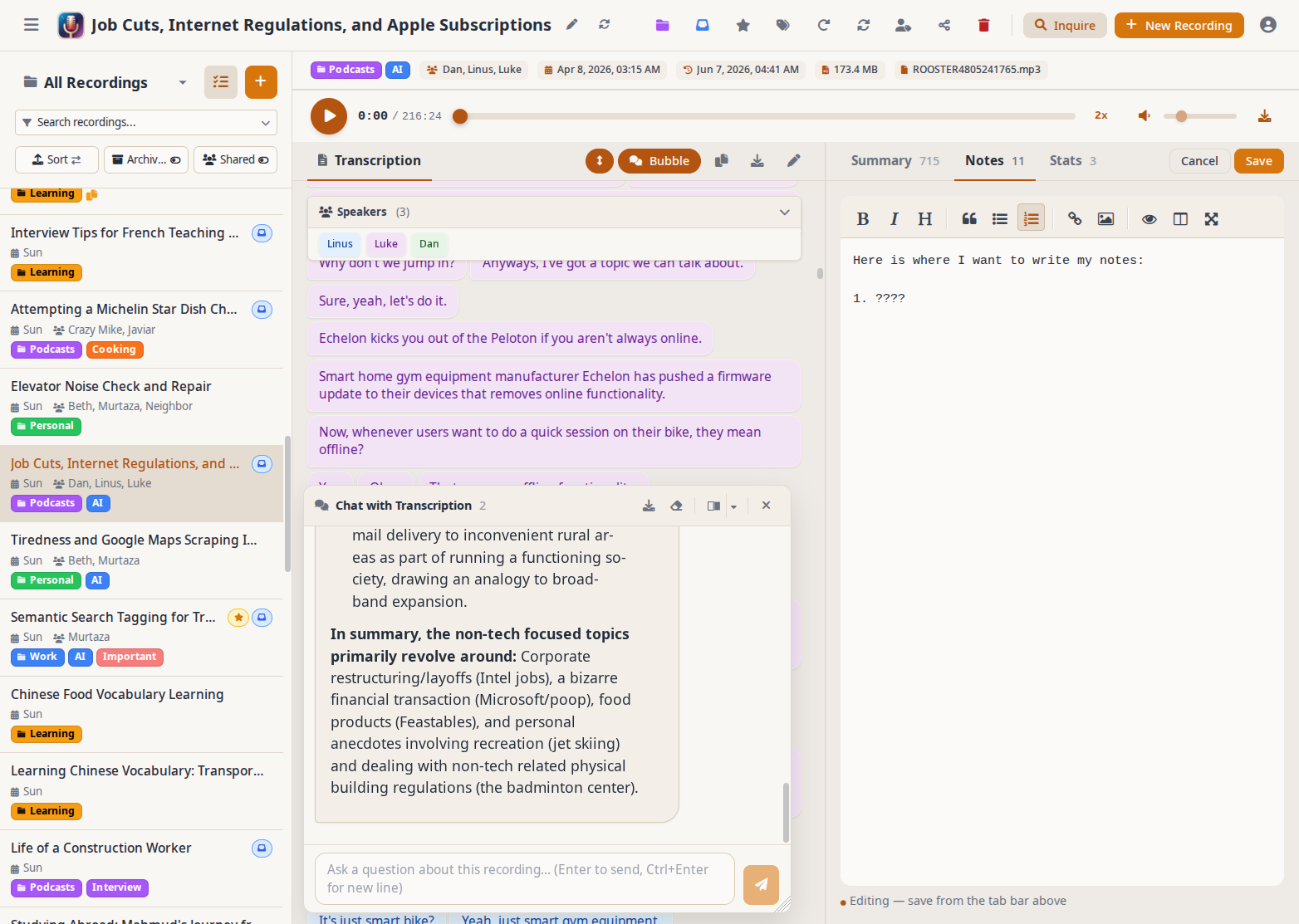
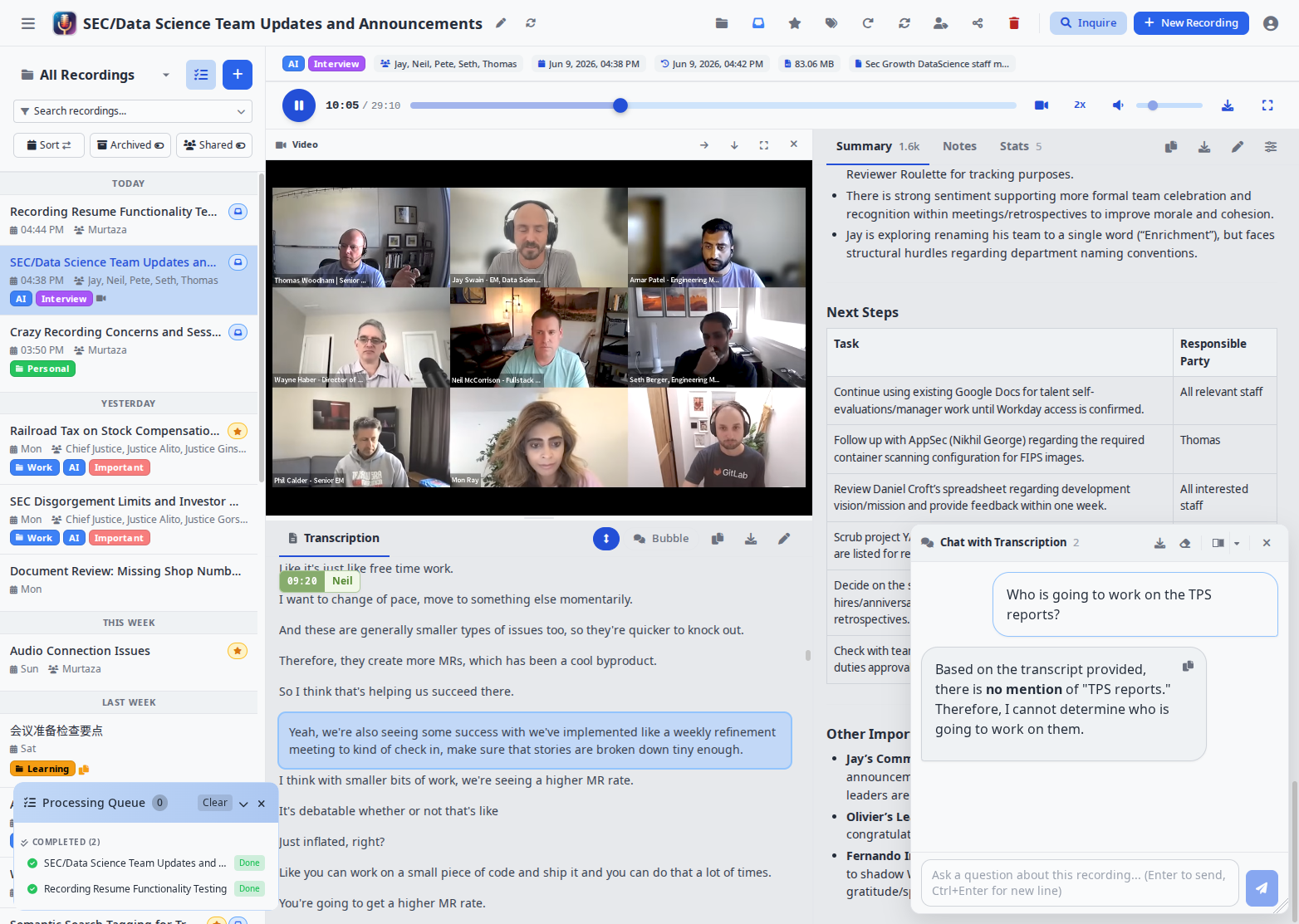
- Synced playback - click any line to jump to that moment, follow-along highlighting during playback, and a chat-style bubble view.
- Language support - automatic language detection plus the full Whisper language list (about one hundred languages), with names localized to your interface language.
Understand
- Summaries - generated automatically, with prompts you can fully customize per recording, tag, or folder (including reusable prompt variables).
- Event extraction - surface action items and calendar-worthy events from a transcript.
- Per-recording chat - ask questions about a single recording in a floating, dockable panel; answers cite transcript timestamps as clickable chips that start playback at that moment.
- Inquire Mode - semantic search and natural-language chat across your entire library at once. An optional agentic mode (opt-in beta) upgrades this to an AI researcher that iteratively searches, lists, and reads your recordings until it can answer - showing every step live, and citing its sources with numbered links that open the recording and start playback at the cited segment. Ask "what did we decide about the pricing change, and did anyone disagree?" and it reads across the relevant meetings and cites each position back to where it was said. You decide what it may read: transcripts always, summaries and private notes only if you allow them.
Organize
- Folders and bulk operations to keep a large library tidy.
- Smart tags that carry their own AI prompt and ASR settings - and stack, so multiple tags layer their instructions.
- Retention policies with auto-deletion and per-recording protection from cleanup.
- Automated export to templated files when a recording finishes.
Collaborate
- Multi-user with Single Sign-On against any OIDC provider (Keycloak, Azure AD, Google, Auth0, Pocket ID).
- Groups with group-scoped tags that auto-share recordings to every member.
- Granular internal sharing (view / edit / reshare) and admin-controlled, secure public links.
Automate
- REST API v1 with a Swagger UI, for automation tools (n8n, Zapier, Make) and dashboards.
- Signed webhooks - HMAC-signed, SSRF-guarded, retrying outbound notifications on recording lifecycle events.
- Usage budgets for LLM tokens and transcription minutes, per user.
Speakr is also an installable Progressive Web App - mobile-first, offline-capable, with a phone share-target - and ships light/dark themes, an incognito mode, a configurable Help Center link for your own documentation, and a UI translated into seven languages.
Unofficial Companion Apps
These apps were built by members of the community for use with your own Speakr server. They are maintained by their authors, not by this project, and I have not tested them myself.
| App | Platform | Description |
|---|---|---|
| Minutes for Speakr | Android, Windows | Recording on the device with upload to Speakr, including automatic recording and automatic folder uploads |
| MeetingRecorder | Windows | Tray app for recording both sides of a call, with upload to Speakr through an API token |
See Companion Apps in the documentation.
Real-World Use Cases
Different people use Speakr's collaboration and retention features in different ways:
| Use Case | Setup | What It Does |
|---|---|---|
| Family memories | Create "Family" group with protected tag | Everyone gets access to trips and events automatically, recordings preserved forever |
| Book club discussions | "Book Club" group, tag monthly meetings | All members auto-share discussions, can add personal notes about what resonated |
| Work project group | Share individually with 3 teammates | Temporary collaboration, easy to revoke when project ends |
| Daily group standups | Group tag with 14-day retention | Auto-share with group, auto-cleanup of routine meetings |
| Architecture decisions | Engineering group tag, protected from deletion | Technical discussions automatically shared, preserved permanently as reference |
| Client consultations | Individual share with view-only permission | Controlled external access, clients can't accidentally edit |
| Research interviews | Protected tag + Obsidian export | Preserve recordings indefinitely, transcripts auto-import to note-taking system |
| Legal consultations | Group tag with 7-year retention | Automatic sharing with legal group, compliance-based retention |
| Sales calls | Group tag with 1-year retention | Whole sales group learns from each call, cleanup after sales cycle |
Creative Tag Prompt Examples
Tags with custom prompts transform raw recordings into exactly what you need:
- Recipe recordings: Record yourself cooking while narrating - tag with "Recipe" to convert messy speech into formatted recipes with ingredient lists and numbered steps
- Lecture notes: Students tag lectures with "Study Notes" to get organized outlines with concepts, examples, and definitions instead of raw transcripts
- Code reviews: "Code Review" tag extracts issues, suggested changes, and action items in technical language developers can use directly
- Meeting summaries: "Action Items" tag ignores discussion and returns just decisions, tasks, and deadlines
Tag Stacking for Combined Effects
Stack multiple tags to layer instructions:
- "Recipe" + "Gluten Free" = Formatted recipe with gluten substitution suggestions
- "Lecture" + "Biology 301" = Study notes format focused on biological terminology
- "Client Meeting" + "Legal Review" = Client requirements plus legal implications highlighted
The order can matter - start with format tags, then add focus tags for best results.
Integration Examples
- Obsidian/Logseq: Enable auto-export to write completed transcripts directly to your vault using your custom template - no manual export needed
- Documentation wikis: Map auto-export to your wiki's import folder for seamless transcript publishing
- Content creation: Create SRT subtitle templates from your audio recordings for podcasts or video content
- Project management: Extract action items with custom tag prompts, then auto-export for automated task creation
Quick Start
Using Docker (Recommended)
# Create project directory
mkdir speakr && cd speakr

# Download docker-compose configuration:
wget https://raw.githubusercontent.com/murtaza-nasir/speakr/master/config/docker-compose.example.yml -O docker-compose.yml

# Download the environment template:
wget https://raw.githubusercontent.com/murtaza-nasir/speakr/master/config/env.transcription.example -O .env

# Configure your API keys and launch
nano .env
docker compose up -d

# Access at http://localhost:8899
Lightweight image: Use
learnedmachine/speakr:litefor a smaller image (~725MB vs ~4.4GB) that skips PyTorch. All features work normally — only Inquire Mode's semantic search falls back to basic text search.
Required API Keys:
TRANSCRIPTION_API_KEY- For speech-to-text (OpenAI) orASR_BASE_URLfor self-hostedTEXT_MODEL_API_KEY- For summaries, titles, and chat (OpenRouter or OpenAI)
Transcription Options
Speakr uses a connector-based architecture that auto-detects your transcription provider:
| Option | Setup | Speaker Diarization | Voice Profiles |
|---|---|---|---|
| OpenAI Transcribe | Just API key | Yes (gpt-4o-transcribe-diarize) |
No |
| WhisperX ASR | GPU container | Yes (best quality) | Yes |
| Mistral Voxtral | Just API key | Yes (built-in) | No |
| VibeVoice ASR | Self-hosted (vLLM) | Yes (built-in) | No |
| MOSI/Mossland MOSS | Hosted API key | Yes (built-in) | No |
| AssemblyAI | Just API key | Yes (built-in) | No |
| OpenASR | Self-hosted server | Yes (built-in) | No |
| Alibaba FunASR | API key + OSS bucket | Yes (built-in) | No |
| Legacy Whisper | Just API key | No | No |
Simplest setup (OpenAI with diarization):
TRANSCRIPTION_API_KEY=sk-your-openai-key
TRANSCRIPTION_MODEL=gpt-4o-transcribe-diarize
Best quality (Self-hosted WhisperX):
ASR_BASE_URL=http://whisperx-asr:9000
ASR_RETURN_SPEAKER_EMBEDDINGS=true  # Enable voice profiles
Requires WhisperX ASR Service container with GPU.
Mistral Voxtral (cloud diarization):
TRANSCRIPTION_CONNECTOR=mistral
TRANSCRIPTION_API_KEY=your-mistral-key
TRANSCRIPTION_MODEL=voxtral-mini-latest
VibeVoice ASR (self-hosted, no cloud dependency):
TRANSCRIPTION_CONNECTOR=vibevoice
TRANSCRIPTION_BASE_URL=http://your-vllm-server:8000
TRANSCRIPTION_MODEL=vibevoice
Requires VibeVoice served via vLLM with GPU.
MOSI/Mossland MOSS (hosted multi-speaker transcription):
TRANSCRIPTION_CONNECTOR=mossland
TRANSCRIPTION_API_KEY=your-mosi-api-key
TRANSCRIPTION_MODEL=moss-transcribe-diarize
Create a key in the MOSI API Key console. The connector keeps long recordings in one provider task so speaker labels remain consistent, and it resumes stalled SSE jobs through task polling without submitting a duplicate. This connector uploads recordings to the third-party MOSI/Mossland service at api.mosi.cn; audio is not processed entirely on your self-hosted Speakr instance.
AssemblyAI (cloud diarization, long multi-speaker meetings):
TRANSCRIPTION_CONNECTOR=assemblyai
TRANSCRIPTION_API_KEY=your-assemblyai-key
Handles multi-hour, multi-speaker files in a single job. New accounts get free credits with no card required.
PyTorch 2.6 Users: If you encounter a "Weights only load failed" error with WhisperX, add
TORCH_FORCE_NO_WEIGHTS_ONLY_LOAD=trueto your ASR container. See troubleshooting for details.
View Full Installation Guide →
Documentation
Complete documentation is available at murtaza-nasir.github.io/speakr
- Getting Started - Quick setup guide
- User Guide - Learn all features
- Admin Guide - Administration and configuration
- Troubleshooting - Common issues and solutions
- FAQ - Frequently asked questions
Latest Release (v0.10.14-alpha)
- The light or dark mode and the color scheme are saved with the account, for every device (#419).
- In the transcript editor, every speaker can be chosen for a segment again (#425).
- Recordings stuck in QUEUED or SUMMARIZING can be reset, and a transcript is no longer lost when reprocessing cannot be queued (#420, #423, #424).
- The exception line of a failed WhisperX request is kept (#422), and "Authentication Error" is no longer shown for an ID that contains "401".
v0.10.13-alpha
- Storage quotas per user, with a default for new accounts, usage on the Account page and in the header (#413).
- Shared Transcripts lists your public links, your shares with people and groups, and recordings shared with you (#416).
- Right-to-left text is shown in its own direction (#414), and speaker counts from
.envare sent to WhisperX (#415). - A local language model can be used without an API key, and the originals of a merge can be kept without their audio.
v0.10.12-alpha
- System Statistics rebuilt: a 7, 30 or 90 day period compared with the one before, activity and health, usage and cost by task and by model, and one sortable users table.
- Corrected statistics: "this month" is the calendar month, monthly charts show every month, and AI requests replace a "Total Queries" that was always 0.
- Even header spacing on phones, and every screenshot recaptured with the current interface.
v0.10.11-alpha
- Dates in generated titles, exports and AI prompts follow each user's timezone; Regenerate title applies the naming template (#412).
- Renaming or merging speakers updates every recording they appear in.
- Scoped, rate-limited API tokens, and an API v1 for integrations: changes feed, search, external references, share links, chat citations and Inquire.
- Signed webhook send times, and
recording.updatedfor edits made in the web app. - Every processing path runs the same steps: titles, events, exports and search indexing no longer depend on how a recording arrived.
- A new icon, and even header buttons on phones.
Full release notes · All releases
Screenshots
Main view with floating chat and notes |
Video playback synced to the transcript |
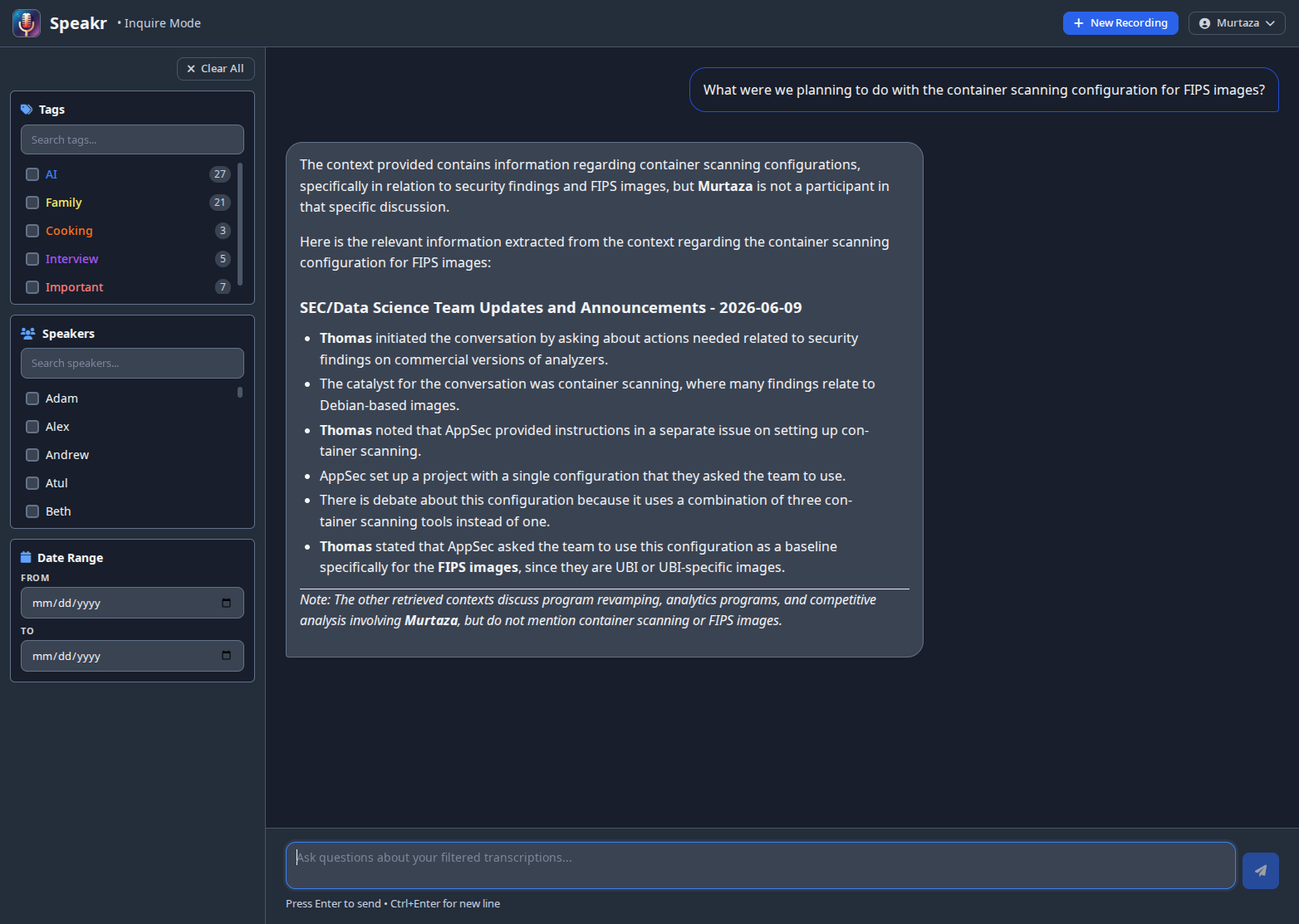
Ask questions across all your recordings |
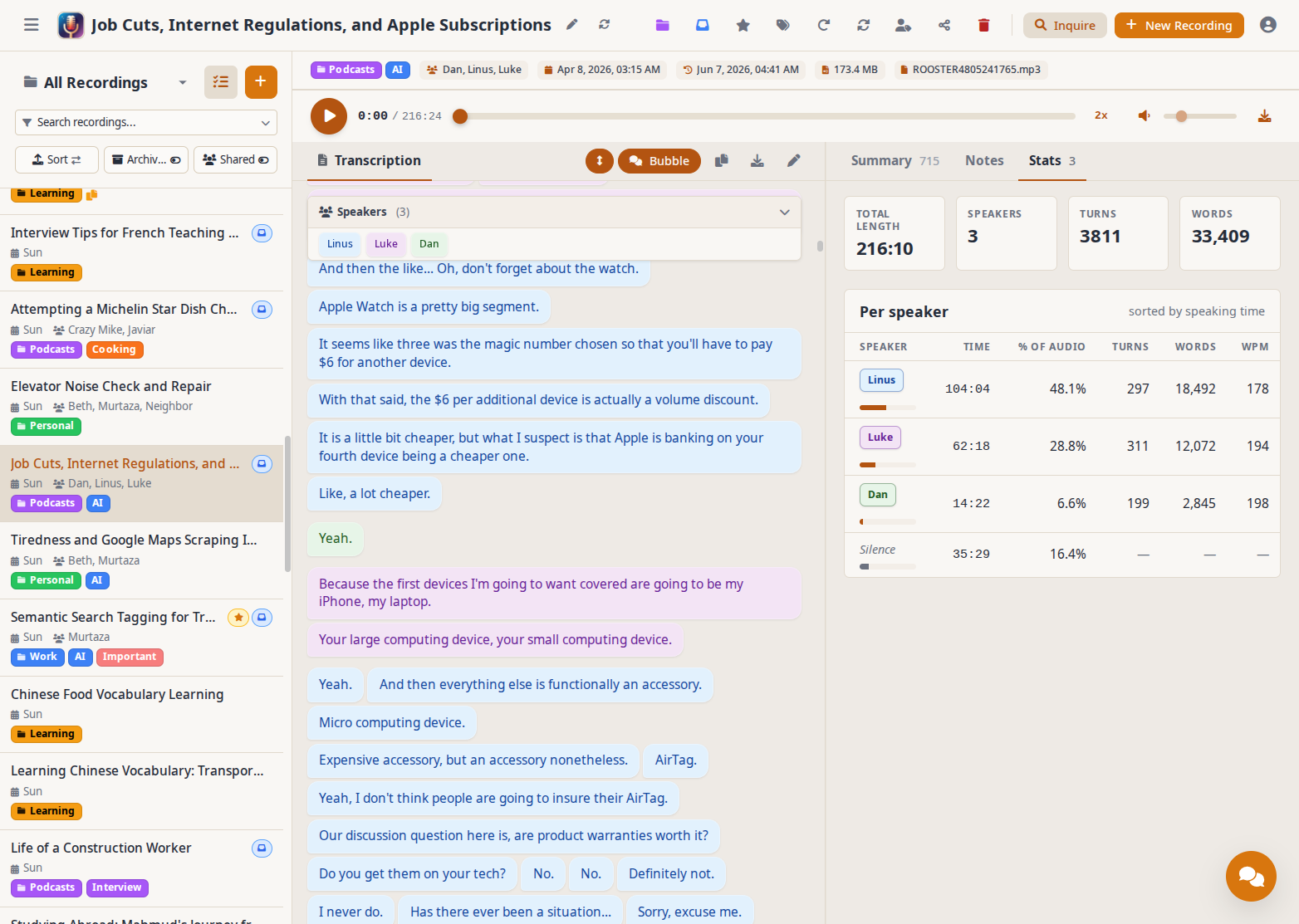
Per-recording stats and speaker breakdown |
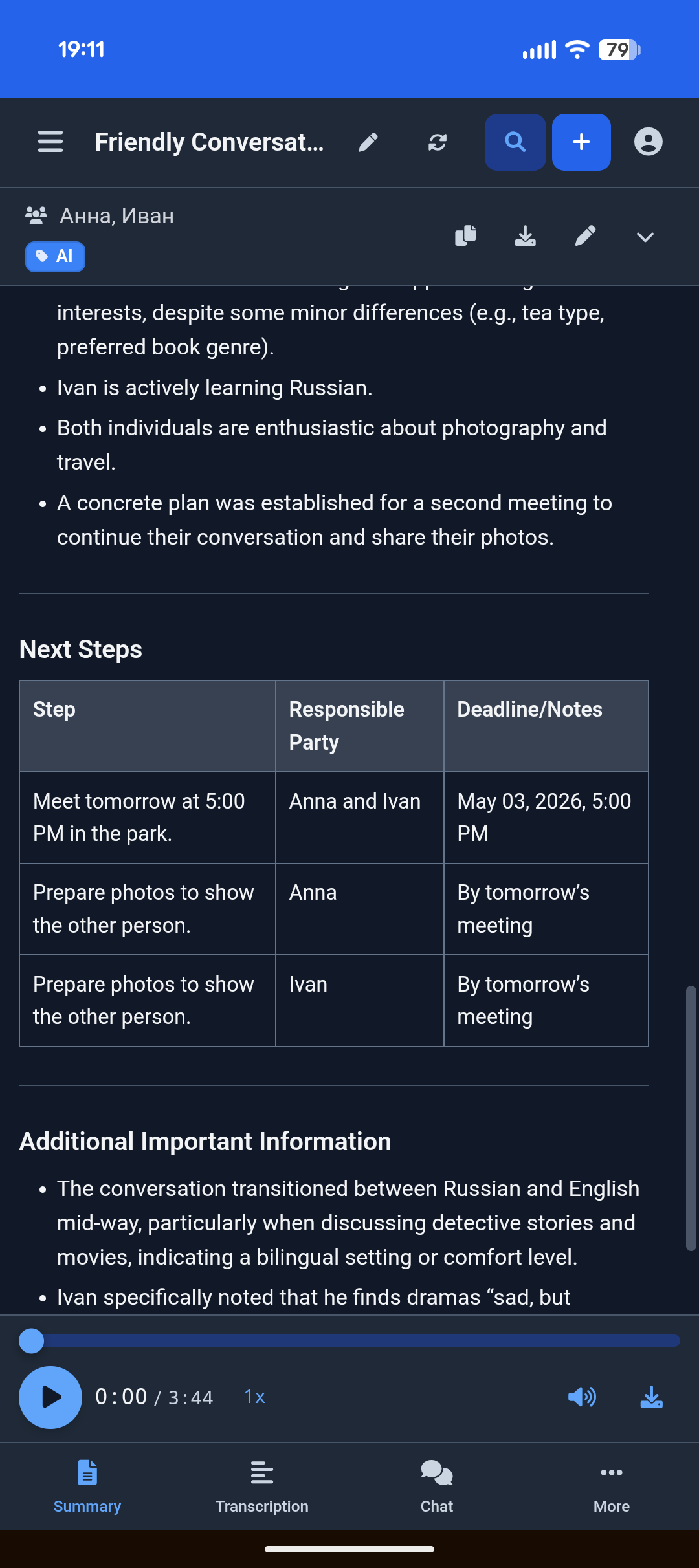
On mobile: summary with bottom navigation |
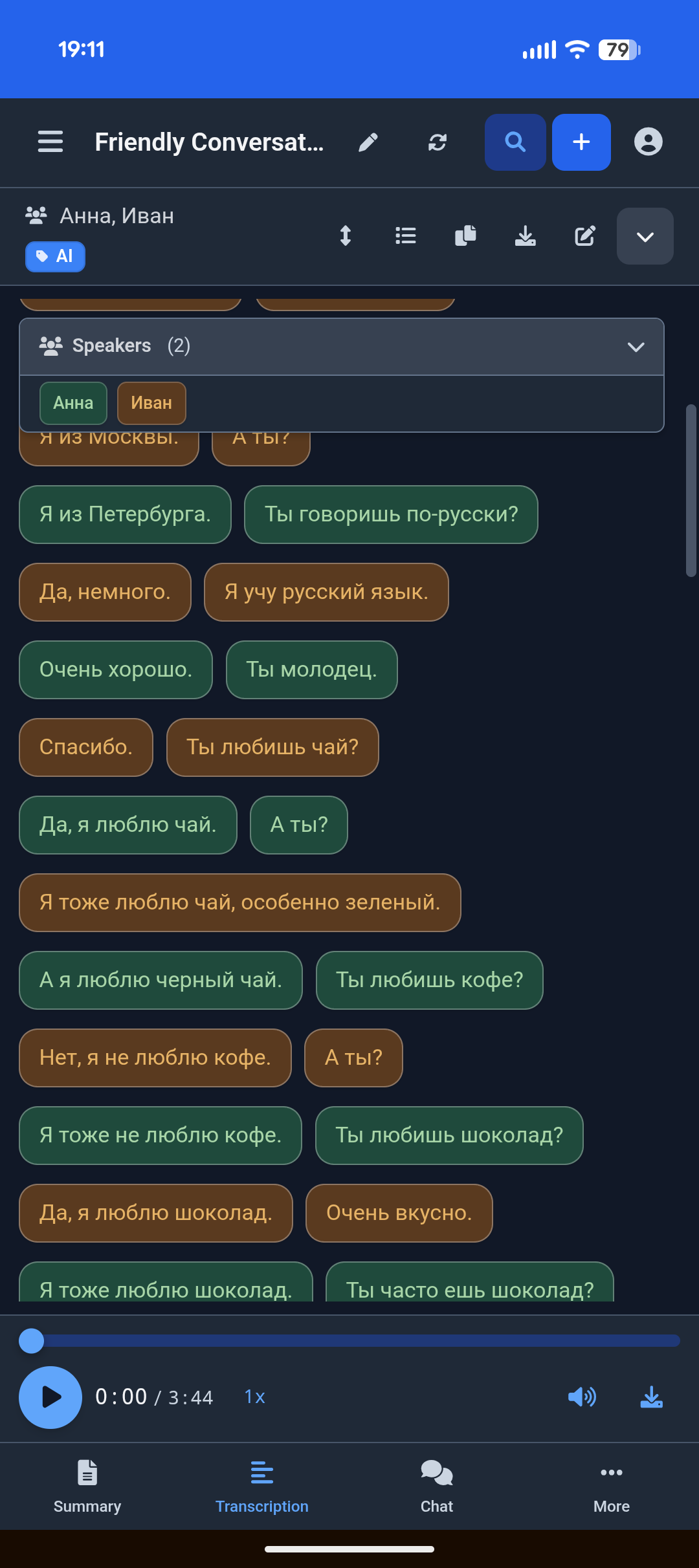
On mobile: transcript in bubble view |
View Full Screenshot Gallery →
Technology Stack
- Backend: Python/Flask with SQLAlchemy
- Frontend: Vue.js 3 with Tailwind CSS
- AI/ML: OpenAI Whisper, OpenRouter, Ollama support
- Database: SQLite (default) or PostgreSQL
- Deployment: Docker, Docker Compose
Roadmap
Completed
- Speaker voice profiles with AI-powered identification (v0.5.9)
- Group workspaces with shared recordings (v0.5.9)
- PWA enhancements with offline support and background sync (v0.5.10)
- Multi-user job queue with fair scheduling (v0.6.0)
- SSO integration with OIDC providers (v0.7.0)
- Token usage tracking and per-user budgets (v0.7.2)
- Connector-based transcription architecture with auto-detection (v0.8.0)
- Comprehensive REST API with Swagger UI documentation (v0.8.0)
- Video retention with in-browser video playback (v0.8.11)
- Parallel uploads with duplicate detection (v0.8.11)
- Fullscreen video mode with live subtitles (v0.8.14)
- Custom vocabulary and transcription hints (v0.8.14)
Near-term
- Quick language switching for transcription
- Automated workflow triggers
Long-term
- Plugin system for custom integrations
- End-to-end encryption option
Reporting Issues
License
This project is dual-licensed:
GNU Affero General Public License v3.0 (AGPLv3)
Speakr is offered under the AGPLv3 as its open-source license. You are free to use, modify, and distribute this software under the terms of the AGPLv3. A key condition of the AGPLv3 is that if you run a modified version on a network server and provide access to it for others, you must also make the source code of your modified version available to those users under the AGPLv3.
- You must create a file named
LICENSE(orCOPYING) in the root of your repository and paste the full text of the GNU AGPLv3 license into it. - Read the full license text carefully to understand your rights and obligations.
- You must create a file named
Commercial License
For users or organizations who cannot or do not wish to comply with the terms of the AGPLv3 (for example, if you want to integrate Speakr into a proprietary commercial product or service without being obligated to share your modifications under AGPLv3), a separate commercial license is available.
Please contact speakr maintainers for details on obtaining a commercial license.
You must choose one of these licenses under which to use, modify, or distribute this software. If you are using or distributing the software without a commercial license agreement, you must adhere to the terms of the AGPLv3.
Contributing
We welcome contributions to Speakr! There are many ways to help:
- Bug Reports & Feature Requests: Open an issue
- Discussions: Share ideas and ask questions
- Documentation: Help improve our docs
- Translations: Contribute translations for internationalization
Code Contributions
By submitting a pull request, you agree to our Contributor License Agreement (CLA). This ensures we can maintain our dual-license model (AGPLv3 and Commercial). You retain copyright ownership of your contribution — the CLA simply grants us permission to include it in both the open source and commercial versions of Speakr. Our bot will post a reminder when you open a PR.
See our Contributing Guide for complete details on:
- How the CLA works and why we need it
- Step-by-step contribution process
- Development setup instructions
- Coding standards and best practices
Requirements
Before starting, you MUST configure API keys:
1. Create a .env file or use environment variables
2. Set TEXT_MODEL_API_KEY (OpenRouter or OpenAI)
3. Set TRANSCRIPTION_API_KEY (OpenAI Whisper)
4. Set ADMIN_USERNAME and ADMIN_PASSWORD
See the GitHub documentation for complete setup instructions.
Download Statistics
Total Downloads Over Time
Related apps
Explore more like this
Explore allLinks
Details
learnedmachine/speakrRuntime arguments
- Web UI
http://[IP]:[PORT:8899]- Network
bridge- Shell
sh- Privileged
- false
Template configuration
Web interface port
- Target
- 8899
- Default
- 8899
- Value
- 8899
Storage for uploaded audio files
- Target
- /data/uploads
- Default
- /mnt/user/appdata/speakr/uploads
- Value
- /mnt/user/appdata/speakr/uploads
Database and application state
- Target
- /data/instance
- Default
- /mnt/user/appdata/speakr/instance
- Value
- /mnt/user/appdata/speakr/instance
Exported transcriptions (for Obsidian, etc.)
- Target
- /data/exports
- Default
- /mnt/user/appdata/speakr/exports
- Value
- /mnt/user/appdata/speakr/exports
Watch directory for automatic file processing
- Target
- /data/auto-process
- Default
- /mnt/user/appdata/speakr/auto-process
- Value
- /mnt/user/appdata/speakr/auto-process
API key for OpenRouter or OpenAI (required for summaries)
- Target
- TEXT_MODEL_API_KEY
API endpoint for text generation
- Target
- TEXT_MODEL_BASE_URL
- Default
- https://openrouter.ai/api/v1
- Value
- https://openrouter.ai/api/v1
Model name for text generation
- Target
- TEXT_MODEL_NAME
- Default
- openai/gpt-4o-mini
- Value
- openai/gpt-4o-mini
OpenAI API key for Whisper transcription (required)
- Target
- TRANSCRIPTION_API_KEY
Whisper API endpoint
- Target
- TRANSCRIPTION_BASE_URL
- Default
- https://api.openai.com/v1
- Value
- https://api.openai.com/v1
Whisper model to use
- Target
- WHISPER_MODEL
- Default
- whisper-1
- Value
- whisper-1
Initial admin username
- Target
- ADMIN_USERNAME
- Default
- admin
- Value
- admin
Initial admin email
- Target
- ADMIN_EMAIL
- Default
- admin@example.com
- Value
- admin@example.com
Initial admin password (CHANGE THIS!)
- Target
- ADMIN_PASSWORD
Allow new user registration (true/false)
- Target
- ALLOW_REGISTRATION
- Default
- false
- Value
- false
Timezone for date/time display (e.g., America/New_York)
- Target
- TIMEZONE
- Default
- UTC
- Value
- UTC
Logging level: DEBUG, INFO, WARNING, ERROR
- Target
- LOG_LEVEL
- Default
- INFO
- Value
- INFO
Maximum tokens for AI summaries
- Target
- SUMMARY_MAX_TOKENS
- Default
- 8000
- Value
- 8000
Maximum tokens for chat responses
- Target
- CHAT_MAX_TOKENS
- Default
- 5000
- Value
- 5000
Split large files for API limits (true/false)
- Target
- ENABLE_CHUNKING
- Default
- true
- Value
- true
Chunk size limit (e.g., 20MB or 1200s)
- Target
- CHUNK_LIMIT
- Default
- 20MB
- Value
- 20MB
Overlap between chunks in seconds
- Target
- CHUNK_OVERLAP_SECONDS
- Default
- 3
- Value
- 3
Enable AI-powered semantic search across recordings (true/false)
- Target
- ENABLE_INQUIRE_MODE
- Default
- false
- Value
- false
Watch directory for automatic file processing (true/false)
- Target
- ENABLE_AUTO_PROCESSING
- Default
- false
- Value
- false
Processing mode: admin_only, user_directories, or single_user
- Target
- AUTO_PROCESS_MODE
- Default
- admin_only
- Value
- admin_only
Check interval for new files (seconds)
- Target
- AUTO_PROCESS_CHECK_INTERVAL
- Default
- 30
- Value
- 30
Automatically export transcriptions to markdown (true/false)
- Target
- ENABLE_AUTO_EXPORT
- Default
- false
- Value
- false
Include transcription in exports (true/false)
- Target
- AUTO_EXPORT_TRANSCRIPTION
- Default
- true
- Value
- true
Include summary in exports (true/false)
- Target
- AUTO_EXPORT_SUMMARY
- Default
- true
- Value
- true
Enable automatic deletion of old recordings (true/false)
- Target
- ENABLE_AUTO_DELETION
- Default
- false
- Value
- false
Days to retain recordings (0 = disabled)
- Target
- GLOBAL_RETENTION_DAYS
- Default
- 90
- Value
- 90
Deletion mode: audio_only or full_recording
- Target
- DELETION_MODE
- Default
- audio_only
- Value
- audio_only
Allow users to delete their own recordings (true/false)
- Target
- USERS_CAN_DELETE
- Default
- true
- Value
- true
Enable user-to-user sharing (true/false)
- Target
- ENABLE_INTERNAL_SHARING
- Default
- false
- Value
- false
Display usernames in interface (true/false)
- Target
- SHOW_USERNAMES_IN_UI
- Default
- false
- Value
- false
Allow public share links (true/false)
- Target
- ENABLE_PUBLIC_SHARING
- Default
- true
- Value
- true
Database connection string
- Target
- SQLALCHEMY_DATABASE_URI
- Default
- sqlite:////data/instance/transcriptions.db
- Value
- sqlite:////data/instance/transcriptions.db