
All apps · 0 apps

QuestarrNG
Docker app from questarrng's Repository
Overview
Readme
View on GitHubQuestarr
Snapetech QuestarrNG fork
This fork adds the SeerrNG catalog and acquisition contract. Use
ghcr.io/snapetech/questarrng:latest or the Compose file in this repository;
the upstream Questarr image does not contain the SeerrNG integration routes.
The fork image is published for linux/amd64 from main.

A video game management application inspired by the -Arr apps (Sonarr, Radarr, Prowlarr...) and GamezServer. Track and organize your video game collection with automated discovery and download management.










⭐ Star us on GitHub — your support motivates us a lot! 🙏😊




Table of Contents
List of features
| Feature | Description |
|---|---|
| Backlog management | Track your collection with status indicators (Wanted, Owned, Playing, Completed, Shelved), ratings, and notes. |
| Game Discovery | Browse popular, new, and upcoming titles via IGDB, RSS feeds, and xREL.to, or sync your Steam wishlist directly into the app. |
| Search & Filter | Find games by genre, platform, and keyword, with automatic search until a release is found, plus release blacklisting and preferred release groups/platforms. |
| Download Management | Integrates with indexers and downloaders with optional auto-download and automatic post-processing import. |
| Real-time Notifications | In-app alerts for releases and downloads, plus external notifications to 100+ providers via Apprise. |
| Rich Game Metadata | Details enriched with IGDB, Steam, PCGamingWiki, and NexusMods, including trending mods where available. |
| Statistics | Visualize collection statistics with Discord sharing support. 🚧 |
| Security Focused | General security hardening, SSL support, and OpenSSF certified — see SECURITY.md for the full process. |
| Integrations | One-click install on UNRAID, CasaOS, Umbrel and Cosmos Cloud, a Home Assistant add-on, and a Helm chart for Kubernetes. 🚧 |
| Design | Clean, minimalist, dark-first UI built with mobile usage in mind. |
Supported Indexers/Downloaders
- Prowlarr synchronization is supported to add all your indexers at once.
- G4u.to: the site offers an API to VIP members, which can be used in Questarr.
| Indexers | Downloaders |
|---|---|
| Torznab protocol (Torrent) | - qBittorent - Transmission - rTorrent - Deluge - Synology Download Station |
| Newznab protocol (Usenet) | - Sabnzbd - Nzbget |
| G4U.to | Same as Newznab |
SeerrNG integration
QuestarrNG provides SeerrNG with an IGDB catalog and request-scoped PC-game
acquisition through a versioned, authenticated integration API. The contract
keeps SeerrNG's request ID and selected OS/architecture attached to Questarr's
tracked game and download records. See docs/API.md for the
catalog, status, retry, cancellation, and imported-file streaming routes.
Cancellation stops only downloads safely correlated to the SeerrNG request;
completed files remain on disk, and ambiguous active downloads are refused. If
Questarr restarts during a handoff before recording its download, it pauses the
request for a duplicate-download check before retrying or cancelling. The retry
or cancel endpoint returns 409 with confirmationRequired until the caller
checks the download queue/history and sends confirmNoExistingDownload: true.
Installation
Docker is the easiest way to deploy Questarr with all dependencies included. Questarr uses a SQLite database which is self-contained in the application container.
Supported architectures: released Docker images are published for linux/amd64 and linux/arm64, so Questarr runs on a Raspberry Pi 4/5 with a 64-bit OS, other 64-bit ARM SBCs, and ARM-based NAS boxes as well as on x86 hardware. Docker selects the right architecture automatically — the commands below are identical on every platform. (32-bit ARM, e.g. armv7/a 32-bit OS on Raspberry Pi 3 and earlier, is not supported. The Home Assistant add-on is amd64-only.)
Option 1: One-liner (Simplest but minimal)
docker run -d -p 5000:5000 -v ./data:/app/data --name questarrng ghcr.io/snapetech/questarrng:latest
Option 2: Docker Compose (more detailed)
Use the
docker-compose.ymlfile from the repo or create a minimal one:services: app: image: ghcr.io/snapetech/questarrng:latest ports: - "5000:5000" volumes: - ./data:/app/data environment: - SQLITE_DB_PATH=/app/data/sqlite.db restart: unless-stoppedStart the application:
docker compose up -dAccess the application: Open your browser to
http://localhost:5000
Proxmox VE (LXC)
Deploy as a Proxmox LXC container — no Docker
Run this on your Proxmox VE host, as root, to create an LXC container with Questarr installed
and running as a systemd service:
bash -c "$(curl --fail --silent --show-error --location --proto '=https' --proto-redir '=https' https://raw.githubusercontent.com/Doezer/Questarr/main/scripts/proxmox/questarr-lxc.sh)"
The script picks the next free container ID, downloads a Debian template if needed, creates an unprivileged container, builds Questarr from source, and prints the URL to open. Every prompt has a default, so you can accept them all and be done in a few minutes.
Update later with pct exec <ctid> -- update.
See docs/PROXMOX.md for non-interactive installs, sizing guidance, configuration, and troubleshooting.
UNRAID
Install via Community Applications
The upstream Questarr Community Apps entry uses the upstream image and
does not include this fork's SeerrNG integration routes. Use the
QuestarrNG fork template
for ghcr.io/snapetech/questarrng:latest. QuestarrNG works as a standalone
game manager; SeerrNG integration is optional. For package or integration
support, use the SeerrNG issue tracker.
- Install the QuestarrNG template rather than the upstream Questarr template.
- Set your Data Path (default
/mnt/user/appdata/questarrng), PUID/PGID, and HTTP port (default5000). - Set the Game Library and Downloads paths to the folders shared with your download client. The game
library is mounted at
/datainside the container; add a matching entry under Settings → Path Mappings when the download client reports a different path. - Apply, then open
http://<unraid-host>:5000to access the UI.
CasaOS
Install via Custom Install (AppFile)
- Open the App Store and click Custom Install.
- Click the import icon (top right) and paste this URL:
https://raw.githubusercontent.com/Doezer/Questarr/main/casaos/docker-compose.yml - Review the mounts — by default
/DATA/AppData/questarrholds Questarr's data and/DATA/Downloadsis mounted at/dataso Questarr can import finished downloads. If you keep that second mount, add a matching entry under Settings → Path Mappings. - Click Install, then open Questarr from the CasaOS dashboard (port
5000).
Umbrel
Install via Community App Store
- In umbrelOS, open the App Store.
- Click the ⋮ menu (top right) → Community App Stores.
- Add this repository URL:
https://github.com/Doezer/Questarr - Open the Doezer store and install Questarr (app ID
doezer-questarr), then open it from your dashboard (http://umbrel.local:5000).
Cosmos Cloud
Install as a ServApp
- Open Market Place → Custom Install (or Servapps → Add).
- Paste this URL:
https://raw.githubusercontent.com/Doezer/Questarr/main/cosmos/questarr.cosmos-compose.json - Fill in the install form: Data folder, optional Library folder (the root your download
client writes into, mounted at
/data), andPUID/PGID. - Install. Cosmos creates the route
questarr.<your-server-hostname>and handles HTTPS for you.
Kubernetes (Helm)
Install with the bundled Helm chart
A Helm chart lives in charts/questarr. It is not published to a Helm
repository yet, so install it from a clone:
git clone https://github.com/Doezer/Questarr.git
cd Questarr
helm install questarr charts/questarr --namespace questarr --create-namespace
Then port-forward (or enable the Ingress) and open the UI:
kubectl port-forward -n questarr svc/questarr 5000:5000
Questarr keeps its state in a single SQLite database on a ReadWriteOnce volume, so the
chart never runs more than one replica. See charts/questarr/README.md
for the full option reference — persistence, media mounts, secrets, Ingress and
subdirectory deployments.
Home Assistant Add-on
Install as a Home Assistant add-on
You can install Questarr as a Home Assistant add-on from this repository:
- In Home Assistant, open Settings → Add-ons → Add-on Store.
- Click the menu (⋮) and choose Repositories.
- Add this repository URL:
https://github.com/Doezer/Questarr - Install the Questarr add-on and start it.
- Open
http://<home-assistant-host>:5000to access the UI.
All platform definitions live in the repository and share the same mounts and ports — see docs/HOME_SERVER_APPS.md for details.
Screenshots
👀 See the app in action
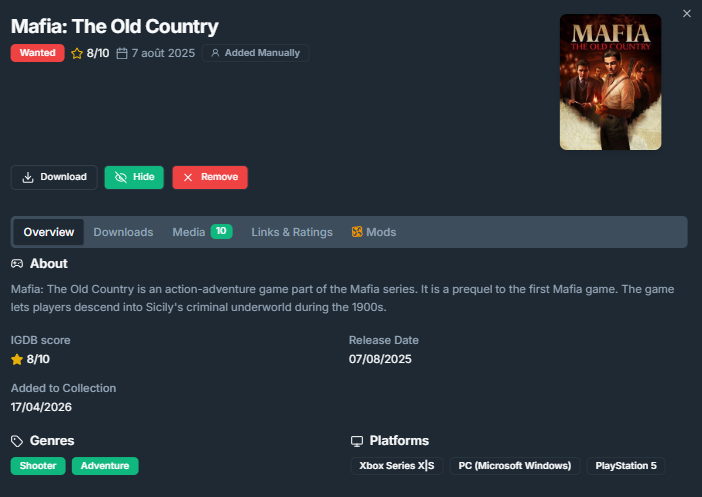
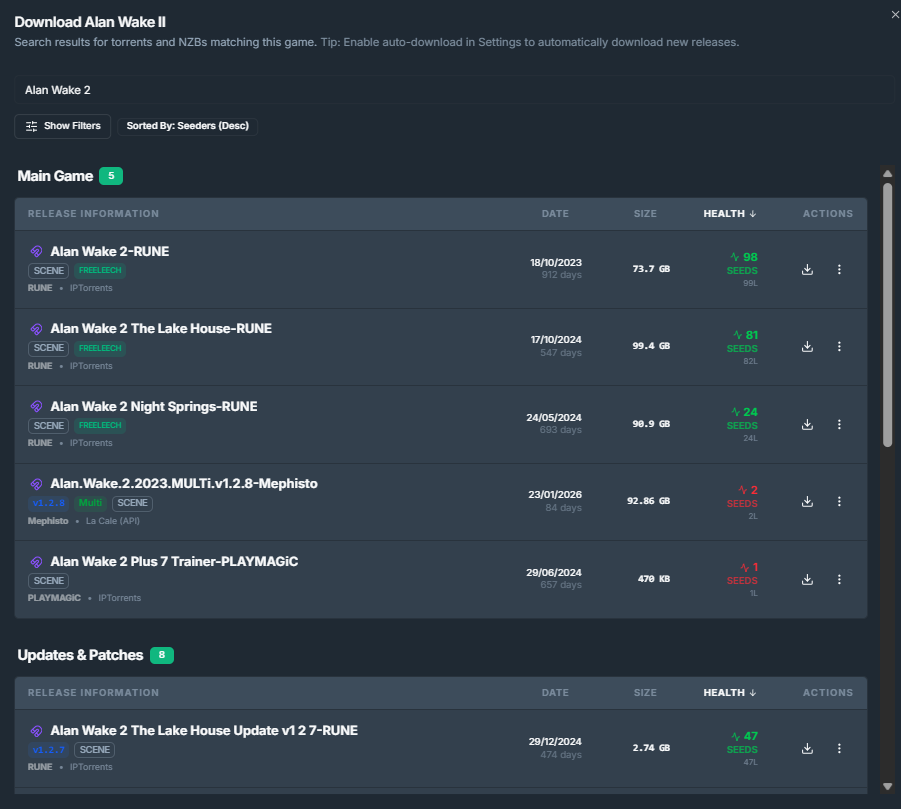
Library
Your central hub for recent activity, collection overview and downloading available games. Manage your owned and wanted games.
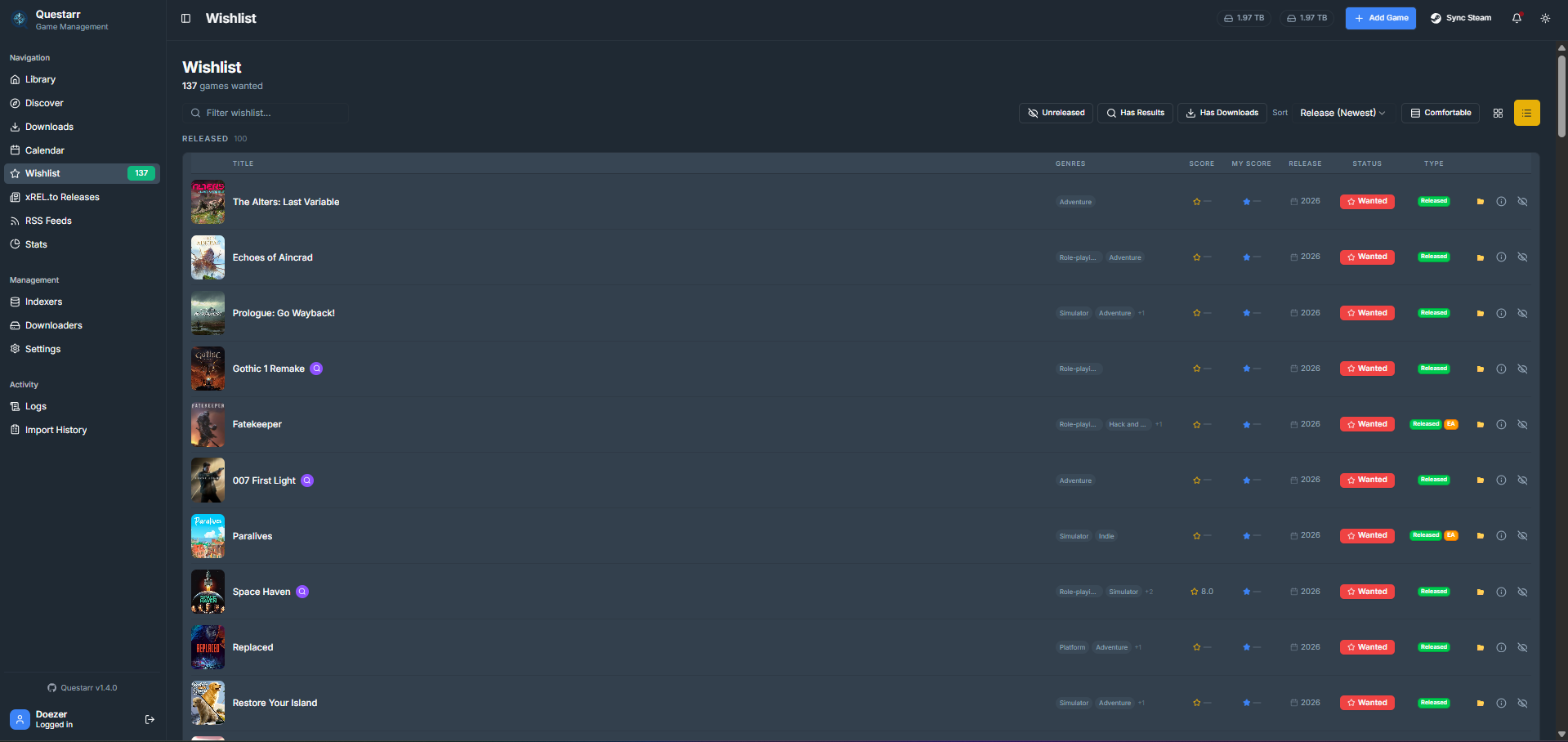
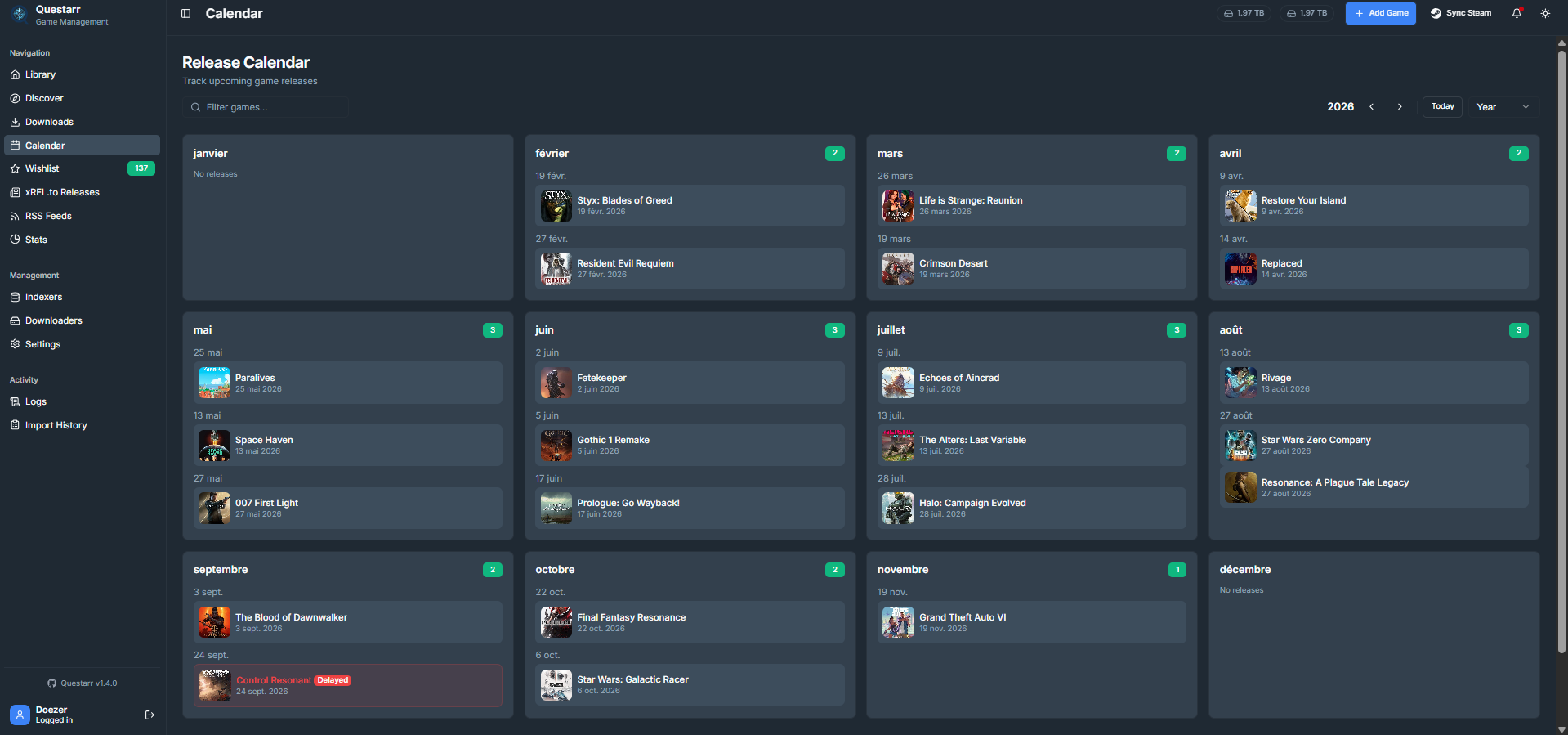
Wishlist & Release calendar
Manage your wanted games and when they release.
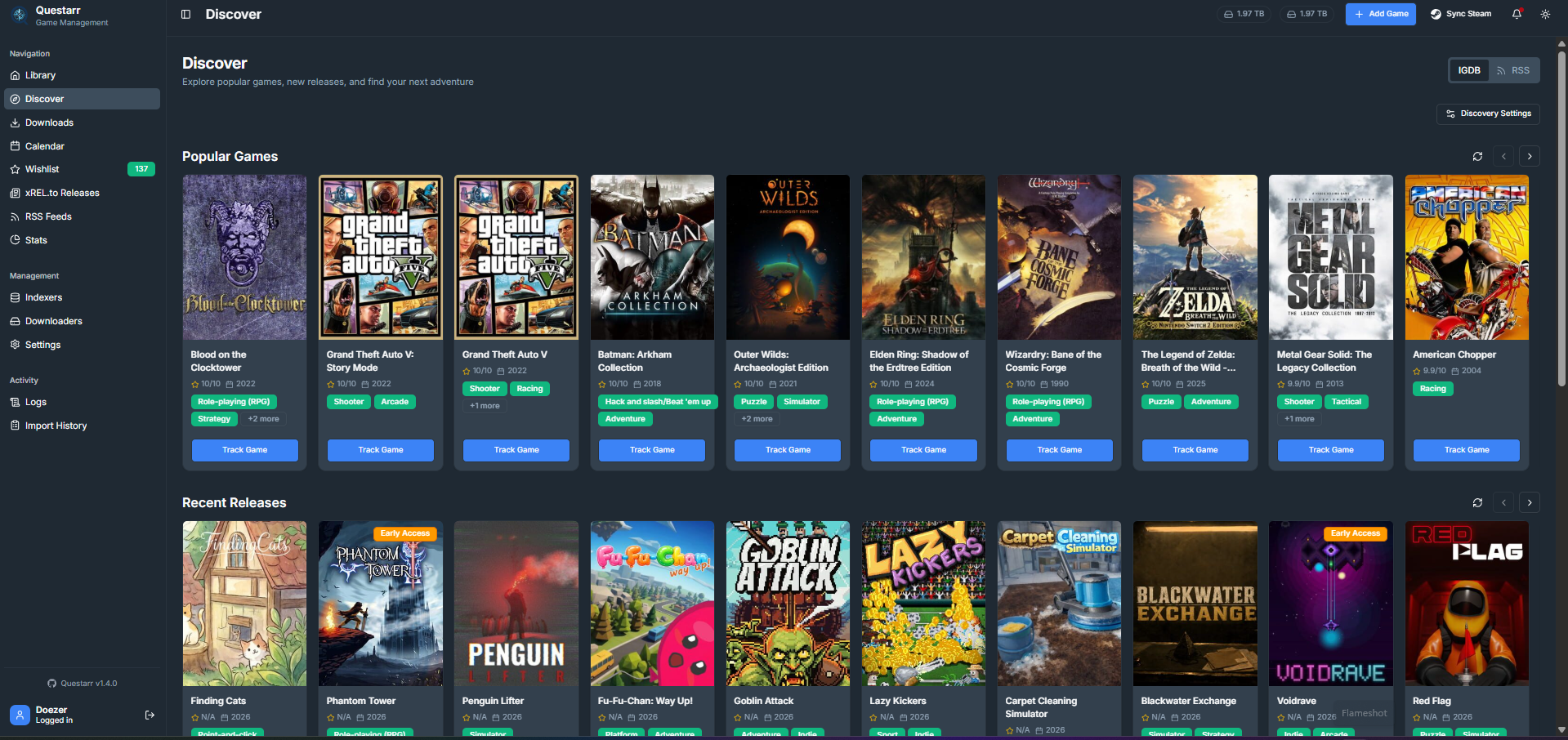
Discover Games
Browse and find new games to add to your collection.
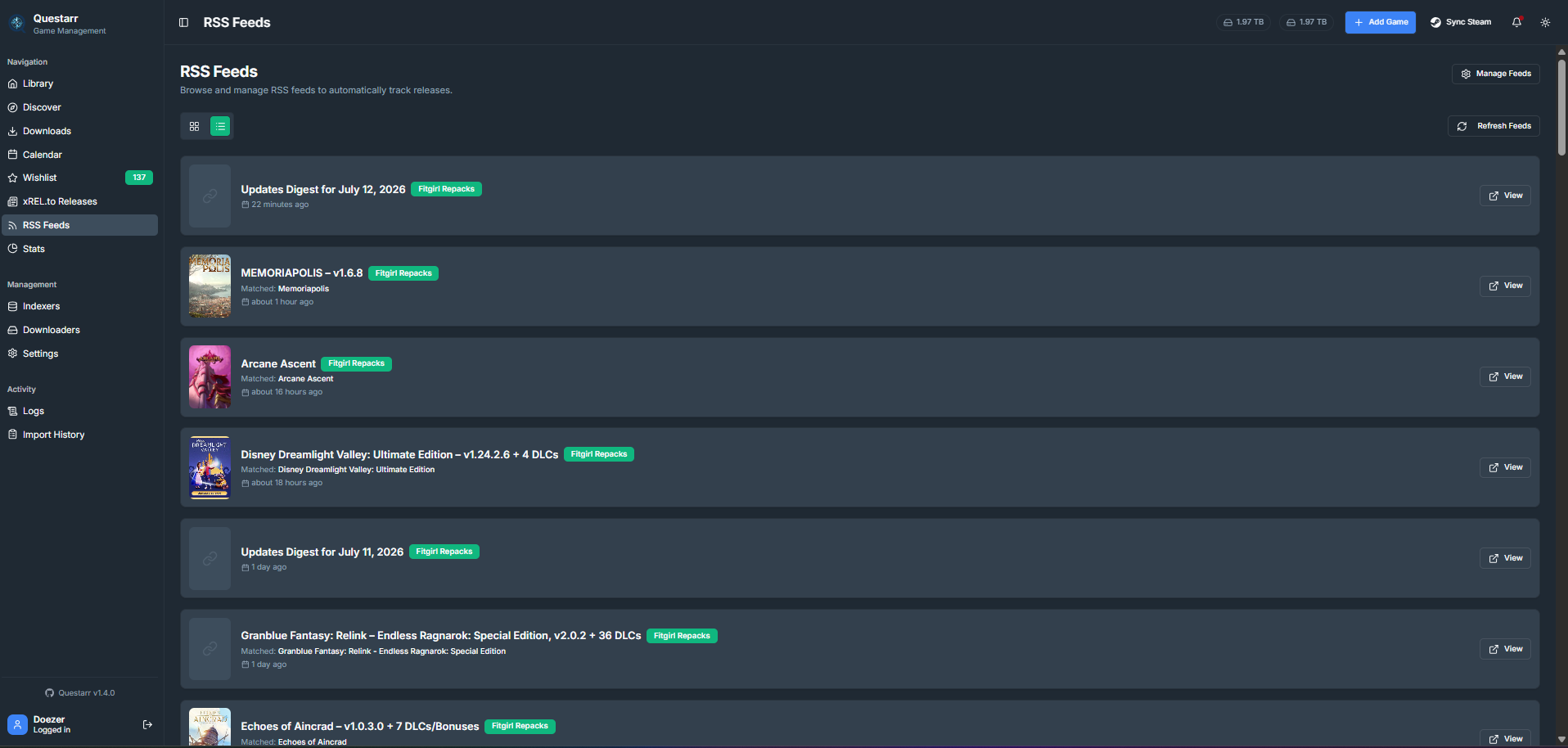
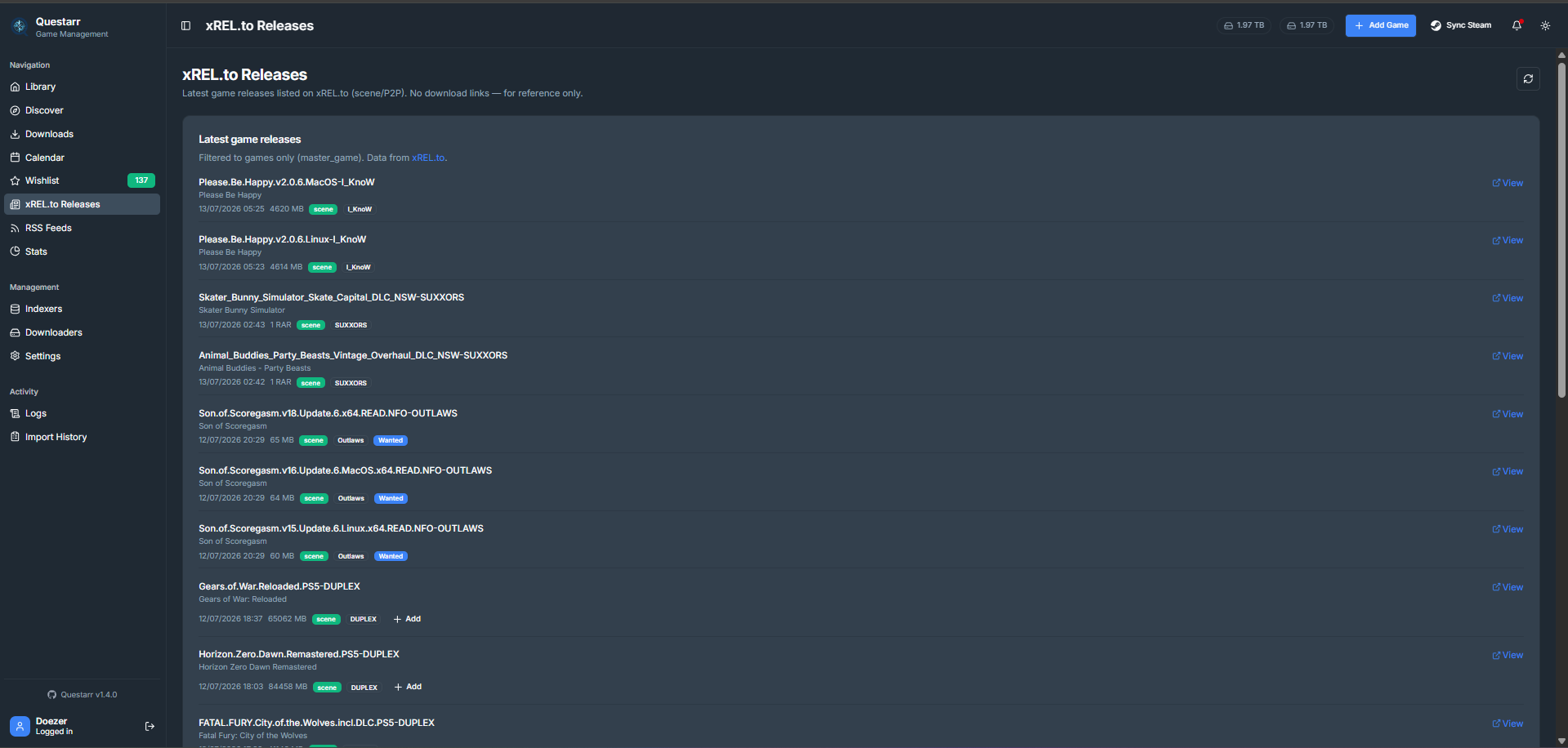
RSS & xRel.to feeds
Custom RSS feeds and xRel.to flux matched to IGDB games directly into the app. Default RSS is set to fitgirl site.
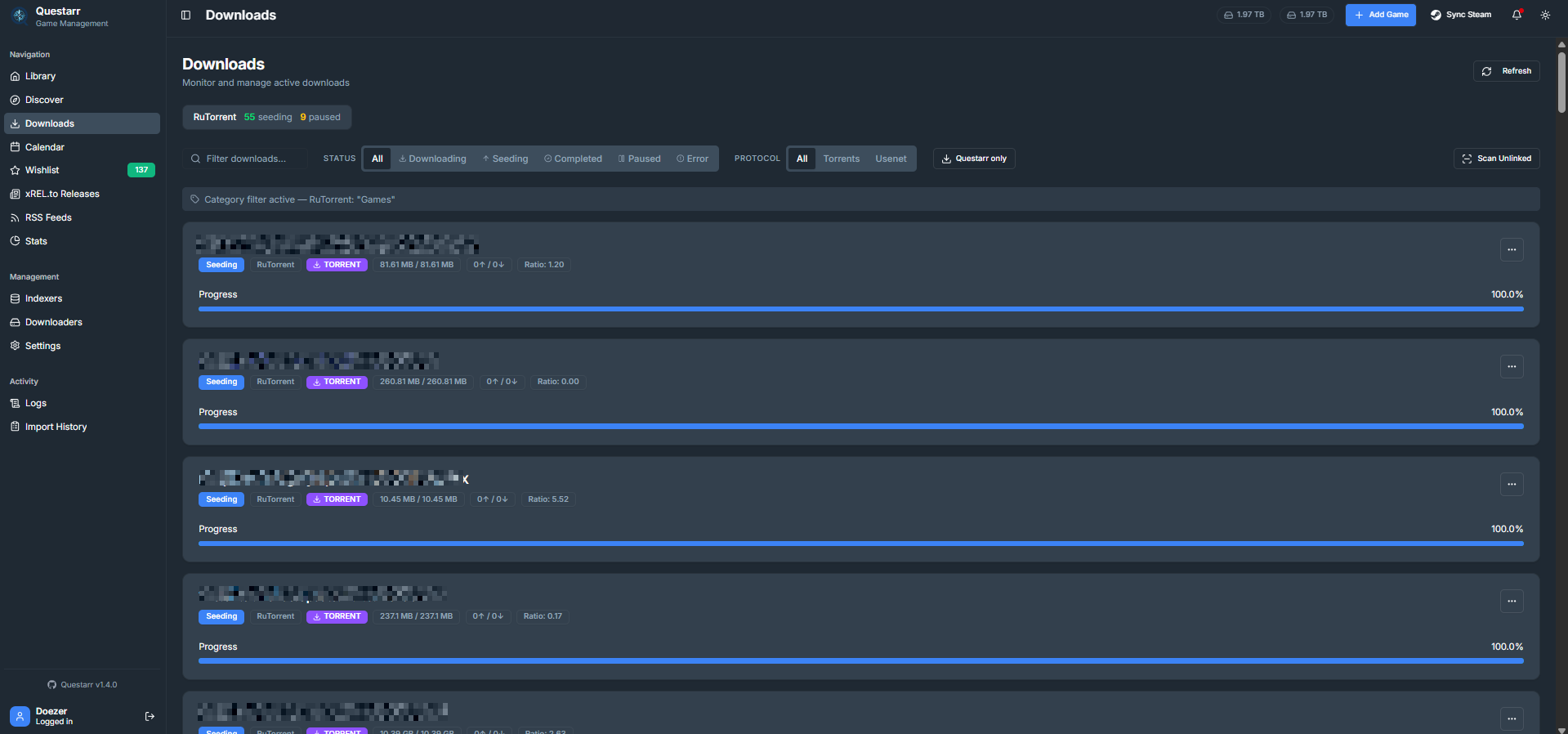
Downloads Queue
Monitor your downloaders' active downloads and history.
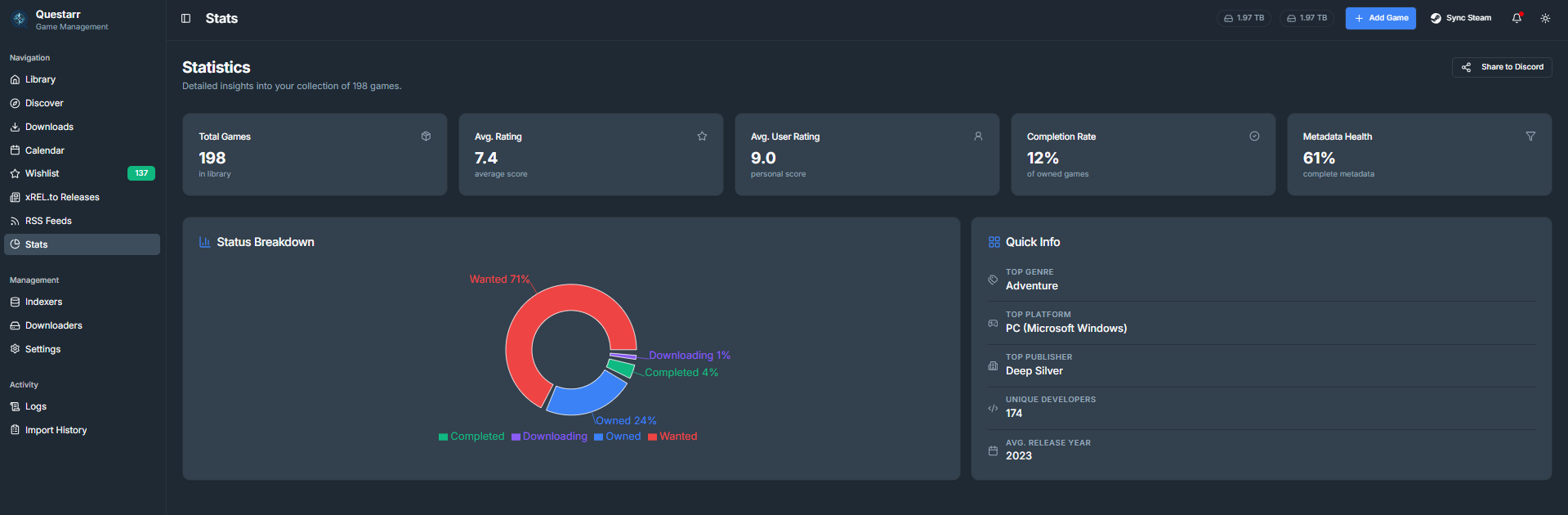
Statistics
Check out your library statistics.
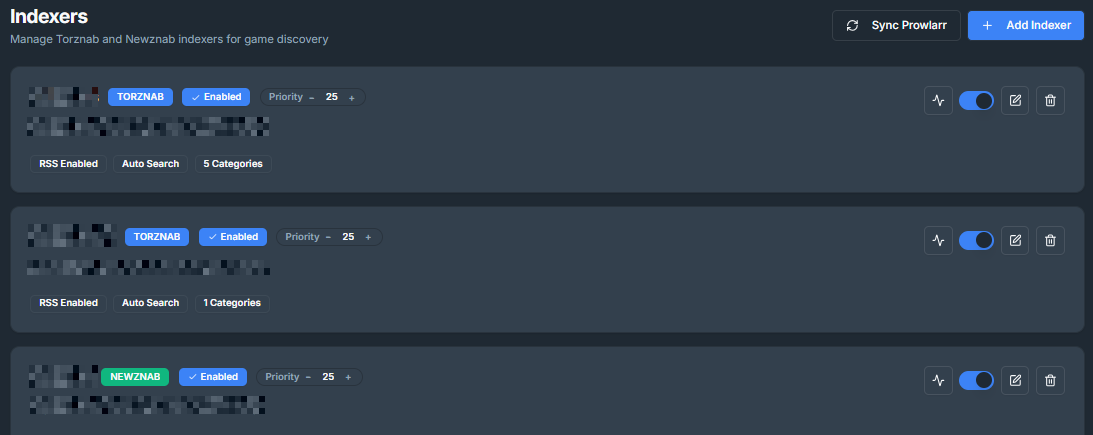
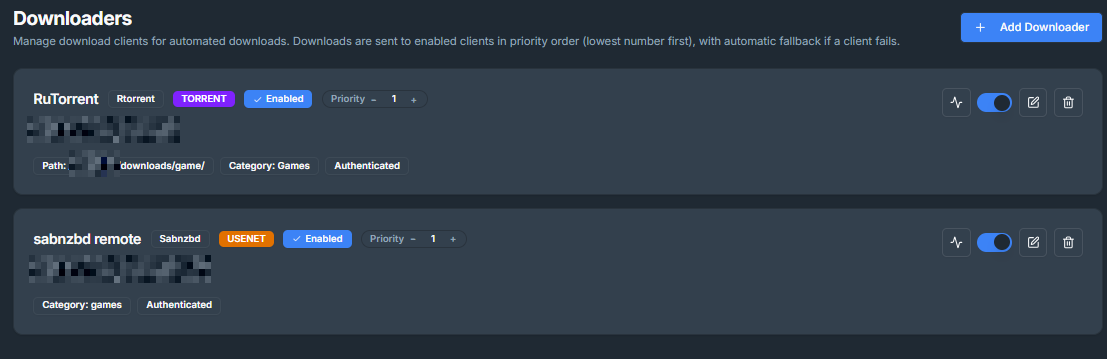
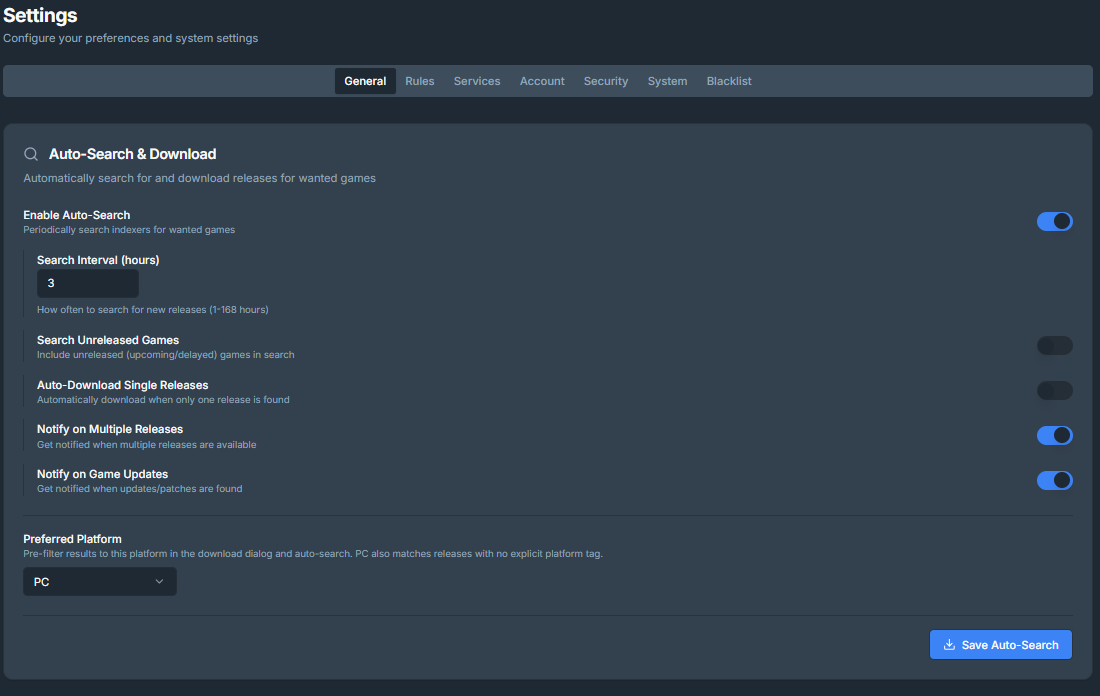
Settings
Configure indexers, downloaders, and application preferences.
Tech Stack






- APIs: IGDB (game metadata), Torznab/Newznab (indexer search), PCGamingWiki, NexusMods, xREL.to
- AIs usage:
- Claude and Github Copilot are used for AI-Assisted coding, internal code reviews, PR cleanup. Eventually automated coding and troubleshooting for small tasks and bug reports.
- Gemini & Codex are used for automated code reviews, and brainstorming from time to time (as well as Perplexity for this usage).
- Google Jules is used for light periodical refactoring.
Configuration
- First-time setup:
- Create your admin account
- Configure the IGDB credentials
Once logged-in:
- Configure indexers
- Add downloaders
- Add games!
See Configuration on the Wiki for more detailed info.
Getting IGDB API Credentials
IGDB provides game metadata (covers, descriptions, ratings, release dates, etc.).
- Go to Twitch Developer Console
- Log in with your Twitch account (create one if needed)
- Click "Register Your Application"
- Fill in:
- Name: Questarr (or any name)
- OAuth Redirect URLs:
http://localhost(not used, but required) - Category: Application Integration
- Click "Create"
- Copy your Client ID and Client Secret
- Add them to your
.envfile
Upgrading from v1.0 (PostgreSQL)
If you are upgrading from an older version that used PostgreSQL, you need to migrate your data.
The migration tooling was removed in v1.5.0 and is now run from the archived v1.4.2 release. Follow docs/MIGRATION.md, which inlines the pinned compose file and links the sources by tag permalink.
This is only for pre-v1.1 PostgreSQL installations. Running Questarr on PostgreSQL as an opt-in backend is a separate feature — see
docs/DATABASE.md.
See docs/MIGRATION.md for more details.
Advanced usage
Docker compose
This is mainly for users who want the latest commit (e.g when trying out fixes for an issue) or contributing users.
- Clone the repository:
git clone https://github.com/Doezer/Questarr.git
cd Questarr
Configure the application: Edit
docker-compose.ymldirectly if you need to setup a specific environment.Build and start the containers:
docker-compose up -d
- Access the application:
Open your browser to
http://localhost:5000
Update to latest version for Docker
Your database content will be kept.
git pull
docker-compose down
docker-compose build --no-cache
docker-compose up -d
Reverse proxy / subdirectory deployment
Want to serve Questarr from a path like https://xxx.domain.com/Questarr
instead of its own subdomain? Set QUESTARR_BASE_PATH=/Questarr on the
container (or in .env for npm installs) and point your reverse proxy at it
— no rebuild required. See docs/REVERSE_PROXY.md for
full setup instructions (nginx, Traefik, Caddy).
Roadmap
Based on the Product Requirements Document, here's what's planned over the next 6 months, in priority order:
- ✅ P0 — Post-Processing Pipeline : Move/copy completed downloads to a destination path, extract archives — closing the "set it and forget it" loop.
- P1 — Smart Game Backlog: Track the version of each downloaded game and notify (or auto-download) when a newer release shows up on indexers.
- P2 — Direct Download Support: Add debrid services (Real-Debrid and similar) as a downloader option, no seeding required.
- P3 — External Library Sync: Import owned games from Steam/GOG libraries and local filesystem scans, not just wishlists.
- P4 — Integrations with External Tools: ✅ Playnite extension shipped (library sync, request-to-download); RomM, Gameyfin, and a generic webhook for anything not explicitly supported are still planned.
- P5 — Indexer Page Links: A "View on indexer" link on search results and downloads.
- P6 — PostgreSQL Support: Re-introduce PostgreSQL as an optional backend, with SQLite remaining the zero-config default.
Ongoing: mobile responsiveness, search UX, performance, and security improvements.
See the full PRD for problem statements, detailed scope, and non-goals.
Troubleshooting
See Troubleshooting on the Wiki
If you run into an issue, go to the Logs page and click Send Logs before reporting it — it makes diagnosing the problem much easier.
Getting Help
- Issues: GitHub Issues
- Discussions: GitHub Discussions
- Discord: Join our Server
Project Security & Documentation
- Start with docs/GITHUB_DOCUMENTATION.md for the canonical documentation map.
Contributing
- See .github/CONTRIBUTING.md for guidelines on how to contribute to this project.
- See MAINTAINERS.md for the current list of project members with access to sensitive resources.
Contributors
Made with contrib.rocks.
Legal Disclaimer
Questarr is a self-hosted game manager designed solely for organizing, tracking, and automating game libraries using user-provided data and metadata APIs (such as IGDB). Questarr does not host, distribute, or provide any copyrighted game content, ROMs, or download links. It is a technology-neutral tool: any indexers, download clients, or sources you configure are chosen and operated entirely by you. You are solely responsible for ensuring that your use of Questarr, and any content you access or download through third-party services you configure, complies with all applicable laws and the terms of service of those third parties.
License
GPL3 License - see COPYING file for details.
Acknowledgments
- Inspired by Sonarr and GamezServer
- Game metadata powered by IGDB API
- UI components from shadcn/ui
Install QuestarrNG on Unraid in a few clicks.
Find QuestarrNG in Community Apps on your Unraid server, review the template, and click Install. Unraid handles the Docker app or plugin setup from the published template.
Requirements
Categories
Related apps
Explore more like this
Explore allDetails
ghcr.io/snapetech/questarrng:latestRuntime arguments
- Web UI
http://[IP]:[PORT:5000]/- Network
bridge- Shell
sh- Privileged
- false
- Extra Params
--restart=unless-stopped
Template configuration
Web UI Port for the standalone web interface.
- Target
- 5000
- Default
- 5000
- Value
- 5000
Persistent QuestarrNG database and settings.
- Target
- /app/data
- Default
- /mnt/user/appdata/questarrng
- Value
- /mnt/user/appdata/questarrng
Game library root.
- Target
- /data
- Default
- /mnt/user/media/games
- Value
- /mnt/user/media/games
Downloads shared with the configured download client.
- Target
- /downloads
- Default
- /mnt/user/downloads
- Value
- /mnt/user/downloads
User ID for files created by this service.
- Default
- 99
- Value
- 99
Group ID for files created by this service.
- Default
- 100
- Value
- 100
Time zone used by this service.
- Default
- Etc/UTC
- Value
- Etc/UTC
Internal QuestarrNG web port.
- Default
- 5000
- Value
- 5000