
All apps · 0 apps

Prismarr
Docker app from Prismarr's Repository
Overview
Readme
View on GitHub

One dashboard for your self-hosted media stack.








Features · Quick start · Configuration · Upgrade · What's next · Support · License · AI
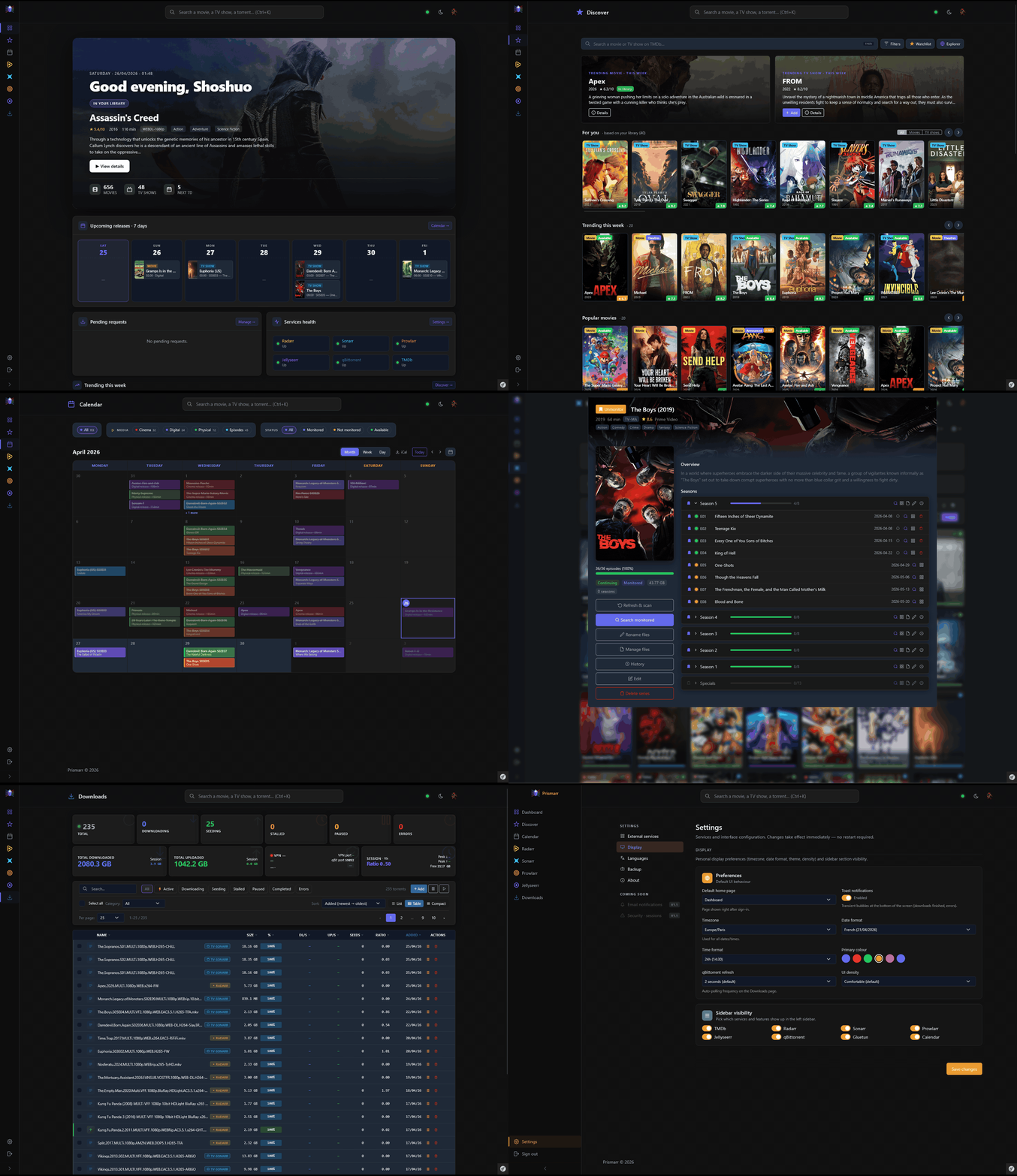
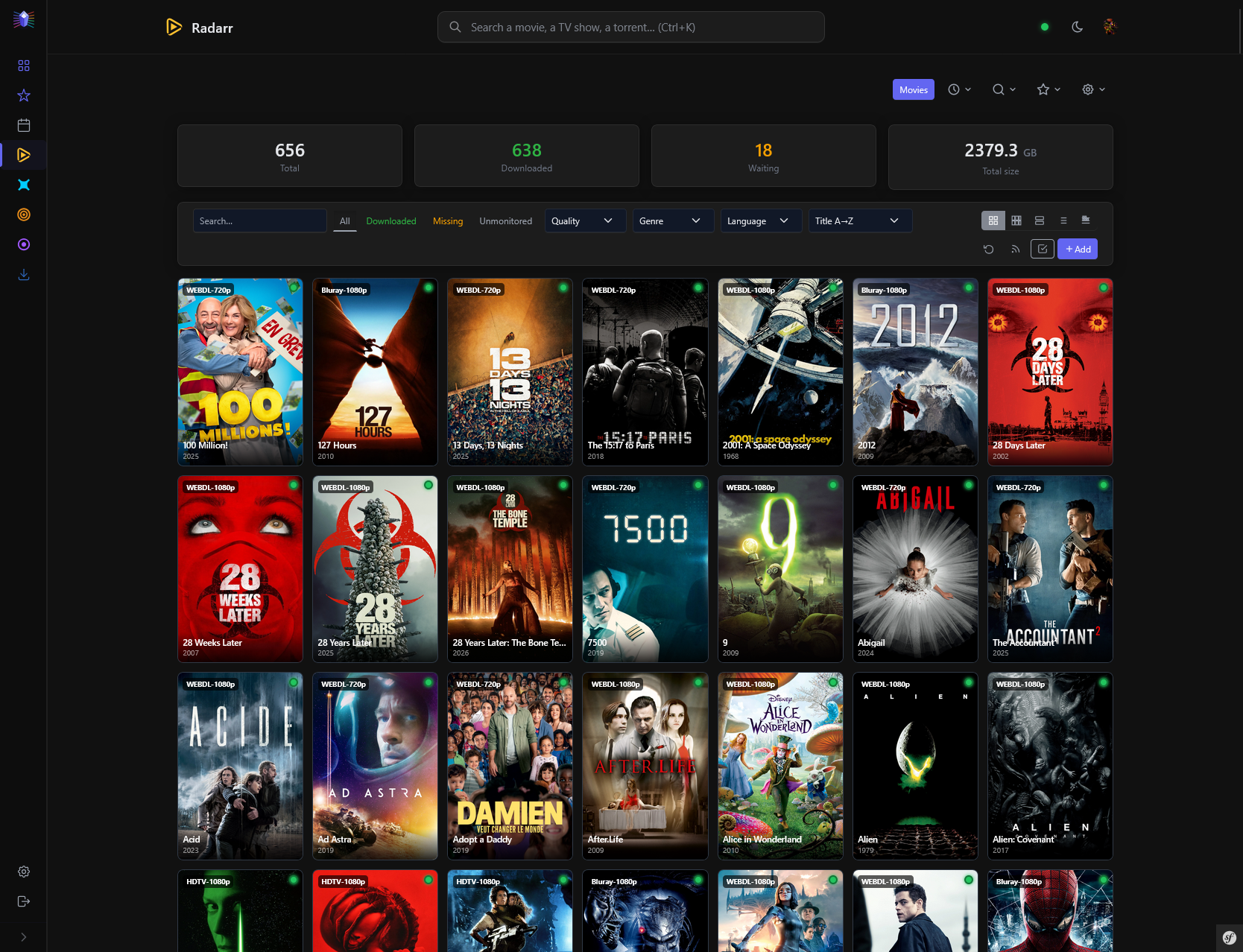
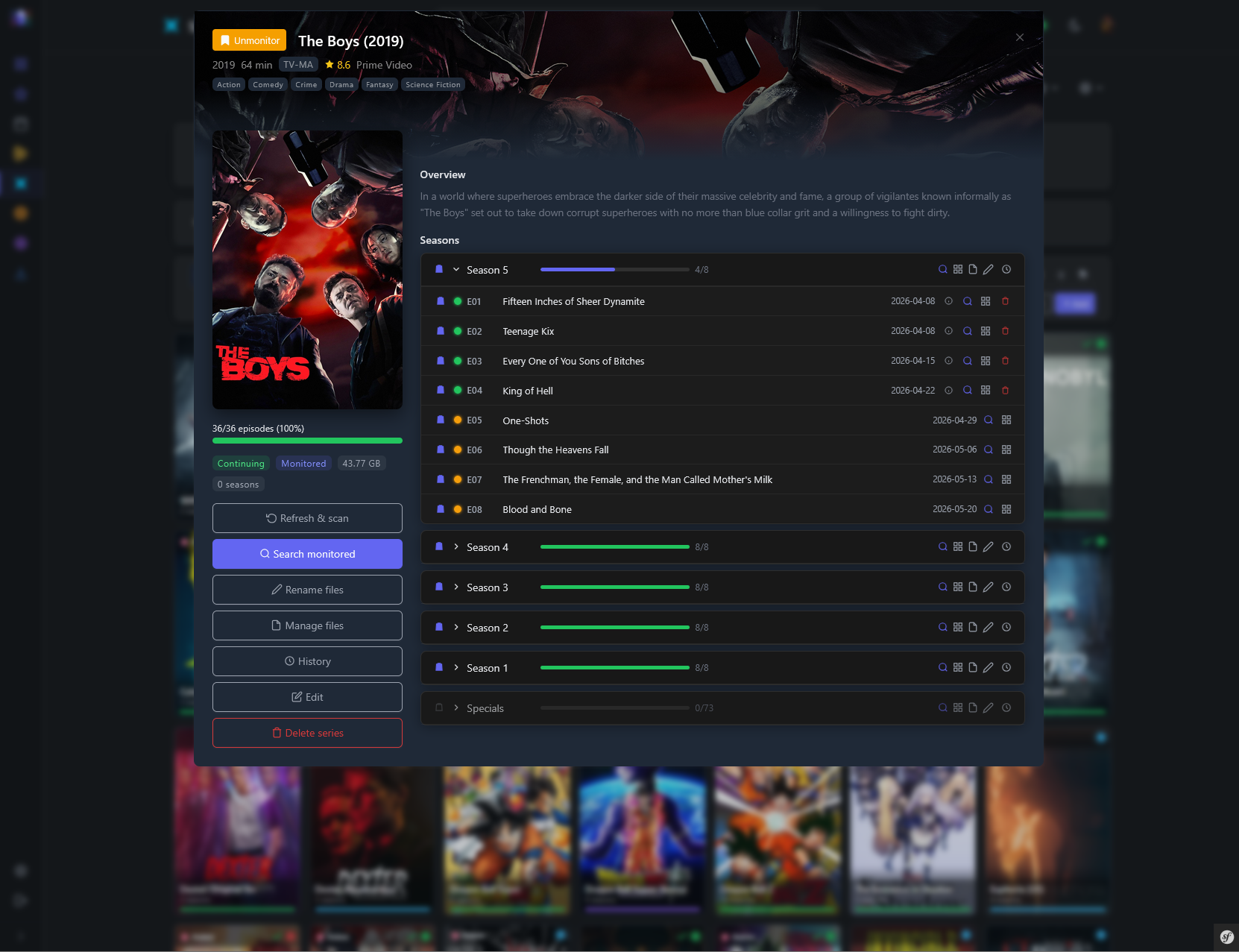
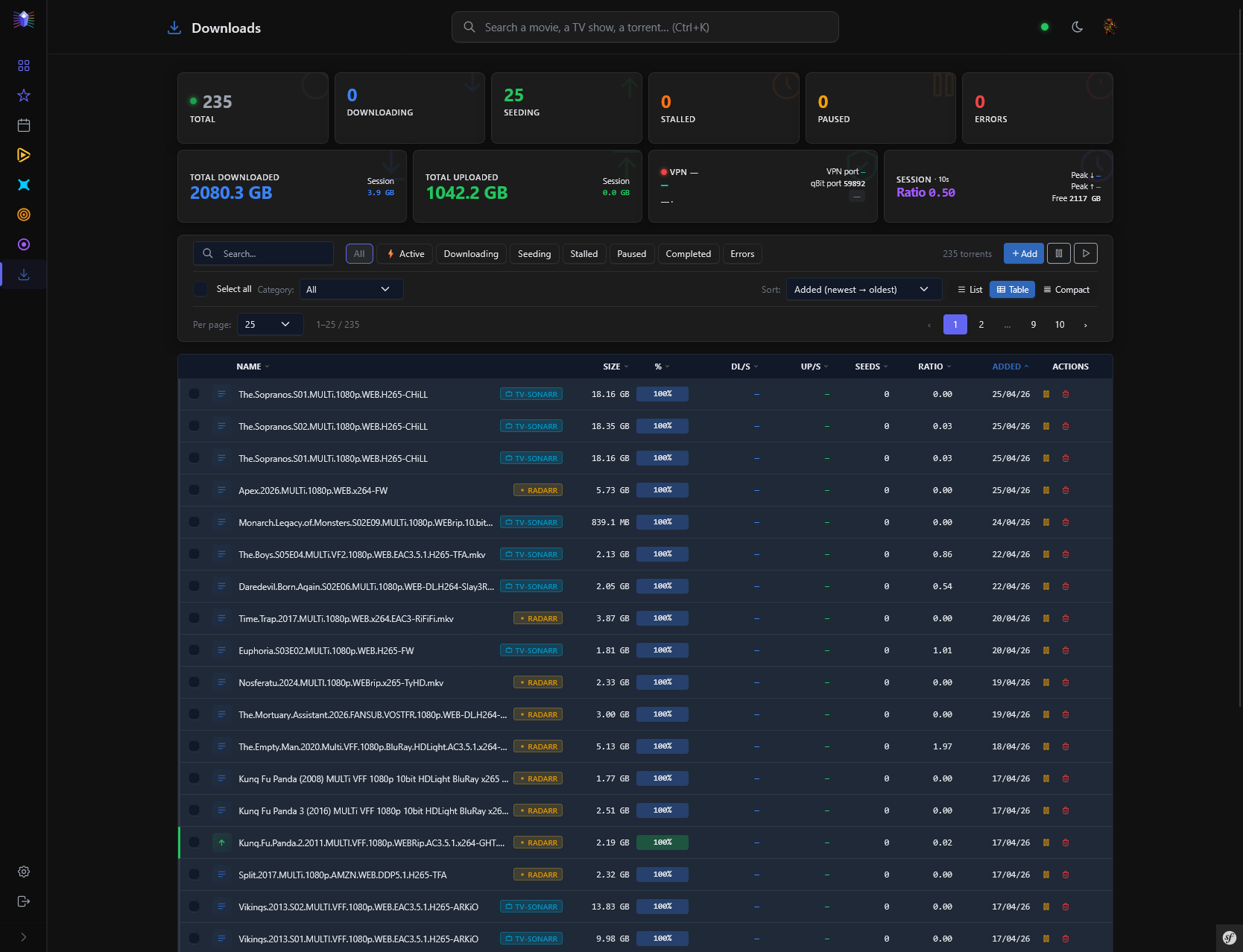
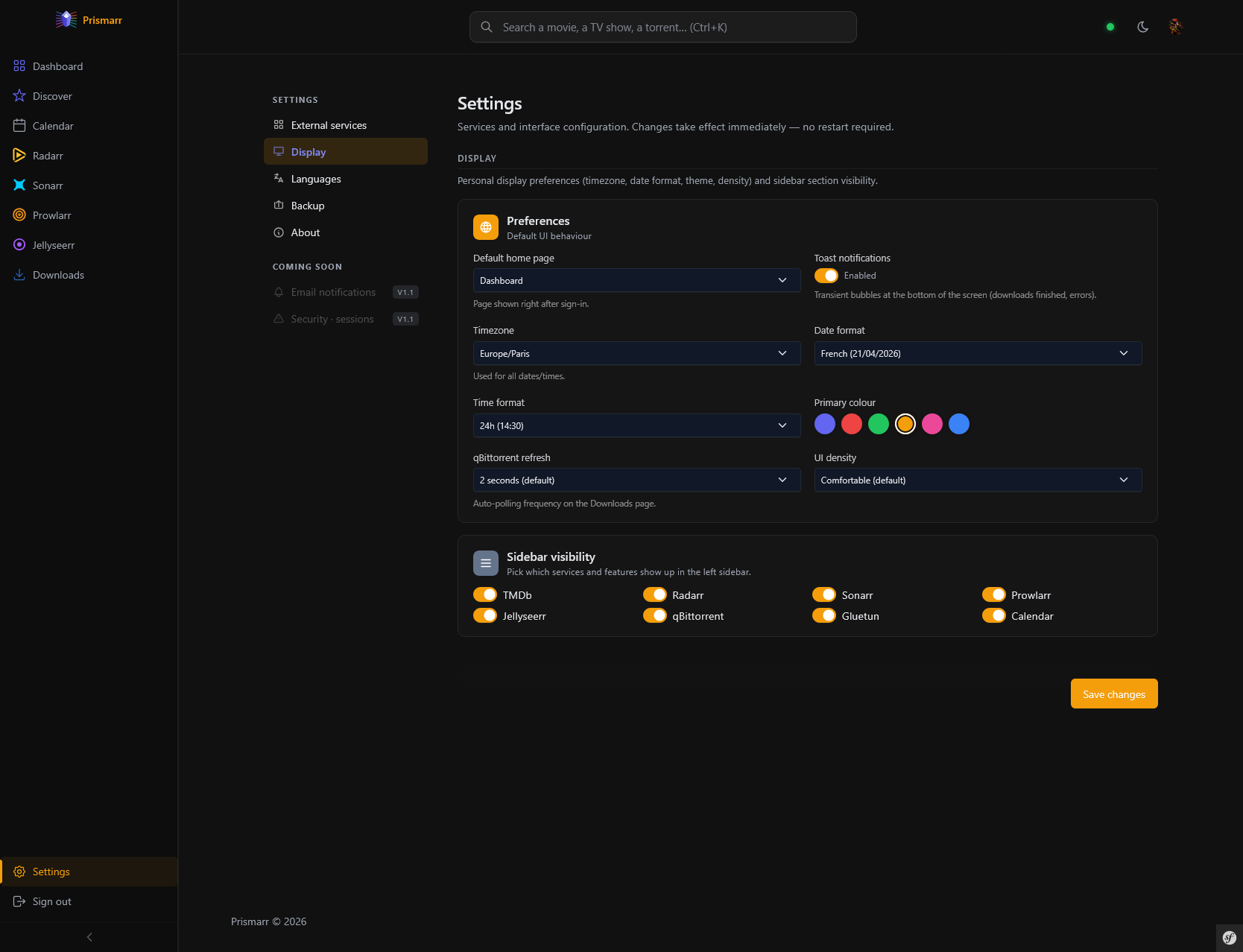
Static screenshots (click to expand)
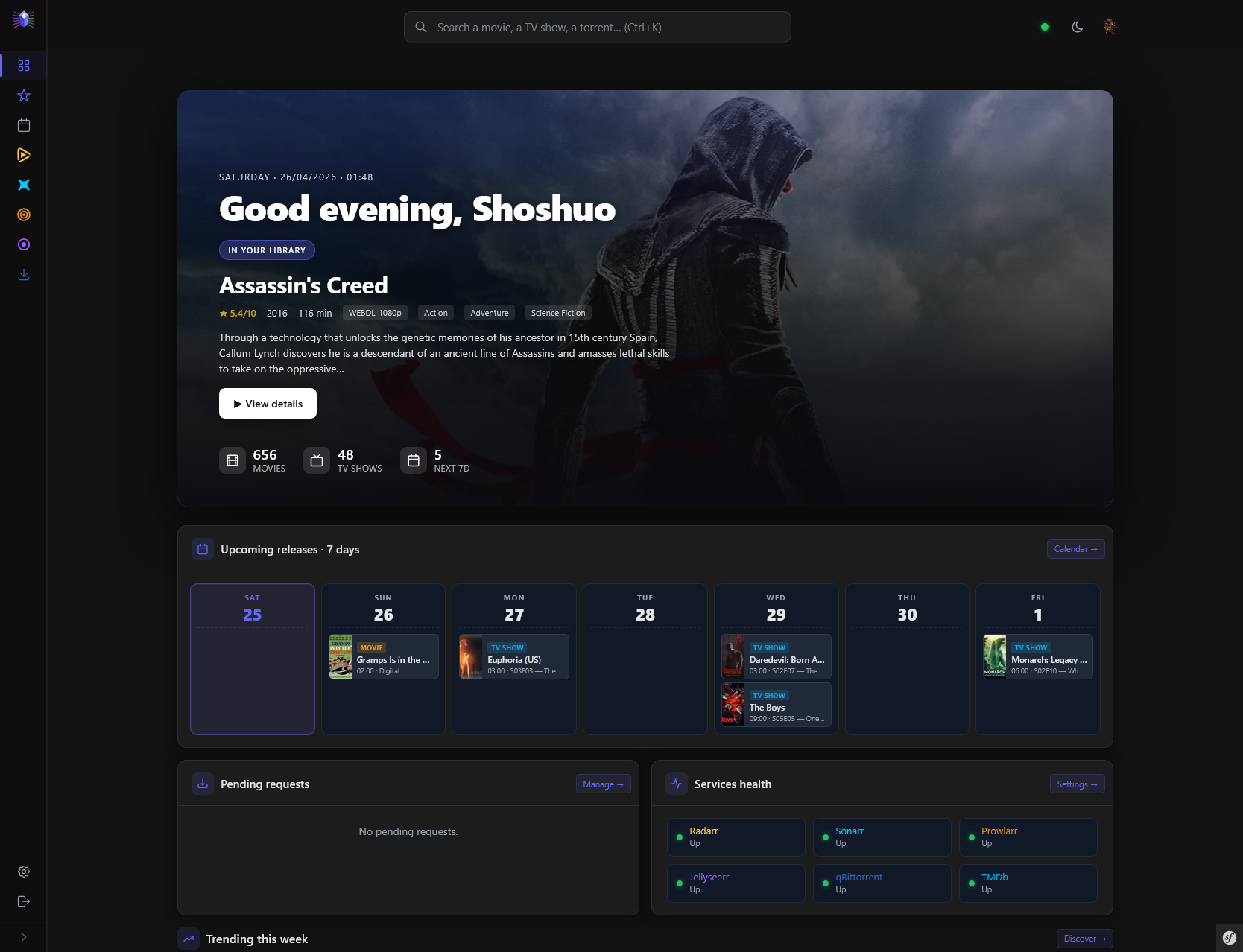
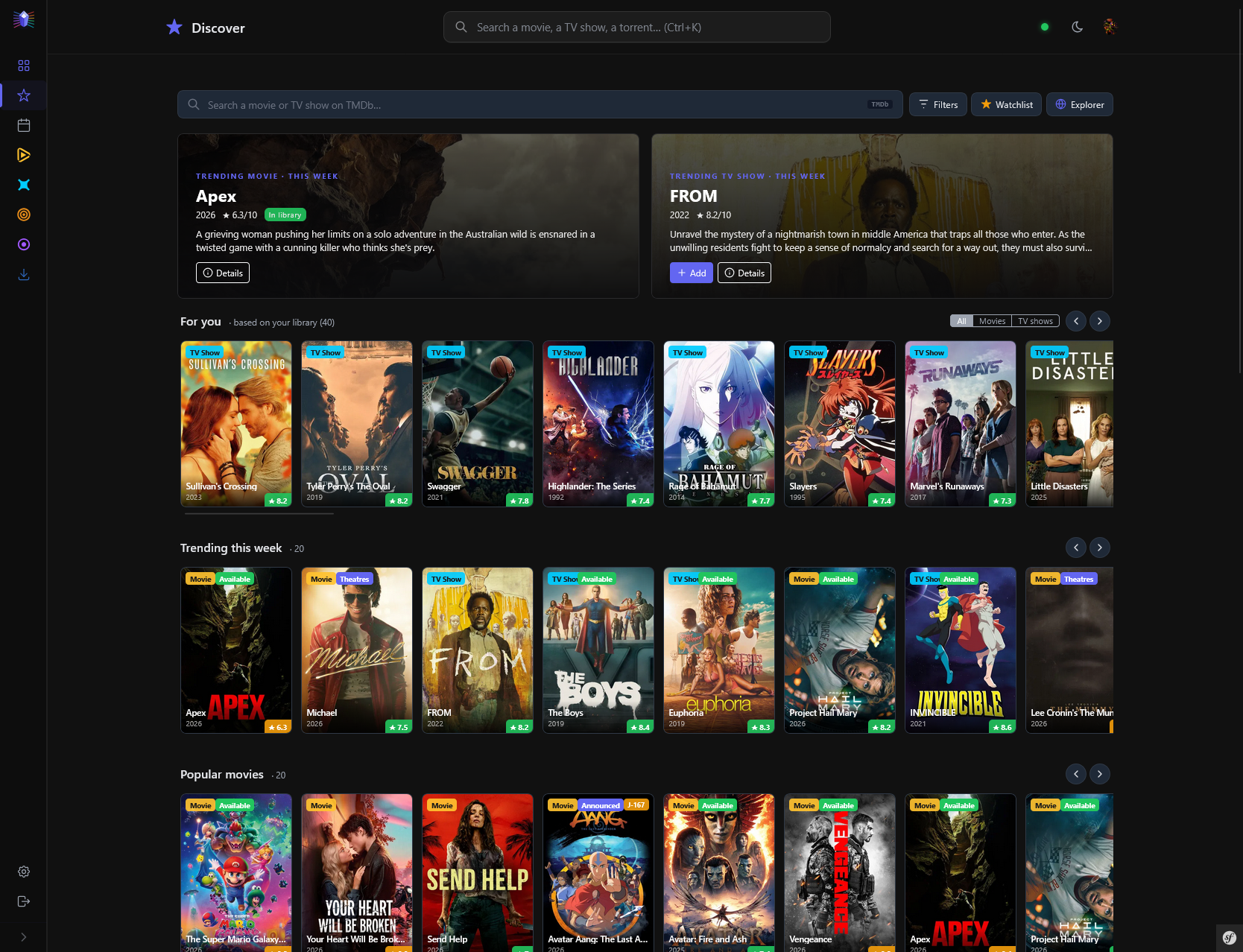
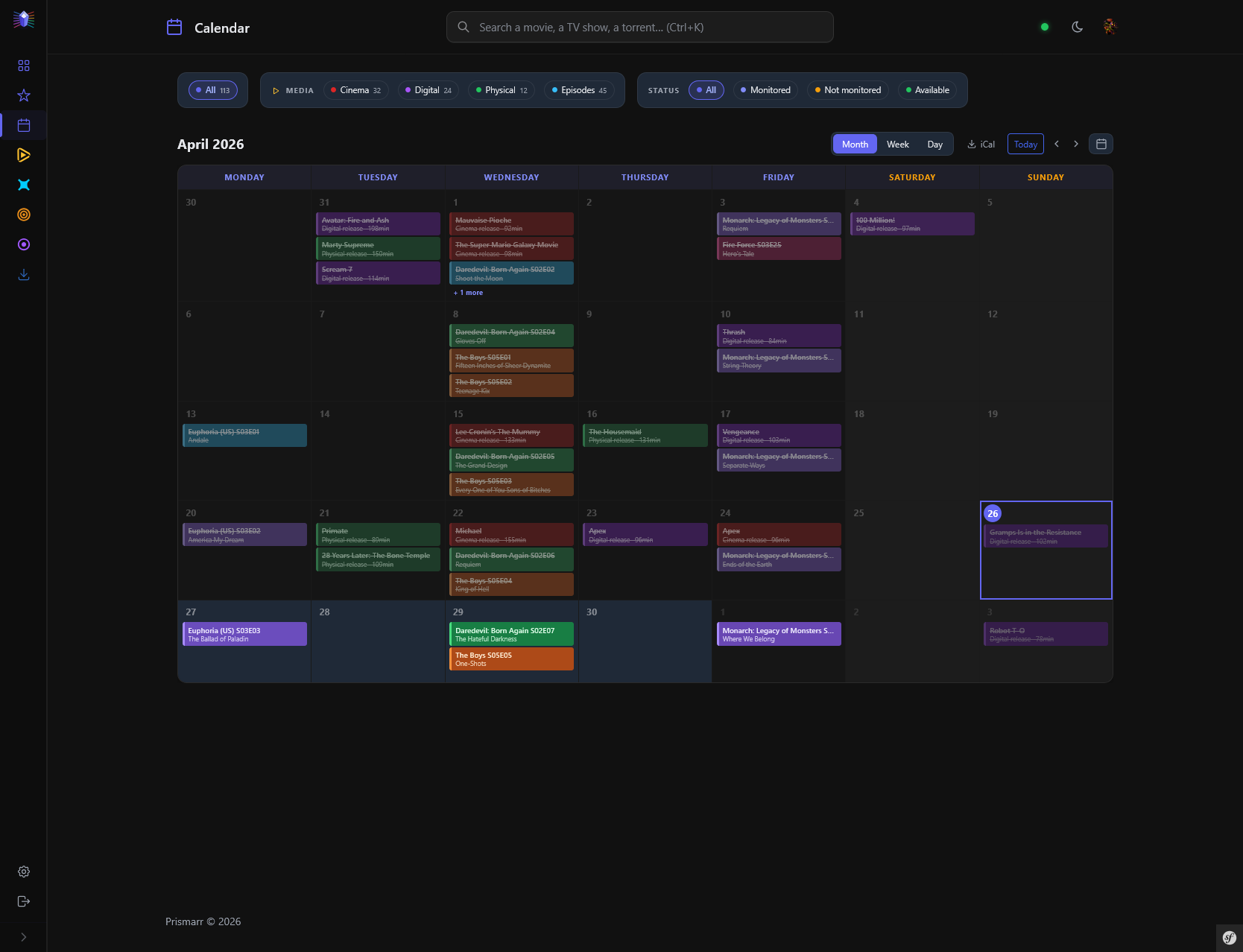
About
Prismarr brings qBittorrent, Radarr, Sonarr, Prowlarr, Seerr and TMDb together in a single modern Symfony interface. No more juggling six tabs to manage your library.
It's not a replacement for Radarr or Sonarr - those run side by side and keep doing what they do best. Prismarr is the unified control surface: one search bar that hits the local library and TMDb, one calendar that merges movie releases and episode airs, one dashboard that surfaces what matters today (a recent download, a pending request, a trending pick), and one settings page where every API key lives - never on disk in plain text and never in environment variables.
The whole thing ships as a single Docker container with SQLite inside.
First boot opens a 7-step wizard: create the admin, plug your services in,
done. No external database, no Redis, no per-service .env files. Pull
the image, mount one volume, you're up.
Project status
Prismarr is maintained by a single developer (for now) in spare time. The codebase is production-ready - I run it on my own homelab daily - but support, bug fixes and new features land when I have the bandwidth. There is no SLA, no commercial backing and no team behind this.
That said, I actively welcome and encourage feedback. Feature requests, bug reports, code reviews, UI critiques, design ideas, translations - if you take the time to write something, I'll take the time to read it carefully and reply. Open an issue, drop a PR, or just tell me what's missing or what could be better. Outside contributors are exactly how a solo project becomes a real one, and I'd love that to happen.
The CHANGELOG is kept up to date, and the public Kanban shows what's in progress, what's planned for the next release and what's queued for later.
Features
- Movies & Series: Radarr and Sonarr libraries with five view modes, multiple instances side by side (1080p / 4K / Anime, each first-class in the UI), global
Ctrl+Ksearch and a quick-add modal with a per-instance target picker. - Unified calendar: movie and episode releases merged across instances, deduped by
tmdbId/tvdbId, with month / week / day views and iCal export. - Dashboard: hero spotlight, upcoming releases, pending Seerr requests, live service health, watchlist, trending and latest additions. Paints instantly, each widget hydrates on its own.
- Downloads: full qBittorrent dashboard (server-side pagination, sorting, filters, drag-and-drop upload) plus dedicated SABnzbd and NZBGet pages. Optional Gluetun integration.
- Discovery: TMDb landing page with recommendations and trending, watchlist, an explorer with filters, and deep-links into your library.
- Plex activity (Tautulli): optional read-only page (now playing, watch stats, graphs, history) plus a "Current Plex activity" dashboard widget. The API key stays server-side and responses are sanitised.
- Theming: a full instance theme chosen in
/admin/settings → Displayfrom a catalogue of glance-style presets (HSL colour model resolved to CSS variables server-side, light and dark). The default reproduces the previous dark look exactly. - Preferences: accent colour, UI density, timezone, date format, English / French UI, settings export / import (credentials always stripped).
- Security: Symfony auth with login rate-limiter, non-root container, dynamic CSP, SSRF protection on user-provided URLs, CSRF on every mutation.
Quick start
Requirements
- Docker and Docker Compose
- At least one of: qBittorrent, Radarr, Sonarr, Prowlarr, Seerr
- Optional: Gluetun if qBittorrent runs behind a VPN
- Optional: a TMDb API key (free) to enable the Discovery page
Install
Step 1. Get a docker-compose.yml file. Pick one of the two options below.
Option A — Copy-paste
Create a file named docker-compose.yml with the following content:
services:
  prismarr:
    image: shoshuo/prismarr:latest
    container_name: prismarr
    restart: unless-stopped
    stop_grace_period: 30s
    ports:
      - "7070:7070"
    volumes:
      - prismarr_data:/var/www/html/var/data

volumes:
  prismarr_data:
Option B — Download
wget -O docker-compose.yml https://raw.githubusercontent.com/Shoshuo/Prismarr/main/docker-compose.example.yml
(or curl -O https://raw.githubusercontent.com/Shoshuo/Prismarr/main/docker-compose.example.yml && mv docker-compose.example.yml docker-compose.yml)
Option C: Bind-mount (Servarr-style layout)
If you prefer host folders next to your other Servarr containers (Radarr, Sonarr, etc.) for easy browsing, replace the named volume with a bind-mount. The container target must stay at /var/www/html/var/data:
    volumes:
      - ./prismarr-config:/var/www/html/var/data
Drop the top-level volumes: block from Option A, and create the host folder before first start: mkdir -p ./prismarr-config.
[!warning] If you write your own compose instead of using a template above, the container target for the data volume must be
/var/www/html/var/data. Prismarr does not use the Servarr/configor/app/configconvention. A bind-mount on the wrong path silently creates an anonymous volume that resets on every redeploy, with no error in the logs.
[!warning] Unraid: map the data volume to a dedicated subfolder on your cache pool (
/mnt/cache/appdata/prismarr), not to/mnt/user/.... The/mnt/usershare goes through FUSE (shfs), where Prismarr's session and database I/O can saturate the share and, in the worst case, lock up the whole server. Always point it at a dedicated subfolder (never theappdataroot) so the container's startupchownstays scoped to Prismarr's own data.
Step 2. Start the container:
docker compose up -d
Step 3. Open http://localhost:7070 in your browser. The setup wizard
will guide you through:
- admin account creation
- TMDb API key (optional)
- Radarr / Sonarr / Prowlarr / Seerr URLs and keys
- qBittorrent + Gluetun (optional)
APP_SECRET and MERCURE_JWT_SECRET are auto-generated on first boot and
persisted in the prismarr_data volume. No .env editing required.
Default port
Prismarr listens on 7070. To use a different port, change the left side of
the mapping in docker-compose.yml:
ports:
  - "8080:7070"  # access on http://localhost:8080
Configuration
Everything is configured from the UI:
- First boot: the 7-step setup wizard at
/setup - Later: the Settings page at
/admin/settings(admin only)
External service credentials (TMDb / Radarr / Sonarr / Prowlarr / Seerr
API keys, qBittorrent password, service URLs), display preferences and
language are stored in the SQLite database (setting table). They never
appear in environment variables or in any committable file.
Two framework-level secrets - APP_SECRET and MERCURE_JWT_SECRET - are
auto-generated on first boot and persisted inside the volume at
var/data/.env.local. They never leave the volume; you don't have to set,
rotate or back them up manually.
Environment variables (optional)
| Variable | Default | Purpose |
|---|---|---|
APP_ENV |
prod |
Switch to dev for local development only |
PRISMARR_PORT |
7070 |
Internal listening port |
TRUSTED_PROXIES |
127.0.0.1,REMOTE_ADDR |
Adjust if running behind Traefik / nginx / Caddy / Cloudflare Tunnel |
TZ |
UTC |
Container time zone (e.g. Europe/Paris, Pacific/Honolulu). Drives both the OS clock and the PHP date helpers — see issue #12 |
PHP_MEMORY_LIMIT |
1024M |
PHP memory ceiling per request. Bump (e.g. 2048M, -1 for unlimited) if you have a very large Radarr / Sonarr library — see issue #13 |
PHP_MAX_EXECUTION_TIME |
120 |
PHP wall-time ceiling per request, in seconds. Bump alongside PHP_MEMORY_LIMIT if the films / series page times out |
Persistent data
Everything lives in the prismarr_data Docker volume:
prismarr.db(SQLite database).env.local(auto-generated secrets)sessions/(login sessions)cache/(TMDb / cover thumbnails)avatars/(uploaded user avatars)
A standard backup is docker run --rm -v prismarr_data:/data -v $(pwd):/backup alpine tar czf /backup/prismarr-data.tgz -C /data ..
Reverse proxy
Prismarr handles HSTS and Permissions-Policy headers itself. When sitting
behind a reverse proxy that terminates TLS (Traefik, nginx, Caddy,
Cloudflare Tunnel), set TRUSTED_PROXIES to your proxy network so that
Symfony reads the right X-Forwarded-* headers.
Upgrade
docker compose pull
docker compose up -d
SQLite migrations run automatically on container start. The prismarr_data
volume is preserved.
To pin a specific version instead of latest:
services:
  prismarr:
    image: shoshuo/prismarr:1.0.0
Testing pre-release builds
shoshuo/prismarr:beta is the unreleased work-in-progress build of main.
/!\ No stability guarantee /!\
:betacan be broken, regress features, or lose data. It is not held to the quality bar of:latest, and there is no promise it works as well, or at all. Do not run it on an instance you care about.
You only ever get :beta if you explicitly set image: shoshuo/prismarr:beta
in your compose file. The :beta tag is built separately and never touches
:latest, so users on :latest (including with Watchtower or other auto-pull
setups) stay on stable. If you do opt into :beta, auto-pull will keep
fetching fresh pre-release builds, which is usually what a tester wants.
If you still want to help test it:
- Back up your
prismarr_datavolume before switching, and again before each:betapull. A pre-release database migration may not be safely reversible, so going back to:latestcan require restoring that backup. - Report problems on the issue tracker with a
[beta]prefix in the title, including the version shown on Settings → Updates anddocker logs prismarr.
What's next
Everything lives on the public Kanban: what's in progress, what's planned for the next release, and what's parked for later.
Support and community
Prismarr is built by one person in spare time. Two ways to be part of it:
- Join the Discord to ask for help, report issues, share setups, or follow what's coming next.
- Buy me a coffee if Prismarr is useful to you and you'd like to support the time that goes into it. Entirely optional, and every bit is appreciated.
For anything that needs tracking (bugs, feature requests), GitHub issues and pull requests stay the right place. See Contributing.
Tech stack
- Backend: PHP 8.4 / Symfony 8 / Doctrine ORM
- Server: FrankenPHP (Caddy + PHP embed, worker mode) supervised by s6-overlay
- Frontend: Tabler UI + Alpine.js + Turbo (Hotwire) via Symfony AssetMapper
- Database: SQLite (zero-config, automatic Doctrine migrations)
- Cache + sessions: filesystem (no Redis required)
- Queue: Symfony Messenger (Doctrine transport)
- Real-time: Mercure SSE built into Caddy
A single Docker container ships everything. The image is ~282 MB and runs
on amd64 and arm64.
FAQ
Why PHP / Symfony? Because the developer (me) is comfortable with it and Symfony 8 lets a solo dev ship a polished, testable, batteries-included web app fast. The runtime is FrankenPHP in worker mode, so the per-request overhead is small. Performance is a non-issue at homelab scale.
ARM / Raspberry Pi support?
Yes. The image is built for linux/amd64 and linux/arm64. It runs
on a Raspberry Pi 4/5, an Apple Silicon Mac, or any arm64 NAS.
Does Prismarr need internet access? Only for TMDb (cover art, metadata, discovery) and the Servarr services you point it at. The app itself works fully on a LAN; if you don't configure TMDb, the Discovery page is the only feature that goes dark.
Can I run it behind a reverse proxy?
Yes. Set TRUSTED_PROXIES to your proxy network (see Configuration).
HSTS and Permissions-Policy headers are emitted by the embedded
Caddy.
Where are my API keys stored? Is it safe?
In the SQLite database (table setting). The database lives in the
prismarr_data Docker volume, never in environment variables, never
in any file under version control. The export feature strips every
key matching api_key, password or secret so accidentally
sharing your config is safe.
How do I back up my install?
Snapshot the prismarr_data Docker volume (one-liner in the
Configuration section). It contains the SQLite DB, the auto-generated
secrets, sessions, cache and avatars - everything needed to restore.
Can I contribute a translation in another language?
Yes - duplicate symfony/translations/messages+intl-icu.en.yaml to
your locale (e.g. messages+intl-icu.de.yaml), translate, and open
a PR. The setup wizard will pick up the new locale automatically.
Contributing
Contributions are welcome - please open an issue first to discuss the scope before submitting a PR.
- Contributor guide: CONTRIBUTING.md (Definition of Done + golden rules)
- Code of conduct: CODE_OF_CONDUCT.md (Contributor Covenant 2.1)
- Security vulnerability: SECURITY.md - please do not open a public issue, contact by email
- Changelog: CHANGELOG.md
Before any commit: make check (PHP lint + Twig lint + full PHPUnit suite).
License
AGPL-3.0 - you may use, modify and redistribute Prismarr freely, including in self-hosted production. Derivatives must remain open source under the same license.
Acknowledgements
Inspired by the remarkable work of:
- Overseerr / Seerr
- The Servarr family (Radarr, Sonarr, Prowlarr, Bazarr…)
- Tabler for the UI kit
And, on a more personal note: thank you to my friends and family for the patience, the encouragement, and for asking "so when does it ship?" often enough to keep me going. This release is for you.
Star history
Note on AI usage
Prismarr is a solo project. I make the calls on what to ship, what to drop, how things plug together. The bugs are on me too. Claude Code (Anthropic) helped me move faster on the chunks listed below; the rest is mine.
To stay transparent, here are the concrete areas where it was actively helpful:
Primary uses
- i18n translation and key wiring - English isn't my native language; Claude handled the bulk of the EN/FR YAML files (4 188 keys on each side, kept in exact parity) and the
trans()call sites in PHP and Twig.- Log and JavaScript debugging - faster triage of stack traces, Turbo/Alpine quirks, and front-end edge cases I couldn't reproduce locally.
- API endpoint cataloguing - mapping the ~600 endpoints across Radarr v3, Sonarr v3, Prowlarr v1, Seerr, qBittorrent v2 and TMDb v3 from their OpenAPI specs.
- Code audits - flagging missed translations, forgotten edge cases and bugs in my own code.
- SVG icons and illustrations - generating and tweaking inline SVGs (logo variants, empty-state illustrations, status icons) when no off-the-shelf asset matched.
Secondary uses
- PHPUnit test debugging - turning failing assertions into readable diffs.
- Mobile responsive design - tightening the calendar week/day views, sidebar collapse and dashboard widget grids on phones.
- Security review and hardening - second-opinion checks on SSRF guards, CSP, CSRF tokens, XSS, SQL/XML injection patterns, profiler exposure.
- Documentation translation and polish - README, CHANGELOG, CONTRIBUTING, SECURITY, CODE_OF_CONDUCT in both English and French.
- Local commit messages and the private PROGRESSION.md log - keeping the per-session journal readable. That file lives only on my machine and is never pushed to GitHub.
- Single-container Docker design - the FrankenPHP + s6-overlay layout that supervises the web server and the messenger worker.
Nothing landed without me reading it, running it, and watching
make checkgo green (PHP lint + Twig lint + full PHPUnit). Claude is a tool I leaned on, not a co-author.
Download Statistics
Total Downloads Over Time
Related apps
Explore more like this
Explore allDetails
shoshuo/prismarr:latestRuntime arguments
- Web UI
http://[IP]:[PORT:7070]/- Network
bridge- Shell
sh- Privileged
- false
- Extra Params
--stop-timeout=30
Template configuration
HTTP port Prismarr listens on.
- Target
- 7070
- Default
- 7070
- Value
- 7070
Persistent data: SQLite DB, auto-generated secrets, sessions, cache, avatars. Container target MUST stay /var/www/html/var/data.
- Target
- /var/www/html/var/data
- Default
- /mnt/user/appdata/prismarr
- Value
- /mnt/user/appdata/prismarr
IANA timezone for the clock and date helpers, e.g. Europe/Paris. Falls back to UTC if unset.
- Default
- UTC
- Value
- UTC
PHP memory ceiling per request. Bump (e.g. 2048M, or -1 for unlimited) for very large Radarr/Sonarr libraries.
- Default
- 1024M
- Value
- 1024M
PHP wall-time ceiling per request, in seconds. Bump alongside PHP_MEMORY_LIMIT if the films/series page times out.
- Default
- 120
- Value
- 120
Set to your reverse-proxy network (Traefik, nginx, Caddy, Cloudflare Tunnel) so Symfony reads the right X-Forwarded-* headers. Leave empty otherwise.