
All apps · 0 apps
OpenScrub
Docker app from Pharmhero's Repository
Overview
Readme
View on GitHub




OpenScrub — local video & screen-recording redaction
A local, GPU-accelerated tool that blurs faces, whole people (silhouette-precise body masking), license plates, and any on-screen text — names, phone numbers, SSNs, emails, dates, or anything you can express as a regex — in videos and screen recordings, with a human review step before anything is published.
Runs entirely on your own machine (no cloud, no upload of sensitive footage). OCR-driven, so it catches text anywhere on screen; face-tracked, so a face detected once stays covered even when the detector blinks; scroll- and motion-aware, so blur boxes follow content as it moves; and onset-aware, so redaction starts on the exact frame a detail first appears rather than a half-second late. Defaults are tuned for the hardest case — dense, scrolling records screens (medical, financial, CRM, support consoles) — but the engine is general-purpose.
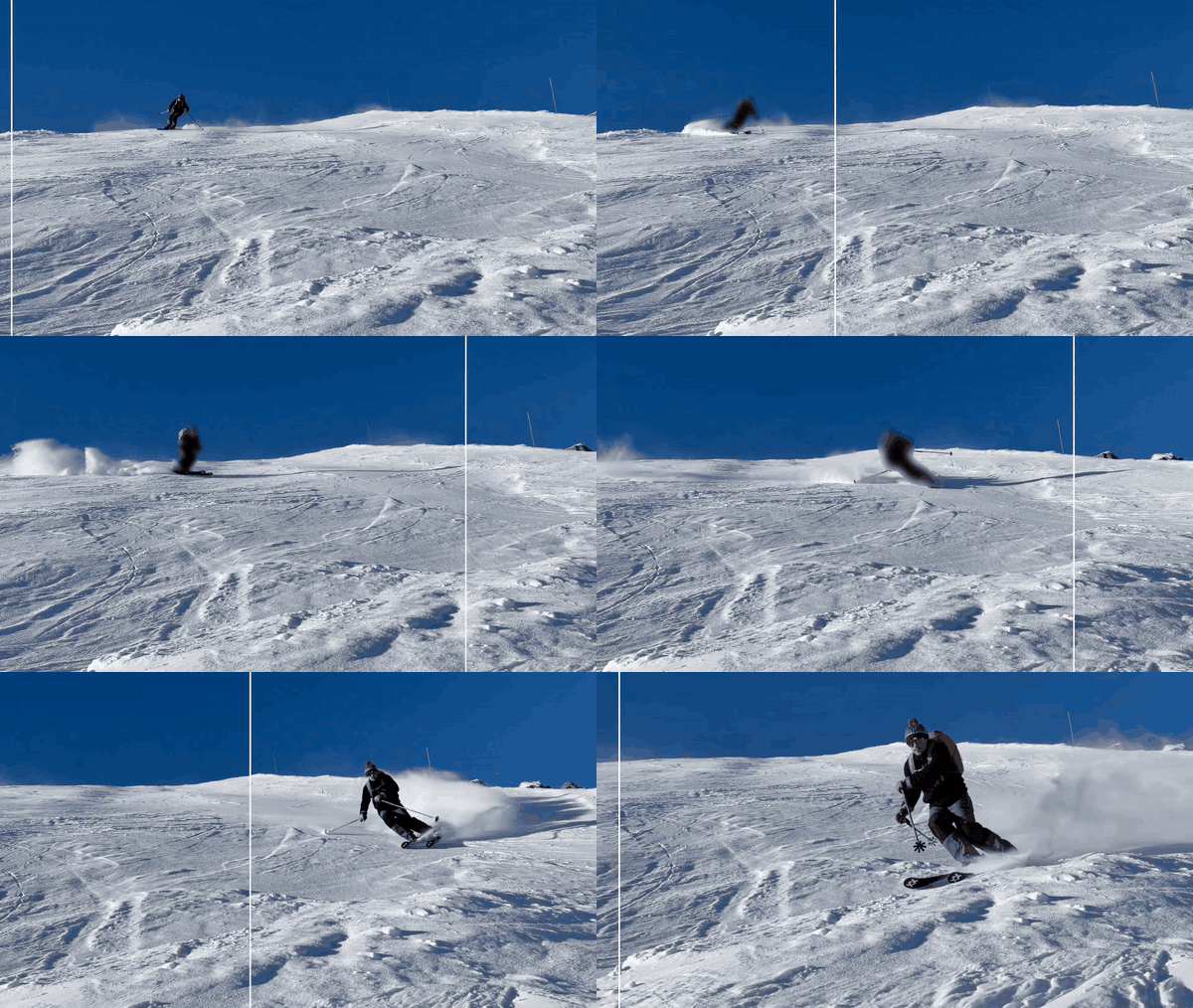
Real output. The wipe reveals the same frames redacted and untouched: the silhouette mask tracks the skier through a fast carve, and only the body is covered — the mountain stays sharp.
Compressed for GitHub — OpenScrub itself renders at full source quality and resolution (see openscrub.app). Footage: Pexels.
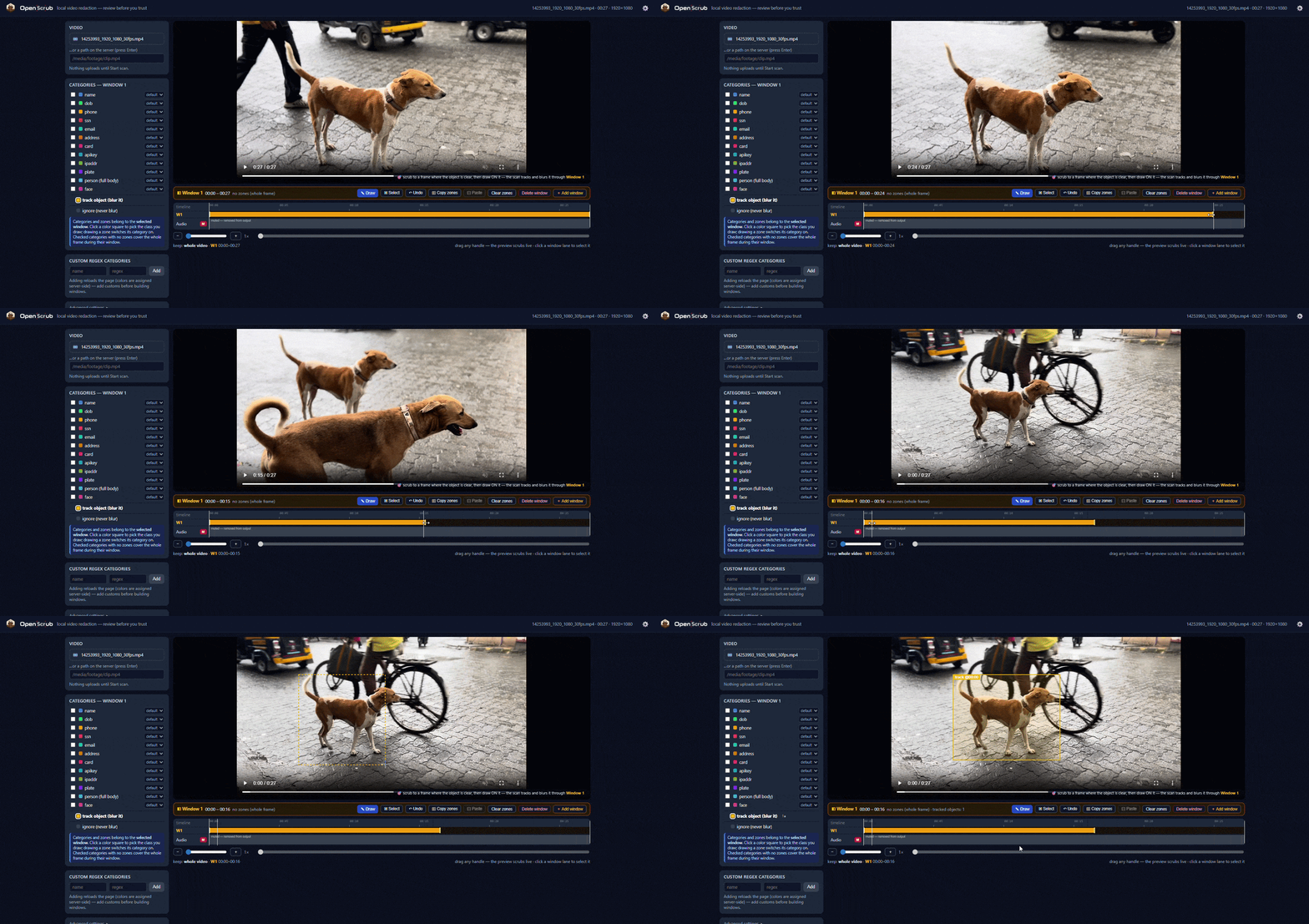
One visual editor: stack detection windows on a timeline, draw zones, mute audio — then scan and review before anything is trusted.
Keywords: video redaction · blur faces in video · blur a person in video · body blur / silhouette masking · redact screen recording · PII redaction · anonymize video · blur license plates · GDPR / CCPA / FERPA / PCI / HIPAA · OCR text redaction · face blur · privacy tool
What it does
- Blur faces — detected with a DNN model and visually tracked, so a single detection covers a face across frames where it would otherwise be missed. Works out of the box; optional higher-accuracy models (CenterFace, SCRFD) can be downloaded and selected in the web UI's Detection models panel — every download is hash-verified.
- Blur whole people — silhouette-precise — the
personcategory detects full bodies and masks each person's exact body outline (blur, black fill, or mosaic follows the silhouette; the background around them stays sharp). A face blur hides a face, but clothing, build, and gait still identify someone — this hides the person. Enabled by downloading a segmentation model in the web UI's Person model panel (hash-verified, ~11 MB); each tracked person gets their own review card. - Blur license plates — via an optional ONNX detector model (see PLATES.md); plates re-detect every frame, so a plate crossing the frame stays covered.
- Redact text by pattern — built-in patterns for SSNs, phone numbers, emails, dates, addresses (including multi-line street/city/state/ZIP blocks), credit/debit card numbers (Luhn-validated), API keys/tokens, and IP addresses — plus custom regex categories: add your own (claim numbers, case IDs, employee IDs, account formats) in the web UI and each one becomes a first-class category with its own color, zones, and review section.
- Redact names — via named-entity recognition plus heuristics, with no list required (though you can supply an allowlist to keep specific names visible and a blocklist to always remove others).
- Detection windows & zones — scope the scan in time AND space before it runs: stack detection windows on a timeline (faces for the whole clip and names only from 5:00–7:00), draw per-window zones on the frame, and mark never-blur ignore zones. Clip bookends trim the output; audio tracks can be muted per-track.
- Redaction styles — blur, solid black box (irreversible), or mosaic pixelation, choosable per category (black-box the SSNs, blur the faces). Faces are masked with a tight ellipse by default — no smeared rectangle corners — and mosaic tiles scale with the face size.
- Human review — every detection is shown as a thumbnail you can keep or blur — one card per tracked face/person/plate, one decision for all its appearances — with an interactive box editor to resize, move, add, time-bound, or template-track a manually drawn box through a chosen time range, and audio mute/bleep spans for spoken PII.
- HDR in, HDR out — iPhone (Dolby Vision/HLG) and HDR10 footage keeps its 10-bit HDR signal through redaction: output is 10-bit HEVC with the original color primaries and transfer preserved, and the blur is applied directly in the native color domain (untouched pixels are never color-converted). Prefer compatibility instead? One toggle tone-maps the output to SDR properly — no washed-out colors either way. SDR sources always render SDR: output matches the source.
- Spoken-PII suggestions — optional local transcription (faster-whisper, included in the Docker images) finds spoken names, phone numbers, SSNs and account numbers and suggests mute spans in review, each with the transcript snippet — approve per item or all at once. Nothing ever leaves your machine.
- Audit trail — each run produces a report with SHA-256 hashes of input and output for provenance.
Use cases
The tool is built for the hardest version of the problem — dense, scrolling, fast-changing screens full of sensitive text — and the same engine fits many privacy workflows:
- Content creators & tutorials — strip inboxes, browser tabs, API keys, file paths, and notification pop-ups out of screen-recorded walkthroughs before publishing. Onset detection catches a notification that flashes for a fraction of a second.
- Legal e-discovery & court exhibits — redact names, SSNs, account numbers, and minors' identities from video exhibits, deposition recordings, and bodycam footage; keep the named party visible, blur the rest.
- Journalism & documentary — protect sources by blurring informants' faces and on-screen identifying text (badges, plates, addresses, shared documents); face tracking survives a source turning their head.
- Law-enforcement & FOIA release — redact bystander faces, minors, and visible PII from body-cam footage for public-records compliance, with a hashed audit report for chain-of-custody.
- GDPR / CCPA compliance — anonymize identifiable people and personal data in any recorded video before it's shared or published.
- Fintech & financial support videos — blur account numbers, balances, routing and card numbers in screen recordings of banking or accounting software (PCI-DSS-relevant), via built-in and custom regex.
- Education & research (FERPA) — protect student names, IDs, and grades in recorded lectures, gradebook screen-shares, and classroom video; "blur every face except the presenter" with an inverted zone.
- Corporate training & internal demos going public — remove real customer names, employee directories, internal URLs, and chat notifications when repurposing production-system recordings for marketing.
- Real-estate & property walkthroughs — blur faces, family photos, mail with addresses, and documents on desks captured incidentally.
- Streaming & gaming VODs — redact Discord DMs, donation alerts with real names, second-monitor leaks, and non-consenting on-cam guests.
- Dashcam footage — blur license plates and pedestrian faces before posting insurance or public clips (plates via the dedicated detector model — see PLATES.md).
- UX & usability research — anonymize participants' faces, names, and on-screen account data before sharing session recordings internally.
- Government document-on-screen redaction — remove names, locations, and marked strings from recordings that walk through sensitive documents, with zones, regex, and an audit trail.
Several of these depend on you supplying the right regex, and on OCR reading the target text reliably at your recording's resolution — see Caveats. Face tracking works best on footage where faces are stationary or scroll with the page rather than moving rapidly across the frame. In all cases this is a best-effort assistive tool: review the output before publishing.
Choosing a redaction mode
Not all redactions are equally irreversible. Modern ML can partially reverse weak pixelation and sometimes deblur faces — especially with many video frames of the same region to average across. OpenScrub's modes, strongest first:
- box — solid fill. Nothing to recover. Recommended for text.
- inpaint — the region is reconstructed from its surroundings, as if the object was never there. Retains nothing of the original; looks cleaner than a box.
- mosaic — pixelation with tiles that scale with the region (floor 6px). Strong for faces; prefer box/inpaint for text.
- blur — Gaussian blur with a kernel that scales with the region. Best looking; weakest against determined reconstruction.
Set the default in Advanced → "Default redaction", or per category via the mode dropdown on each category row. Safety bands always use the strongest mode any category selected.
Install with Docker (recommended)
The most complete OpenScrub install: Tesseract, FFmpeg, spaCy NER, and
the face model are all preinstalled — nothing to set up, and updates are
a docker pull away. Every release publishes identical images to
Docker Hub (pharmhero/openscrub)
and GitHub Container Registry (ghcr.io/austinmabry/openscrub):
docker run -d -p 8384:8384 \
  -v openscrub_data:/root/.local/share/OpenScrub \
  pharmhero/openscrub:latest
(or ghcr.io/austinmabry/openscrub:latest — use whichever registry
pulls faster for you). Published tags are refreshed weekly with the
latest OS security patches, not just at releases — the refresh only
changes a small top layer, so a weekly re-pull downloads the patch delta,
not the whole image.
Tesseract, FFmpeg, and the face model are baked in; jobs, certificates,
zones, and downloaded plate models live in the mounted volume, so the
container is disposable. Add --token <secret> after the image name
(as openscrub-web --host 0.0.0.0 --token <secret>) for access
control. The "process a file already on the server" box accepts any
video path the process can read; set OPENSCRUB_MEDIA_ROOT=/path (env
var) to confine it to one directory tree — recommended whenever the web
UI is reachable by anyone but you. To update, pull the new tag and recreate the container — the
in-app updater doesn't apply inside Docker. Both images include
spaCy NER (name detection) out of the box; the default image is
CPU-only. If you use Encryption at rest, stop the container with a
generous grace period (docker stop -t 120) so the shutdown lock has
time to encrypt large job stores.
NVIDIA GPU build (:cuda / :<version>-cuda) — CUDA-accelerated
PaddleOCR and NVENC hardware encoding:
docker run -d --gpus all -p 8384:8384 \
  -v openscrub_data:/root/.local/share/OpenScrub \
  pharmhero/openscrub:cuda
On Unraid: install the Nvidia Driver plugin, add a container with
repository pharmhero/openscrub:cuda, extra parameter
--runtime=nvidia, port 8384, and map
/root/.local/share/OpenScrub to /mnt/user/appdata/openscrub.
GPU features engage automatically (the OCR engine picks the CUDA build,
and the render's NVENC test selects hardware encoding). Note the GPU
image is several GB.
Intel GPU build (:intel / :<version>-intel) — Quick Sync
hardware encoding (fast HDR renders on any Gen 9+ iGPU or Arc card)
plus ONNX model inference through OpenVINO:
docker run -d -p 8384:8384 \
  --device /dev/dri:/dev/dri \
  -v openscrub_data:/root/.local/share/OpenScrub \
  pharmhero/openscrub:intel
--device /dev/dri is what hands the container the GPU — without it
everything still works, just on the CPU. On Unraid/CasaOS/TrueNAS
add /dev/dri as a device in the container template (no host driver
install needed — the image ships Intel's media driver; the host only
needs its normal kernel i915/xe support, which every mainstream distro
has). The engine pre-flight-tests every hardware encoder with a real
test encode before trusting it and falls back loudly to CPU, so a
missing driver can never silently break a render.
What the Intel GPU accelerates, and how to confirm it's engaged:
- Encoding (the big win): HDR renders and the tone-mapped scan
copy. Check the scan/render log for
encoder: hevc_qsv 10-bit (GPU)orencoder: h264_qsv (GPU)— seeinglibx264/libx265 (CPU)instead means the GPU wasn't reachable (usually a missing--device /dev/dri). - Detection models: license-plate and person/silhouette inference
runs through OpenVINO (
onnxruntime, OpenVINOExecutionProviderin the log). Face detection remains CPU in this image. - Very new Arc cards may need a newer compute runtime than Debian ships for iGPU inference; encoding works regardless, and inference falls back to OpenVINO-on-CPU automatically.
- Force everything to CPU for troubleshooting with
-e OPENSCRUB_CPU_DNN=1and the web UI's Advanced → encoder →x264.
Install from PyPI
pip install OpenScrub
This installs the Python package with all of its Python dependencies and
gives you two commands: openscrub (the CLI engine) and openscrub-web
(the web interface). The YuNet face model (~230 KB) downloads
automatically on first run.
Fresh Windows 11 PC — complete setup (copy-paste)
winget install -e --id Python.Python.3.12
Close and reopen the terminal (so PATH updates), then:
pip install OpenScrub
openscrub-setup
openscrub-setup detects what's missing and installs Tesseract and FFmpeg
for you via winget (asking first; --yes to skip prompts, --check to
only report). Prefer manual control? The equivalent commands:
winget install -e --id UB-Mannheim.TesseractOCR
winget install -e --id Gyan.FFmpeg
Fresh Linux (Debian/Ubuntu)
sudo apt install python3-pip
pip install OpenScrub
openscrub-setup        # offers: sudo apt install tesseract-ocr ffmpeg
Then run openscrub-web and open the URL it prints.
Two system tools are not pip-installable and must be present for full functionality:
- Tesseract OCR — required for every text category (names, SSNs,
emails, …). Face and plate detection work without it; text detection
does not.
- Windows:
winget install -e --id UB-Mannheim.TesseractOCR(or the installer from https://github.com/UB-Mannheim/tesseract/wiki) - Linux:
sudo apt install tesseract-ocr
- Windows:
- ffmpeg (ffprobe ships with it) — strongly recommended: audio
passthrough, H.264 output, and VFR screen-recording normalization all
depend on it.
- Windows:
winget install -e --id Gyan.FFmpeg - Linux:
sudo apt install ffmpeg
- Windows:
Optional extras:
pip install "OpenScrub[ner]"             # spaCy name detection (recommended)
python -m spacy download en_core_web_sm
pip install paddleocr paddlepaddle       # better OCR on small UI fonts (large install)
spaCy is strongly recommended — it's the primary name detector. The tool still runs without it using heuristics, but NER is more accurate.
A proper Windows install (Program Files + Start Menu)
Prefer a normal Windows program over pip? Every release has
OpenScrub-Setup-<version>.exe attached on the
Releases page
(built automatically by CI). It installs branded openscrub.exe and
openscrub-web.exe into C:\Program Files\OpenScrub with Start Menu
shortcuts, an uninstaller, and optional one-click winget installs of
Tesseract and FFmpeg. To build it yourself instead, run
windows\build_installer.bat from a checkout (requires Python 3.10+
and Inno Setup 6). App data — jobs, certificates,
zones, downloaded models — lives in %LOCALAPPDATA%\OpenScrub, never in
Program Files. Note: the frozen build detects names with the built-in
heuristics (spaCy NER is a pip-only extra).
If you stay with pip instead, openscrub-setup on Windows now offers to
create Start Menu + Desktop shortcuts for OpenScrub Web, so you never
have to hunt for pip's Scripts folder.
Guided installer (Windows / Linux / macOS best-effort)
Prefer a setup that installs the system tools too? Clone or download the repository and run:
python install.py
It probes every dependency and installs what's missing with your consent: core pip packages, spaCy NER, Tesseract and ffmpeg (via winget / apt / dnf / pacman / brew), and PaddleOCR — automatically offering the GPU build when an NVIDIA card is detected — then verifies NVENC hardware encoding and creates a launchable "OpenScrub" shortcut with the program icon (Desktop + Start Menu on Windows, a .desktop entry on Linux, a .command on macOS).
--check reports what's present without changing anything; --yes runs
unattended; --cpu-only skips GPU OCR; --with-plates fetches a
license-plate model (see PLATES.md). Start the app from the
created shortcut, or python openscrub_web.py — the web interface is the
primary interface. (openscrub_gui.py, the desktop Tk interface, still
works but is legacy: new features land in the web app.)
Updating
openscrub-update            # interactive: shows versions, asks, updates
openscrub-update --check    # just report whether an update exists
It detects how OpenScrub was installed: pip installs upgrade via
pip install --upgrade OpenScrub; folder deploys download the latest
release from PyPI, verify its SHA-256 against the hash PyPI
publishes, and replace only the released files — your jobs, certificates,
zones, models, allowlist, and locally pinned plate-model hashes are
never touched, and every replaced file is backed up to
backups/pre-update-<version>/ first. Git checkouts are left to
git pull.
The web interface checks for updates too: when a newer release exists, the footer shows an update link — one click runs the same updater (only while no job is running), then asks you to restart the server. Restart after any update to run the new version.
Web interface (LAN) — one page, editor to review
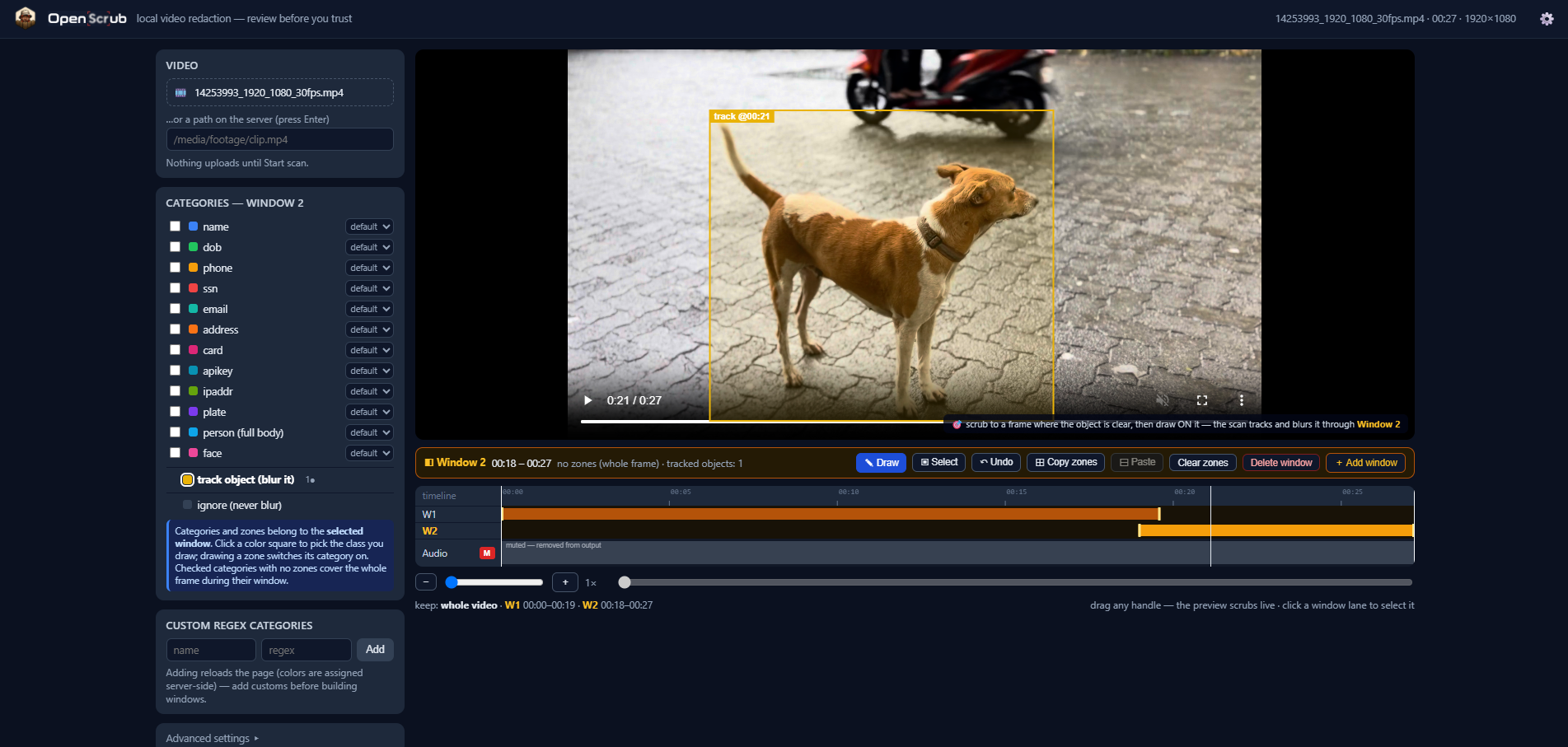
Draw a box around any person, animal, or object — OpenScrub identifies it, tracks it, and blurs it (silhouette-precise) through the window.
Run openscrub-web (or python openscrub_web.py) on an always-on
machine and open the printed URL from any device on your network —
laptop, phone, or tablet. The whole app is one dark, video-editor-style
page: the Scan Setup editor on top, your jobs and the review workflow
right below it, and server settings behind the gear icon in the header.
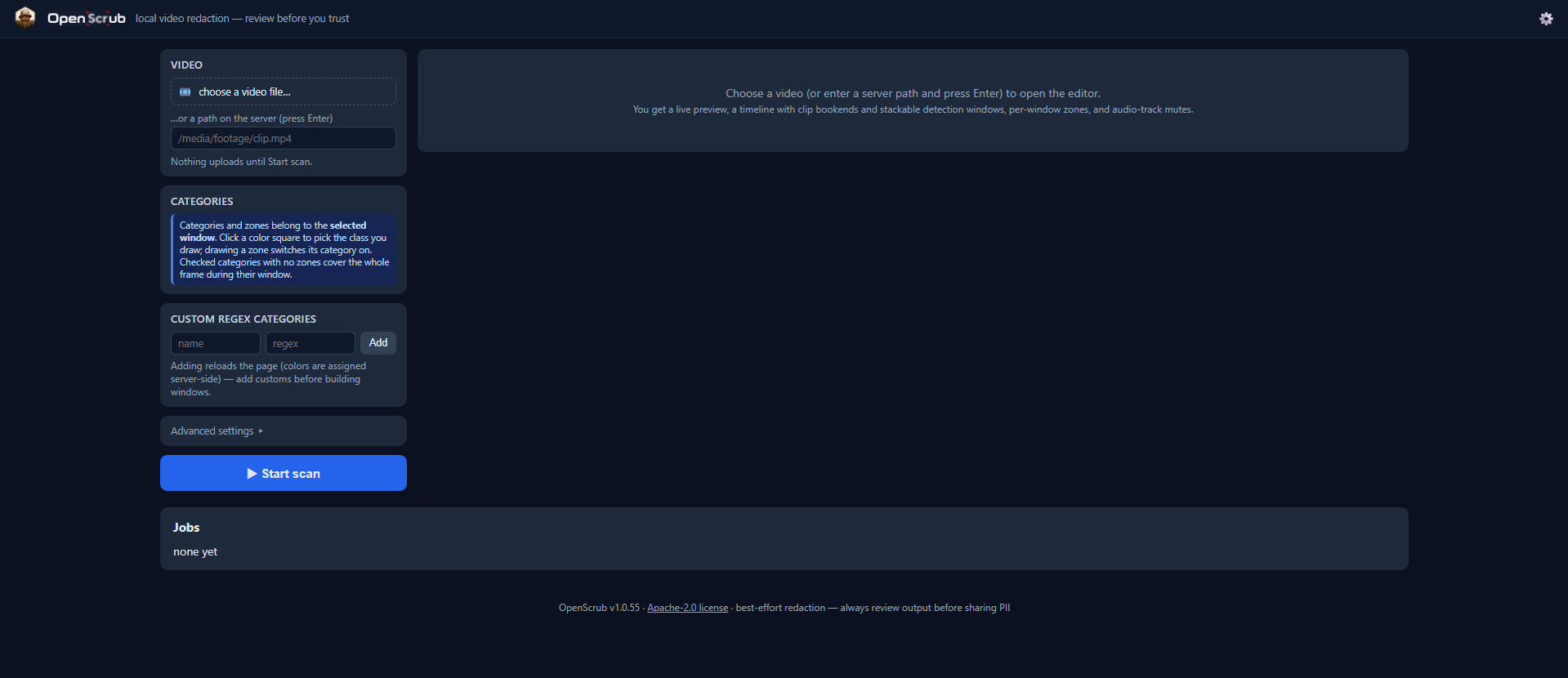
The editor is the homepage — load a video and the timeline appears; nothing is detected until you choose a category.
Scan Setup editor (the top of the page):
- Load a video — pick a local file or enter a path already on the server. Nothing uploads until you press Start scan; the preview runs in your browser.
- Pick categories — everything starts OFF, so nothing is detected until you say so (the summary line warns you while nothing is selected). Check what you want; drawing a zone auto-checks its category.
- Scope the scan — detection windows live on the timeline, one lane each, and may overlap: blur faces for the whole clip AND names only from 5:00–7:00 by stacking two windows. Each window carries its own categories and its own zones (click a category's color square, then draw on the frame; Copy/Paste moves zones between windows). White clip bookends trim the output; audio lanes show a waveform so you can scrub straight to a loud noise or the moment someone starts talking, and each lane has an M button to remove that track. Need to blur something the detectors don't know — a tattoo, a badge, a specific person or object? Pick track object, scrub to a frame where it's clear, and draw ON it: the scan template-tracks it through the window and blurs it wherever it goes. A zoom bar (−/slider/+, with a pan control) magnifies the timeline up to 40× for sub-second placement, and dragging any handle scrubs the preview live — including on iPhone/iPad.
- Start scan — the job queues instantly and its progress card opens right below with a live log and ETA. Jobs queue one at a time so they don't fight over the GPU.
Review (below the editor): every detection appears as a thumbnail you keep or blur — one card per tracked face, person, or plate, one decision for all of its appearances — with per-category all-on/all-off, a before/after box editor to resize, move, add, or time-bound any blur, "Track object" to template-track a manually drawn box through a time range, and audio mute/bleep spans. Then render and download the redacted video plus the audit report.
Settings (gear icon): detection model pickers for Face, License-plate, and Person (full-body blur) — optional models are downloaded on demand with SHA-256 verification and license badges — plus optional engines, Encryption at rest, HTTPS certificates, and the learned safe-words list.
Security: HTTPS by default (self-signed certificate — your browser warns
once; or install your own cert in the settings view). Access is open to
everyone on your network unless you start with --token <secret>, which
then gates every request (recommended). Either way this is LAN-grade
protection — never expose the port to the internet. The jobs folder on
the server contains PII (uploads + reports); protect it accordingly.
--retain-days auto-deletes finished job folders (default 7 days).
HDR support
OpenScrub matches the output to the source:
- SDR source → SDR output. Nothing changes.
- HDR source → HDR output by default. iPhone Dolby Vision, HLG, and
HDR10 footage is detected at intake and rendered as 10-bit HEVC with
the source's color primaries and transfer function (BT.2020 PQ/HLG)
preserved. Blurs are applied directly in the 10-bit native color domain,
so pixels outside the redacted regions never pass through a color
conversion. Set
--hdr-output sdr(CLI) or the HDR output dropdown (web) to tone-map the output to SDR BT.709 instead — the proper conversion, not a washed-out naive decode. - Detection always runs on an internally tone-mapped SDR copy (the detectors are 8-bit); it shares the exact frame timeline with the HDR render, so blur timing is identical.
Notes:
- Dolby Vision clips keep their HDR10/HLG base layer — the output is real HDR — but the Dolby Vision dynamic metadata (per-scene RPUs) is dropped: it is a proprietary layer that cannot be re-authored with open tools after the frames are modified. Players simply treat the result as HDR10/HLG, which is how most non-Apple devices play these files anyway.
- Hardware: a GPU with a 10-bit HEVC encoder (NVENC on GTX 10-series or newer) renders HDR at full speed. Without one, OpenScrub says so in the job log and falls back to CPU encoding (libx265) — correct output, much slower. If neither encoder exists, it falls back to SDR output with a clear notice; it never fails silently.
- The audit report records
hdr_tonemapped(detection copy was created) andhdr_output(output kept HDR) in its provenance block.
⚠️ Disclaimer — read this before using openscrub on real footage
openscrub is a best-effort assistive tool, not a compliance guarantee (GDPR, HIPAA, or otherwise), a de-identification certification, or a substitute for human review. It uses OCR, named-entity recognition, pattern matching, and face detection — all of which can and do miss things: low-contrast text, unusual names, stylized fonts, partially occluded faces, content visible for only a fraction of a second, handwriting, text inside images, and categories of identifiers it was never designed to detect.
You remain fully responsible for reviewing every output before it is shared, published, or distributed. The built-in review workflow and the final QC scrub are not optional extras — they are the compensating control this tool is designed around. If a redacted video leaks someone's personal information, that is your exposure, not this software's.
Specifically:
- The validation numbers in this README are measurements against a synthetic corpus. They demonstrate the pipeline works as designed; they are not a guarantee of performance on your recordings, your software, your fonts, or your screen resolution.
- Audit reports, job folders, and normalized/intermediate video files contain PII in plaintext unless you enable the web UI's Encryption at rest panel: set a password and job files are encrypted (scrypt-derived key, AES-256-GCM) whenever the vault is locked or the server shuts down, and decrypted while you work. There is no password reset — a lost password makes encrypted files permanently unrecoverable. While unlocked (and during processing) files are plaintext on disk, so pair the vault with OS disk encryption (BitLocker etc.), restricted access, and deletion when no longer needed.
- The web interface provides LAN-grade access control at most
(HTTPS with an optional access token — set one with
--token). Never expose it to the internet, and run it only on networks and machines already authorized to handle the footage. - This tool addresses on-screen visual content only. Audio narration, metadata, file names, and embedded subtitles are untouched and can all carry PII.
- Nothing in this project constitutes legal, compliance, or regulatory advice. Consult your privacy officer or counsel for questions about GDPR, HIPAA, state privacy law, or your organization's obligations.
This software is provided "AS IS" without warranty of any kind — see the LICENSE (Apache-2.0, §7–8) for the governing terms.
Validation
OpenScrub ships a reproducible redaction benchmark
(benchmark/) — you run the same commands and get your
own numbers instead of trusting ours. It measures what a reader of the
output actually cares about: is the planted PII still readable, and
can a face recognizer still identify the person?
Text PII (v1.0.79, CPU, corpus v2 — 8 scenarios including dark mode, sensor noise, 2.5° rotation and 120 kbps re-compression; 64 planted values × 5 sampled frames):
PII recall:           100.0%   (64/64 planted values never readable in the output)
Frame leak rate:        0.00%  (0/320 sampled region-frames readable)
Benign preservation:  100.0%   (43/43 non-PII samples left readable)
Face re-identification (v1.0.79, default blur, SFace matcher, valid
same-person controls): 1 of 559 redacted faces re-identified (0.2 %)
across a handheld party clip at 1080p and native 4K, a public-domain
close-up interview, and a mosaic-mode run — with mean post-redaction
similarity below the cross-person chance floor, i.e. a redacted face
matches its own original no better than a stranger's face does. The one
residual is published, not hidden: an extreme close-up whose face IS
covered — the match rides on uniform insignia below the blur (what the
person category exists for).
Numbers on a fixed corpus mean the corpus no longer finds leaks — not
that leaks are impossible. The benchmark README lists every defect the
harness caught (all fixed and regression-pinned), and the rules for
quoting these numbers honestly. The shipped test suite
(pytest test_openscrub.py) exercises the same end-to-end pipeline on
synthetic videos — for this tool a regression is not a bug, it's a leak,
so the suite must stay green on every change.
Feature notes
- VFR normalization — OBS/Game Bar variable-frame-rate recordings are detected (ffprobe) and normalized to CFR before processing, preventing blur-timing drift and audio desync; recorded in provenance.
- OCR quality: low-confidence words that are structurally PII-shaped
(emails, phones, digit runs) are rescued instead of dropped; small text
triggers an automatic 2x re-OCR; a reverse pass re-searches the whole
timeline for near-misses of remembered PII.
--paranoidpreset maxes recall at the cost of false positives (clean up in review). - False-positive economics: names must be caught by a primary detector on two separate scans before memory starts recalling them; a top-recalls summary prints after every scan; the web review suggests allowlisting strings you disabled everywhere, building a permanent allow-list.
- Web: before/after compare scrubber on finished jobs, ETA on the
progress bar,
--retain-daysauto-deletes PII-bearing job folders (default 7 days). - Batch resume — re-running
--batchskips files already done (--overwriteto redo). - Review workflow — scan and render are separate phases; between them
you can audit every detection and correct both false positives and
misses. CLI equivalent: run with
--report audit.json, edit the JSON (set"enabled": false, or append boxes), thenopenscrub.py video.mp4 --from-report audit.jsonre-renders in seconds without re-scanning. - Face detection — the
facecategory blurs faces in photos, people on camera, and webcam bubbles, which OCR is blind to. Uses the YuNet DNN detector (auto-downloaded, ~230 KB) with a Haar-cascade fallback. Faces re-detect on every frame; boxes are expanded 15%; face tracks are grouped by facial identity (SFace embeddings) so review shows one card per person. - Person (full-body) detection — the
personcategory masks whole bodies with silhouette precision: a segmentation model traces each person's outline every frame and only the pixels inside it are redacted. Download a model (YOLO11n-seg recommended) in the settings Person panel; without one the category is inactive and says so. Tuning:--person-threshold(default 0.5). Tracks are positional — someone who leaves frame and returns gets a second review card. - Config profiles —
--config profile.yamlloads per-environment settings (engine, categories, custom regexes, ignore regions…). CLI flags override the file. - Ignore regions —
--ignore-region X1,Y1,X2,Y2(repeatable, or in config) excludes screen areas like the taskbar clock from all blurring. - Batch mode —
--batch folderprocesses every video, writing per-file outputs + audit reports and abatch_summary.json. - Provenance — every audit report records tool version, timestamp, full settings, and SHA256 of input and output, making the audit trail independently verifiable.
Desktop GUI (Windows, legacy)
python openscrub_gui.py opens a desktop app covering everything the
CLI does (legacy: it still works, but new features land in the web app):
- Source / output / audit-report file pickers
- OCR engine selection with live status (Tesseract / PaddleOCR / spaCy NER / NVENC detected or missing) and one-click Install buttons for PaddleOCR (CPU or GPU CUDA 12.6) and spaCy NER
- GPU/CPU toggle for OCR, NVENC/x264 toggle for encoding
- Category checkboxes, blur vs box, preview mode, memory on/off
- Allow-names and always-blur name lists (type directly or load a file)
- Sample interval / scan trigger / padding / bridge gap / regex fields
- Live preview showing each frame as it's analyzed with detection boxes
- Progress bar, log pane, and a Cancel button that cleans up partial output
Extra requirement for the preview pane: pip install pillow
Usage
:: standard run
python openscrub.py recording.mp4

:: keep provider/staff names visible (one name per line in the file)
python openscrub.py recording.mp4 --allow-names providers.txt

:: tuning pass — draws boxes instead of blurring
:: (red = detected PII, orange = unscanned scroll safety band)
python openscrub.py recording.mp4 --preview

:: everything
python openscrub.py recording.mp4 --allow-names providers.txt ^
    --extra-names always_blur.txt --sample-interval 0.5 --scan-trigger 60 ^
    --pad 8 --mode blur --report audit.json -o recording_redacted.mp4
How names are detected (no name list)
Three stacked signals, any of which triggers a blur:
- spaCy NER — PERSON entities in reconstructed text lines
- Label heuristic — text following "Patient:", "Name:", "Pt:", "Member:", "Insured:", "Guarantor:", etc., stopping at the next label
- Capitalized-pair heuristic — adjacent capitalized non-UI words ("Maria Gonzalez", "Henderson, Robert", "Mrs. Whitfield"); auto-enabled as fallback when spaCy is missing, or force with --heuristic-names on
--allow-names providers.txt whitelists names to KEEP visible (your
physicians/PAs, e.g. Smith, Patel, Nguyen, Garcia).
--extra-names force-blurs specific names the detectors might miss.
How scrolling is handled
Three mechanisms working together:
- Per-frame motion tracking — global scroll offset is measured every frame via phase correlation against a keyframe (drift-bounded, verified to a few px over a 500px scroll). Every blur box is anchored in content coordinates and translated with the scroll, so blur rides along with the text on every single frame — not just at sample times.
- Motion-triggered scans — in addition to the time-based interval, an OCR scan fires after every --scan-trigger pixels of scroll (default 60), so newly revealed content is scanned almost immediately.
- Safety bands — any strip of screen that scrolled into view since the last OCR scan is blurred wholesale until it has been scanned. Unverified content is never shown, even between scans.
Net effect: text detected once stays covered while it moves, and text scrolling into view is covered by the safety band before it's even been read. Verified in testing with 26/26 PII regions covered across static, mid-scroll, and post-scroll frames.
PII memory and gap bridging
Two reasoning layers prevent "flash of PII" from intermittent OCR misses:
- PII text memory — every string confirmed as PII is remembered for the rest of the video. Each scan checks all OCR'd words against memory (fuzzy for names, near-exact for numbers), so "Henderson" identified once gets blurred on every later appearance anywhere on screen, even where NER/heuristics would fail (e.g. a bare surname mid-sentence). Disable with --no-memory. Memory is per-run only; nothing persists.
- Evidence-based gap bridging — if the same PII is detected, missed for a few scans, then re-detected in the same region, the blur is held straight through the gap (up to --bridge-gap seconds, default 4.0) — UNLESS an intermediate scan positively read different text there, meaning the content genuinely changed. Unreadable or empty gaps fail closed: they stay blurred.
Caveats — read these
- Best-effort, not a guarantee. OCR can miss low-contrast or tiny text; NER can miss unusual names (heuristics + label detection back it up, but nothing is 100%). Do a final QC scrub in your editor at 2x before anything goes public. Treat this as removing ~95% of the manual work.
- All dates are blurred, since the tool can't distinguish DOBs from
visit dates. Usually right on record-style UIs; drop
dobfrom --categories if too aggressive for a given recording. - Partial-screen scrolling (one panel scrolls while the rest is static) is tracked as whichever motion dominates. If a recording is mostly panel-scrolling, use --preview to check coverage and consider --sample-interval 0.25.
- Identifier formats are bring-your-own-pattern: record numbers,
claim numbers, and account numbers only get caught if you add a custom
regex category for your format in the web UI (e.g.
\b\d{7}\bfor exactly 7 digits). From the CLI, the legacymrncategory still works via--categories ...,mrn --mrn-regex PATTERN. - The --report JSON contains PII in plaintext. Handle it like any PII file.
Recommended workflow
- Record as usual
--previewpass, spot-check red boxes and orange bands- Real pass (optionally with --report)
- Import
_redacted.mp4into your editor, edit normally - Final QC scrub before publishing
Tuning cheat sheet
| Symptom | Fix |
|---|---|
| Provider names blurred | add them to --allow-names |
| A name slips through | add to --extra-names; install spaCy if not present |
| Random capitalized words blurred | install spaCy so the pair heuristic turns off, or --heuristic-names off |
| Text slips through during very fast scrolling | --scan-trigger 40 and/or --sample-interval 0.25 |
| Benign numbers blurred by a custom regex category | tighten its pattern |
| A person isn't detected (small/distant) | lower --person-threshold to 0.35, or pick the larger seg model |
| Non-people masked by the person category | raise --person-threshold to 0.6 |
| Blur box clips edges of text | --pad 12 |
| Small text missed entirely | install paddleocr; record at native resolution |
License
OpenScrub is licensed under the Apache License 2.0 (© 2026 Austin Mabry — see NOTICE). The published Docker images additionally contain third-party components (FFmpeg, Tesseract OCR, PaddleOCR, spaCy, OpenCV, and others) under their own licenses; those are aggregated alongside OpenScrub, not relicensed by it.
Download Statistics
Related apps
Explore more like this
Explore allDetails
pharmhero/openscrub:latestRuntime arguments
- Web UI
https://[IP]:[PORT:8384]/- Network
bridge- Shell
bash- Privileged
- false
Template configuration
HTTPS web interface (self-signed certificate — your browser warns once, or install your own cert in App settings).
- Target
- 8384
- Default
- 8384
Jobs (contains the sensitive uploads and reports!), review decisions, certificates, zones, downloaded models, encryption vault. Everything OpenScrub stores lives here — the container itself is disposable.
- Target
- /root/.local/share/OpenScrub
- Default
- /mnt/user/appdata/openscrub
Leave empty for open access on your LAN, or set a secret to require it on every request (recommended if others use your network). The WebUI URL becomes https://ip:8384/?token=SECRET on first visit.
- Target
- OPENSCRUB_TOKEN
Optional read-only mount of your media share so the 'path on the server' picker can process files without uploading them through the browser.
- Target
- /media
- Default
- /mnt/user/media
Confines the server-path picker to this directory tree. Leave set to /media to match the Media mount; clear it to allow any container path.
- Default
- /media