
All apps · 0 apps
nfsen-ng
Docker app from mbolli's Repository
Overview
Readme
View on GitHubnfsen-ng










nfsen-ng is an in-place replacement for the ageing NfSen web frontend. It sits on top of the existing nfdump tools and adds real-time SSE push, a responsive UI, and support for RRD or VictoriaMetrics as the storage backend.
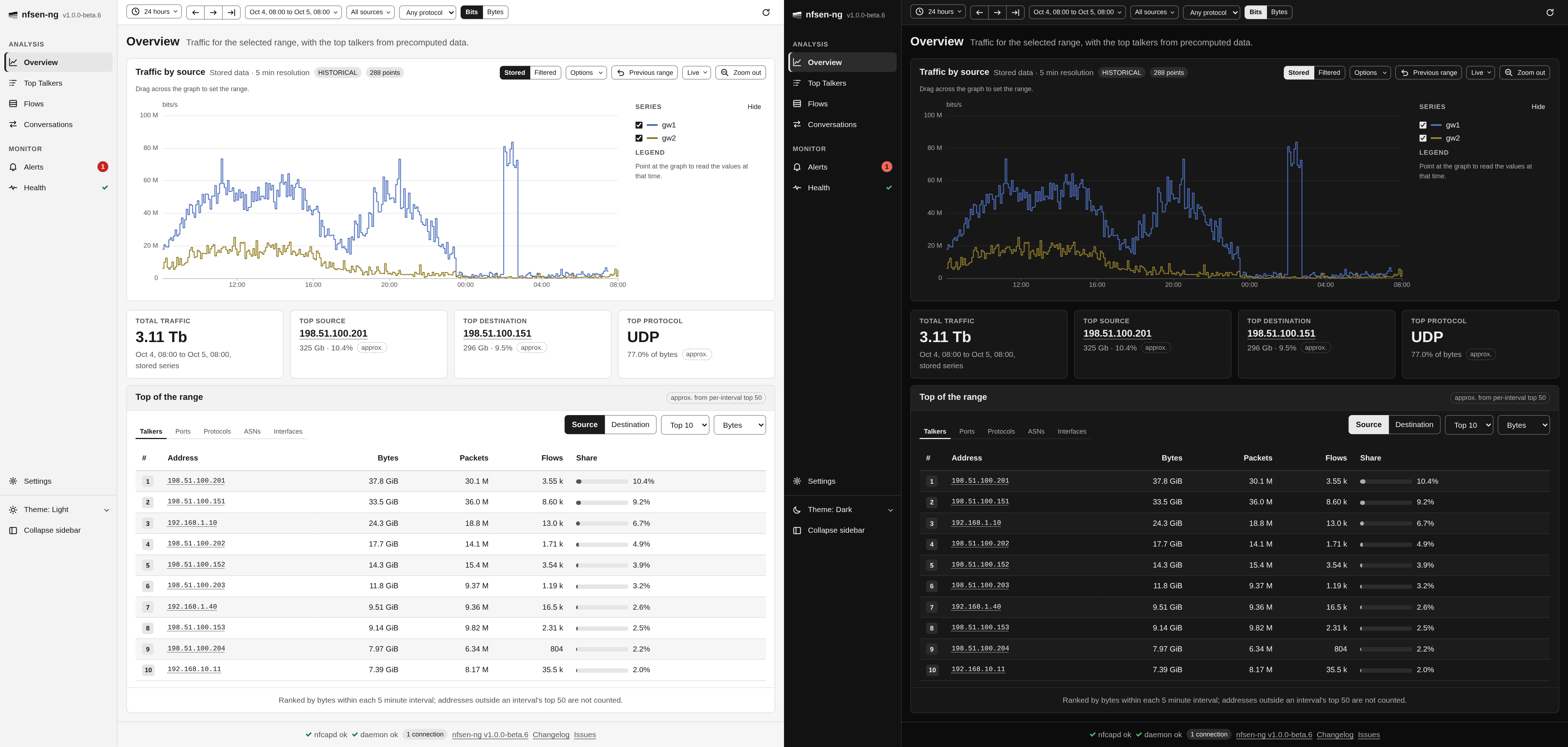
Seven pages. Four analysis pages share one time range: Overview (the traffic graph, key figures and the top talkers of the range, precomputed while importing), Top Talkers (exact top-N by any nfdump statistic), Flows (individual records, raw output and a summary), Conversations (who talks to whom as a Sankey, a Matrix or a table). Next to them sit Alerts, Health and Settings. Anything that reads capture files shows its cost first and runs only when you press Run.
Requires Linux. The backend runs on the OpenSwoole PHP extension, which has no maintained FreeBSD/other-BSD port; see openswoole/ext-openswoole#233. Docker images are Linux-only.
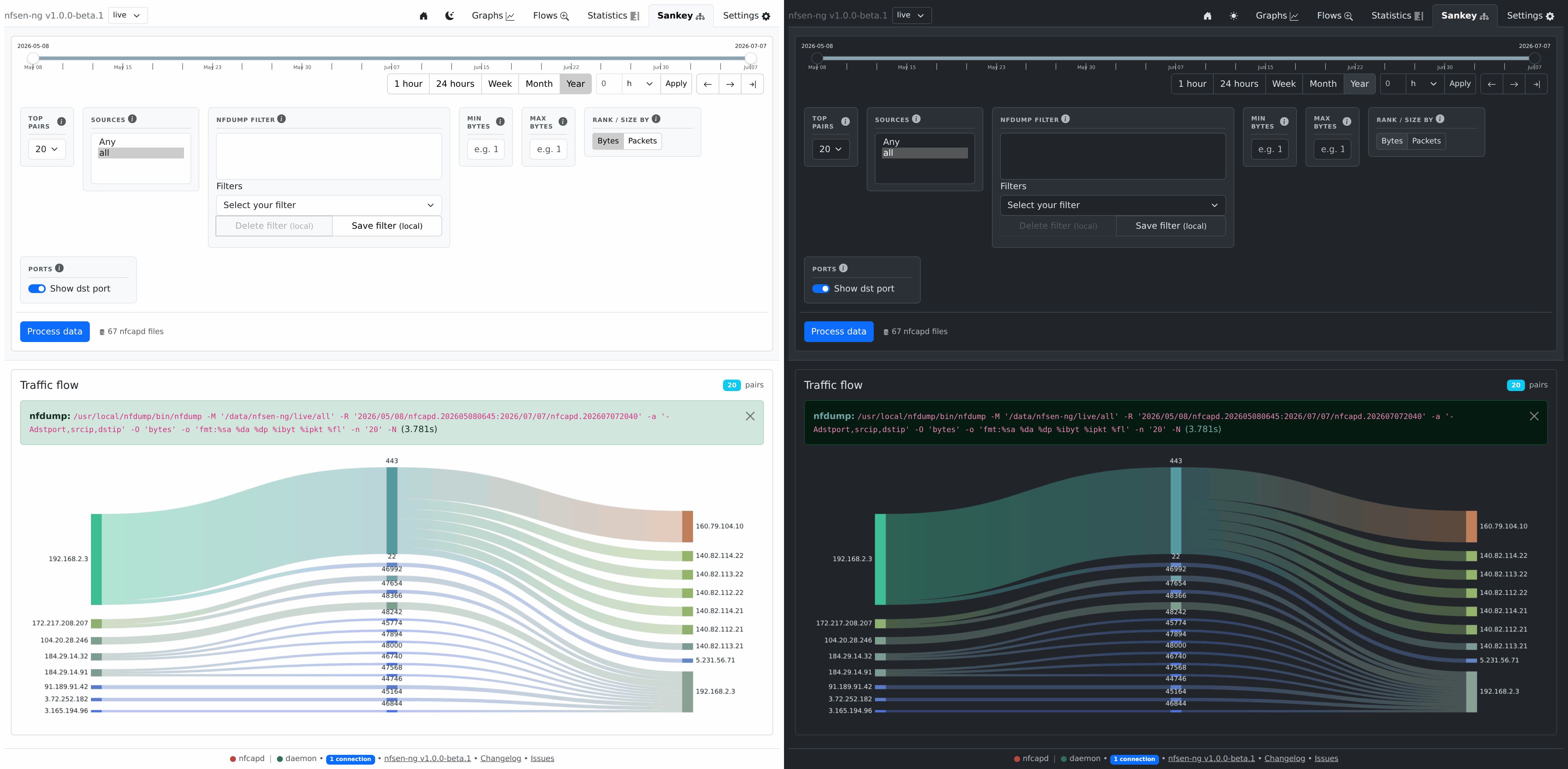 Conversations grouped by destination port: source IP, port and destination IP as a Sankey. The same result is also shown as a Matrix and a ranked table.
Quick start
No clone needed. Grab the compose file and go:
curl -O https://raw.githubusercontent.com/mbolli/nfsen-ng/master/deploy/docker-compose.yml

# Edit NFSEN_SOURCES, NFSEN_NFDUMP_PROFILES, and other env vars in docker-compose.yml, then:

# Production with bundled Caddy (auto-HTTPS, ports 80/443)
docker compose --profile proxy up -d

# Production behind your own reverse proxy (app on port 9000 only)
docker compose up -d
The app image is published on GHCR: ghcr.io/mbolli/nfsen-ng. The bundled-Caddy profile uses the stock caddy:latest image; no custom build is needed, since php-via serves and Brotli-compresses static assets itself. :latest tracks the newest release, betas included while pre-1.0; :edge always tracks the newest master build; or pin an explicit version tag from Releases for a fixed image.
Development (source mounted, auto-reload on file change):
git clone https://github.com/mbolli/nfsen-ng
cd nfsen-ng
docker compose -f deploy/docker-compose.dev.yml up -d
Set NFSEN_SOURCES, NFSEN_NFDUMP_PROFILES, and other options as environment variables in your compose file. The named volume nfsen-data keeps the RRD data, the preferences and the SQLite store (saved filters, alert history, top-N data) across upgrades. See Installation and Configuration in the book for the full guide.
MCP server (AI agent access, optional)
nfsen-ng ships an optional, off by default, read-only MCP server, so an AI agent can investigate traffic through the same data the UI shows without anyone writing nfdump filter expressions by hand.
Ten tools in two tiers, and every description says which: the cheap ones answer from the stored five-minute aggregates immediately, while the rest read capture files with nfdump and cost time proportional to the window. estimate_cost prices a window before you commit to it.
# stdio: a client launches it as a subprocess, no socket, no credentials
docker exec -i nfsen-ng php /var/www/html/nfsen-ng/backend/mcp.php
Set NFSEN_MCP_HTTP=true to serve the same tools at /_mcp on nfsen-ng's own port instead, for an agent that does not live on this host.
Nothing in it writes: no rule creation, no import triggering, no settings changes, so the worst case is disclosure of flow data rather than control of the box. Access to it is equivalent to access to the dashboard. See the MCP chapter.
Documentation
The full user guide and developer reference live in the nfsen-ng book: installation, configuration, a guide to every page, and the architecture/signals/SSE internals for contributors.
Upgrading from 1.0.0-beta.5, or migrating from the old v0.x NfSen-style release? See the upgrade guide in the book. Bare-metal installs now need php8.4-sqlite3 and a memory_limit of 512M for the server, and should run nfdump 1.7.10 (the Health page warns below it); the Docker image has all three.
Requirements
Categories
Related apps
Explore more like this
Explore allDetails
ghcr.io/mbolli/nfsen-ng:latestRuntime arguments
- Web UI
http://[IP]:[PORT:9000]/- Network
bridge- Shell
bash- Privileged
- false
- Extra Params
--restart unless-stopped
Template configuration
nfsen-ng web interface (OpenSwoole HTTP). Front with a reverse proxy for TLS.
- Target
- 9000
- Default
- 9000
- Value
- 9000
nfdump profiles/flow-file directory. MUST be the same path the collector writes to.
- Target
- /data/nfsen-ng
- Default
- /mnt/user/appdata/nfsen-ng
- Value
- /mnt/user/appdata/nfsen-ng
nfsen-ng's own data: the RRD database (rrd/), plus preferences, alert rule state and the SQLite store nfsen-ng.sqlite with saved filters, alert history and top-N data (state/). Keep this on a persistent path so it survives image updates.
- Target
- /var/lib/nfsen-ng
- Default
- /mnt/user/appdata/nfsen-ng-data
- Value
- /mnt/user/appdata/nfsen-ng-data
Container timezone.
- Target
- TZ
- Default
- UTC
- Value
- UTC
Comma-separated source names. Each must exist as live/name under the data directory, so it has to match the collector's output sub-directory.
- Target
- NFSEN_SOURCES
- Default
- flows
- Value
- flows
Comma-separated port numbers tracked per source in RRD.
- Target
- NFSEN_PORTS
- Default
- 80,443,22,53
- Value
- 80,443,22,53
Container-side profiles path. Must equal the 'Data (profiles)' mount target above.
- Target
- NFSEN_NFDUMP_PROFILES
- Default
- /data/nfsen-ng
- Value
- /data/nfsen-ng
Path to the nfdump binary inside the container.
- Target
- NFSEN_NFDUMP_BINARY
- Default
- /usr/local/nfdump/bin/nfdump
- Value
- /usr/local/nfdump/bin/nfdump
DEBUG, INFO, NOTICE, WARNING, ERR, CRIT, ALERT or EMERG.
- Target
- NFSEN_LOG_LEVEL
- Default
- INFO
- Value
- INFO
Backfill window (years) processed on first start.
- Target
- NFSEN_IMPORT_YEARS
- Default
- 3
- Value
- 3
Days of per-interval top-N data kept in SQLite for the Overview tables. 0 turns collection off. Budget about 12 MB per source and day under App data.
- Target
- NFSEN_TOPN_RETENTION_DAYS
- Default
- 31
- Value
- 31
Optional path to a MaxMind GeoLite2/GeoIP2 City or Country .mmdb. Copy the file into the App data share and enter its container path, e.g. /var/lib/nfsen-ng/GeoLite2-City.mmdb. When set, IP lookups use it instead of the web service.
- Target
- NFSEN_GEOIP_DB