
All apps · 0 apps

nexcrate
Docker app from DerKezorm's Repository
Overview
Readme
View on GitHubnexcrate
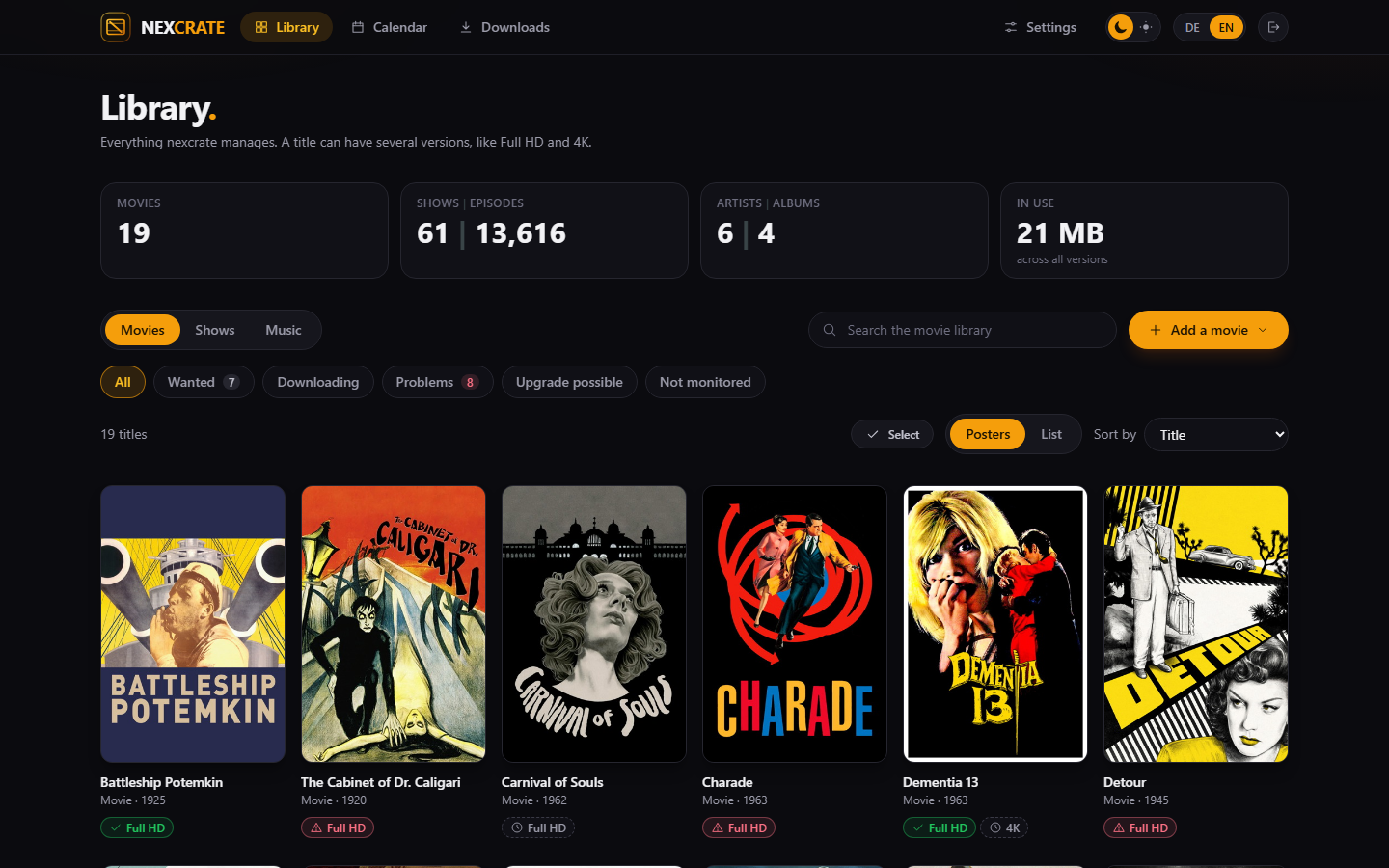
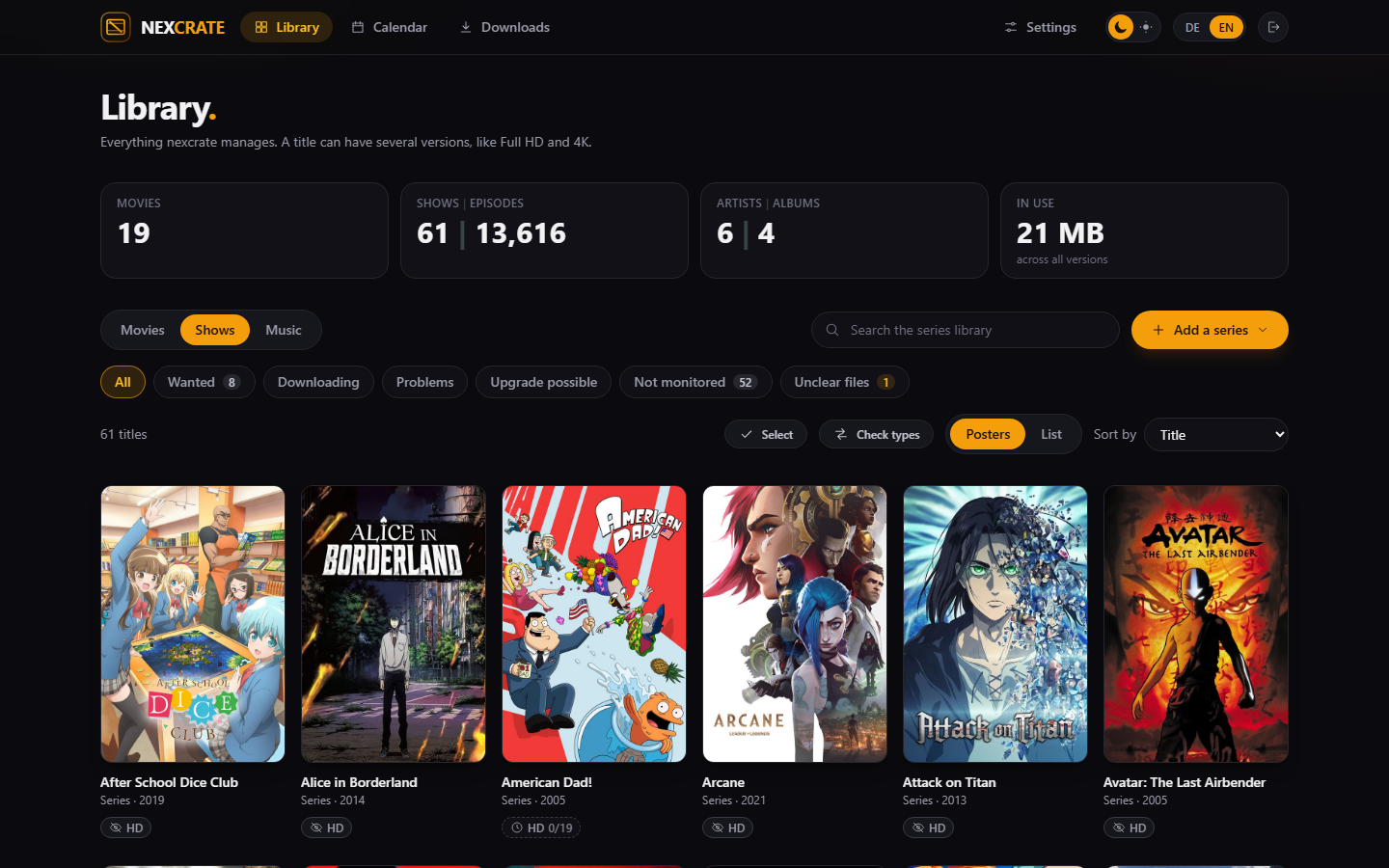
Movies, shows and music in one self-hosted app. A movie or a show can have several versions, such as Full HD and 4K; music has one version for now. One app instead of Radarr, Sonarr and Lidarr side by side.
Website: nexcrate.nexapps.dev
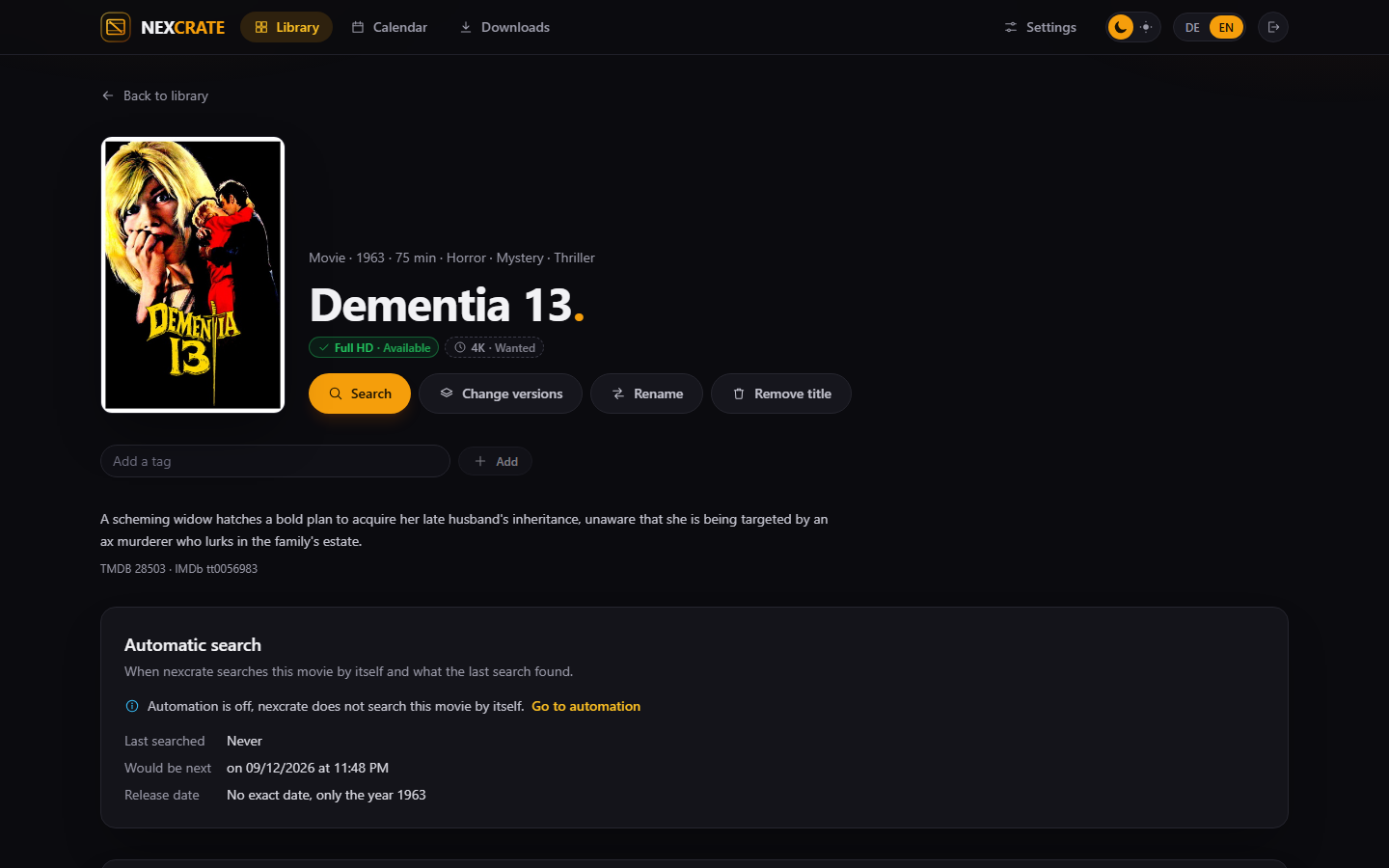
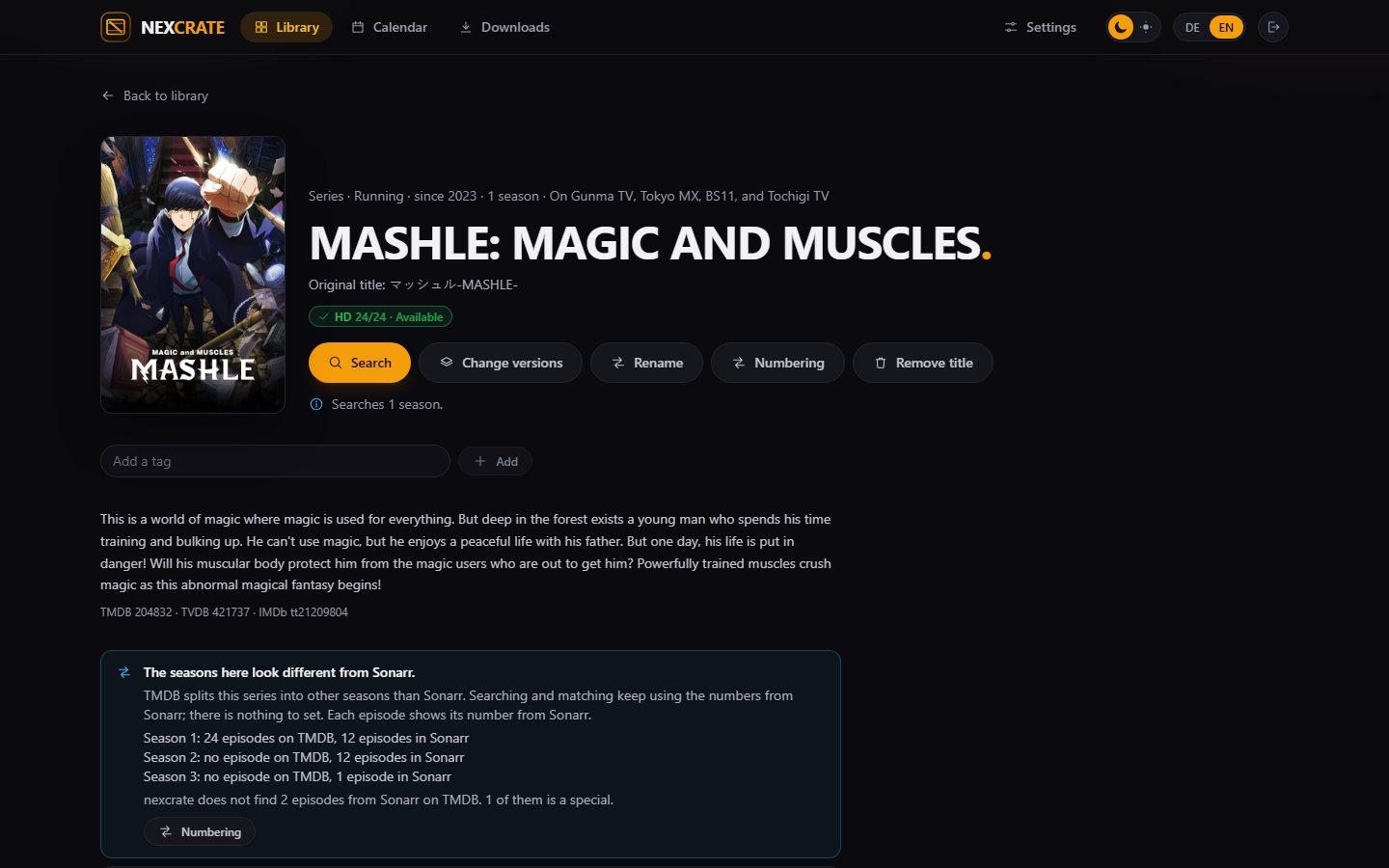
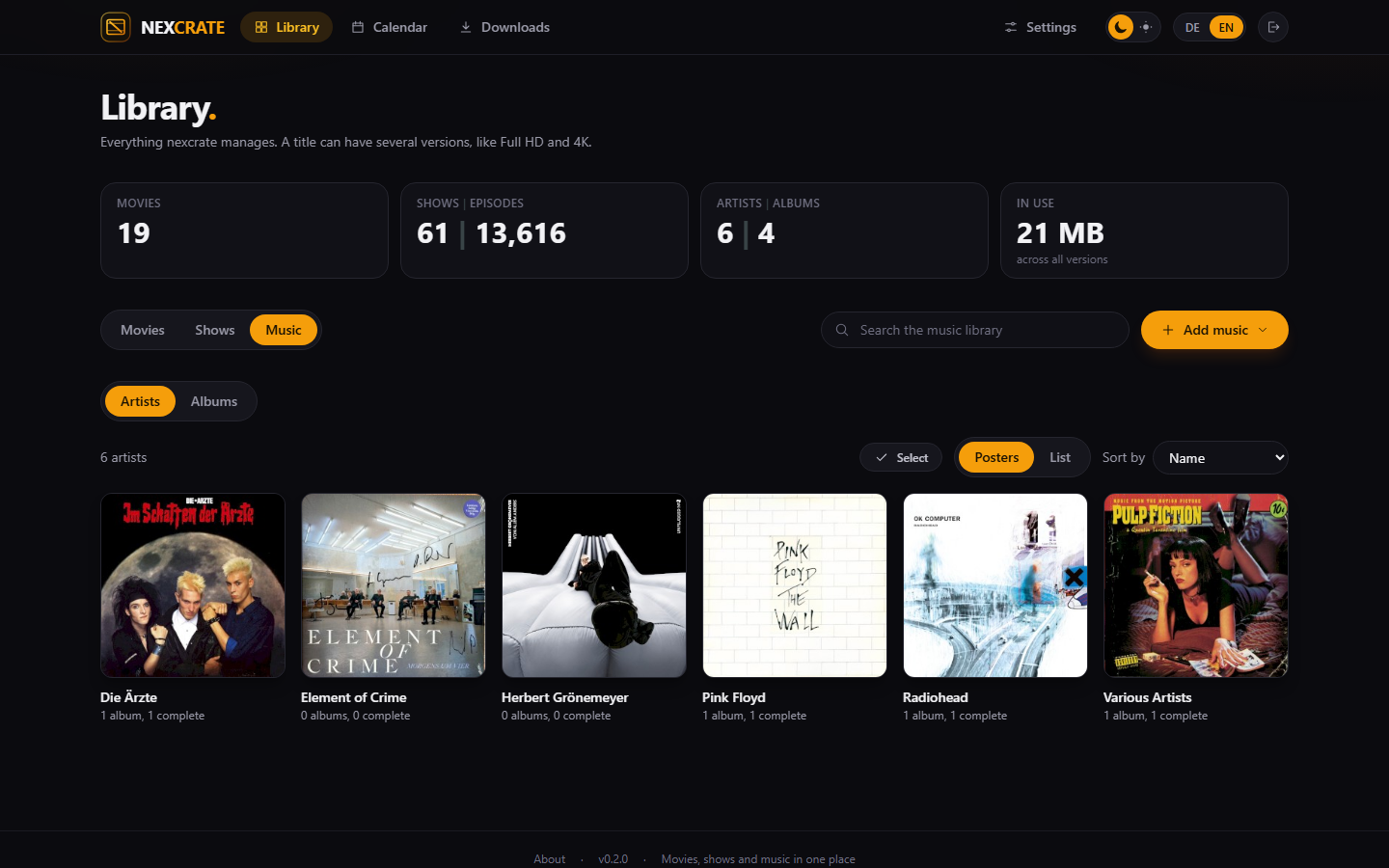
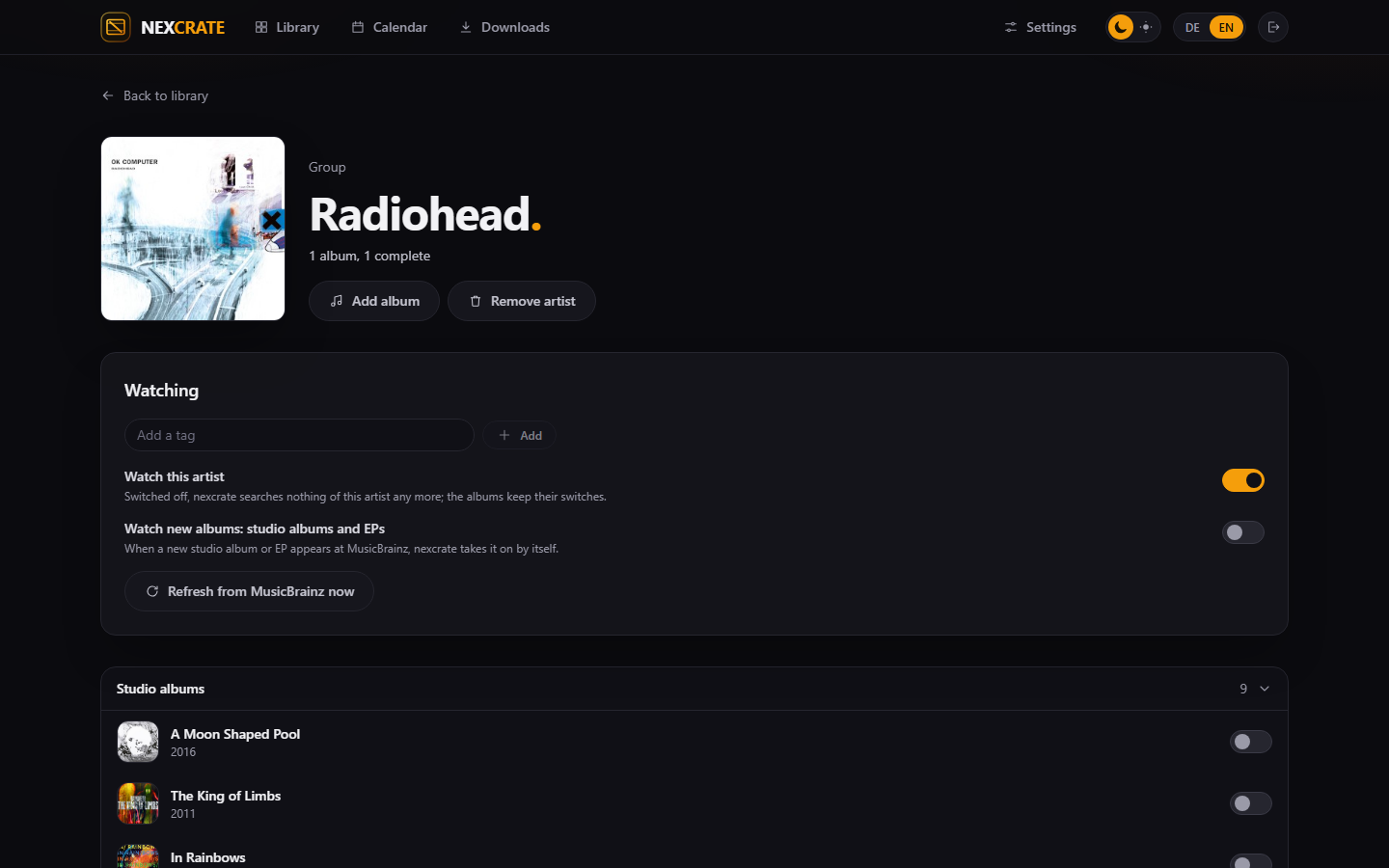
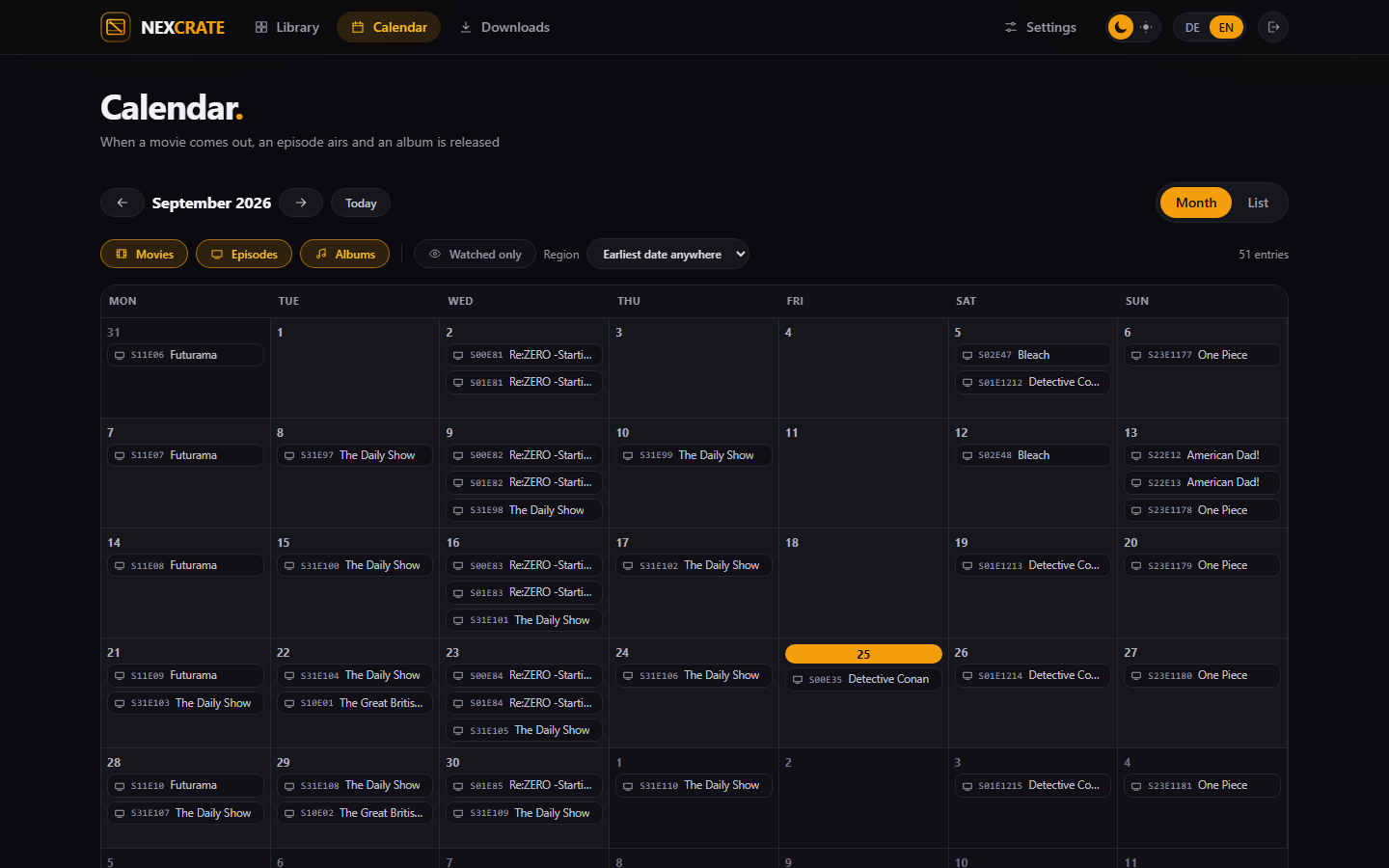
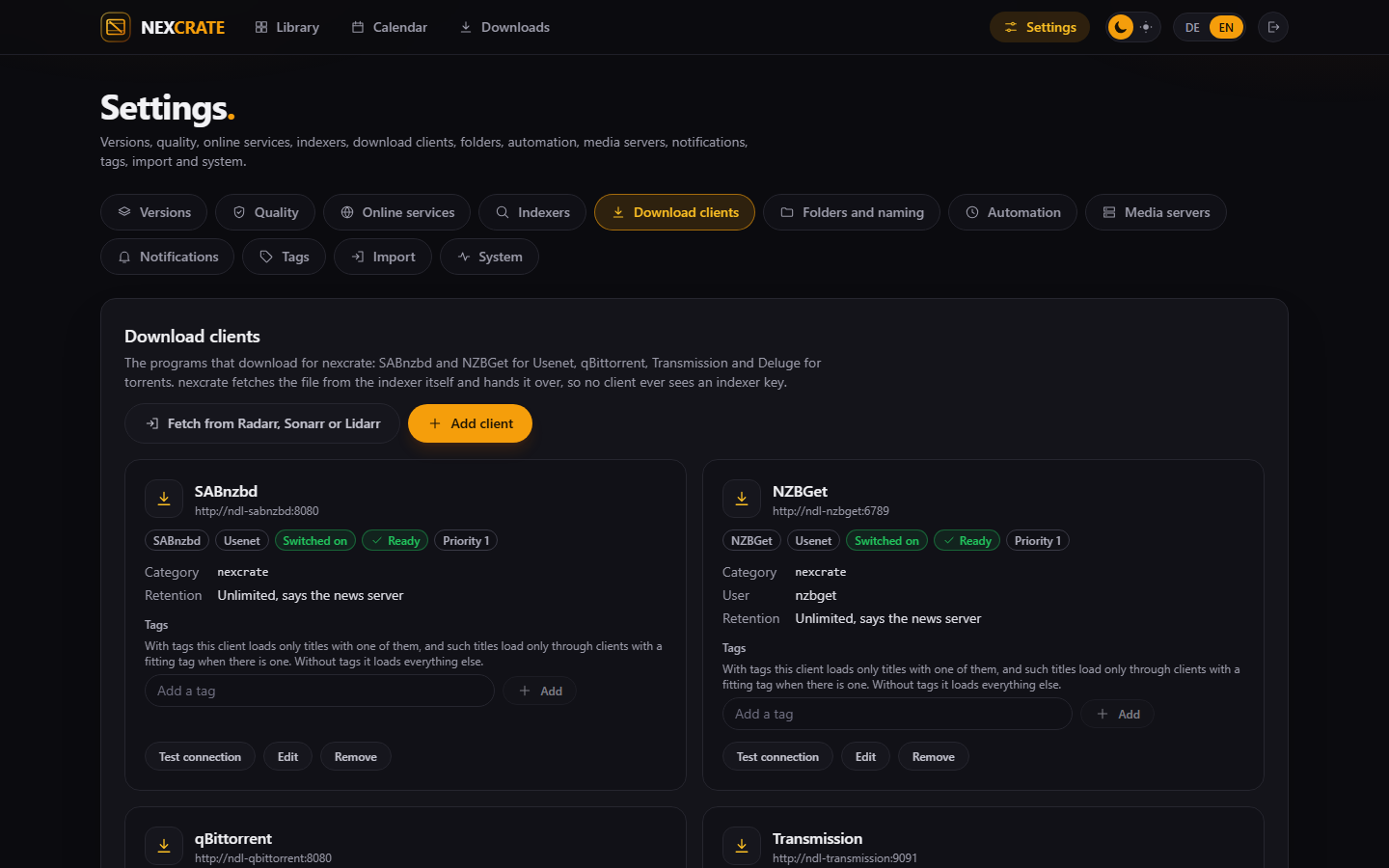
The screenshots show a throwaway instance with public-domain movies, a few shows and artists, and made-up releases.
What it does
- Versions: a movie or a show can have several versions, each with its own profile and folder. No second instance for 4K. Music has one version for now.
- Profiles from everyday questions, with the rules of the TRaSH Guides inside: qualities, custom formats, sizes and scores as Radarr and Sonarr use them. An expert mode edits every part by hand, and a profile can be read from an existing Radarr or Sonarr.
- Movies, shows and anime from TMDB, scene numbering from TheXEM, episodes counted through for anime, double episodes, specials.
- Music from MusicBrainz: artists, albums and the release that fits best, files matched to tracks by tags, names and AcoustID fingerprints, tags written on filing.
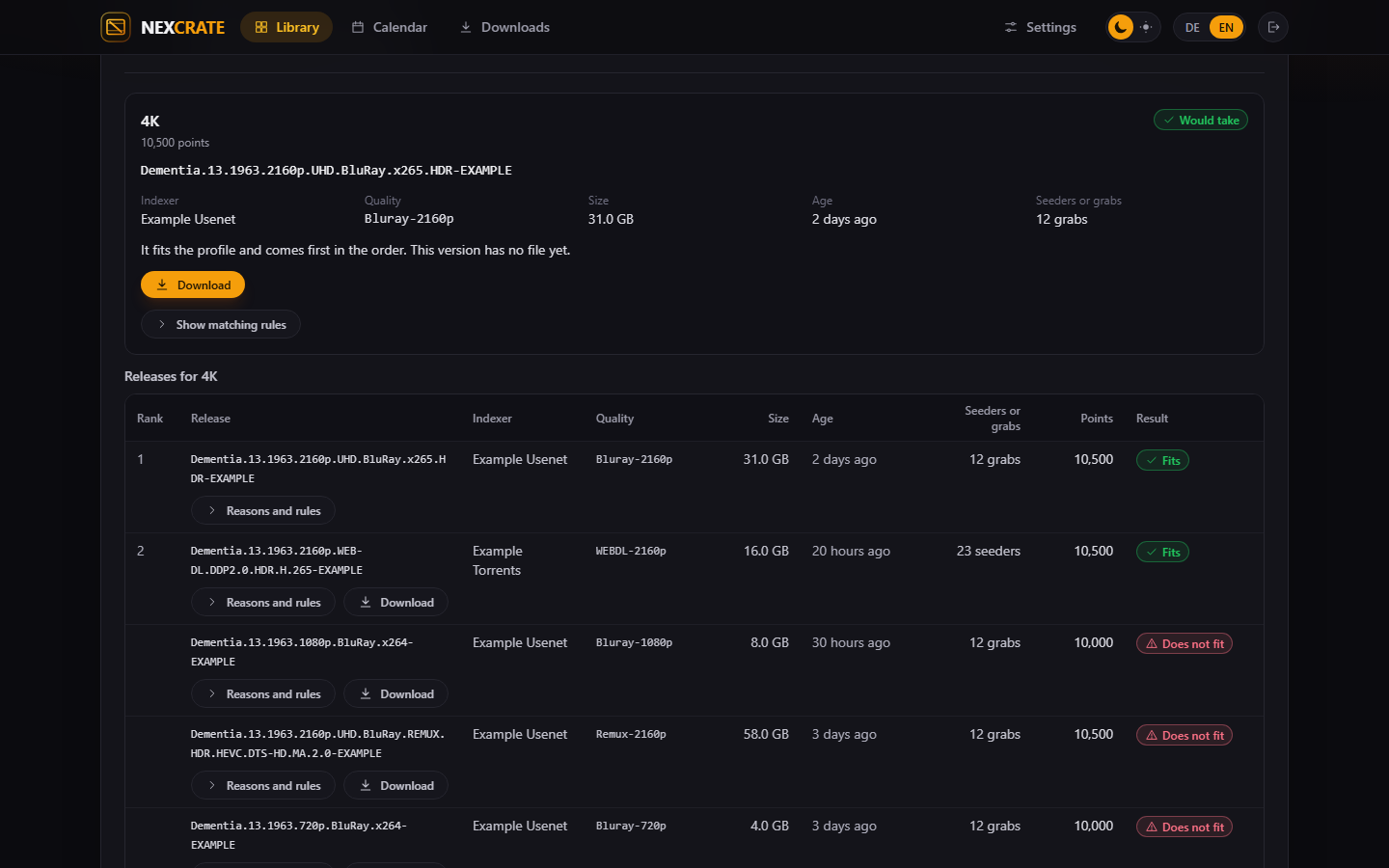
- Search over Newznab and Torznab indexers, with the decision per version and the reason for every release.
- Downloads through SABnzbd, NZBGet, qBittorrent, Transmission or Deluge. Torrents are hardlinked and keep seeding, Usenet downloads are moved, failed ones are replaced.
- Automatic search, RSS and delay rules per version, with a daily limit and a pause for upgrades.
- Switching over from Radarr, Sonarr and Lidarr: read their library, indexers, download clients and profiles, then take the files over; or start from the folders on disk.
- Rename whole libraries with a preview and an undo, library rules that pick the target folder by genre, certification, tag or kind of series.
- Calendar with an iCal feed, notifications (ntfy, Gotify, Telegram, Discord, webhook, Apprise, e-mail), Plex, Jellyfin and Emby told about new files, backups with an encrypted download.
- An API for other programs (
/api/v1) with keys, an event feed and webhooks.
 |
 |
 |
 |
 |
 |
 |
 |
Running with Docker
docker compose up -d
The bundled docker-compose.yml pulls ghcr.io/derkezorm/nexcrate:latest. Open
http://<your-host>:8390 and create the account.
⚠️ Whoever reaches a fresh installation first can claim it. Until the account exists, anybody who can open the page can create it, and it is the only account there is. Create it right after the first start, before the port is reachable from other networks. Once the account exists, the setup route is closed for good.
Forgot the password?
There is one account and no other way back in. Whoever controls the server sets a new one:
docker exec -it nexcrate python -m app.cli reset-password
It asks for the new password twice without showing it, and ends every session.
The data directory
Everything lives in /data (./data next to the compose file): the database, the secret key,
the logs and the backups (data/backups/).
⚠️
/databelongs on a local disk, never on an SMB or NFS share. SQLite's locking does not work reliably over network file systems, and that is how it loses data. On a NAS use a path on an internal volume, not a mounted share.
Back up secret.key together with the database. Stored credentials, such as API keys of other
programs, are encrypted with it; without it they have to be entered again.
Media and downloads
nexcrate files into folders it can see inside its container, and you choose them from a list; there is no path to type. Mount the folder that holds your downloads and your media, for example:
    volumes:
      - ./data:/data
      - /srv/data:/media
/data is nexcrate's own and is never offered as a media folder.
⚠️ Hardlinks work only inside one mount. Keep the downloads of your download clients and your media folders below one host folder and mount that folder once. With two mounts, even of the same disk, every torrent is copied and takes its space twice.
- Categories: nexcrate keeps its downloads apart under a category of its own,
nexcrate: a category in SABnzbd and qBittorrent, which nexcrate creates; any category in NZBGet, which takes one without setup; a subfolder and, from version 4, a label in Transmission; a label in Deluge, whose Label plugin nexcrate switches on. - Usenet retention is read from the news servers set up in SABnzbd and NZBGet; a release older than the longest retention is left out. There is nothing to enter.
- Indexer keys stay inside nexcrate. nexcrate fetches the NZB or torrent file itself and hands the file over; no download client ever sees an indexer key.
- Different paths: when a download client sees the folder under another path, for example
/datainstead of/media, nexcrate finds the finished download and asks once to confirm the mapping. - Recycle bin: a replaced or deleted file waits in
.nexcrate-recycleinside its root folder, seven days by default, and can be taken back from Settings, Files.
The library on disk
Every title nexcrate owns carries a small file release.nex in its folder (for shows in every
season folder, for albums in the album folder): the TMDB, IMDb or MusicBrainz number and per
version the file, its quality and release. Should the database ever be lost, nexcrate reads the
library back from these files without guessing. Plex, Jellyfin and Emby ignore the file.
Backups
Settings, System, "Backups". nexcrate copies its database weekly at night (or daily, monthly or
never), before every schema change, and when you ask. Download turns a copy into an
AES-encrypted ZIP with the database and secret.key, protected by a password you choose.
Restore takes such an archive and restarts nexcrate, which swaps it in before anything opens
the database; this needs a restart policy such as restart: unless-stopped, which the bundled
docker-compose.yml sets.
Settings
All optional, see .env.example and docker-compose.yml.
| Variable | Default | Meaning |
|---|---|---|
NEXCRATE_DATA_DIR |
./data |
Database, key, logs, backups |
NEXCRATE_SECRET_KEY |
generated in data/secret.key |
Key for stored credentials |
NEXCRATE_COOKIE_SECURE |
auto |
auto follows the scheme of each request, on for a reverse proxy that ends TLS, off never |
NEXCRATE_LOG_LEVEL |
empty | Fixes the log mode: quiet, normal, detailed, trace |
NEXCRATE_PORT |
8390 |
Port inside the container |
NEXCRATE_URL_BASE |
empty | Serve nexcrate under a sub path such as /nexcrate; /api/health also answers at the root |
Logs
The log is in data/logs/ and in the interface, with download. There are four modes: quiet,
normal, detailed and trace; the two deep ones switch back to normal after 30 minutes,
2 hours or 8 hours. Every answer carries an X-Request-Id header that finds the lines of that
request. Secrets are masked before a line is written.
API
The interface uses the same API anybody can use. Documentation: /api/docs, the OpenAPI
document: /api/openapi.json. Requests that change something need the header
X-Requested-With: nexcrate.
Other programs use /api/v1, a contract that stays stable while the routes of the interface
follow its pages. It opens with a key from Settings, System, API keys, sent as
Authorization: Bearer <key>. A key is shown once and nexcrate keeps only its hash. Three
scopes: read (versions, titles and their state, seasons and episodes, the queue, problems,
history, the calendar, ratings, an event feed also as Server-Sent Events), request (request
titles, take requests back, freeze, move files into the recycle bin, ask for a search) and
operate (retry, remove, clear and assign the files of a stuck download). A program can also
ask to be connected (POST /api/v1/pairing) and collect its key once the owner confirms.
Webhooks send the same events signed with HMAC-SHA256.
Run from source
Backend on port 8390:
cd backend
python -m venv .venv
.venv/bin/python -m pip install -r requirements-dev.txt
NEXCRATE_DATA_DIR=../data-dev .venv/bin/python -m uvicorn app.main:app --port 8390 --reload
Frontend on port 5390, talking to the backend under /api:
cd frontend
npm ci
npm run dev
Data sources
- TMDB for movies and shows: This application uses TMDB and the TMDB APIs but is not endorsed, certified, or otherwise approved by TMDB. A free TMDB token is entered under Settings, Online services.
- TheXEM for the scene numbering of shows and anime.
- MusicBrainz and the Cover Art Archive for music, AcoustID for recognizing files without usable tags.
- The TRaSH Guides (MIT) for the rules inside the profiles.
- IMDb ratings: Information courtesy of IMDb (https://www.imdb.com). Used with permission. Rotten Tomatoes and Metacritic with an OMDb key of your own.
TheXEM, MusicBrainz, AcoustID and the IMDb ratings can be switched off under Settings, Online services. Once a day nexcrate asks GitHub for its newest release; nothing but the request itself goes out, and it can be switched off on the About page.
Licence
Install Nexcrate on Unraid in a few clicks.
Find Nexcrate in Community Apps on your Unraid server, review the template, and click Install. Unraid handles the Docker app or plugin setup from the published template.
Related apps
Explore more like this
Explore allLinks
Details
ghcr.io/derkezorm/nexcrateRuntime arguments
- Web UI
http://[IP]:[PORT:8390]/- Network
bridge- Shell
sh- Privileged
- false
Template configuration
Port you reach nexcrate at. Container port: 8390
- Target
- 8390
- Default
- 8390
- Value
- 8390
Holds the SQLite database, the key that encrypts the stored credentials, logs and backups. Keep it on a local disk, not on a network share, and give nexcrate a folder of its own: it refuses to start on a folder that holds files it did not create.
- Target
- /data
- Default
- /mnt/user/appdata/nexcrate
- Value
- /mnt/user/appdata/nexcrate
One folder that holds your downloads and your movie, show and music libraries, for example /mnt/user/data with torrents, usenet and media below it. Mounted once, so hardlinks work and a torrent does not take its space twice. Change it to the folder you use. nexcrate offers only folders mounted like this for libraries and downloads, never /data.
- Target
- /media
- Default
- /mnt/user/data
- Value
- /mnt/user/data
User id that should own the files in /data. 99 is the Unraid default.
- Default
- 99
- Value
- 99
Group id that should own the files in /data. 100 is the Unraid default.
- Default
- 100
- Value
- 100
The zone the container runs in, for example Europe/Berlin. The calendar, the planning of upcoming episodes and the timestamps of backups use it. Leave blank to use UTC.
- Target
- TZ
Leave this empty unless you switched Network Type to Host. In bridge mode the WebUI Port above already does the job and setting this will break it, because the mapping still points at 8390. On host networking the port inside the container is the port on your server, so use this to move nexcrate off 8390 if something else is already there.
- Target
- NEXCRATE_PORT
Encrypts the stored credentials, such as the API keys of indexers and download clients. Leave blank: nexcrate creates one on first start and keeps it in /data/secret.key. Back it up together with the data directory; without it the stored credentials cannot be read.
- Target
- NEXCRATE_SECRET_KEY
auto marks the session cookie Secure when the request arrived over https. Use on only if a proxy terminates TLS and forwards plain http, and never if nexcrate should also be reachable over http, or nobody stays signed in. off never marks it.
- Target
- NEXCRATE_COOKIE_SECURE
- Default
- auto
- Value
- auto
Fixes the log mode: quiet, normal, detailed or trace. Leave blank to use the mode chosen in the interface. Meant for the case that nexcrate does not start at all.
- Target
- NEXCRATE_LOG_LEVEL
Serve nexcrate under a sub path behind a reverse proxy, such as /nexcrate. Leave blank for the root.
- Target
- NEXCRATE_URL_BASE