
All apps · 0 apps

NASearch
Docker app from UnraidUser-4408178955's Repository
Overview
Readme
View on GitHubNASearch


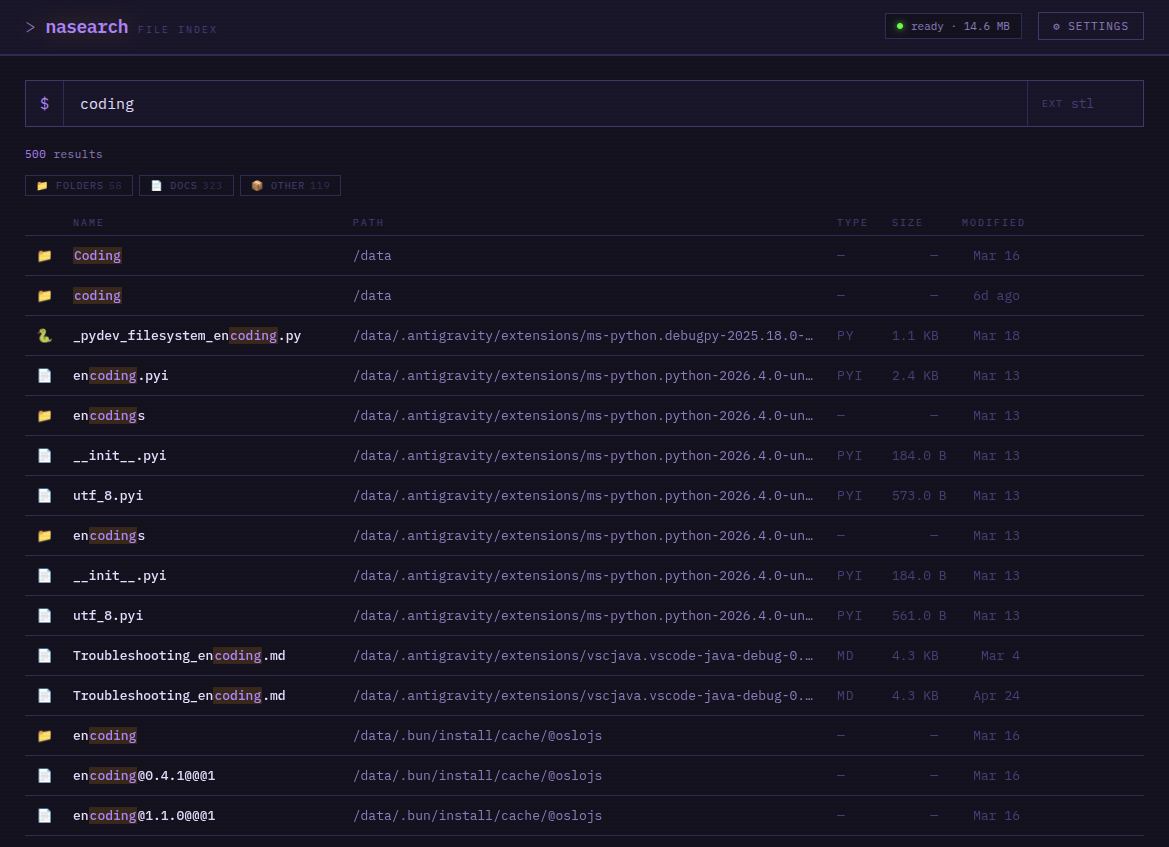
Lightweight file search for self-hosted storage. FastAPI + plocate, no Elasticsearch, no Node, no build step.
Point it at your array, let it index, then search from a browser.
Features
- Fast search — plocate pre-built index returns results in milliseconds regardless of array size; filter by extension, sort by name/size/modified, filter by file type
- File previews — click any result to open an in-browser preview: images, video (with seeking), audio, PDF, Markdown (rendered + sanitised), plain text and code, ZIP contents
- Folder browser — navigate into any directory from the preview panel; breadcrumb navigation; download any folder as a streaming ZIP
- Infinite scroll — results load in batches; no pagination
- Re-index schedule — configurable interval (manual, 1h, 6h, 12h, 24h, 48h, weekly) with live status indicator in the header
- Multiple themes — Dark, Light, Purple, Slate
- Auth — session cookie login with CSRF protection and login rate limiting; or opt out explicitly with
NOAUTH=true
Why not just use find?
The shell has excellent tools for this — find, locate, fd — and if you're comfortable in a terminal they're great. NASearch is for a different situation: searching a large NAS from a browser, sharing access with people who aren't comfortable on the command line, or quickly previewing a file without downloading it first.
The bigger practical issue with find /mnt/user | grep something on a large array is speed. find traverses the filesystem in real time, touching every directory on every disk. On an array with millions of files across spinning drives that can take several minutes. NASearch uses plocate, which pre-builds a compressed index — searches return in milliseconds regardless of array size. The trade-off is a small staleness window between index runs, handled by the configurable schedule and the manual re-index button.
Install
Unraid — Community Applications
Search for NASearch in the Community Applications store and install directly from there. All config fields (port, paths, auth) are exposed in the Unraid template UI.
Docker Compose
Create a directory and a docker-compose.yml:
services:
  nasearch:
    image: ghcr.io/dewgenenny/nasearch:latest
    container_name: nasearch
    restart: unless-stopped
    ports:
      - "8000:8000"
    volumes:
      - /mnt/user:/data:ro   # your array, read-only
      - ./index:/index        # index DB + settings.json
    environment:
      - LOCATE_DB=/index/files.db
      - DATA_PATH=/data
      - PRUNE_PATHS=/data/appdata /data/system /data/domains /data/isos
      - MAX_RESULTS=500

      # ── Auth (choose one) ────────────────────────────────────────
      # NASearch will refuse to start until you pick an option.
      #
      # Option A — Session auth (recommended):
      # - AUTH_USER=admin
      # - AUTH_PASS=your-strong-password-here
      #
      # Option B — No auth (acknowledged risk):
      # - NOAUTH=true
Then start it:
docker compose up -d
The container builds the initial index on first start (a few minutes depending on array size). Browse to http://your-server:8000.
Updating
docker compose pull && docker compose up -d
Configure volumes
Single volume (simplest — everything under one mount):
volumes:
  - /mnt/user:/data:ro
  - ./index:/index
Multiple volumes — mount each source as a named subdirectory under /data:
volumes:
  - /mnt/user:/data/nas:ro
  - /media/external:/data/external:ro
  - /home:/data/home:ro
  - ./index:/index
NASearch indexes the entire /data tree, so all sources appear in results. Paths show the full mount path (e.g. /data/nas/movies/..., /data/external/photos/...), making it clear which volume a file lives on.
Exclude noisy subdirectories with PRUNE_PATHS — see Configuration.
Security
NASearch runs as root inside the container and can serve any file under /data. That's an intentional trade-off — see Why root? below. Because of this, the app refuses to start unless you have explicitly acknowledged the auth situation.
Session auth
Set both variables in your compose file:
environment:
  - AUTH_USER=admin
  - AUTH_PASS=your-strong-password-here
- Credentials are submitted once via a login form and validated with a constant-time compare (timing-attack resistant)
- A
httpOnly,SameSite=laxsession cookie is issued on success (24-hour lifetime by default, configurable withSESSION_HOURS) - A per-session CSRF token is validated on all state-changing requests
- Login is rate-limited: 5 failed attempts within 15 minutes locks the IP out for 15 minutes
- CDN scripts (marked.js, DOMPurify) are loaded with Subresource Integrity hashes — the browser refuses to execute them if the content doesn't match
- A Content-Security-Policy restricts where the UI may load scripts, styles and data from
- Files from the array are treated as untrusted: HTML/XML is never served inline with an executable MIME type, and inline previews carry a
Content-Security-Policy: sandboxheader so a malicious file on the NAS can't run scripts on NASearch's origin - If you serve NASearch over HTTPS, set
COOKIE_SECURE=trueso the session cookie is never sent over plain HTTP
Use HTTPS — and think carefully before exposing it at all
Without TLS, the login POST is cleartext on the wire. If you expose NASearch outside your local network you must put it behind a TLS-terminating reverse proxy. Nginx Proxy Manager and Caddy are popular options.
That said, the strong recommendation is don't expose it to the internet at all. NASearch is a root-running process that can read and serve every file on your array. If you need remote access, a VPN (Tailscale, WireGuard) is a much safer boundary.
Why the container runs as root
updatedb needs to crawl the entire directory tree — including paths owned by other users, Docker btrfs subvolumes, and system directories — to build a complete index. A restricted user silently misses anything it can't stat, defeating the point of the tool.
The actual risk surface is kept small by other means:
- All source volumes are mounted read-only — the process can never modify your files
- All file-serving paths are validated against
DATA_PATHto prevent directory traversal - Session auth with CSRF protection gates the entire UI when credentials are configured
- Docker's own namespace and cgroup isolation still applies
Configuration
| Variable | Default | Purpose |
|---|---|---|
AUTH_USER |
(unset) | Login username; both must be set to enable auth |
AUTH_PASS |
(unset) | Login password |
SESSION_HOURS |
24 |
Session cookie lifetime in hours |
COOKIE_SECURE |
false |
Set true when serving over HTTPS (e.g. behind a TLS reverse proxy) to add the Secure flag to the session cookie |
NOAUTH |
false |
Set true to start without auth (acknowledged risk) |
DATA_PATH |
/data |
Root path that is indexed and served |
LOCATE_DB |
/index/files.db |
Path to the plocate database |
PRUNE_PATHS |
See compose file | Space-separated absolute paths to skip during indexing |
MAX_RESULTS |
500 |
Cap on results returned per search |
ZIP_MAX_FILES |
2000 |
Max files allowed in a folder zip download |
ZIP_MAX_BYTES |
2147483648 |
Max uncompressed size of a folder zip (2 GB) |
Excluding paths from the index
Set PRUNE_PATHS as a space-separated list of absolute paths:
environment:
  - PRUNE_PATHS=/data/nas/appdata /data/nas/system /data/nas/isos
Useful for high-churn directories (Docker appdata, VM images) that would otherwise bloat the index.
Note that PRUNE_PATHS is passed to updatedb as a single space-separated string, so a path containing a space cannot be excluded this way — that's a limitation of updatedb, not of NASearch.
Excluding archive contents
If archives are mounted as directories on your array, their contents show up in results — searching for a common word can bury you in hits from inside hundreds of ZIPs. Two controls:
archtoggle (search bar) — hides results whose path runs through an archive (…/backup.zip/file.txt). Instant, no re-index needed.- Archive indexing (settings) — turn it off to keep archive contents out of the index entirely. The next re-index is slower, because the archive directories have to be located before
updatedbruns, and a smaller index means faster searches afterwards. Archive contents are hidden from results while this is off regardless, so paths that can't be excluded at index time (again, those containing spaces) still never appear.
Homepage dashboard integration
NASearch exposes a JSON widget endpoint compatible with Homepage. Uncomment and fill in the labels section of your compose file:
labels:
  - homepage.name=NASearch
  - homepage.group=Tools
  - homepage.href=http://192.168.1.10:8000
  - homepage.icon=si-files
  - homepage.widget.type=nasearch
  - homepage.widget.url=http://192.168.1.10:8000
Media gallery
Categories
Related apps
Explore more like this
Explore allDetails
ghcr.io/dewgenenny/nasearch:latestRuntime arguments
- Web UI
http://[IP]:[PORT:8000]/- Network
bridge- Shell
bash- Privileged
- false
Template configuration
Port to access the NASearch web interface.
- Target
- 8000
- Default
- 8000
- Value
- 8000
Root of your Unraid array, mounted read-only. NASearch will index and serve files from here.
- Target
- /data
- Default
- /mnt/user
- Value
- /mnt/user
Persistent storage for the plocate database and settings.json.
- Target
- /index
- Default
- /mnt/user/appdata/nasearch
- Value
- /mnt/user/appdata/nasearch
Login username. Set both AUTH_USER and AUTH_PASS to enable authentication (recommended).
- Target
- AUTH_USER
Login password. Set both AUTH_USER and AUTH_PASS to enable authentication (recommended).
- Target
- AUTH_PASS
Set to 'true' to explicitly disable authentication. Only use on a fully trusted, firewalled network. Either AUTH_USER+AUTH_PASS or NOAUTH=true must be set.
- Target
- NOAUTH
Space-separated list of paths to skip during indexing.
- Target
- PRUNE_PATHS
- Default
- /data/appdata /data/system /data/domains /data/isos
- Value
- /data/appdata /data/system /data/domains /data/isos
Maximum number of search results returned per query.
- Target
- MAX_RESULTS
- Default
- 500
- Value
- 500
Display name shown on your Homepage dashboard. Leave blank if you are not using Homepage (https://gethomepage.dev).
- Target
- homepage.name
- Default
- NASearch
- Value
- NASearch
Dashboard group/category to place NASearch in (e.g. Tools, Media, System). Leave blank if not using Homepage.
- Target
- homepage.group
Full URL Homepage should link to (e.g. http://192.168.1.10:8000 or your reverse-proxy address). Leave blank if not using Homepage.
- Target
- homepage.href