
All apps · 0 apps

Muxarr
Docker app from KirovAir's Repository
Overview
Bulk-strip unwanted audio and subtitle tracks from your media library by remux (no re-encode, no quality loss), with Sonarr/Radarr integration to keep each title's original language. Dropping spare audio tracks alone often reclaims 10-30% of a file, and a 4GB one still processes in about a minute even on a NAS.
Under the hood it uses mkvmerge for Matroska and ffmpeg stream-copy for MP4-family, and validates the remuxed output before replacing the original, so a failed run leaves your source untouched. New imports can be auto-processed via webhook, and per-directory profiles let different folders (anime vs movies, say) follow different rules.
Features:
- Language priority and per-language track limits (e.g. keep only the best English audio), tuned for quality or smallest size.
- Metadata cleanup of encoder/codec junk in track names, applied instantly with mkvpropedit (no remux for metadata-only changes).
- Library overview of codecs, resolutions and languages, plus a stats API for dashboards.
- Supports Matroska (.mkv, .webm) and MP4-family (.mp4, .m4v).
Paths: mount your library at the SAME path your Sonarr/Radarr containers use (e.g. /media). If they differ, add a Path Mapping under Settings > Integrations in Muxarr. Add more /media style mappings for libraries that live on other shares.
Readme
View on GitHub




Muxarr
Ever had your player pick the wrong audio language, or show 20 subtitle options you'll never use? Most media files ship with far more tracks than you need.
Muxarr cleans them up by removing unwanted audio and subtitle tracks and standardizing track metadata. It uses mkvmerge for MKV files and ffmpeg with stream copy for other containers, so tracks are remuxed rather than re-encoded and there is zero quality loss. A 4GB file takes about a minute instead of hours, even on low-end hardware like a NAS or Raspberry Pi.
Hooks into Sonarr & Radarr for original language detection and automatic processing - new imports get cleaned up as they arrive.
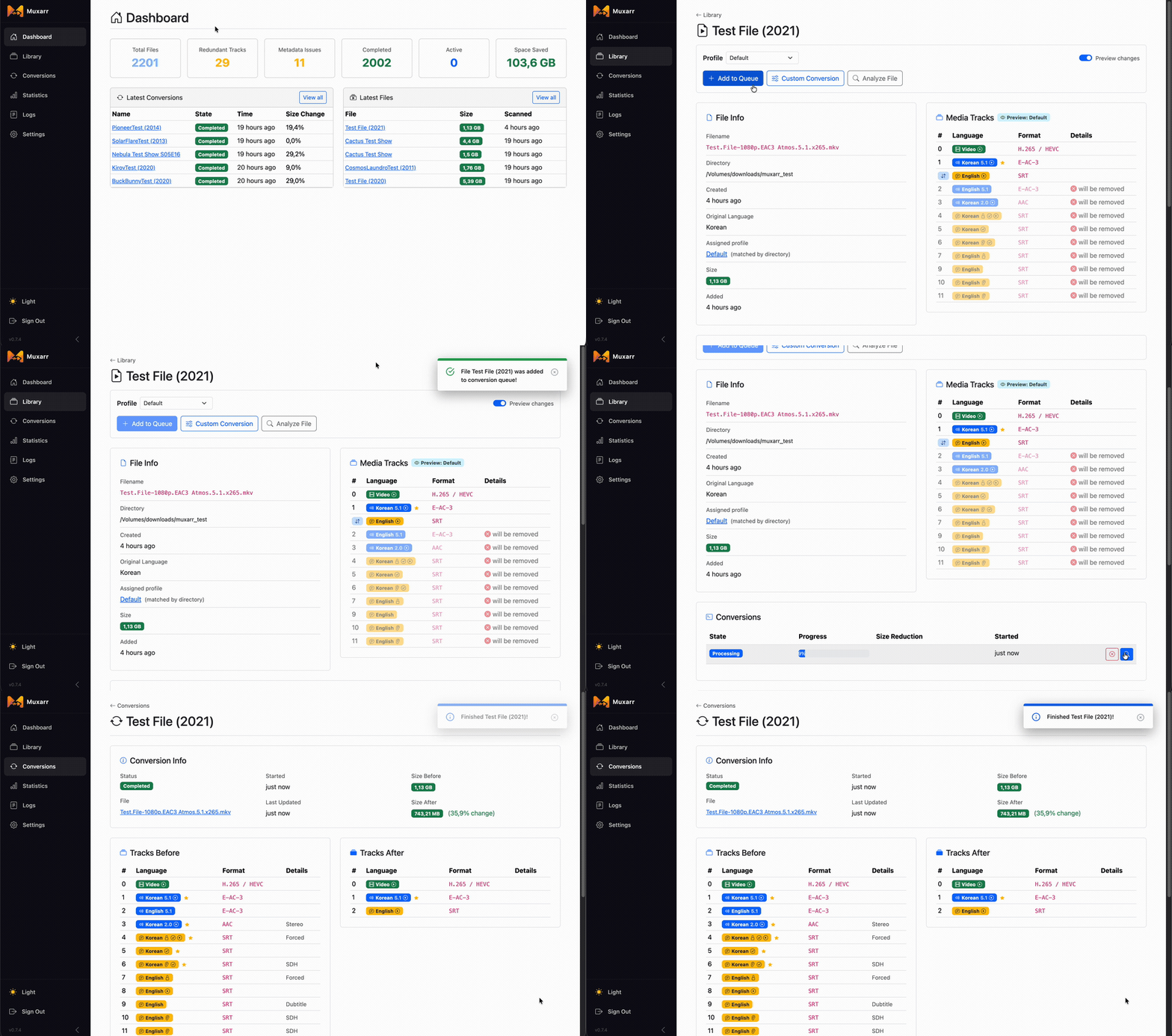
A quick demo of a file being optimized (35.9% reduction)
Quick Start
services:
  muxarr:
    image: ghcr.io/kirovair/muxarr:latest
    container_name: muxarr
    environment:
      - TZ=Europe/Amsterdam
      - PUID=1000
      - PGID=1000
    volumes:
      - /path/to/appdata:/config
      - /path/to/media:/media
    ports:
      - 8183:8183
    restart: unless-stopped
Upgrading from an older version? See Upgrading before changing your mounts.
Features
- Strip unwanted tracks - remove audio (commentary, foreign dubs) and subtitles (SDH, foreign) without re-encoding, so quality is untouched. A typical 4GB file processes in about a minute depending on disk speed. Cutting spare audio tracks alone often saves 10-30%.
- Original language detection - integrates with your *arr stack so foreign films and shows always keep the correct audio track
- Automatic processing - webhook support to process new imports as they arrive
- Per-directory profiles - different language and track rules for different collections (e.g. anime vs western media)
- Language priority & track limits - control track ordering per language, limit tracks per language (e.g. keep only the best English audio track), and choose between best quality or smallest size
- Fallback languages - hang a language under another so it is only kept when the one above it is missing. "English subs, but only if the file has no German ones"
- Regional language variants - tells VFQ apart from VFF/Truefrench, Latino from Castilian, and more. Reads BCP 47 tags and track names, so "keep Quebec French, drop the France dub" just works
- Smart metadata fixes - cleans up encoder tags and codec dumps from track names. Uses mkvpropedit for metadata-only changes (instant, no remux needed)
- Safe by default - validates the output file before replacing the original. If anything fails, the original is untouched.
- Library overview - full breakdown of codecs, resolutions, and languages across your library
Supports Matroska (.mkv, .webm) and MP4-family (.mp4, .m4v). Every setting is explained in the profiles docs.
More screenshots

⬇️

Before and after metadata cleanup
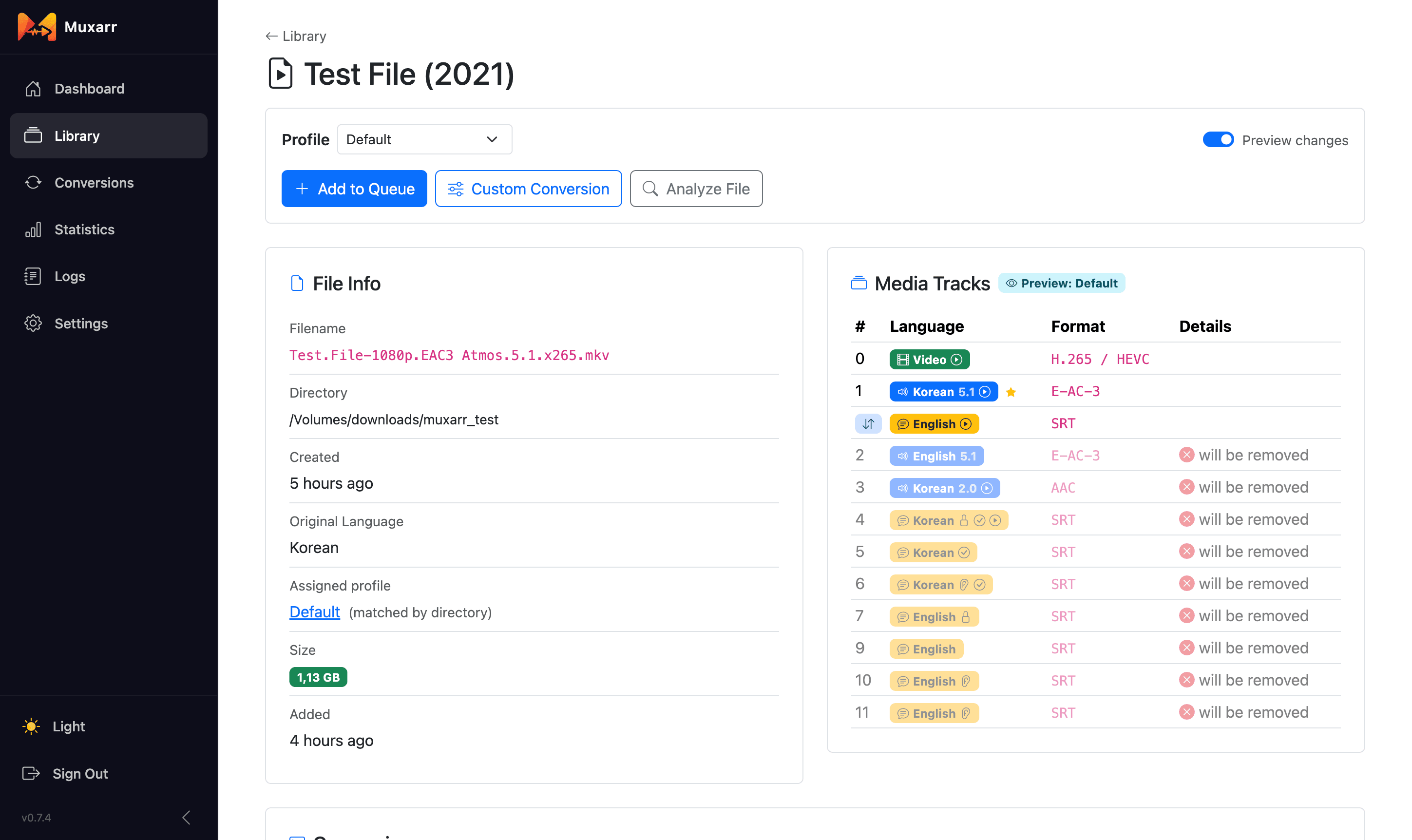
File details with track preview
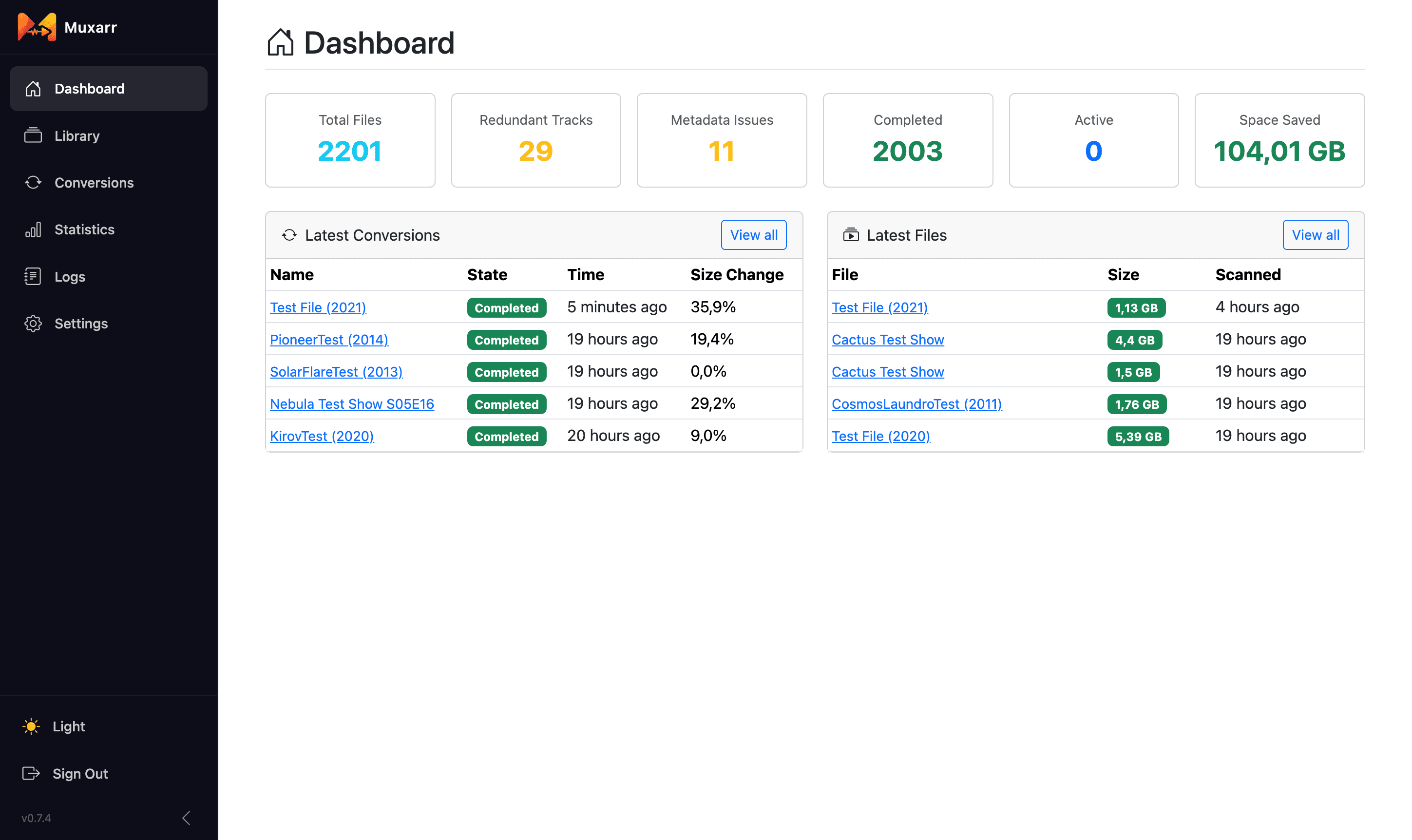
Dashboard
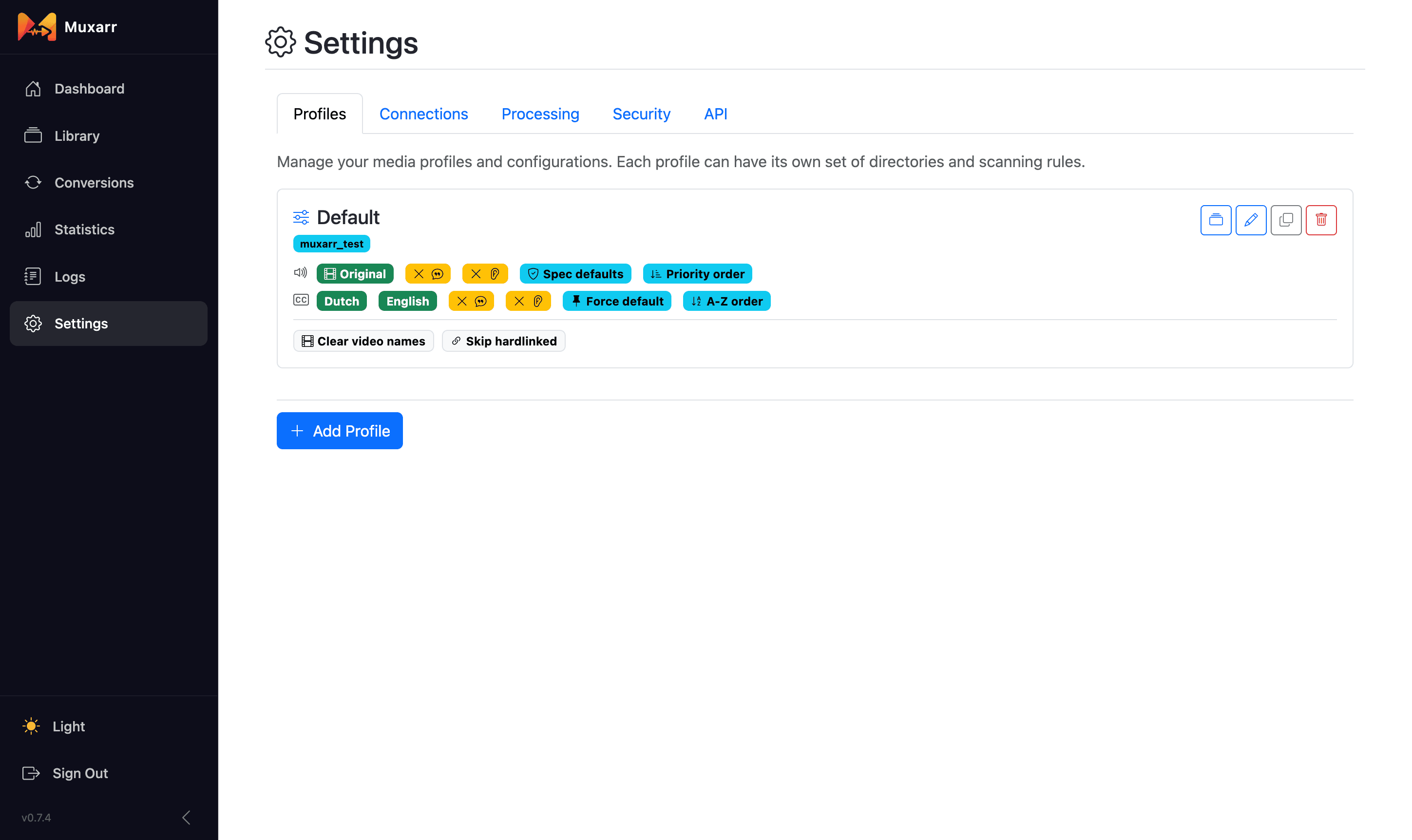
Profile settings
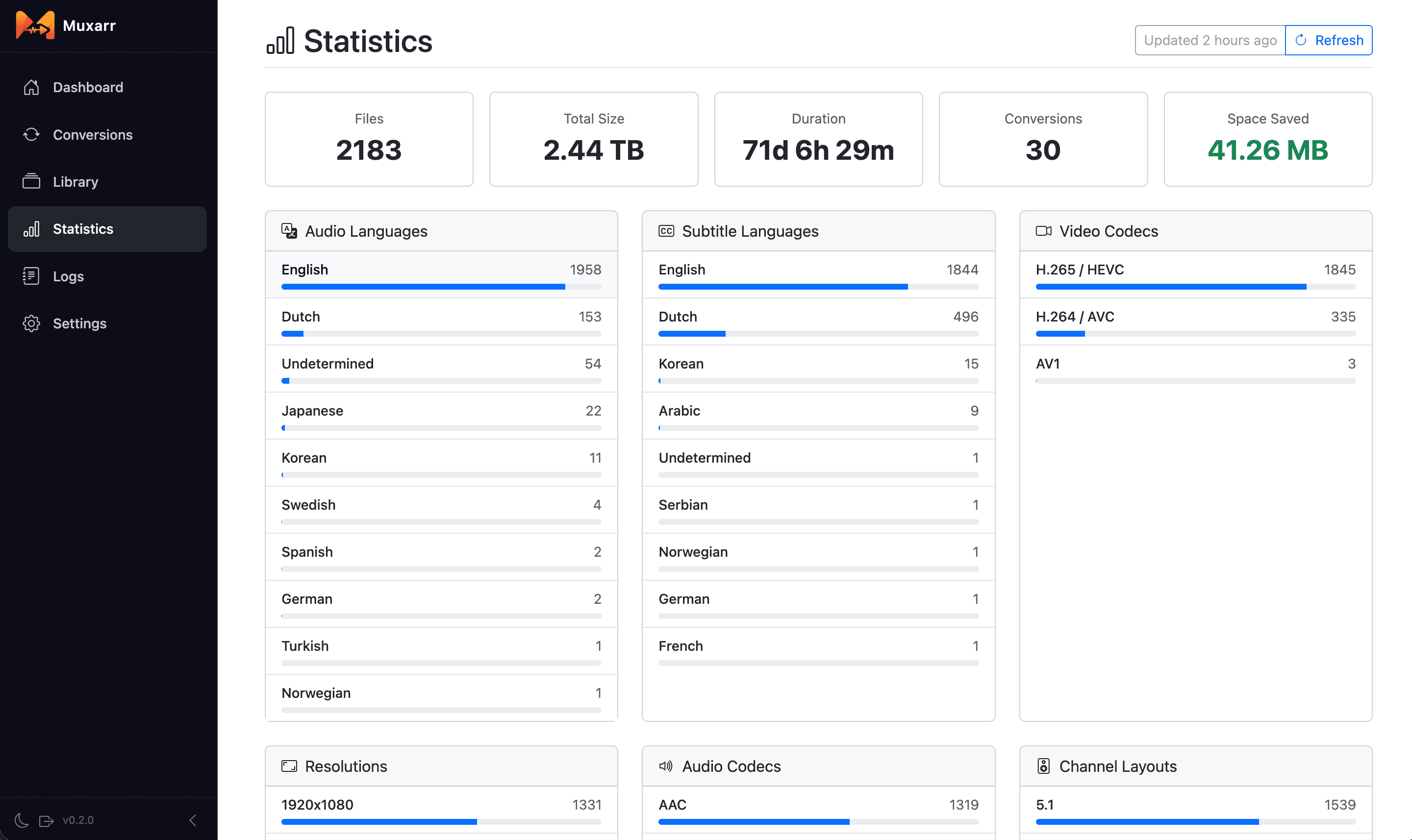
Statistics
Installation
Docker Run
docker run -d \
  --name=muxarr \
  -e TZ=Europe/Amsterdam \
  -e PUID=1000 \
  -e PGID=1000 \
  -p 8183:8183 \
  -v /path/to/appdata:/config \
  -v /path/to/media:/media \
  --restart unless-stopped \
  ghcr.io/kirovair/muxarr:latest
Running without Docker
Muxarr is a plain ASP.NET Core app, so it also runs in a Proxmox LXC, a VM or on a NAS without Docker. There are no prebuilt binaries, so build it yourself. The steps below assume Debian or Ubuntu and a user media that can write to your media files.
- Install
git, the .NET 10 SDK,mkvtoolnixand ffmpeg 8.1 or newer. Distro packages of ffmpeg are usually too old; take a static build from BtbN like the Docker image does.mkvmerge,mkvpropedit,ffmpegandffprobehave to be on thePATH. - Build it and create a folder for the database:
git clone https://github.com/KirovAir/muxarr.git cd muxarr sudo install -d -o "$USER" /opt/muxarr dotnet publish Muxarr.Web/Muxarr.Web.csproj -c Release -o /opt/muxarr sudo install -d -o media -g media /var/lib/muxarr - Save this as
/etc/systemd/system/muxarr.serviceand runsudo systemctl enable --now muxarr. The two variables set the database path (without it Muxarr uses/config/muxarr.db, the Docker default) and the port. The working directory matters: that is where it looks forappsettings.jsonandwwwroot.[Unit] Description=Muxarr After=network.target [Service] User=media WorkingDirectory=/opt/muxarr Environment="ConnectionStrings__DefaultConnection=Data Source=/var/lib/muxarr/muxarr.db" Environment="ASPNETCORE_HTTP_PORTS=8183" ExecStart=/usr/bin/dotnet /opt/muxarr/Muxarr.Web.dll Restart=on-failure [Install] WantedBy=multi-user.target - Open
http://your-ip:8183and continue with Setup.
To update, git pull, publish again and sudo systemctl restart muxarr. Settings, history and logs all live in /var/lib/muxarr; stop the service before copying that folder, SQLite keeps recent writes in the -wal file next to the database.
Upgrading from older versions
Older versions stored the database in /data. To upgrade an existing install, point your appdata volume at /config instead of /data and keep the same host path:
    volumes:
      - /path/to/appdata:/config  # was - /path/to/appdata:/data
      - /path/to/media:/media     # keep media mounts exactly as they were
Do not move your media mounts. Your profiles and Sonarr/Radarr path mappings reference the old container paths, so /media stays /media.
Until you do, Muxarr keeps running from /data and shows a reminder in the app. Nothing is moved or deleted automatically, so rolling back to an older version only takes pointing the mount at :/data again. If your appdata folder is empty (you never mounted one, or you mounted /config on an older version that ignored it), the database sits in a Docker volume: stop the container, run docker cp muxarr:/data/. /path/to/appdata/ before removing it, then mount that folder at /config.
Configuration
Environment Variables
| Variable | Description | Default |
|---|---|---|
TZ |
Timezone | UTC |
PUID |
User ID for file permissions | 888 |
PGID |
Group ID for file permissions | 888 |
UMASK |
Permission mask for files Muxarr writes, e.g. 002 for group-writable libraries |
022 |
MUXARR__AUTH__RESET |
Set to true to remove the login on the next start if you lost the password. Remove it again afterwards |
unset |
Volumes
| Path | Description |
|---|---|
/config |
Database and configuration |
/media |
Media files (any mount path works, use multiple -v mounts as needed) |
Setup
- Open
http://your-ip:8183- the setup wizard will guide you through - Set a username and password (optional)
- Connect Sonarr/Radarr for original language detection and webhook automation (optional)
- Create a profile with your media directories and language rules
- Scan your library, preview the changes, and queue files for processing
API
Muxarr has a small API, authenticated with the X-Api-Key header. GET /api/stats gives library statistics for Homepage and other dashboards, POST /api/queue queues every file that needs work (so you can turn off auto-queue and convert from a cron job at night) and GET /api/conversions lists conversions so a script can follow them. See Settings > API for examples.
Built With
- .NET 10 / Blazor
- MKVToolNix (mkvmerge, mkvpropedit)
- FFmpeg (ffmpeg, ffprobe)
License
GPL-3.0 - see LICENSE.
Muxarr is not affiliated with Sonarr, Radarr, or any other *arr projects.
Media gallery
1 / 5Categories
Download Statistics
Related apps
Explore more like this
Explore allDetails
ghcr.io/kirovair/muxarr:latestRuntime arguments
- Web UI
http://[IP]:[PORT:8183]/- Network
bridge- Shell
sh- Privileged
- false
Template configuration
Web interface port.
- Target
- 8183
- Default
- 8183
- Value
- 8183
Database and settings.
- Target
- /config
- Default
- /mnt/user/appdata/muxarr
- Value
- /mnt/user/appdata/muxarr
Your media library. Mount this at the SAME container path your Sonarr/Radarr use, or set a Path Mapping in Muxarr. Add more Path entries for libraries on other shares.
- Target
- /media
- Default
- /mnt/user/media
- Value
- /mnt/user/media
User ID for file permissions (99 = nobody on Unraid).
- Default
- 99
- Value
- 99
Group ID for file permissions (100 = users on Unraid).
- Default
- 100
- Value
- 100
Permission mask for files Muxarr writes, e.g. 002 for group-writable libraries.
- Default
- 022
- Value
- 022
Timezone, e.g. Europe/London or America/New_York.
- Default
- UTC
- Value
- UTC