
All apps · 0 apps

media-box
Docker app from devblaze's Repository
Overview
Readme
View on GitHub

media-box
A self-hosted, all-in-one PVR + media server in a single container — a replacement for Sonarr, Radarr, Bazarr, Jellyseerr, and Jellyfin. The only thing you need to bring is an indexer.
🚧 UNDER DEVELOPMENT — USE AT YOUR OWN RISK 🚧
This is an early work in progress and is NOT optimized or hardened for public / production use.
Expect rough edges, breaking changes, and bugs. If you stumbled on this and want to try it:
keep backups, don't point it at data you can't afford to lose, and run it entirely at your own risk.
What it does
- Two libraries, one app — movies and series, metadata via TMDB.
- Full PVR loop — monitor → RSS sync → search Torznab indexers → grab via qBittorrent or TorBox (debrid) → import (hardlink / copy / move) with template renaming → history & upgrades.
- Release preferences — per quality profile, prefer specific groups (e.g. YIFY/YTS for movies, an
anime group for anime) with automatic fallback; plus required / ignored terms (substring or
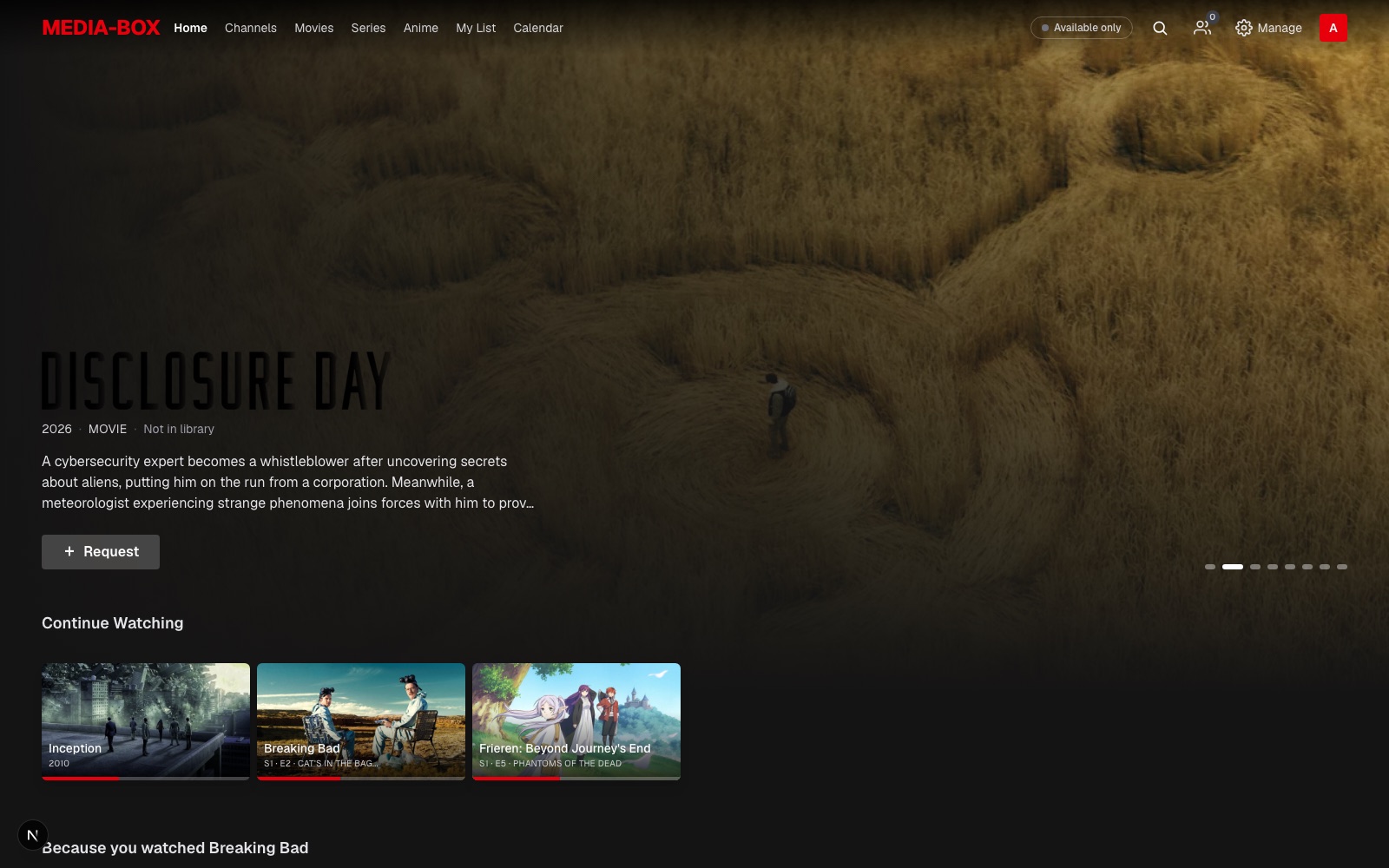
/regex/). - Netflix-style Discover for everyday users — hero billboards, hover rows, Movies / Series / Anime categories, search with type filters, an "available only" toggle. Available titles play in-browser; the rest can be requested.
- In-app player — direct-play with HTTP-range seeking, plus an HLS transcoder (Intel QSV/VAAPI, AMD VAAPI, NVIDIA NVENC) for anything the browser can't decode. ffprobe-populated media info.
- Library Import — scan existing movie/series folders, auto-match to TMDB, and resolve the uncertain ones from a manual review panel.
- Requests + roles — admins manage everything; normal users browse & request.
- One-click migration from existing Sonarr / Radarr (library, monitored flags, quality profiles, Torznab indexers, qBittorrent clients).
Built on Next.js 16 (a single process: UI + /api/v1 + an in-process job scheduler) with SQLite/Drizzle.
Screenshots
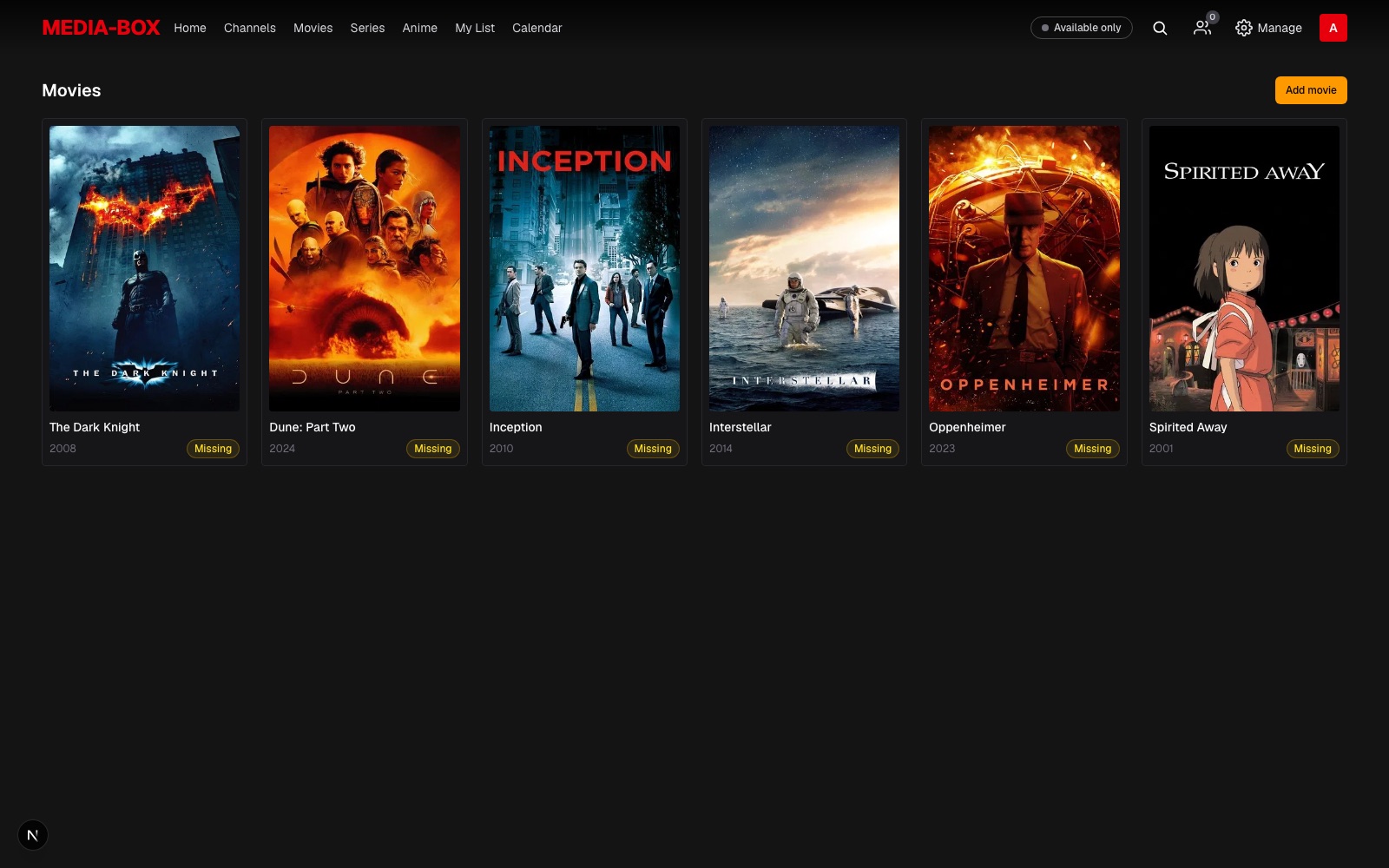 Movie library |
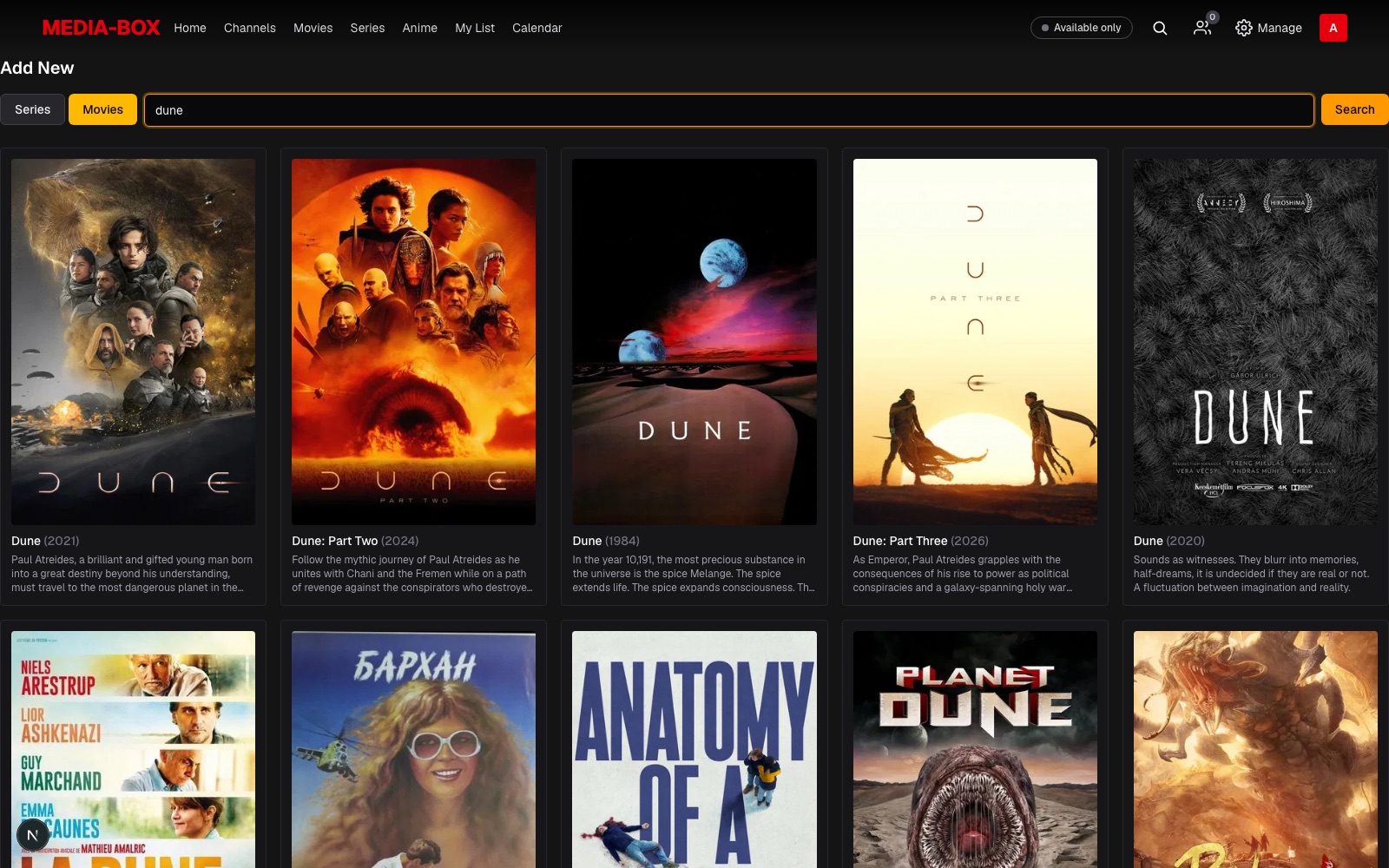 Add anything from TMDB |
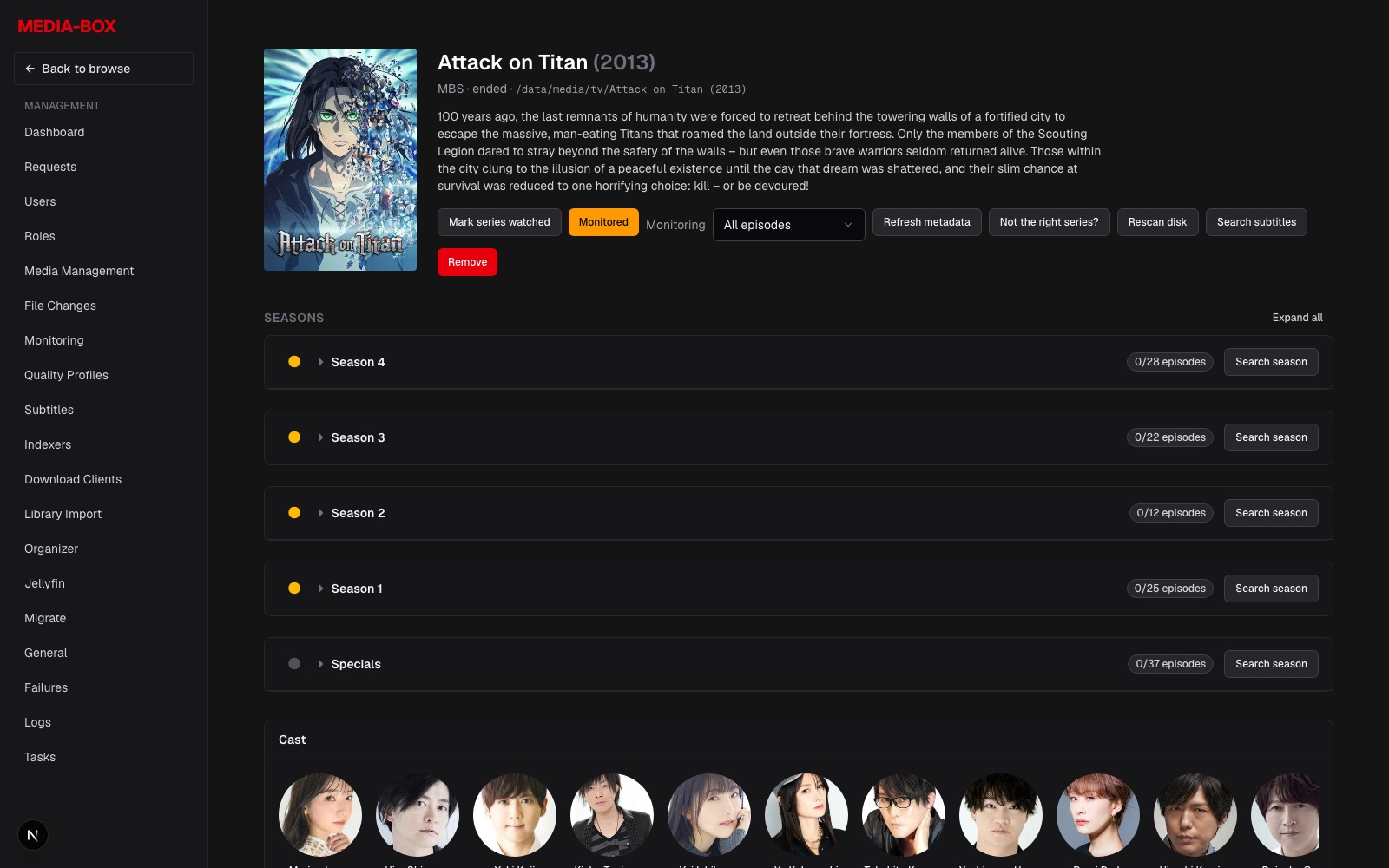 Series management — seasons, monitoring, search |
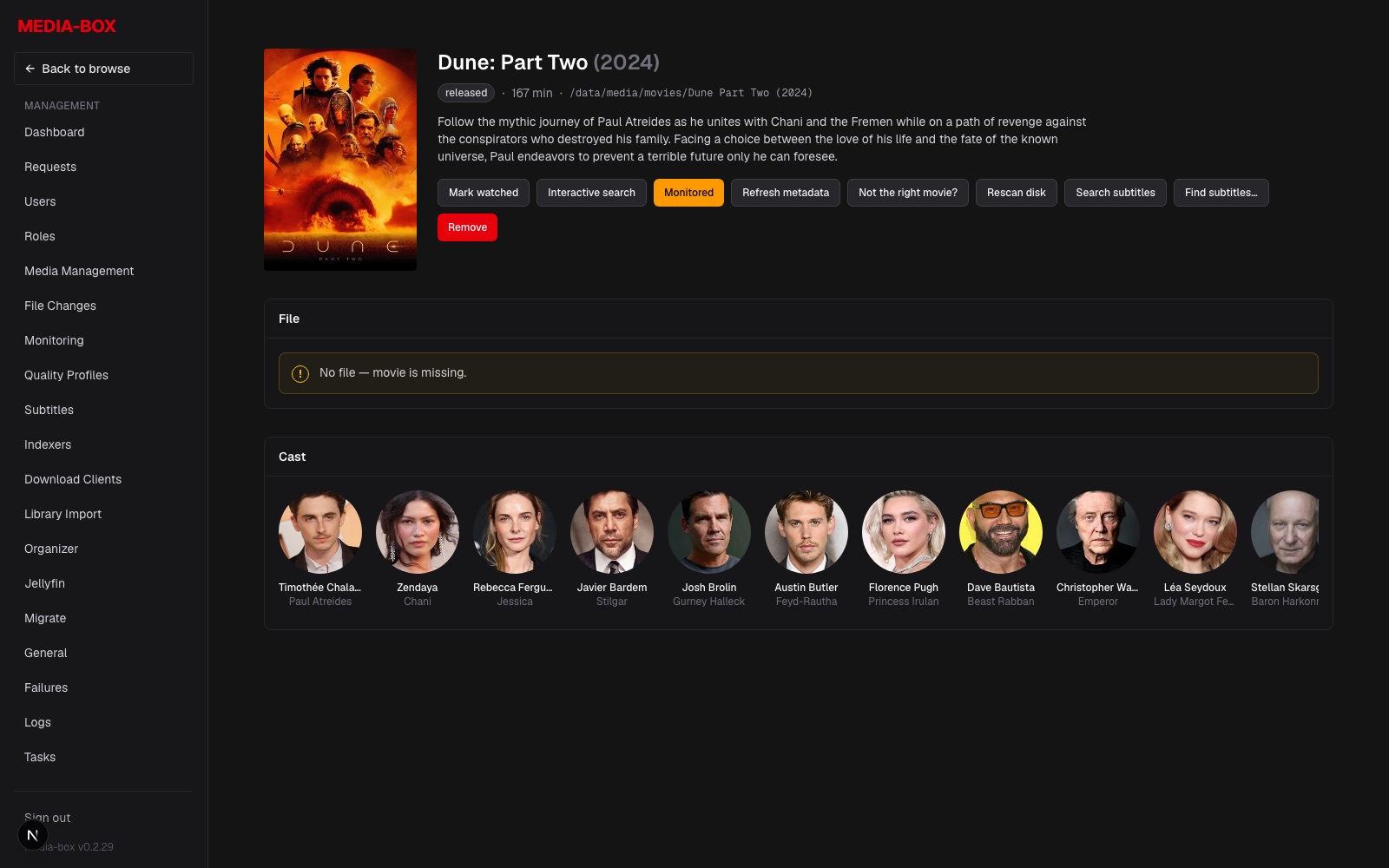 Movie management with cast & file state |
More in docs/screenshots/ — Library Import, admin settings (transcoding, RAM cache, AI assistant).
Install on Unraid (Docker template)
Easiest: media-box is available in Unraid Community Applications — open the Apps tab and search for media-box. (The CA-registered copy of the template lives in
devblaze/torbox-client/templates/, the maintainer template repo — keep it in sync withunraid/media-box.xml.)⚠️ Use with caution on existing media libraries. media-box manages files — it can move, rename, upgrade and delete media it imports. Pointing it at a library that Sonarr/Radarr or your media server already manage? Start with Settings → Media Management → File operations set to Read-only or Ask, and switch to Allow once you trust what it does.
The manual route below still works: media-box ships an Unraid Docker template at
unraid/media-box.xml. The container image is published to the GitHub Container Registry (ghcr.io/devblaze/media-box).
1. Publish the image (once, and on each update)
Let CI do it (recommended). The included GitHub Actions workflow
(.github/workflows/docker-publish.yml) builds linux/amd64
and pushes to ghcr.io/devblaze/media-box on every commit to main — no secrets to configure, it uses
the built-in GITHUB_TOKEN.
One-time: after the first successful run, the ghcr package is private. Open the package settings → Change visibility → Public so Unraid can pull it without a
docker login.
Or build and push it yourself (docker login ghcr.io with a PAT that has write:packages):
docker buildx build --platform linux/amd64 \
  -t ghcr.io/devblaze/media-box:latest --push .
2. Install the template in Unraid
Unraid reads user templates from /boot/config/plugins/dockerMan/templates-user/. Drop
unraid/media-box.xml in there and it shows up in the Add Container → Template dropdown.
SSH into your Unraid server (or open the web terminal) and fetch the template straight from the repo:
wget -O "/boot/config/plugins/dockerMan/templates-user/my-media-box.xml" \
  https://raw.githubusercontent.com/devblaze/media-box/main/unraid/media-box.xml
Then in the Unraid GUI: Docker tab → Add Container → set Template to media-box and fill in the paths below.
No SSH? Download
unraid/media-box.xml, then upload it to/boot/config/plugins/dockerMan/templates-user/my-media-box.xmlwith any SMB/SFTP client (theflashshare maps to/boot).
3. Configure the container
The template exposes these; adjust the host paths to your shares:
| Setting | Container path | Notes |
|---|---|---|
| WebUI Port | 7878 |
change the host side if it clashes |
| Config | /config |
app config + SQLite DB — persist this (/mnt/user/appdata/media-box) |
| Downloads | /downloads |
your download client's output share |
| Movies | /movies |
movie library share |
| TV | /tv |
series library share |
| PUID / PGID / UMASK / TZ | env | Unraid defaults 99 / 100 / 022 |
| Intel/AMD GPU (optional) | /dev/dri |
for hardware transcoding — then set Settings → Transcoding |
Hardlinks vs copy: if Downloads is on a different filesystem than Movies/TV, imports copy (slower, needs free space). Point all three at subfolders of one share for instant, space-free hardlink imports (the trash-guides layout). For NVIDIA, install the Unraid Nvidia-Driver plugin and add Extra Parameters
--runtime=nvidiaplusNVIDIA_VISIBLE_DEVICES=allinstead of the/dev/dridevice.
4. First run
Open http://<unraid-ip>:7878, create the admin account, then:
- Settings → General — paste a free TMDB API key.
- Settings → Media Management — set your downloads / movies / series paths (or they seed from the
DOWNLOADS_DIR/MOVIES_DIR/SERIES_DIRenv vars) and add root folders. - Settings → Indexers — add Torznab endpoints (Prowlarr/Jackett).
- Settings → Download Clients — add qBittorrent and/or TorBox.
- Settings → Library Import — import media you already have on disk.
- Optionally Settings → Migrate — import from an existing Sonarr/Radarr.
Normal (non-admin) users you create land on the Netflix-style Discover page and can play what's available or request the rest.
Updating
media-box applies its database migrations automatically on boot, so updating is just pulling a newer image:
- Rebuild & push a new image (step 1 above) — or let the GitHub Actions CI publish it on push to
main. - In Unraid: Docker tab → media-box → Force update (or Check for Updates → Update). Unraid pulls
the new
:latestand recreates the container;/config(your DB) is preserved.
docker compose users: docker compose pull && docker compose up -d.
Non-Unraid (docker compose)
A docker-compose.yml mirrors the Unraid mapping (separate downloads/movies/tv
shares, optional /dev/dri). Edit the volume paths, then docker compose up -d.
API
Everything the UI does goes through GET/POST/PUT/DELETE /api/v1/*. External tools authenticate with the
X-Api-Key header (shown under Settings → General). GET /api/v1/health is unauthenticated for the
container healthcheck.
Development
yarn install
yarn dev       # config + SQLite DB land in ./.config-dev
yarn test      # parser / naming / scoring test suite
yarn typecheck
Note: this repo tracks a modified Next.js 16 — read
node_modules/next/dist/docs/before changing framework-facing code (seeAGENTS.md).
Install media-box on Unraid in a few clicks.
Find media-box in Community Apps on your Unraid server, review the template, and click Install. Unraid handles the Docker app or plugin setup from the published template.
Related apps
Explore more like this
Explore allDetails
ghcr.io/devblaze/media-box:latestRuntime arguments
- Web UI
http://[IP]:[PORT:7878]- Network
bridge- Shell
sh- Privileged
- false
Template configuration
Web interface port
- Target
- 7878
- Default
- 7878
- Value
- 7878
App configuration and SQLite database (persist this)
- Target
- /config
- Default
- /mnt/user/appdata/media-box
- Value
- /mnt/user/appdata/media-box
Download client output (torrents/usenet). Put on the SAME share as Movies/TV for hardlinks.
- Target
- /downloads
- Default
- /mnt/user/downloads
- Value
- /mnt/user/downloads
Movie library
- Target
- /movies
- Default
- /mnt/user/movies
- Value
- /mnt/user/movies
Series (TV) library
- Target
- /tv
- Default
- /mnt/user/tv
- Value
- /mnt/user/tv
User ID for file ownership
- Default
- 99
- Value
- 99
Group ID for file ownership
- Default
- 100
- Value
- 100
File creation mask
- Default
- 022
- Value
- 022
Timezone (e.g. Europe/Athens)
- Default
- Europe/Athens
- Value
- Europe/Athens
Pass the iGPU for hardware transcoding (Intel QuickSync / AMD VAAPI). Then set Settings > Transcoding > Hardware acceleration to VAAPI or QSV. Leave unset for CPU transcoding. For NVIDIA, install the Unraid Nvidia-Driver plugin and add Extra Parameters: --runtime=nvidia plus NVIDIA_VISIBLE_DEVICES.
- Target
- /dev/dri
- Default
- /dev/dri
- Value
- /dev/dri