
All apps · 0 apps

masqueradarr.aio
Docker app from i.Flip721's Repository
Overview
Readme
View on GitHub📄 Guides and Docs ⮕ Start Here
Aggregating scattered IPTV sources behind a single, trusted identity.


What is masqueradarr
DISCORD is the fastest way to find out exactly what is happening with this project. Tons of updates happening from community input.


masqueradarr : Guides : Explanations : Documentation
masqueradarr is a self-hosted IPTV aggregator. It pulls channel playlists (M3U) and guide data (EPG/XMLTV) from a range of online IPTV services, normalizes them into one catalog, and serves them back as a single, unified, standards-compliant playlist + guide — behind one trusted identity that your media apps and IPTV clients can talk to.
It is the direct successor to TVApp2, which is now
deprecated. masqueradarr is not a fork or a patch — it is a ground-up re-architecture of the same
idea, carrying the project into the *arr self-hosted media family (Sonarr, Radarr, …) it's named for.
| Swag Pack | Location to full swag pack |
|---|---|
| 📦 Icon Pack | 🔗 masqueradarr icon pack |
| 📦 Font Pack | 🔗 masqueradarr font pack |
| 📦 Emblem-Sets | 🔗 masqueradarr emblem-sets |
| 📦 Label-Sets | 🔗 masqueradarr label-sets |
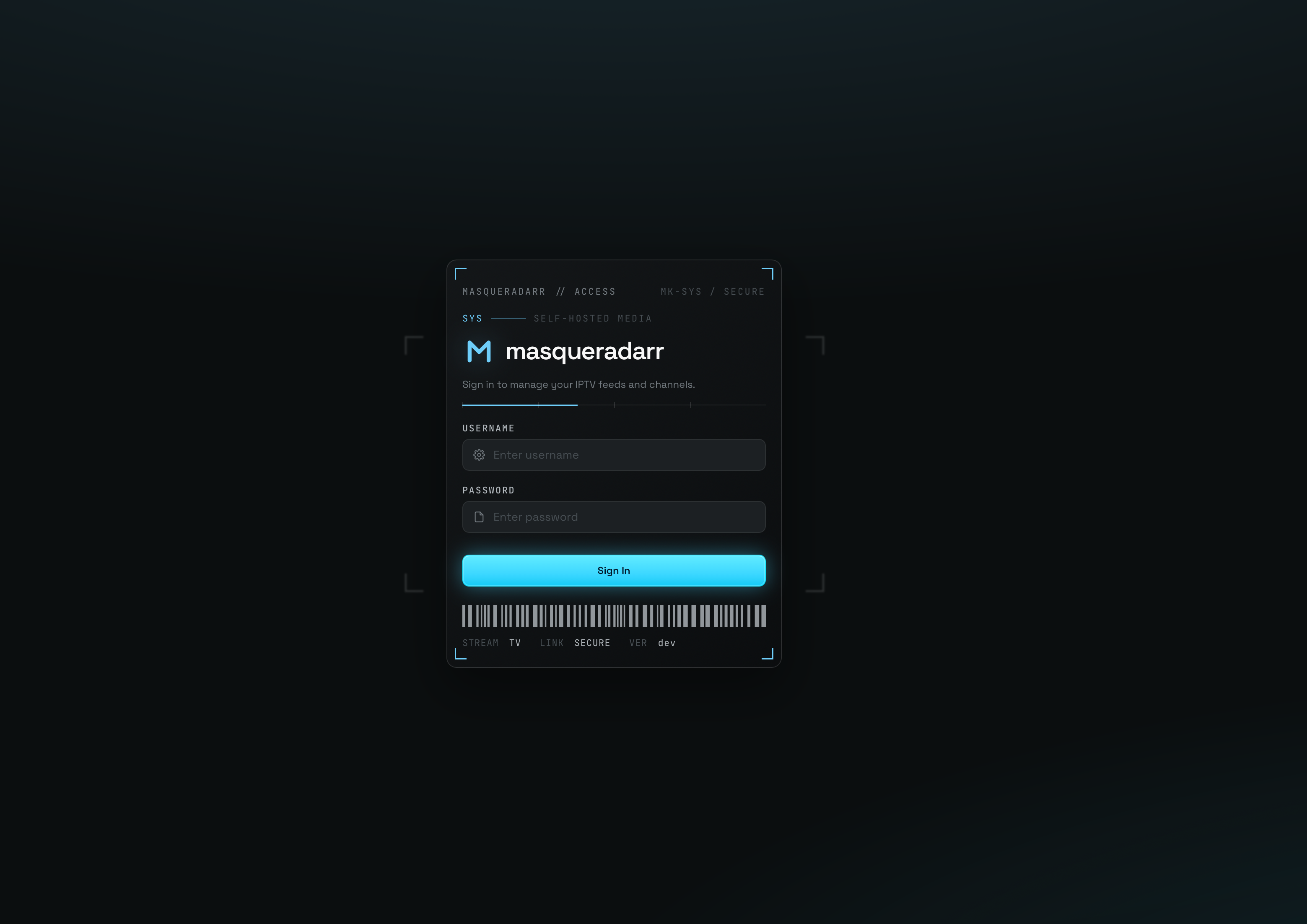
[!NOTE] View more screenshots of the current system including the updated branding and layout.
Evolution — masqueradarr
Where it started: TVApp2
TVApp2 was a single, self-contained Docker container whose job was simple and effective: on a
schedule, scrape a handful of IPTV providers (TheTvApp, TVPass, MoveOnJoy), download and
regenerate flat .m3u and .xml files, and serve them over a small web interface so that
Jellyfin, Plex, or Emby could ingest them. It was a Node.js app on an Alpine Linux base,
supervised by s6-overlay, configured almost entirely through environment variables, with
HDHomeRun emulation and HD/SD quality toggles. It did one thing well — keep static playlists fresh.
That model had ceilings. Streams were static URLs baked into files, so anything behind a login, a device check, an expiring token, or a rotating mirror couldn't be served. There was no database, no real UI beyond file links, no per-user access control, no live observability of who was watching what, and no transcoding for clients that couldn't play the upstream format. Every new provider meant bespoke scraping glued into the core.
Where it's going: masqueradarr
masqueradarr keeps the original promise — aggregate scattered IPTV sources into one playlist + guide — and rebuilds everything underneath it to lift those ceilings:
- Static files → a live, resolve-on-demand engine. Instead of writing dead URLs to disk, masqueradarr resolves each stream at play time through an HLS proxy. That's what makes authenticated and rotating sources possible — e.g. an in-app, server-streamed Chromium captures a real login session, and per-play signed URLs are minted on demand.
- Flat config → MongoDB + a real management SPA. State lives in MongoDB; the front end is a Vue 3 single-page app with full screens for Dashboard, Active Streams, History / Metrics, Playlists, EPG Sources, Channel Mapping, Users, and Settings.
- Bespoke scrapers → a source-agnostic adapter framework. Adding a provider is one adapter file plus one registry line; the generic core (sync, catalog, telemetry) never branches per source.
- File server → an API + a live video proxy. An in-app player and M3U / XMLTV export for external
clients, with playback served by a rebuilt, durable Rust proxy engine (
masq-proxy) that resolves each stream on demand — HLS today; the few remux-dependent paths (e.g. HDHomeRun TS→HLS) are still pending. - Env-var toggles → users, roles & per-user access. Real authentication (scrypt), session vs. stream tokens, and per-user tokenized playlist access.
- Blind scheduling → live observability. WebSocket-pushed viewer/bandwidth/buffering telemetry, live system-performance stats, and MongoDB-backed application logs.
At a glance
| TVApp2 (deprecated) | masqueradarr | |
|---|---|---|
| Role | Static M3U/XMLTV regenerator | Live IPTV aggregator + delivery platform |
| Streams | Static URLs written to files | Resolve-on-demand via HLS proxy |
| State | Flat files, no DB | MongoDB (Mongoose 8) |
| Frontend | Links to generated files | Vue 3 + Vite management SPA |
| Backend | Node.js scripts | Express 4 API (ESM, TypeScript) |
| Sources | Hard-coded scrapers (TheTvApp, TVPass, MoveOnJoy) | Pluggable adapters + URL / HDHomeRun / file imports |
| Guide data | One bundled XMLTV grabber | Gracenote, EPG-PW, Jesmann, Custom XMLTV + self-EPG |
| Auth | None | scrypt users, roles, per-user access lists |
| Auth'd sources | Not possible | Supported (streamed-login session capture) |
| External clients | Pass-through only | M3U / XMLTV export + live Rust HLS / raw-TS proxy |
| Video engine | None (static URLs) | Remux-free Rust data-plane proxy (resolve-on-demand; retry / failover / raw-TS) |
| Observability | Logs | Live WS telemetry, history/metrics, system stats, app logs |
| Backup | None | Full-system gzip backup / restore + scheduled backups |
| Base image | Alpine + s6-overlay | Debian bookworm (glibc) + tini |
| Config | Environment variables | DB-backed settings + minimal .env bootstrap |
Primary Architecture
masqueradarr is two independently-built, independently-versioned npm packages that the Docker image stitches together — not a workspace, and they never import across the boundary:
/(root) — the Vue 3 + Vite SPA (the management front end;hls.js,vue-router,mitt).server/— the Express 4 + Mongoose 8 API (ESM, TypeScriptstrict), which serves the built SPA, the/api/*REST surface, and four WebSockets (login-stream, stream-stats, logs-stream, system-stats).
At a high level, the SPA and IPTV clients talk to the Express control plane, which owns MongoDB and
drives a Rust data-plane sidecar (masq-proxy) for stream bytes:
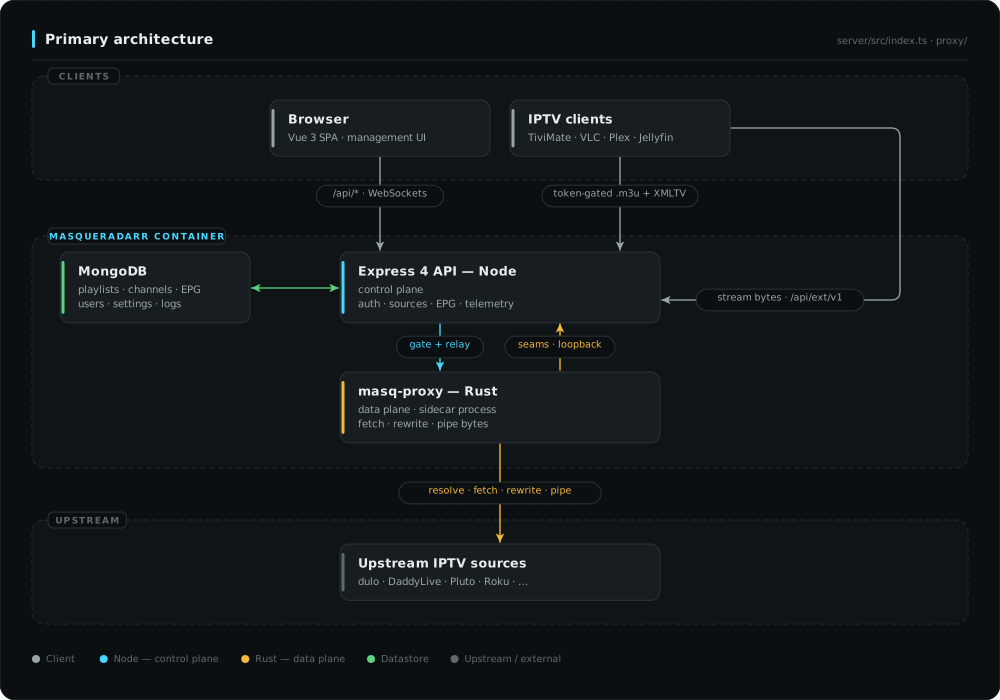
Key subsystems:
- Sources adapter framework — a source-agnostic core (sync → normalize → dedupe → resolve) with 17 built-in provider adapters, plus proxy-only sources — direct (passes user-imported stream URLs straight through), hdhomerun (imports a local tuner's channel lineup; playback is dormant pending remux support in the video engine) and local (Local Now's per-market playlists) — that back bring-your-own playlists.
- Channel model — a pristine synced reference (
sourcechannels) projected into an editable, UI-facing store (playlistchannels); user edits survive re-syncs. - EPG + scheduler — multiple guide ingesters behind one shared sync path — Gracenote,
EPG-PW, Jesmann, and user-supplied Custom XMLTV (file upload or re-fetchable remote URL,
streamed so multi-GB national guides parse with bounded memory) — plus the self-built guides that
built-in carry. All driven by a
croner-backed runtime scheduler over a persistedcronjobscollection. - Composition + export — composes Global, per-user, and custom
.m3uplaylists with matching XMLTV guide siblings for downstream clients. - Video proxy engine — live. A remux-free Rust data-plane sidecar (
masq-proxy) resolves each stream on demand and serves it over a durable HLS / raw-TS pipe (retry, re-resolve, read-ahead buffering). Node stays the control plane (auth, resolve, token gate, telemetry authority); Rust moves the bytes. See Video Proxy Engine. - Backup & maintenance — full-system gzip backup / restore, scheduled backups, and Mongo index-rebuild / workspace-reset maintenance actions.
Migration status
The rename and re-architecture are effectively complete: the codebase, brand, runtime, and Docker
images are all masqueradarr. The compose stack pulls the standard app image
iflip721/masqueradarr (built from docker/app.Dockerfile); the all-in-one variant is built from
docker/aio.Dockerfile. If you're coming from TVApp2: there is no in-place upgrade path —
masqueradarr is a new application with a new data model (MongoDB instead of flat files), so stand it up
fresh and re-add your sources through the UI.
Lineage & credits
masqueradarr is the successor to TVApp2 by TheBinaryNinja, and inherits its core aggregation framework (ported from the sibling project). TVApp2 remains available, archived, and deprecated — all new development happens here.
Features
Aggregation & delivery
- Pulls M3U playlists and EPG / XMLTV guide data from multiple IPTV providers and normalizes them into one catalog.
- Resolve-on-demand catalog — each stream is resolved at play time (no dead URLs on disk), which is what makes authenticated, token-gated, and rotating-mirror sources possible. The bytes are served by the Rust video proxy engine (see Video Proxy Engine below).
- Delivery surfaces — an in-app slide-out player and M3U / XMLTV export for external clients (TiviMate / VLC / Emby / Jellyfin / Plex).
- Composition + export — builds Global, per-user, and custom
.m3uplaylists, each with a matching XMLTV guide sibling advertised viax-tvg-url.
Getting started
masqueradarr ships as Docker images. There are two deployment shapes.
Option A — Compose stack (app + MongoDB)
Copy the env template and fill it in:
cp .env.example .envAt minimum set
MONGO_ROOT_USER/MONGO_ROOT_PASS, yourDOMAIN, and the host volume paths (COMPOSE_PATH,BACKUPS_PATH,MONGO_DATA_PATH) — each host dir must be writable by uid 1000 (the container'snodeuser). To publish on a host port other than3000, setMASQUERADARR_PORT(and updateDOMAINto match).Bring it up:
docker compose up -dOpen
http://localhost:3000(or yourDOMAIN; the host port reflectsMASQUERADARR_PORT). The app self-provisions itsconfig.jsonfrom the.envon every boot — there is no host config file to manage.
Option B — All-in-one (single container)
A second image bundles app + MongoDB + config bootstrap into one container, so the whole stack runs
from a single docker run with no external database — ideal for a quick trial or a small home server. One
/data volume persists the database, exports, config, and credentials. It's published under the
iflip721/masqueradarr name (see Migration status above).
No-AVX hosts (Synology NAS, Atom/Celeron, older Xeons, kvm64/qemu64 VMs). On amd64 the bundled MongoDB 7.0 requires a CPU with AVX — without it mongod dies at boot with
Illegal instruction (core dumped). Those hosts want themongo4.4-tags, an otherwise-identical image built with MongoDB 4.4 (which predates the AVX requirement):iflip721/masqueradarr-aio:mongo4.4-latest. It needs a fresh/datavolume — a database written by MongoDB 7.0 cannot be opened by 4.4. To carry data across, generate a backup from Settings → Data on the 7.0 image, boot this one on an empty volume, then restore. Alternatively, use the compose stack withimage: mongo:4.4.
To publish on a different host port, change the left side of the -p mapping — e.g. -p 8080:3000
(the container always serves on 3000 internally; MASQUERADARR_PORT only applies to the compose stack).
First run
On first launch there are no users — the app reports needsSetup and the SPA walks you through
creating the first admin account. After that:
Add a playlist — the Add Playlist modal offers every built-in source plus custom playlists (clone / file / URL / HDHomeRun).
For an authenticated source (dulo), capture a login session from Settings (a server-streamed Chromium signs you in; only tokens are stored). The server then keeps the session alive on its own, rotating the token ahead of each expiry — and it auto-discovers dulo's current Supabase config at runtime, so when dulo migrates its Supabase project (rotating the public URL + anon key) the session self-heals on its next refresh with no re-capture and no key to bump. If you captured the session from your own browser (pair/paste), just close that dulo tab — don't sign out: signing out of dulo revokes the very session you handed over.
dulo also rebrands onto new domains periodically, and that one is operator-configurable:
dulo.domainin the playlist configuration (below) drives every dulo-facing hop — catalog fetch, playback-session mint, Supabase bundle scrape, the pairing bookmarklet, the streamed login, and the SSRF apex. Saving a changed domain signs the dulo session out — a captured session belongs to the site it came from — so re-pair afterwards.Playlist Domain / Configuration (Settings → Advanced) is one JSON document holding the per-provider settings for the three providers whose home moves or needs tuning.
enable—falsehides the provider: it leaves the Add Playlist picker (provisioning refuses it) and its settings card is hidden (dulo's sign-in). It is a visibility switch only — an existing playlist of that provider keeps syncing and playing.domain— the site the provider runs on, as a bare host. DaddyLive's is its content mirror, pinned (there is no mirror auto-picker — when DaddyLive moves, change it here and re-Sync).
The document is validated strictly on save (every problem listed by path; nothing saved until it's clean), stored in the Settings record (so backups carry it), applied live, and mirrored to
playlist-config.jsonbeside the infra config (/app/config/,/data/in the AIO image;MASQUERADARR_PLAYLIST_CONFIGoverrides the path — the file is a mirror, rewritten on every boot and save). Test probes every listed domain with the editor's current, unsaved text — DaddyLive's 24/7 directory, dulo's catalog + frontend bundle.Sync now to populate channels, then optionally add EPG Sources and link guide data on the Channel Mapping screen.
Create Users with per-user access lists — each gets a personal tokenized
.m3u+ XMLTV guide URL for their IPTV client.
Configuration
All runtime settings live in MongoDB and are editable on the Settings screen (domain, DNS
nameservers, video configuration, backups, …). The DNS nameservers govern both halves of the engine:
Node's outbound fetches and the Rust data plane's upstream lookups ask the configured servers first and
fall back to the OS resolver on any failure (so .local / LAN names keep working), and a change reaches the
running sidecar on its next flush to Node, no restart. The .env only bootstraps infrastructure on first
boot:
| Variable | Purpose |
|---|---|
MASQUERADARR_PORT |
Host port mapped to masqueradarr (default 3000). |
MONGO_ROOT_USER / MONGO_ROOT_PASS |
MongoDB root credentials; also assemble the app's mongoUri. |
DOMAIN |
Public base URL written into composed playlist / guide links. |
DISPLAY_NAME |
App display name. |
TZ |
Container timezone (used by the scheduler). |
COMPOSE_PATH |
Host dir for composed .m3u + XMLTV exports (uid-1000 writable). |
BACKUPS_PATH |
Host dir for scheduled backups. |
MONGO_DATA_PATH |
Host dir for persistent MongoDB data. |
MONGO_HOST_PORT |
Host port mapped to mongod (default 27017). |
MONGO_URI / MONGO_HOST |
Optional — point the app at an external / Atlas MongoDB instead of the compose mongo service. |
DNS_LOG_LEVEL |
Outbound-DNS trace verbosity (1–3); seeds the setting on first boot. |
MASQ_EDGE |
Optional (default off). 1 inverts the topology so the Rust proxy owns the public port and Node runs behind it on a loopback internal port — same public port, reversible. Enable for scale / high concurrency. See Public edge mode. |
App-settings vars are seeded with
$setOnInsert— they apply on the first provision only. Change them in the Settings UI afterward; a redeploy won't clobber UI changes.
[!IMPORTANT] This sample enviornment variable is also included in the release notes and the
mainbranch repository:.env.example
Ensure you updateCOMPOSE_PATHBACKUPS_PATHMONGO_DATA_PATHwith the appropriate folders for your system.
For the best experience, create each folder path assigned toCOMPOSE_PATHBACKUPS_PATHMONGO_DATA_PATHbefore composing the docker stack.mkdir compose && chown -R 1000:1000 ./compose && chmod -R 777 ./compose mkdir backups && chown -R 1000:1000 ./backups && chmod -R 777 ./backups mkdir mongo && chown -R 999:999 ./mongo && chmod -R 777 ./mongo
Development
The repo is two independently-built npm packages (not a workspace):
# Frontend (repo root) — Vite dev server on :5173, proxies /api → http://localhost:3000
npm install && npm run dev

# Backend (server/) — tsx watch on :3000 (needs a reachable MongoDB)
cd server && npm install && npm run dev
There is no test runner and no linter — correctness is verified by npm run build (type-check) in
each package and by running the app. The Rust proxy/ crate is the exception: CI builds it, lints it
(cargo clippy -- -D warnings) and runs its in-file cargo test suites.
Pluggable sources
- A source-agnostic adapter framework: adding a provider is one adapter file plus one registry line; the generic core (sync → normalize → dedupe → proxy) never branches per source.
| Source | Mechanism |
|---|---|
| Distro TV | makeFastSource · jsrdn tv_v5 catalog (Android-TV UA) · geo-qualified channel IDs · per-play double-underscore VAST macro expansion via resolveStream · distro.tv Origin/Referer-gated CDN · separate guide from epg/query.php |
| FreeLiveSports | makeFastSource · Unreel/PowR sports catalog · direct-HLS masters bearing Unreel VAST macros ([DEVICE_ID]/[CB]/[REF]/[UA]/…) · per-play macro expansion via resolveStream |
| LG Channels | makeFastSource · Public mirror via schedulelist (catalog + XMLTV guide in one call) · direct-HLS masters bearing [DEVICE_ID]/[UA]/[NONCE]/… VAST macros · per-play macro expansion via resolveStream |
| (Local Now) | Sentinel-resolve adapter · localnow://<id>?slug=<slug> stored at sync · resolves to a fresh signed CDN master per play · market-scoped channel set imported via local/import.ts · US-only (geo-gated) |
| Plex | makeFastSource · sentinel+resolve · /lineups/plex/channels catalog yields channel ids + metadata · fully anonymous X-Plex-Token JWT (cached, no credentials) · per-play signed library/parts HLS master that 302s to AWS MediaTailor · self-EPG from a per-channel, per-day grid fanout |
| DaddyLive | HTML catalog scraped from an operator-set rotating mirror (daddylive.domain) · watch.php?id=<N> entry sentinel · 3-hop, Referer-gated scrape per play to a fresh signed playlist · six independent embed providers per channel ("Player 1..6"), walked and learned per channel (playerMemory.ts) with a provider-agnostic hop-2 reader (embedExtractors.ts) · dynamic SSRF allow-set · self-EPG via schedule scrape + Gracenote crosswalk |
| dulo.tv | Authenticated · Supabase session captured by a server-streamed Chromium (or pair / paste) and kept alive by the server, with dulo's Supabase config auto-discovered at runtime · dulo://channel/<id> sentinel → a device-bound, expiring playback session minted per play · operator-set domain (dulo.domain) · no committed snapshot · Gracenote crosswalk |
| Pluto TV | makeFastSource · sentinel+resolve · /v2/guide/channels catalog yields channel IDs only · stateful per-region boot session (boot.pluto.tv) · per-play JWT-stitched HLS master from the stitcher CDN |
| STIRR | makeFastSource · sentinel+resolve · videos/list catalog yields video IDs + provider-EPG pointers · per-play resolve via POST /playable · bundled provider guide |
| Samsung TV+ | makeFastSource · Public mirror (i.mjh.nz) · no auth · jmp2.uk short-link redirect followed per play to a rotating CDN master · dynamic SSRF allow-set learned at play time |
| TCL TV+ | makeFastSource · sentinel+resolve · livetab → programlist catalog via the ideonow.com gateway · per-play HLS master minted by a format-stream-url POST |
| Roku Channel | makeFastSource · sentinel+resolve · /api/v2/epg catalog yields channel IDs and metadata only · stateful Cloudflare-sensitive anonymous session · per-play JWT-signed HLS master from Roku's OSM CDN |
| Tubi TV | window.__data scrape of /live for channel catalog · per-channel EPG + short-lived JWT-signed HLS manifest from /oz/epg/programming · the stored entry is the stable …/oz/epg/programming?content_id=<id> URL, re-resolved per play (the manifest is minted per request) · Gracenote crosswalk for the curated US channels, then self-EPG via afterSync for the rest |
| Vidaa Free TV | makeFastSource · direct-HLS (identity resolveStream) · client-config bootstrap (BOURL + tenant) · geo-qualified channel IDs · ad-DI macros stripped at catalog time |
| Vizio WatchFree+ | makeFastSource · direct-HLS (identity resolveStream) · public anonymous catalog from watchfreeplus-epg-prod.smartcasttv.com · ad-DI macro placeholders substituted with privacy-neutral values at normalize time |
| Whale TV+ | makeFastSource · macro-expansion · keyless auth bootstrap (apiToken → short-lived bearer) · Ottera/SSAI ad macros ([did]/[session_id]/[cachebuster]/…) expanded per play via resolveStream |
| Xumo Play | makeFastSource · sentinel+resolve · Valencia catalog yields channel IDs only · 3-hop per-play resolve (broadcast → asset → HLS source → macro-fill) |
Custom playlists (bring your own)
- Clone — hand-pick channels from any synced source into a curated playlist; the channels are independent copies (so edits don't disturb the originals) but streams still route through the real adapter.
- Import — pull in any remote M3U URL (re-syncable), upload a static
.m3ufile, or expose a local HDHomeRun tuner (its channel lineup is imported; playback — the TS→HLS remux — is dormant pending remux support in the video engine). - Every custom playlist rides the same per-user, token-gated
.m3u+ XMLTV export machinery as the built-in sources.
Local Now playlist
- Local Now (localnow.com) is a US-based FAST (Free Ad-Supported Streaming TV) service that delivers a market-specific lineup of live channels — local broadcast stations, regional news, and national FAST networks — curated by geographic television market. Masqueradarr integrates it as a fully managed, re-syncable custom playlist type with a bundled EPG guide.
[!NOTE] US-only. Local Now is geo-gated to US IP addresses. Attempting to add a Local Now playlist from a non-US IP will return a clear error. No VPN workaround is built in; route the server through a US network to use this feature.
Local Now : City / Market Lookup
When adding a Local Now playlist you choose a city/market — the geographic unit Local Now uses to select a channel lineup. Masqueradarr exposes two ways to pick one:
| Method | How it works |
|---|---|
| City search | Type at least 2 characters in the city field. A typeahead calls GET /api/import/local/cities?q= which queries Local Now's City/Search API and returns matching cities with their market identity. |
| Auto-detect | Click "Use my detected market." The server reads the geo-detected market from Local Now's own homepage response and pre-fills the closest market to the server's public IP. Falls back to New York City if the homepage carries no geo signal. |
Local Now : DMA and Market — what they are
Every choice resolves to two stored identifiers:
| Field | What it is | Example |
|---|---|---|
DMA (marketDma) |
A numeric Designated Market Area code — the Nielsen/TV-industry identifier for a regional television market. | 501 (New York) |
Market (marketSlug) |
A comma-joined list of Local Now market slugs — a primary city slug plus any associated PBS station slugs for that market. | nyNewYorkCity,pbs-wnet,pbs-wedh,pbs-wliw,pbs-wnjt |
Both are stored on the playlist row and are used together as the query parameters for every upstream catalog/guide fetch. They are set once at creation and never modified afterward (to change market, delete the playlist and create a new one).
Local Now : What the Playlist Provides
When you add a Local Now playlist, Masqueradarr:
- Creates a custom playlist row (
source: 'local',endpoint: 'custom') with the market's DMA and slug stored directly on the playlist. - Immediately syncs the market's channel lineup from Local Now's combined catalog + guide endpoint. Channels appear in the playlist the moment creation completes.
- Prunes subscription-locked channels — any channel with
subscription_access.unlocked === falseis excluded; only freely available content is imported. - Deduplicates the raw channel list by channel ID before writing.
Local Now : Channel fields
Each imported channel carries:
| Field | Value |
|---|---|
| Name | The channel's display name from Local Now |
| Group | Local News for local broadcast stations (identified by W/K call signs, My City genre, hyperlocal/epg-local-now slugs), otherwise the first IAB genre tag, otherwise Local |
| Channel number | The broadcast channel number when provided by Local Now |
| Logo | The channel's logo URL from Local Now |
| Stream entry | An opaque localnow://<id>?slug=<slug> sentinel — streams are resolved on demand per play via Local Now's DSP backend, not stored as static URLs |
Local Now : What the EPG Source Provides
Each Local Now playlist automatically creates and owns a playlist-bound EPG source (visible in the EPG Sources screen, labeled <Market> — Local Now). Key properties:
| Property | Value |
|---|---|
| Source | local |
| Binding | Playlist-bound (playlistBinding: true) — manual sync and schedule controls are hidden in the EPG Sources UI; the playlist's hourly cronjob drives all refreshes |
| Guide data | Inline program[] from the market's catalog fetch — no separate EPG call needed |
| Guide window | ~5 programs per channel per sync (continuous coverage maintained by the hourly schedule) |
| Program fields | Title, start/end times, description, content rating, season/episode numbers (parsed from Local Now's composite title format), IAB category |
| Channel linking | Channels are self-linked automatically at sync time — no manual Channel Mapping required. Each channel's tvg_id and epg fields are set to point at this EPG source on first sync, so the guide renders immediately |
The EPG source ID matches the playlist ID — they are a matched pair scoped to the same market. Deleting the playlist cascade-deletes the EPG source, all guide channels, all programs, and the hourly cronjob together.
Local Now : Adding Multiple Local Now Playlists (Different Markets)
You can add as many Local Now playlists as you want, one per city/market. Each is fully independent:
| Aspect | Behavior |
|---|---|
| Playlist row | A separate playlists document per market, with its own id, marketDma, marketSlug, and marketLabel |
| Channel storage | Each market's channels are stored under their own playlist ID — there is no sharing or collision between markets |
| EPG source | Each market gets its own EpgSource (id = playlist id), its own epgchannels, and its own programs collection scope |
| Schedule | Each market gets its own independent hourly Cronjob |
| Naming | Masqueradarr disambiguates playlist IDs automatically — if you add "New York" twice the second gets a numeric suffix (newYork2) |
| Deletion | Deleting one market's playlist removes only that market's channels, EPG, and schedule — the others are unaffected |
Example: adding New York (DMA 501) and Los Angeles (DMA 803) gives you two separate playlists (newYork and losAngeles), two separate EPG sources, and two independent hourly schedules. Each can be assigned to different users via the standard playlist access controls.
Guide data (EPG)
- Ingests guide data from Gracenote, EPG-PW, Jesmann (guided picker), and any Custom XMLTV source — an uploaded file or a re-fetchable remote URL, streamed so multi-GB national guides parse with bounded memory — plus the self-built guides that playlist-bound carry.
- Channel Mapping links channels to guide data with composite match-scoring and many-to-one EPG linking; the link survives re-syncs.
Management SPA (Vue 3)
- Full screens for Dashboard, Active Streams, History / Metrics, Playlists, EPG Sources, Channel Mapping, Users, and Settings.
- An editable channel store where user edits survive re-syncs, and shared progress modals for the long-running sync / compose operations.
Users & access control
- scrypt authentication, admin / user roles, and per-user access lists (allowed playlists / custom playlists).
- A session-token vs. stream-token split, and per-user tokenized M3U access (token-free download, token-gated stream).
Observability
- WebSocket-pushed viewer / bandwidth / buffering telemetry — the Rust proxy measures the true byte edge and reports it over the telemetry seam, so Active Streams and History / Metrics show real, live sessions.
- Live system-performance push (CPU / memory) on the Dashboard.
- Persisted view-session history + per-user metrics, and MongoDB-backed application logs (13
categories, 14-day TTL) with a live log drawer — including a dedicated
proxycategory fed by the Rust engine's full resolve→fetch→rewrite→serve lineage.
The video engine is a Rust proxy. masqueradarr serves video through a remux-free Rust data-plane sidecar (replacing an older transcode engine) that resolves each stream on demand and rewrites its
.m3u8manifests — see Video Proxy Engine for the full picture. The one part still pending is remux / transcode (e.g. HDHomeRun TS→HLS).
Scheduling
- A
croner-backed runtime scheduler over a persistedcronjobscollection: playlist re-sync, EPG re-sync, M3U / XMLTV recompose, and scheduled backups.
Backup & restore
- One-click full-system backup — a gzipped snapshot of every collection, downloaded or written to a configured backup directory on a schedule.
- Restore from an uploaded backup or a saved file; the restore re-orchestrates the dependent subsystems (boot init, DNS, scheduler) in place.
- Maintenance actions from Settings: rebuild MongoDB indexes, or reset the workspace (wipe content, keep users / settings).
Channel Adapter Architecture : Pluggable sources
All adapters implement the SourceAdapter contract (server/src/sources/types.ts) and are registered in server/src/sources/registry.ts. The generic core (buildSource) never branches per source — every per-source difference is encapsulated in the adapter object. Each adapter's resolveStream/proxy are live — the Rust data-plane engine calls them per stream through the resolve seam (see Video Proxy Engine).
When a source needs different behaviour from the core, it declares a capability rather than being special-cased by id — neither the Node core nor the Rust engine ever tests source === '…':
| Capability | Declared on | What the core does with it |
|---|---|---|
playerSelectable |
adapter | alternate-upstream stage before failover children; player picker in the UI |
probeExempt |
adapter | the scheduled probe sweep skips the source's channels (per channel, on origin ?? source) |
maxConcurrentStreams() |
adapter | the resolve seam counts each live stream against the adapter serving it (failover backups included) and refuses a NEW one over the cap — a definitive 429 source_stream_cap, or a walkable 502 when a failover backup elsewhere could carry it |
applyEpgLinks() |
adapter | re-run after every successful Gracenote / Jesmann guide sync — and after such a guide is added — for built-ins that crosswalk onto guides they don't own |
adSignature |
proxy bag |
rides the grant; the local origin's ad classifier for sources with no cue tags |
originRequired |
proxy bag |
forced into the grant's proxyConfig.originEnabled, whatever the proxy config says |
segmentUnwrap |
proxy bag |
rides the grant; the pass-through byte paths strip a disguised segment's container prefix |
The /api/sources manifest publishes the flags the SPA needs (playerSelectable, probeExempt, originRequired), so the UI never hardcodes a source list either.
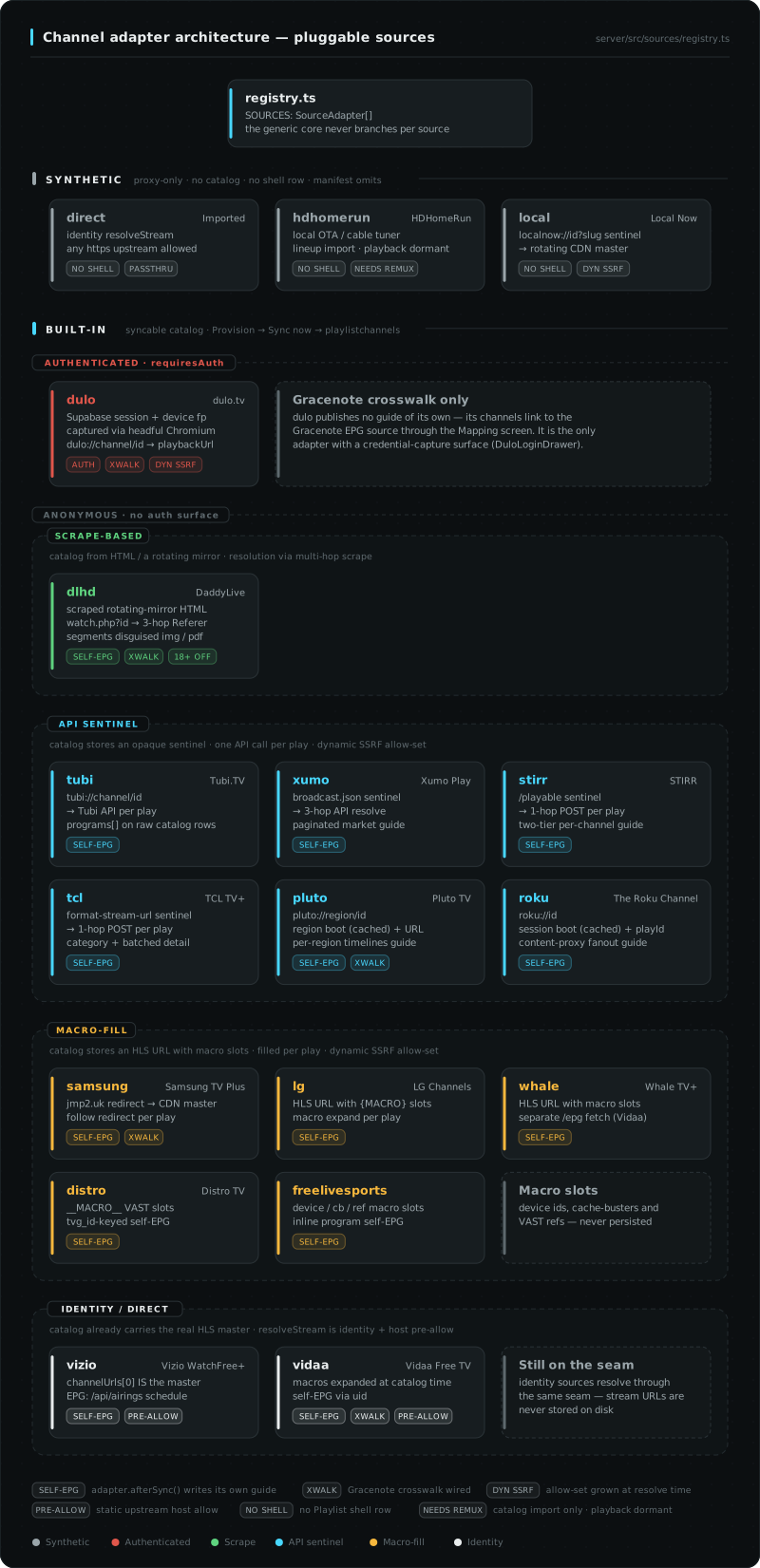
Key Properties Summary
| Adapter | Label | Auth | Resolve Strategy | Self-EPG | Gracenote XWalk |
|---|---|---|---|---|---|
direct |
Imported | — | Identity (passthrough) | — | — |
hdhomerun |
HDHomeRun | — | Catalog import (playback dormant — needs remux) | — | — |
local |
Local Now | — | Sentinel → rotating CDN | — | — |
dulo |
dulo.tv (default; operator-set) | session | dulo:// sentinel → playbackUrl |
— | yes |
dlhd |
DaddyLive | — | watch.php → 3-hop scrape, 6 providers |
yes | yes |
tubi |
Tubi.TV | — | …/oz/epg/programming?content_id= → Tubi API (JWT manifest) |
yes (inline) | yes |
xumo |
Xumo Play | — | broadcast.json → 3-hop API | yes | yes (wired) |
stirr |
STIRR | — | /playable → 1-hop POST |
yes | yes (wired) |
tcl |
TCL TV+ | — | format-stream-url → 1-hop POST |
yes | yes (wired) |
pluto |
Pluto TV | — | pluto:// → region boot + URL |
yes | yes (wired) |
roku |
The Roku Channel | — | roku:// → session + playId |
yes | yes (wired) |
plex |
Plex | — | plex:// → anon JWT + signed master |
yes | yes (wired) |
samsung |
Samsung TV Plus | — | jmp2.uk redirect | yes | yes (wired) |
lg |
LG Channels | — | {MACRO} fill per play |
yes | yes (wired) |
whale |
Whale TV+ | — | macro fill per play | yes | yes (wired) |
distro |
Distro TV | — | __MACRO__ fill per play |
yes | yes (wired) |
freelivesports |
FreeLiveSports | — | macro fill per play | yes | yes (wired) |
vizio |
Vizio WatchFree+ | — | Identity (direct HLS master) | yes (airings) | yes (wired) |
vidaa |
Vidaa Free TV | — | Identity (macros pre-expanded) | yes | yes (wired) |
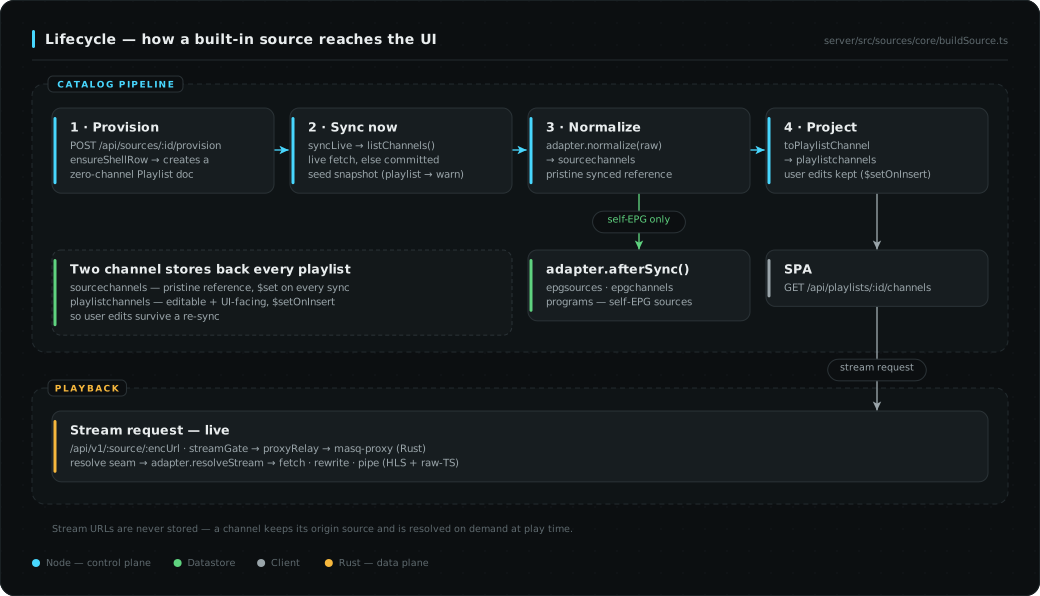
Lifecycle: how a built-in source reaches the UI
Playlists
Scope: the playlist data model — what a playlist is, the built-in vs. custom kinds, how guide data binds to it, and how per-user access is granted. The catalog (
playlistchannels) and the export surface (.m3u+ XMLTV guide sibling) meet here.
How Playlists work
A Playlist is a row in the playlists collection — the envelope (name, hosted URL, endpoint mode,
schedule, state). Its channels live separately in playlistchannels, queried by the playlist's
source (or clone) id. A playlist row with no channels is a valid, paused shell.
- Two channel stores back every playlist. A sync writes a pristine, source-of-truth
sourcechannelsreference, then projects it into the editable, UI-facingplaylistchannels. You edit the latter (rename, disable, channel #, EPG link) and your edits survive a re-sync: a sync$sets source-derived fields,$setOnInserts the user-editable ones, and prunes channels that vanished upstream. - Hosted URL + endpoint mode. A
global-endpoint playlist is served through the one consolidated Global M3U endpoint; acustom-endpoint playlist is served at its own path. Theurl("HOSTED AT") always prependssettings.domain, so changing the domain in Settings cascades to every playlist's URL. - State + schedule.
state:falsepauses the endpoint (downstream clients get a 404).interval+autodrive the scheduler; a manual Sync now is always available. - Streaming is resolve-on-demand. A channel's stream URL is derived (
/api/v1/<source>/<enc-entry>), never stored — the Rust video proxy resolves the real upstream at play time. Every channel keeps itsoriginsource, so a cloned or imported channel routes through the right adapter's resolver.
What kinds of playlists are possible
| Kind | source tag |
Created via | Channels |
|---|---|---|---|
| (Default) source playlist | <dynamic> |
Add Playlist → Built-In (provisions a zero-channel shell; populates on first Sync now) | Synced from the adapter; id === source |
| Clone | clone |
Add Playlist → Clone — hand-pick channels from any synced source | Independent COPIES in playlistchannels; origin = the provider source for routing |
| URL import | url |
Add Playlist → URL — fetch a remote .m3u / .m3u8 |
Parsed from the upstream; re-syncable via the stored remoteUrl |
| File upload | file |
Add Playlist → File — upload a static .m3u |
Parsed once from the uploaded file |
| HDHomeRun | hdhomerun |
Add Playlist → HDHomeRun — point at a LAN tuner (deviceUrl) |
Discovered from the device (channel lineup); playback (TS→HLS remux) is dormant pending remux support in the video engine |
Built-in defaults are Global-endpoint by default; the custom kinds are Custom-endpoint and ride the
per-playlist export machinery (their own path + guide sibling). All the type tags (clone/file/url/
hdhomerun) and modes (global/custom) are stored lowercase.
Failover groups (channel backups)
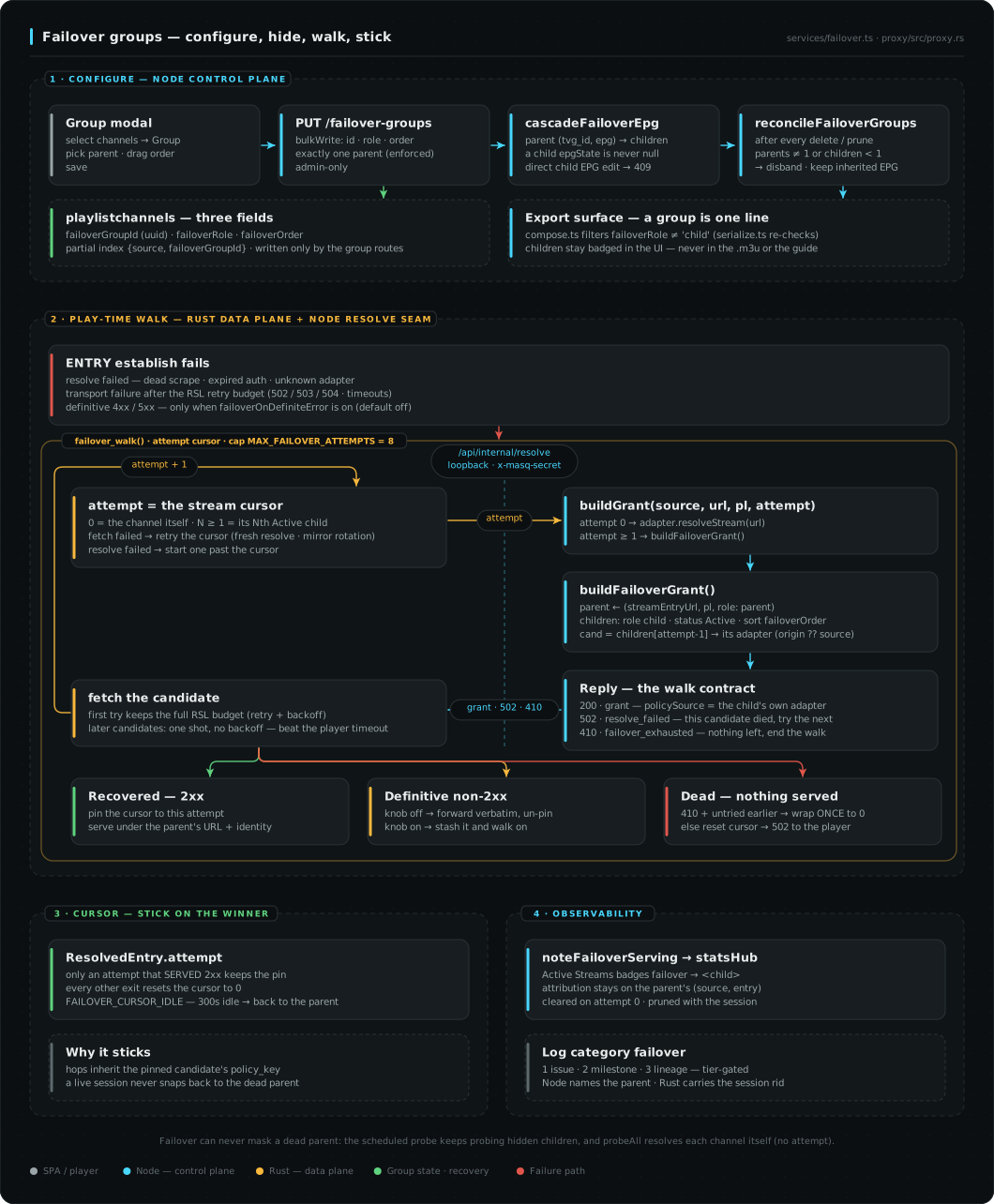
Any playlist's channels can be grouped into a failover group: one parent plus an ordered list of children — silent backups for the same real-world channel, possibly from different providers. Select the channels on the playlist detail screen → Group → pick the parent, drag the children into priority order, save.
- One line exported. The composed M3U (and its guide) contains only the parent; children are
hidden from every export surface but stay visible (badged
parent/child) in the management UI. - EPG identity is inherited. Children mirror the parent's
tvg_id/epglink — set at group save and re-cascaded whenever the parent's EPG link changes (drawer, Mapping screen, bulk edits). Direct EPG edits on a child are rejected (409 failover_child_epg_locked); auto-match skips children. - Observability. Active Streams badges a failed-over stream with
failover → <child>; the scheduled channel probe keeps probing hidden children (except those from aprobeExemptsource such as DaddyLive), so a dead backup is visible before failover ever reaches it. - Self-healing. Any prune/delete that removes a group's parent (or its last child) auto-disbands the
group; disbanding is also available in the Group modal — children keep their inherited EPG link but
re-enter the export. Children must stay Active to remain probe-covered and candidate-eligible
(a
Disabledchild is skipped at failover; aDisabledparent hides the whole group from exports).
Knobs: failoverEnabled (default on — configuring a group is the real opt-in) and
failoverOnDefiniteError (default off) in the proxyconfigs subsystem.
Seamless mid-segment splicing is a future enhancement — a parent dying mid-play is caught on the player's
next playlist refetch.
DaddyLive players (alternate upstreams)
DaddyLive's channel pages offer PLAYER 1..6. These are not redundant embeds of one feed — each
button loads a different third-party provider, and they do not all carry the same channels. Ch 648
(Boomerang USA), verified live: Player 1's own CDN 404s it, Players 2/3/5/6 are Cloudflare-gated, dead or
NXDOMAIN, and only Player 4 — an entirely separate operator — actually carries it.
So picking a player picks a provider, and which provider works varies per channel and drifts over time. The resolver is built around that:
- Provider-agnostic hop 2. Any
<iframe>on the player page is a candidate (the/premiumtv/embed is simply tried first). An embed page that only frames the real player page is followed up to two levels deep, sending the Referer a browser would. The signed playlist URL is read by a chain of extractors that ALL run and pool their candidates by rank, so a decoy.m3u8can't hide the real one: base64/atob, the chunk-shuffled_econfigJSON config, an XOR-arrayevalblob, a p·a·c·k·e·d payload, base64 chunks joined through a localatobdecoder, a character array joined with DOM text, hex escapes, and plaintext last (sources/adapters/dlhd/embedExtractors.ts). Each recovers whatever constants the page carries rather than hardcoding them — the_econfiglayout (chunk count, junk index, order) is recovered from the payload itself — so a key rotation self-heals; a genuinely new obfuscation is a ~10-line addition.tsx scripts/dlhd-extractor-check.ts(fromserver/) is the offline gate for every family. - Both playlist shapes are valid. Providers return either a master (
#EXT-X-STREAM-INF) or a media playlist (#EXTINF) — an#EXTM3Uwith neither is now rejected instead of being served as an empty stream. - Learned + sticky. The winning player is remembered per channel (~30 min) and a failing one is burnt
(~5 min), so the common case stays a single hop-1 fetch even when the winner isn't Player 1
(
playerMemory.ts). The operator's pick —defaultPlayerin Playlist Domain / Configuration, or the per-channel override in the channel drawer — always leads; the rest are the fallback order. - Bounded. Every hop has a timeout (
DLHD_HOP_TIMEOUT_MS, 8 s) and the whole walk has a deadline (DLHD_RESOLVE_BUDGET_MS, 20 s) so a hanging provider can't outlast a player's manifest timeout. - Frugal with the mirror. Hop 1 is the mirror's heaviest page and the traffic that gets an IP rate-limited
(on 2026-09-15 the origin behind every advertised mirror began refusing this server outright). So each
player page's embed list is cached (~20 min) and a renewal goes straight to hop 2. The
watch.phpplayer list is cached too (~30 min). Concurrent resolves of a channel share one walk, and a walk that found no working player is replayed for ~90 s rather than repeated on every client retry. A hop-1 refusal, unresolvable domain or HTTP429stops the walk at once and opens a mirror-wide breaker (~60 s), so every channel stops knocking; the error then says whether changingdaddylive.domaincan help at all (resolveCache.ts,transport.ts). DaddyLive isprobeExemptfor the same reason. - Play-time rotation. The data plane's first failover attempt re-resolves the same channel through a
different provider (the seam burns the one that was serving); only then does it start walking the
channel's configured failover-group children. Active Streams badges
the result —
failover → Player 4.
Knobs: DLHD_PLAYER_STICKY_MS, DLHD_PLAYER_BURN_MS, DLHD_HOP_TIMEOUT_MS, DLHD_RESOLVE_BUDGET_MS,
DLHD_EMBED_CACHE_MS, DLHD_PLAYER_LIST_CACHE_MS, DLHD_FAILURE_CACHE_MS, DLHD_MIRROR_BREAKER_MS.
(The mirror itself and the source-wide default player are operator settings — daddylive.domain and
defaultPlayer in Playlist Domain / Configuration; the old DLHD_BASE / DLHD_PLAYER env vars are gone.)
These providers are third parties that rotate — this layer is the most churn-prone part of the adapter by design. When DaddyLive itself stops carrying a channel on every player, failover groups are the durable answer.
Playlists + EPG Sources with Playlist Binding
Guide data reaches a playlist through two distinct mechanisms — keep them separate:
- Channel-level guide linking (the everyday case). EPG attaches to a playlist through its channels,
not the playlist row. Each channel carries a 2-factor
(tvg_id, epg)link — set on the Channel Mapping screen, self-linked by sources that ship their own EPG, or crosswalked by a built-in's committed map onto guides you already have (dlhd / dulo / tubi by(epg, tvg_id)pair. At compose time the guide is built from exactly the channels that carry a link, so "which EPG sources feed this playlist" is simply whichever sources its channels are mapped to — many sources can contribute to one playlist's guide. - **Playlist-bound EPG sources (
playlistBinding). Built-in carry their own inline guide. When you sync such a playlist, itsafterSynchook writes the guide and upserts a matching EPG source row flaggedplaylistBinding: true, then self-links the playlist's channels to it. These rows are owned by the playlist's sync — the playlist drives their refresh cadence, so the EPG Sources screen hides their manual-sync + schedule controls. You never add or schedule them by hand.
Assigning Playlist access to users
- Access is a per-user allow-list, split to mirror the endpoint modes:
allowedPlaylists(Global-endpoint playlists) andallowedCustomPlaylists(Custom-endpoint playlists). - You assign membership on the Playlists screen (per playlist — it was moved here off the Users screen), not by editing the user.
- Admins ⇒ every playlist. An admin account's allow-lists are materialized to hold every playlist id (a real invariant, not just a role bypass), and creating a new playlist auto-grants it to all admins — so an admin always sees the full catalog.
- Each user gets a personal, tokenized
.m3u+ XMLTV guide URL for their IPTV client: the download is token-free, but the stream is token-gated to that user's allowed playlists.
EPG Sources
Scope: the guide-data subsystem — what an EPG source is, the provider kinds, the one shared sync path, how playlist-bound self-EPG differs, and how guide data is woven into a playlist's
.m3uat compose time. The XMLTV wire format itself is the sibling of the M3U export.
How EPG Sources work
An EPG source is a row in epgsources registering one guide provider. A sync writes two collections:
epgchannels (one row per guide channel) and programs (the airings), both keyed by a composite
<epg>:<tvg_id> id so multiple sources never collide.
- One shared sync path. Every kind goes through
syncEpgSource.ts, whether triggered by a manual Sync now or by a scheduler tick; it maintains the per-sourcesyncSuccessCount/syncFailCountandstatus. - A sync is a per-source replace. The source's old channels/programs are swapped for the fresh pull. The
streaming-XMLTV path replaces up-front, so a mid-stream failure marks the source
errorand the next good sync heals it cleanly (the sharedepgchannels/programscollections are scoped bysource). - Reorder + run-stats. The EPG Sources screen is drag-to-reorder (
order); the guide-generation run-stats (lastXmlAt,xmlGeneratedCount,xmlFailCount) are credited during compose (below).
What kinds of EPG Sources are possible
The source discriminator (stored lowercase):
| Kind | Added via | Notes |
|---|---|---|
| gracenote | Add EPG Source → Gracenote | Provider/lineup grid; provenance fields (headend / lineup / postal / country / …) let the grid URL be rebuilt + re-synced |
| epg-pw | Add EPG Source → EPG-PW | epg.pw per-channel XML |
| jesmann | Add EPG Source → Jesmann (guided picker) | Large national XMLTV guides, streamed so multi-GB files parse with bounded memory |
| xml file | Add EPG Source → Custom (upload) | One-shot uploaded XMLTV document |
| remote url | Add EPG Source → Custom (URL) | Re-fetchable remote XMLTV URL (streamed, gzip-aware) |
| playlist-bound | (automatic) — the playlist's afterSync binding |
Playlist-bound self-EPG (playlistBinding:true); not user-added |
EPG Sources with a Playlist Binding + the syncing process
- Standalone sources (gracenote / epg-pw / jesmann / custom XMLTV) sync on demand or on a
cronjobsschedule, independent of any playlist. - Playlist-bound sources (built-in) have no manual sync of their own. They are written by the
playlist's
afterSynchook off the same listing that playlist sync already fetched, and the bound source row is re-asserted (playlistBinding:true) on every playlist sync. To refresh a bound guide you sync its playlist — the EPG Sources screen deliberately hides their sync/schedule controls because the playlist owns the cadence. - Either way, the binding between guide data and a playlist's channels is the channel-level
(tvg_id, epg)link — Channel Mapping for user-added sources, self-linked for channel-adapter built-in sources. - Built-ins that link onto your guides are re-linked after every guide sync. A built-in whose committed
crosswalk targets guides it does not own (
applyEpgLinks) would otherwise wait for its own next playlist sync to pick up a guide you just added. So every successful gracenote or jesmann sync — manual, scheduled, or the first one that runs when you add the guide — re-runs the crosswalk for each such built-in you have added, fill-only-if-untouched and never failing the guide sync.
How EPG Sources are ingested into playlists during a compose
Guide data only reaches a downstream client at compose time, and composition is playlist-scoped: a
guide is written as a sibling of the M3U by composeGuide(), which runs off the same Active channel set
composeM3u() just wrote (the Global union, or one Custom playlist) — so a guide can never drift from its M3U.
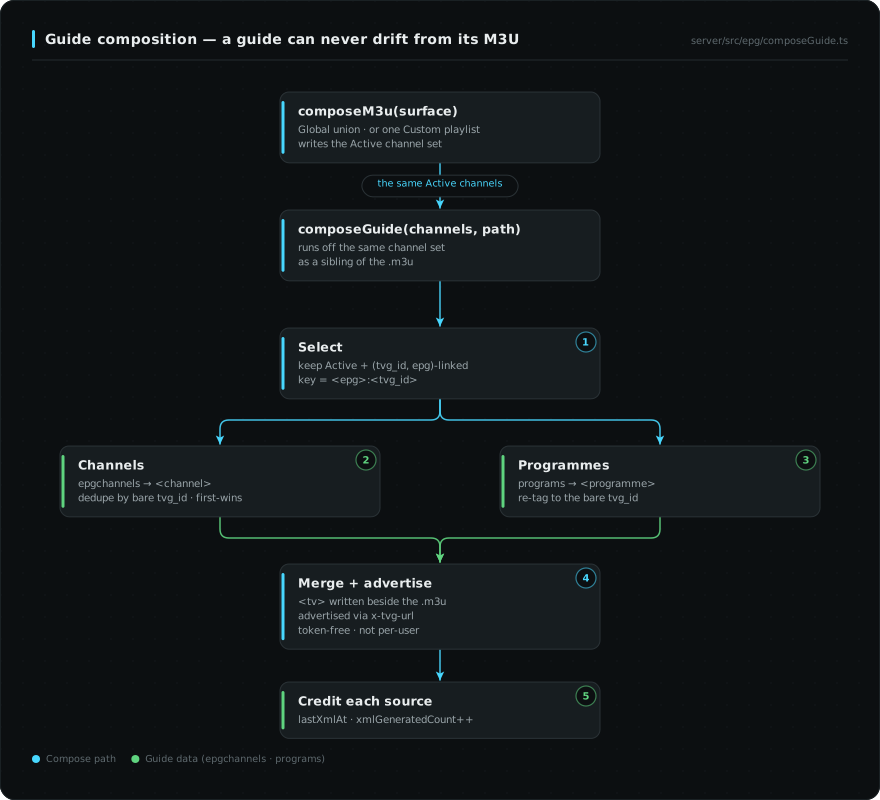
Per composed surface:
- Select — keep only Active channels that carry a 2-factor
(tvg_id, epg)link; index them by the composite key<epg>:<tvg_id>. - Channels — resolve each key's
epgchannelsrow (display-name / call-sign / channel-no) and emit one<channel>, de-duped by the baretvg_id(first-wins — two sources can publish the same id and a player can't disambiguate anyway). A channel linked to anepgchannelsrow that isn't synced yet is skipped, never orphaned. - Programmes — pull the
programsfor those keys and emit<programme>s, re-tagged to the baretvg_idso each airing matches its<channel id>. - Merge + advertise — the result merges programme data from every EPG source the playlist's channels
link to into one
<tv>document written next to the.m3u, advertised viax-tvg-url. The guide is token-free and not per-user (a superset of any one user's channels is harmless). - Credit — every contributing source gets
lastXmlAt+xmlGeneratedCount++(orxmlFailCount++on failure).
Video Proxy Engine
Scope: how masqueradarr actually serves video — a remux-free Rust data-plane sidecar (replacing an older transcode engine) that resolves each stream on demand and pipes it durably to the player. This section covers the two-plane split, the internal seams, the request path, the durability features, local origin mode, the tunable config, and the opt-in public-edge topology.
Remux-free is still true; "passthrough" no longer is. Nothing is ever re-encoded — but with local origin enabled the engine stops forwarding the provider's playlist and publishes one it wrote itself, from segments it ingested, decrypted and cached in RAM.
Two planes: Node control plane · Rust data plane
Video is split across two processes that ship in the same container:
- Node — the control plane (the brains). Everything stateful and provider-specific stays in TypeScript: per-source auth (dulo's Supabase session + device fingerprint), scraping (dlhd's rotating-mirror, 3-hop Referer-gated resolve), vetting upstream-supplied URLs, per-source stream limits, the stream-token gate, telemetry authority, and config storage.
- Rust — the data plane (the muscle). A small standalone binary,
masq-proxy(theproxy/crate), does the byte work: fetch upstream, follow redirects, rewrite.m3u8manifests, enforce the SSRF gate, and pipe segments — fast, multi-threaded, near-zero-copy. It is driven per stream by a "grant" from Node; it never re-derives provider logic or branches on which provider it is serving — what a source needs arrives as declared grant fields.
Node spawns and supervises masq-proxy as a child process (auto-restart with backoff). A missing or crashed
sidecar is non-fatal — the app keeps managing playlists / EPG / channels / users and serving M3U / XMLTV
downloads; only live playback pauses until it's back.
The data plane's SSRF gate. On the pass-through path every upstream fetch — the entry included — must be
http(s) and must not be a private IP literal unless its grant sets allowPrivate, which no grant does today
(imported playlists included); a hop named inside a manifest must also be in the stream's allow-set (see
resolve below). The local origin's ingest and the raw-TS producer apply the same private-literal check to
every segment and key they pull. "Private" means RFC 1918, loopback, link-local and unspecified IPv4, IPv6
loopback / ULA / link-local, IPv4-mapped IPv6 spellings of any of those, and the whole localhost zone. The
check reads literals only — it never resolves a hostname. Two consequences for imported (direct) playlists:
- Bracketed IPv6 literals are now judged, and a private one is refused. A URL hands an IPv6 host over as
[fd7a:…], and earlier builds never matched that form against the IPv6 rules, sohttp://[::1]/or a tailnet'shttp://[fd7a:115c:a1e0::…]:8089/passed unchecked. Import a tailnet box that you reach over IPv6 by its MagicDNS hostname instead of its address. - The shared
100.64.0.0/10range stays allowed for data-plane hops — it is carrier-grade NAT space, not RFC 1918, and it holds every Tailscale IPv4 address, so an import ofhttp://100.x.y.z:8089/…plays as it did before.
The internal seams (loopback, shared-secret)
Node and Rust talk over one private loopback channel — POST /api/internal/*, guarded by a shared
x-masq-secret (the SPA never calls it; only the Rust engine does). One contract, four jobs:
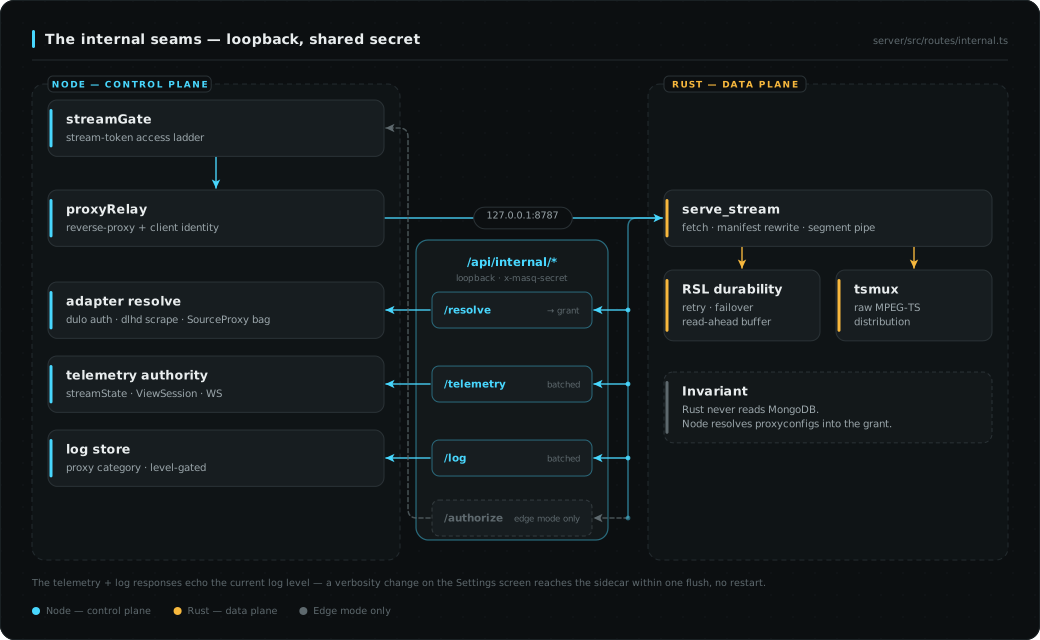
- resolve (
/api/internal/resolve) — Rust asks Node to resolve a stream; Node runs the adapter logic and returns a per-stream grant that Rust replays for the whole stream: the resolvedtarget, theupstreamHeadersfor every hop (the ones the resolve reported for this stream when it has them — DaddyLive's player-pageReferer/Origin— else the adapter's rule; operatorheaderOverrideson top),relabelSegment,allowPrivate, the resolvedproxyConfig, the adapter's declared capabilities (playerSelectable,adSignature,segmentUnwrap), the target's ownexpiresAtMswhen the adapter knows it, andpolicySource/failoverfor a failover candidate. There is no host list in it: Rust seeds its per-source SSRF allow-set fromtargetand grows it from the hosts it finds in the manifests it rewrites. Two non-grant answers are terminal:410 failover_exhaustedends a failover walk, and429 source_stream_cap(a source at its concurrent-stream limit) is relayed to the player as-is — no walk, no retry. Node sends that429only where no candidate could carry the stream instead; a limit a failover backup can route around is answered as an ordinary walkable502, and its error is neversource_stream_cap. A re-resolve the data plane makes because its target failed carries areason;target_rejectedandrefresh_failedask the adapter for a freshly resolved target rather than one it cached (ResolveStreamOptions.fresh), while a scheduled renewal carries none. - telemetry (
/api/internal/telemetry) — Rust measures the true byte edge and reports batched viewer / byte / phase / close events; Node stays the telemetry authority (Active Streams WS, History / Metrics, persistedViewSession). - log (
/api/internal/log) — Rust ships level-gated, request-tagged engine logs into the dedicatedproxylog category — the same "View logs" drawer as everything else. - authorize (
/api/internal/authorize) — edge mode only (below): the per-request stream-token check when Rust owns the public socket.
The telemetry + log responses both echo { logLevel, nameservers }, so changing verbosity or the DNS
nameservers on the Settings screen reaches the sidecar within one flush — no restart. Both are also stamped
into the sidecar's environment at spawn (MASQ_LOG_LEVEL, MASQ_NAMESERVERS). The nameservers drive the
data plane's upstream resolver with the same semantics as Node's dns.ts — configured servers first, the
OS resolver on any failure (NXDOMAIN included, so .local / LAN names keep working), IP literals never
resolved, A before AAAA — while Rust's own loopback calls to Node always stay on the system resolver, so no
DNS setting can cut the data plane off from its control plane.
How a stream request flows
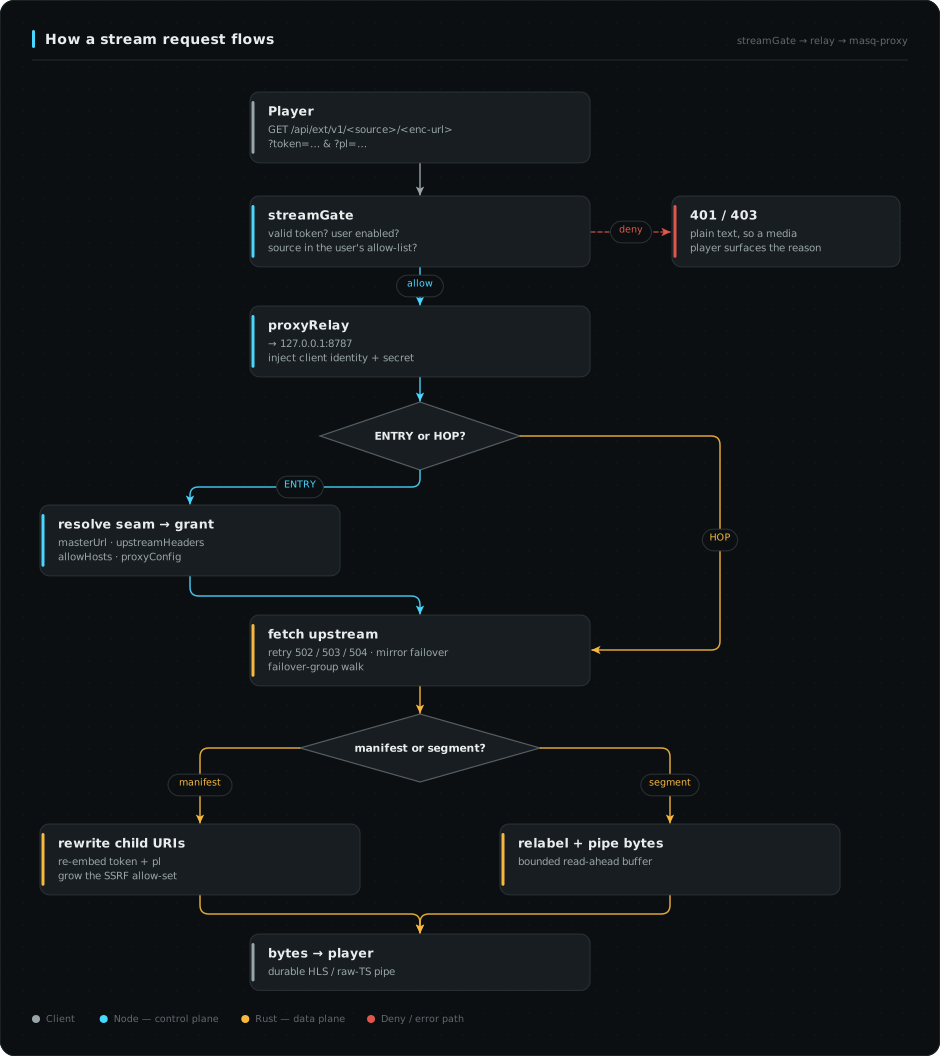
- A player requests
/api/v1/…(in-app) or/api/ext/v1/…(external clients; the mount the composed M3U always emits), carrying the per-user?token=and the?pl=playlist id. - The stream-token gate runs first: valid token? enabled? (for a non-admin) is this source in the user's allow-list? Denials are plain text so a media player surfaces them.
- On allow, Node relays the request to the sidecar and adds the client identity it can see (IP, UA, username) plus the shared secret.
- Inside Rust, the first request (ENTRY) resolves via the seam to get the grant + master URL; child
requests (HOP — variant playlists, segments, keys) reuse the cached policy. Manifests are rewritten so
every child URL routes back through the proxy with the token re-embedded; segments are relabelled — and,
for a source whose grant carries
segmentUnwrap, stripped of their disguise — and piped straight through. - A media segment whose upstream name a libavformat client would refuse (
.png,.image?…, any signed?query) gets a clean media tail on its hop URL —…/h/<encoded upstream>/s.ts?token=…— that the router strips again before decoding. ffmpeg's HLS demuxer (mpv, Jellyfin, Plex, Channels) checks every segment URL's extension against the format it detects in the bytes; hls.js, VHS and ExoPlayer never did. The tail keeps the upstream's own extension when that one passes (a.mp3?sig→/s.mp3), uses/s.vttin a WebVTT playlist, and never touches keys, init sections or playlists; a plainseg.tshop keeps its old shape byte for byte, and hops minted before tails existed still route.
Durability + raw-TS
The Rust engine is built to keep a stream alive on flaky upstreams:
- Retry — transient upstream failures (transport errors +
502/503/504) are retried with bounded backoff; definitive4xx/5xxare forwarded verbatim (unlessfailoverOnDefiniteErrorroutes them into the failover walk below). - Re-resolve — a dead resolved master forces a fresh resolve of the same channel (a new signed URL; for dlhd, a fresh player walk against its configured mirror).
- Alternate upstreams — where a source exposes several interchangeable providers per channel (dlhd's Player 1..6), a failed establish first re-resolves the SAME channel through a different provider before any configured backup is considered. See DaddyLive players.
- Failover groups — when a channel has configured backups and its stream still won't establish, the
engine walks the ordered children (
attempt=1,2,…against the resolve seam) and serves the first live one under the parent's identity, then sticks to it for the session. See Failover groups. - Signed-URL expiry — a resolved target is normally reused for 60 s; when the grant says when it expires
(
expiresAtMs), it is reused only until 60 s before that (never less than 5 s), so a reused signed URL never lapses mid-poll. A definitive401/403/410on an ENTRY drops the cached target as well, so the next request re-resolves instead of replaying a dead URL for the rest of the minute (at most once per entry per minute). That re-resolve — and the origin ingest's re-resolve after a failed playlist refresh — tells Node why, so an adapter that reuses its resolved targets mints a new one instead of handing back the one that just failed, within its own rate limit. - Stream-limit refusal — a source at its concurrent-stream limit answers a new channel with
429 source_stream_cap. That is policy, not a fault: the player gets the429and Node's message as plain text, with no failover walk, no retry loop and no upstream telemetry. When a failover backup on another provider could carry the channel, Node answers a walkable502instead and the walk plays the backup. - Stall detection — an idle read timeout (
readTimeoutMs) turns a silent upstream into a clean truncation instead of a hang. - Read-ahead buffer — a bounded in-memory buffer (
bufferSizeKb) smooths jitter and fixes the chunked / no-Content-Length byte undercount that used to fake client-side buffering. - Batched telemetry — events are coalesced and posted off the hot path, so reporting never blocks bytes.
- Raw MPEG-TS — with
outputFormat: 'ts', an external-mount stream is served as one continuousvideo/mp2tstream (segments concatenated, no remux) for players that prefer a flat TS pipe. On the passthrough path fMP4 / AES sources auto-fall back to HLS; with local origin enabled AES-128 is decrypted at ingest instead, so only fMP4 andSAMPLE-AESstill decline. A demuxed source needs more than concatenation — origin mode interleaves the pair into one program rather than declining. With local origin — and on the pass-through path for asegmentUnwrapsource — a socket's first segment is trimmed to start on a keyframe (see keyframe joins), so a join never opens on seconds of undecodable picture.
Local origin — republishing the stream
Everything above describes a rewriting proxy: the upstream playlist is fetched, its URIs are rewritten to
point back through masqueradarr, and the rest is passed through. That hides hostnames, but the client is still
looking at the provider's timeline — their media sequence, their #EXT-X-KEY, even their vendor tags.
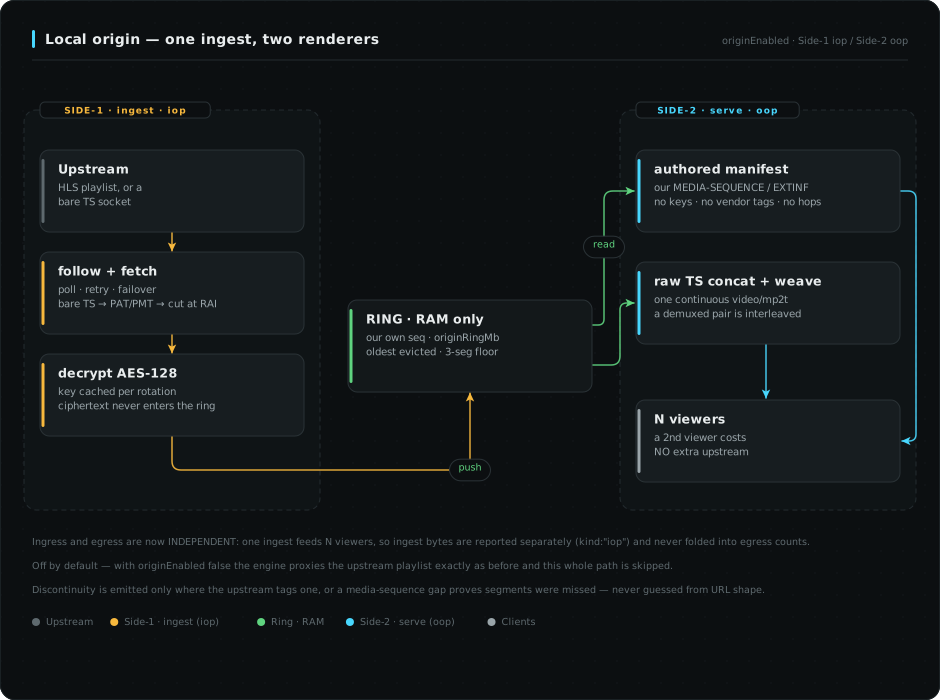
With originEnabled, masqueradarr becomes the origin instead. One ingest per channel (not per
viewer) follows the upstream, decrypts each segment, and pushes it into an in-memory ring; both output
shapes are then rendered from that ring:
originEnabled: false |
originEnabled: true |
|
|---|---|---|
outputFormat: 'hls' |
the upstream playlist, URI-rewritten | a playlist we authored + our own segment paths |
outputFormat: 'ts' |
upstream segments concatenated per viewer | the same ring concatenated (decrypts); a demuxed source is interleaved into one program |
What a player receives in origin mode contains no provider host, path, session id or query; no
#EXT-X-KEY; no vendor tags; no proxy hop URLs — only our own #EXT-X-MEDIA-SEQUENCE, #EXTINF, and
/api/…/o/<entry>/<generation>-<seq>.ts segment paths (still token-gated, since those paths are guessable by
construction).
Three consequences worth knowing:
- A second viewer of a channel costs no extra upstream bandwidth. The passthrough path fetches per viewer; the ring is shared.
- Encrypted sources become fully supported rather than degraded. AES-128 is decrypted at ingest, so
outputFormat: 'ts'works on sources that previously fell back to HLS.SAMPLE-AES/ FairPlay and fMP4 remain out of scope and decline cleanly, with a WARN naming the reason. - Ad-stitched sources still show
#EXT-X-DISCONTINUITYat real splices. That is in-spec output, not a leak — it says nothing about the origin — and every player handles it. The engine emits it only where the upstream tags one, or where a media-sequence gap proves segments were missed; it deliberately does not guess splices from URL shape (that was tried, and produced false positives on two different CDNs).
Demuxed sources and the interleaving muxer
Audio in its own #EXT-X-MEDIA rendition. Some providers — pluto on every device
cohort — offer no muxed variant at all: every #EXT-X-STREAM-INF defers its audio to a separate rendition
playlist. Following the variant alone would ring, and serve, video only. The engine therefore rings the
pair: one ring entry holds the video segment and its audio partner, and the entry URL answers with a
small master we author over two media playlists of our own (…/o/<entry>/v.m3u8 and
…/o/<entry>/a.m3u8).
Three properties make this safe, and all three are load-bearing:
- The pair is matched on the wall clock, not the sequence number.
#EXT-X-PROGRAM-DATE-TIMEdates the media itself, so it survives a renumbering; the media sequence only looks like a cross-rendition identity. Pluto renumbers the two renditions independently across a session renewal — its stitcher ends the playlist every ~25 s — so a fresh video playlist can open at sequence 10 against the audio's 11 for the same media, and index pairing then puts every pair of that session about one segment out. The sequence index remains the fallback for a source that publishes no PDT, where an aligned pair resolves to the same segment either way. Each lane's own sequence still matters once a partner is picked: an absent#EXT-X-KEYIV is derived from it (RFC 8216 §5.2), and the two lanes' numbers are exactly what diverge. - One offset, both lanes. A single affine shift is computed from the video lane's DTS and applied to both renditions, so the source's authored A/V skew is translated rather than replaced. Computing an offset per lane would manufacture a lip-sync error that was not in the source. A skew guard declines the pair outright if the lanes' offset ever moves more than half a second from the skew locked on the first pair — it bounds the DRIFT, not the skew's own magnitude, which a source is free to author as large as it likes — and a declined pair publishes both lanes verbatim so they stay in sync with each other.
- Both lanes get the PID remap. An ad creative is JIT-transmuxed into separate video and audio sources with their own arbitrary PSI, so the pids churn on both sides of a pod edge — normalising only the video would leave the audio track dying at every break.
The two authored playlists are rendered from the same ring entries, so their media sequence, discontinuity
sequence, #EXTINF ladder and #EXT-X-PROGRAM-DATE-TIME anchors are identical by construction.
outputFormat: 'ts' on a demuxed source — the interleaving muxer. HLS can publish a pair as two
playlists; raw TS is one socket, and two transport streams do not concatenate. That used to be a decline,
which meant the one source shape local origin exists for was exactly the shape raw TS could not serve. It is
now woven instead: the two lanes are folded into one authored program on the way out, off the same ring
the HLS lanes are rendered from.
The muxer is small because the pairing above already did the hard part — one shared clock, disjoint canonical pids, correct per-pid continuity counters. So the weave is transport-layer only, with no decode, no re-encode and no timestamp rewriting: drop each lane's PSI and padding, emit one PAT + one PMT declaring both elementary streams, and merge the two lanes' PES access units in decode order (video keyed on DTS, audio on PTS — for AAC they are the same thing). Per-pid packet order survives by construction, because an access unit is contiguous within its pid.
Three details worth knowing:
- No PCR is generated. The video lane's clock references were already shifted by the shared offset and the
merge keeps the video lane's relative order, so PCR stays monotonic and its spacing in stream time is
unchanged. The published PMT names the video pid as
PCR_PID. - The published program is locked on the first woven pair and re-emitted byte-identically, on a ~110 ms cadence so a demuxer that resyncs finds it again quickly. A later pair whose stream set differs is declined rather than republished under a changed table — a PMT that changes shape mid-socket is itself a reconfiguration event.
- A declined pair is skipped, not served verbatim: there is no verbatim option when the output is one
socket. The reason is logged under
oop, latched per distinct cause, and three consecutive declines end the socket cleanly so the client reconnects instead of watching a stream that is open but frozen.
spliceNormalize does not gate this path — it is the kill switch for splice absorption, but authoring
one program out of two renditions requires the pid remap and shared clock to exist at all. Set
outputFormat: 'hls' to publish the two renditions untouched.
RAM, not disk. The ring holds decrypted media and is never written to disk. It is bounded per channel
by originRingMb (default 25 MiB ≈ a minute at 3.3 Mbps), oldest segment evicted first, with a hard floor of
3 segments so the window stays playable — when a source's bitrate makes the floor beat the cap, that is
logged so the cap can be raised rather than leaving unexplained stalls. There is no global ceiling across
channels yet, so a many-channel box wants a conservative per-channel value.
Bare-TS sources. A direct / hdhomerun upstream arrives as one endless socket with no playlist, so the
engine finds the boundaries itself: it reads the PSI tables (PAT → PMT) for the video PID and cuts at packets
flagged as random-access points, deriving each segment's duration from the stream's own PCR clock. Those
segments join the same ring, so such a source republishes as ordinary HLS.
Observability — iop vs oop. Once one ingest feeds N viewers, ingress and egress are independent
quantities, so a stuttering channel has two possible causes. The engine tags every ingest line iop
(input operation — resolve, poll, fetch, decrypt, ring push/evict) and every serving line oop (output
operation — manifest render, segment serve, TS concat), both under the proxy log category. Active Streams
shows both sides per channel: Delivery is what viewers receive, Ingest / Ring / Upstream pulled is
what the single shared ingest is doing.
Signed URLs, disguised segments and keyframe joins
Some upstreams hand out URLs that expire, hide their media inside another container, or cut segments that do not start on a picture a decoder can show.
- Disguised segments. A segment can arrive wrapped. The ingest unwraps every source's segments at fetch
time (a slice, not a remux — the TS bytes are untouched), so the splice scan, the ring and both renderers
only ever see clean TS; the wrapper is reported on the ingest's
ioptelemetry (segmentWrapper) and logged once. Detection is structural, never a fixed offset: a body that already starts on a sync byte is left alone; otherwise a RIFF/WEBP chunk walk takes an EXIF payload that starts on0x47and is a whole number of 188-byte packets; otherwise the first offset within 4 KiB where five sync bytes line up 188 bytes apart. fMP4, ADTS audio, WebVTT, keys and HTML are never touched. The pass-through paths — the relay and the pass-through raw-TS producer — strip a wrapper only for a policy whose grant carriessegmentUnwrap(streaming, holding at most ~5 KB), so every other source's bytes stay byte-identical; for those policies the rewritten playlist also drops a false#EXT-X-INDEPENDENT-SEGMENTS. - Token continuity. When the ingest re-resolves the same candidate (not a failover escalation) and the
fresh window still lists — or abuts, or has slid at most 30 segments past — the segment it would have
fetched next, it keeps the ring, its generation, the splicers and the upstream cursor: the overlap is
deduped, a slide is still marked as a sequence gap, and viewers see nothing change. Anything else (a
different candidate, an escalation, a window renumbered below ours) resets the ring and forces
#EXT-X-DISCONTINUITYonto the first new segment. Before this, an expired signed URL dropped the whole ring: every segment URL a client held turned404, every viewer waited for three segments to re-land, and the overlap replayed as new media with no tag to warn the player. - Renewal ahead of expiry. With
expiresAtMsin the grant, the ingest re-resolves 60 s before the target expires (never sooner than 30 s after the resolve that scheduled it) through the keep-ring path above, while the old target still plays; a failed renewal retries in 15 s. - Bounded reads and backoff. Every origin read — segment, key, playlist refresh, the entry, a bare-TS
socket's silence — is bounded by max(
readTimeoutMs, 3 × target duration (capped at 120 s), 10 s); before, a CDN connection that went quiet mid-body could park the ingest forever with the ring frozen. Repeated failures back off 2 s → 4 → 8 … → 60 s and reset when media lands, but the first retry is immediate — so a routine expiry403followed by a fresh resolve never waits. - Refusals end promptly. An ingest whose resolve is refused with
429 source_stream_capstops at once, and clients asking for that channel get the429straight away instead of a503after waiting 20 s for a ring that will never fill. - Keyframe joins. A raw-TS socket's first segment is cut to start at the PAT/PMT plus the packet that opens
the first keyframe (H.264 IDR, HEVC IRAP), found by a full NAL scan. Only that socket's bytes are trimmed: the shared ring is
untouched, a segment with no keyframe is sent whole, and later segments stream as before. On the origin this
applies to every source; on the pass-through raw-TS path, to
segmentUnwrapsources.
Tuning knobs — the proxyconfigs subsystem
The engine's knobs live in the proxyconfigs collection (the videoconfig successor), edited in the UI and
resolved by Node into each grant (Rust never reads MongoDB). Two tiers, doc-level fallback:
_id: 'app'— the (Default) config applied to every playlist. Edited on Settings → Advanced._id: 'app_<playlistId>'— a (Custom) per-playlist override that fully replaces the Default for that playlist. Edited in the playlist drawer (ProxyConfigPanel.vue, auto-saved).
| Knob | Status | Effect |
|---|---|---|
headerOverrides |
live | extra upstream headers, merged over the adapter's (operator wins) |
connectTimeoutMs, maxRedirects |
live | per-config upstream HTTP client (cached in Rust) |
readTimeoutMs, bufferSizeKb |
live | per-stream stall timeout + read-ahead buffer size (on the origin, readTimeoutMs is one term of the ingest's read bound) |
outputFormat (hls | ts) |
live | distribution shape (ts = continuous MPEG-TS, external mount only) |
originEnabled |
live | local origin: republish from our own ring instead of proxying the upstream playlist (default off = today's output byte-for-byte). Forced on in the grant for a source that declares originRequired, whatever the stored value — the panel shows forced by , and keeps originRingMb / spliceNormalize editable even with its own toggle off, because those streams run on them |
originRingMb |
live | per-channel ring cap in MiB (default 25); a 3-segment floor still wins over it |
failoverEnabled |
live | walk a channel's ordered failover children on an establish failure (default on) |
failoverOnDefiniteError |
live | also treat a definitive upstream 4xx/5xx as a failover trigger (default off) |
segmentCacheTtlSec |
reserved | shipped in the grant, not yet enforced |
Public edge mode (MASQ_EDGE)
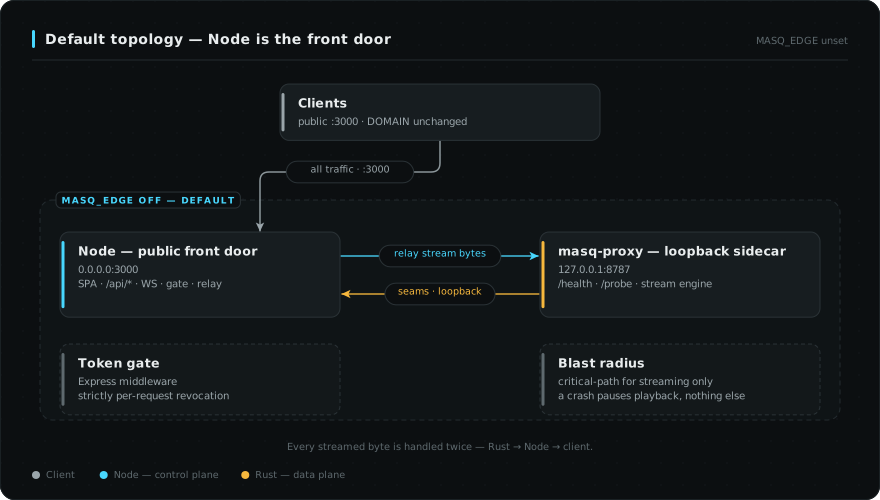
By default Node is the public front door and Rust is a loopback-only sidecar it relays bytes to.
Setting MASQ_EDGE=1 inverts the topology: Rust binds the public port and serves streams
in-process, while reverse-proxying everything else — the SPA, /api/*, the token-free .m3u / guide
downloads, and all four WebSockets — back to Node on a loopback internal port. The public port and DOMAIN
are unchanged, and it's fully reversible by clearing the flag (no rebuild).
Default — MASQ_EDGE off (Node is the front door):
MASQ_EDGE=1 (Rust is the front door):
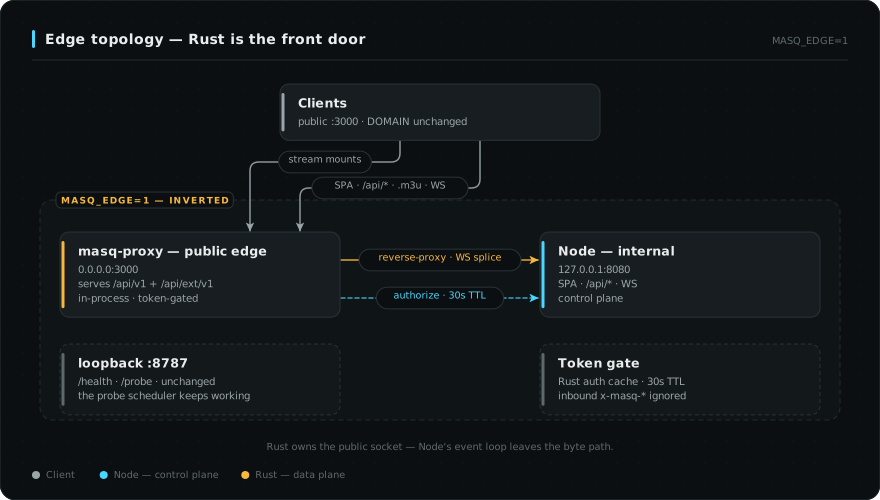
What changes under the hood. In edge mode the token gate can't be Express middleware (Rust owns the
socket), so it becomes a per-request check against a small Rust auth cache backed by
POST /api/internal/authorize — revocation lands within a 30-second TTL (vs. strictly per-request in the
default topology). The edge synthesizes client identity server-side (forwarded-or-peer IP, real
User-Agent, gated username) and ignores inbound x-masq-* headers, so a public client can't spoof them.
Rust's loopback :8787 listener (/health + /probe) is unchanged, so the channel-probe scheduler keeps
working. Because Rust is now on the critical path for all traffic, Node restarts it unboundedly.
When to turn it on (and when not to)
The core idea: take Node's single-threaded event loop out of the video byte path. In the default topology every streamed byte is handled twice (Rust → Node → client); edge mode removes that hop.
- Many concurrent or high-bitrate viewers (the main reason) — once you're serving dozens of streams (or a few 4K ones), Node's event loop becomes the throughput ceiling and adds jitter to everything, including the dashboards you monitor from. Rust shovels bytes far better without starving the control plane.
- Keep the management UI responsive under streaming load — Node's loop stays free for the SPA, the live WebSockets, and logs no matter how much video is flowing.
- Constrained hardware (Raspberry Pi / small VPS) — halving the per-byte copies lets the same box serve noticeably more streams.
- Lowest-latency, most-durable public path — the durability engine already lives in Rust; edge mode applies its backpressure straight to the client socket instead of through Node's pipe.
- When to leave it off — a personal setup with a handful of viewers gains nothing, and the default (sidecar) topology is the simpler, more battle-tested path, keeps strictly per-request token revocation, and has a smaller blast radius (Rust is critical-path only for streaming, not everything). Edge mode is build- and unit-verified, but a full runtime end-to-end pass on a live stack is still pending — treat it as an opt-in scale / performance topology, not the default.
Download Statistics
Related apps
Explore more like this
Explore allLinks
Details
iflip721/masqueradarr-aio:latestRuntime arguments
- Web UI
http://[IP]:[PORT:3000]- Network
bridge- Shell
sh- Privileged
- false
Template configuration
Optional (default off). 1 inverts the topology so the Rust proxy owns the public port
- Value
- 1
- Target
- 3000
- Value
- 3000
- Target
- 27017
- Value
- 27017
Update MONGO_ROOT_USER to set a different username
- Value
- masqueradarr
Update MONGO_ROOT_PASS to set a different password
- Value
- changeme
- Target
- /data
- Value
- /mnt/cache/appdata/masqueradarr/mongo
- Target
- /app/compose
- Value
- /mnt/cache/appdata/masqueradarr/compose
- Target
- /app/backups
- Value
- /mnt/cache/appdata/masqueradarr/backups
Update DOMAIN to match your local system or public domain
- Value
- http://localhost:3000
- Value
- masqueradarr
- Value
- America/New_York