
All apps · 0 apps

jotty
Docker app from fccview's Repository
Overview
Readme
View on GitHub

jotty·page
A self-hosted app for your checklists and notes.
jotty·page is a lightweight alternative for managing your personal checklists and notes. It's extremely easy to deploy, keeps all your data on your own server and allows you to encrypt/decrypt your notes for your personal peace of mind.
ex rwMarkable


Join our communities
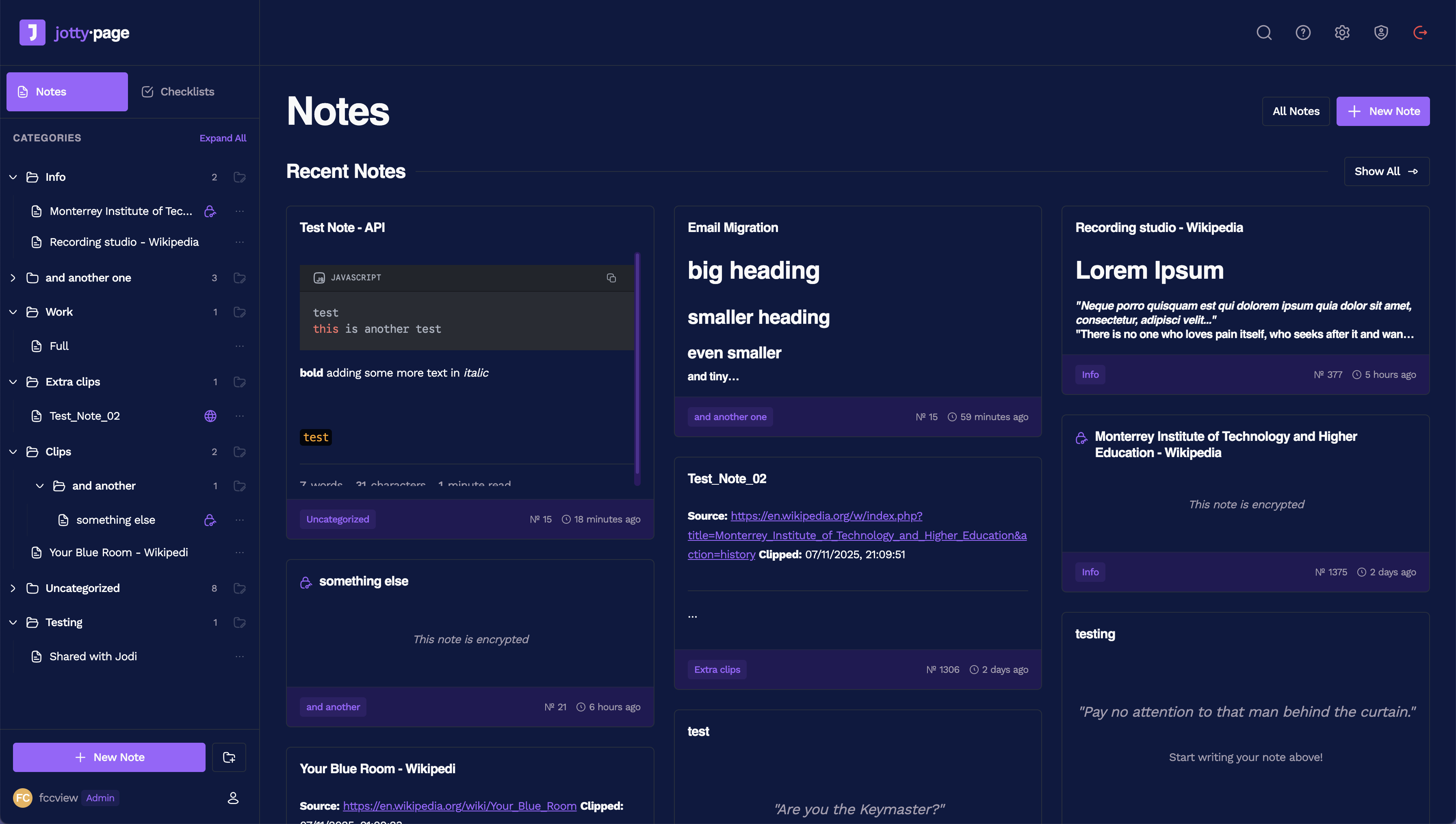
Clean, intuitive interface for managing your checklists and tasks.
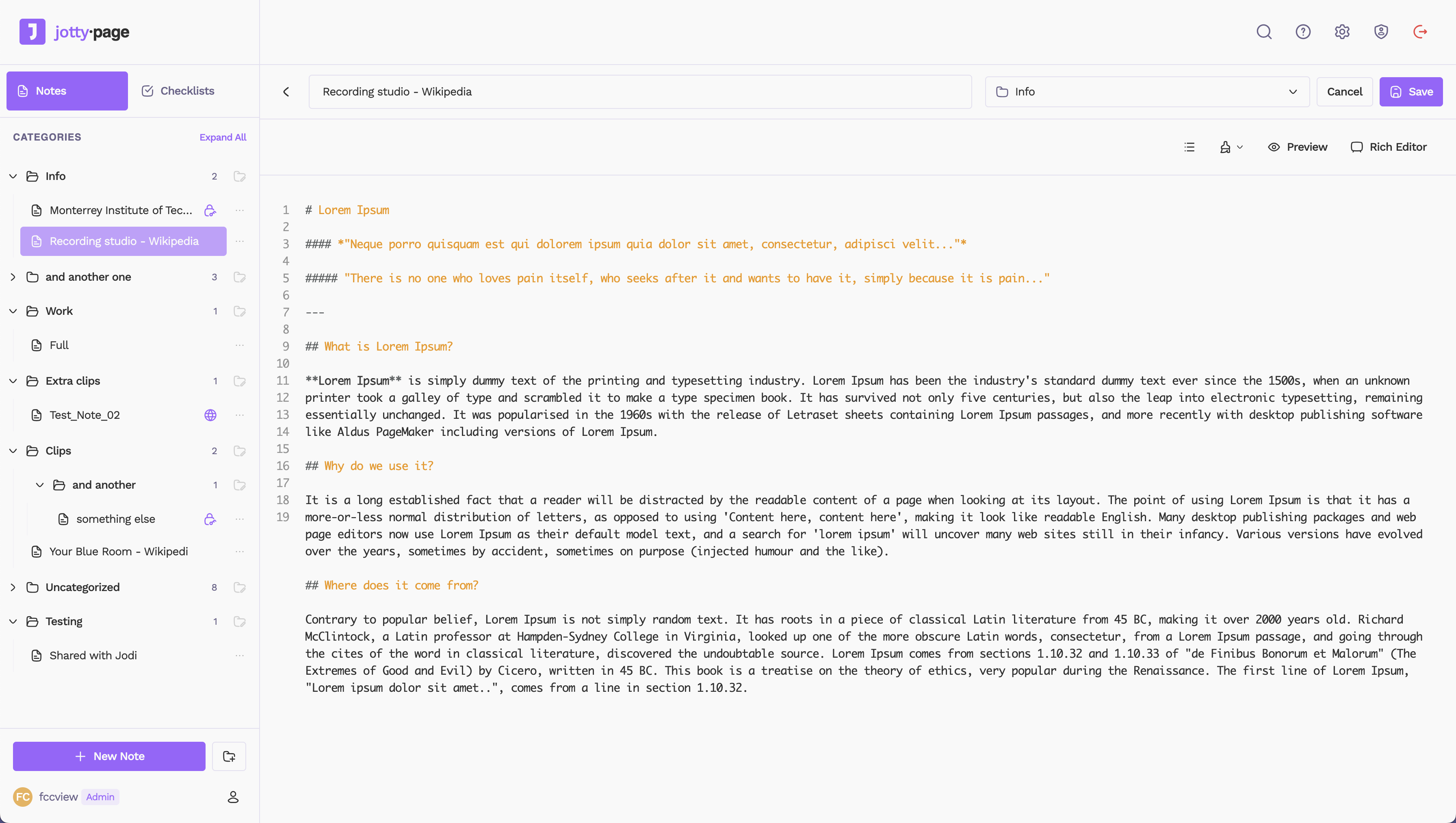
Rich text editor for notes.
Quick nav
- Features
- Getting Started
- Data Storage
- Versioning Scheme
- Encryption
- API
- Shortcuts
- Single Sign-On (SSO) with OIDC
- Multi-Factor Authentication (MFA)
- Translations
- Custom Themes and Emojis

Features
- Checklists: Create task lists with drag & drop reordering, progress bars, and categories. Supports both simple checklists and advanced task projects with Kanban boards and time tracking.
- Rich Text Notes: A clean WYSIWYG editor for your notes, powered by TipTap with full Markdown support and syntax highlighting.
- Sharing: Share checklists or notes with other users on your instance, including public sharing with shareable links.
- File-Based: No database needed! Everything is stored in simple Markdown and JSON files in a single data directory.
- User Management: An admin panel to create and manage user accounts with session tracking.
- Customisable: 14 built-in themes plus custom theme support with custom emojis and icons.
- Encryption: Full on PGP encryption, read more about it in howto/ENCRYPTION.md
- API Access: Programmatic access to your checklists and notes via REST API with authentication.
- PWA Jotty doesn't have a native app, but it's built mobile first. Once installed the PWA on your device it will feel like you installed it from the app store. There's also partial offline caching, as long as you visited a page while online Jotty will allow you to re-visit it while offline. At the moment there's no current support for offline CRUD operation.
Getting Started
My recommended way to run jotty·page is with Docker. You can also use:
- The Proxmox community script for Proxmox VE
- The Unraid template for Unraid Community Applications
Running it without Docker, from source or from the prebuilt tarball, needs Node.js 22.15 or later in the 22.x series, or Node.js 23.11 or later.
Docker Compose (Recommended)
Create a
docker-compose.ymlfile:📖 For advanced settings and more information about how the docker compose file works and what these variables do, please read howto/DOCKER.md
services:
  jotty:
    image: ghcr.io/fccview/jotty:latest
    container_name: jotty
    user: "1000:1000"
    ports:
      - "1122:3000"
    volumes:
      - ./data:/app/data:rw
      - ./config:/app/config:rw
      - ./cache:/app/.next/cache:rw
    restart: unless-stopped
    environment:
      - NODE_ENV=production
Create the data directory and set permissions:
mkdir -p config data/users data/checklists data/notes data/sharing data/encryption cache
sudo chown -R 1000:1000 data/
sudo chown -R 1000:1000 config/
sudo chown -R 1000:1000 cache/
Note: The cache directory is optional. If you don't want cache persistence, you can comment out the cache volume line in your
docker-compose.yml.Start the container:
docker compose up -d
The application will be available at http://localhost:1122.
Initial Setup
On your first visit, you'll be redirected to /auth/setup to create your admin account if SSO is disabled, otherwise you'll be prompted to sign in via your choosen SSO provider.
Once that's done, you're ready to go! First user will be admin by default.
Data Storage
jotty·page uses a simple file-based storage system inside the data/ directory.
data/checklists/: Stores all checklists as.mdfiles.data/notes/: Stores all notes as.mdfiles.data/users/: Containsusers.jsonandsessions.json.data/sharing/: Containsshared-items.json.data/encryption/: Contains all public/private keys for all users.
Make sure you back up the data directory!
Versioning Scheme
This project uses a [STABLE].[FEATURE].[FIX] versioning scheme, not strict SemVer. As a product (not a package), this format makes more sense for my specific release cycle.
My format is 1.10.1, which breaks down as:
1.x.x(Stable): The1represents the current stable generation. I will only change this (e.g., to2.0.0) for a complete rewrite or a fundamental shift in the product or seriously breaking changes.x.10.x(Feature): This is the main release number. I increment this for new features, code refactors, or significant changes (e.g.,1.9.0->1.10.0). This is the equivalent of a SemVerMINORbump.x.x.1(Fix): This is incremented only for hotfixes, bug-fix-only and very minor feature releases (e.g.,1.10.0->1.10.1). This is the equivalent of a SemVerPATCHbump.
A Note on "Breaking" Changes
A Feature release (like 1.10.0) may include major backend or data structure changes. When this happens, I will always provide an automatic migration script that runs on first launch to update your data seamlessly.
Because the migration is automatic, I do not consider this a "breaking" change that requires a 2.0.0 version.
I will always detail these migrations in the release notes. I highly recommend you back up your data before any feature update, just in case.
SUPPORTED MARKDOWN
jotty·page supports GitHub Flavored Markdown (GFM) and some custom syntax for complex functionality.
📖 For the complete MARKDOWN documentation, see howto/MARKDOWN.md
📖 For links, wikilinks and the brain view, see howto/BRAIN.md
ENCRYPTION
jotty·page uses industry standard PGP encryption.
📖 For the complete ENCRYPTION documentation, see howto/ENCRYPTION.md
API
jotty·page includes a REST API for programmatic access to your checklists and notes. This is perfect for:
- Automation: Create tasks from external systems
- Integrations: Connect with other tools and services
- Scripts: Automate repetitive tasks
- Dashboards: Build custom interfaces
📖 For the complete API documentation, see howto/API.md
SHORTCUTS
jotty·page supports a wide range of keyboard shortcuts to help you navigate and edit more efficiently without leaving the keyboard. They are divided into two main categories: global shortcuts that work anywhere in the app, and editor-specific shortcuts that work when you are writing a note.
📖 For the complete SHORTCUTS documentation, see howto/SHORTCUTS.md
Single Sign-On (SSO) with OIDC
jotty·page supports any OIDC provider (Authentik, Auth0, Keycloak, Okta, Google, EntraID, etc.)
📖 For the complete SSO documentation, see howto/SSO.md
Multi-Factor Authentication (MFA)
jotty·page supports MFA, this needs to be enabled in settings -> profile
📖 For the complete MFA documentation, see howto/MFA.md
Translations
jotty·page can be translated in multiple languages, all translations are community driven and can be found in the app/_translations directory.
📖 For the complete translations documentation, see howto/TRANSLATIONS.md
Custom Manifest
You can completely customize your PWA by creating an override manifest file. This allows you to change the app name, description, icons, colors, and more. Custom themes and emojis can be managed through the admin UI.
📖 For the complete customisation documentation, see howto/CUSTOMISATIONS.md 📖 For better understanding on how the PWA works see howto/PWA.md
Community shouts
I would like to thank the following members for raising issues and help test/debug them!


Star History
Media gallery
1 / 2Requirements
Categories
Download Statistics
Total Downloads Over Time
Related apps
Explore more like this
Explore allDetails
ghcr.io/fccview/jotty:latestRuntime arguments
- Web UI
http://[IP]:[PORT:3000]- Network
bridge- Privileged
- false
Template configuration
You can change 1122 to any available port on your host system.
- Target
- 3000
- Default
- 1122
- Value
- 1122
- Target
- /app/data
- Value
- /mnt/user/appdata/jotty/data
- Target
- /app/config
- Value
- /mnt/user/appdata/jotty/config
- Target
- /app/.next/cache
- Value
- /mnt/user/appdata/jotty/cache
Sets the Node.js environment to production mode for optimal performance and security.
- Default
- production
- Value
- production
Process User ID that the container will run as.
- Default
- 99
- Value
- 99
Process Group ID that the container will run as.
- Default
- 100
- Value
- 100
Sets the default file creation mask.
- Default
- 002
- Value
- 002
Enables HTTPS mode for secure connections.
- Default
- false|true
- Value
- false
Base URL of your jotty·page instance. Required for secure session (https) and SSO. Include the https://
- Target
- APP_URL
Allows public access to uploaded images via direct URLs.
- Target
- SERVE_PUBLIC_IMAGES
- Default
- yes|no
- Value
- yes
Allows public access to uploaded files via direct URLs.
- Target
- SERVE_PUBLIC_VIDEOS
- Default
- yes|no
- Value
- yes
Allows public access to uploaded files via direct URLs.
- Target
- SERVE_PUBLIC_FILES
- Default
- yes|no
- Value
- yes
If set to yes stops the github api call and won't give you a toast when a new update is available.
- Target
- STOP_CHECK_UPDATES
- Default
- no|yes
- Value
- no
Optional. Disables brute force protection for local login authentication. By default, accounts are temporarily locked after 3 failed login attempts with exponential delays (10s, 30s, 60s, etc.). Set to true to completely disable this security feature.
- Target
- DISABLE_BRUTEFORCE_PROTECTION
- Default
- false|true
- Value
- false
Optional. Sets the default language for the application (e.g., on the login page) when no user is logged in or a user hasn't set a preference.
- Target
- DEFAULT_LOCALE
- Default
- en
- Value
- en
Optional. Enables zooming on the PWA for accessibility reasons.
- Target
- ENABLE_PWA_ZOOM
- Default
- no|yes
- Value
- no
Enables OIDC (OpenID Connect) single sign-on or LDAP/Active Directory authentication. Set to 'oidc' or 'ldap'. Supersedes SSO_MODE.
- Target
- AUTH_MODE
- Default
- |oidc|ldap
Legacy fallback for AUTH_MODE. Kept for backward compatibility with existing setups — prefer AUTH_MODE for new installs. Leave empty if AUTH_MODE is set.
- Target
- SSO_MODE
- Default
- |oidc
URL of your OIDC provider (e.g., Authentik, Auth0, Keycloak).
- Target
- OIDC_ISSUER
Client ID from your OIDC provider configuration.
- Target
- OIDC_CLIENT_ID
Optional. Client secret for confidential OIDC client authentication.
- Target
- OIDC_CLIENT_SECRET
Optional. Path to file containing the OIDC client ID. If set, takes priority over OIDC_CLIENT_ID. Useful for Docker Secrets.
- Target
- OIDC_CLIENT_ID_FILE
Optional. Path to file containing the OIDC client secret. If set, takes priority over OIDC_CLIENT_SECRET. Useful for Docker Secrets.
- Target
- OIDC_CLIENT_SECRET_FILE
Optional. Allows both SSO and local authentication methods.
- Target
- SSO_FALLBACK_LOCAL
- Default
- yes|no
- Value
- yes
Optional. Comma-separated list of OIDC groups that should have admin privileges.
- Target
- OIDC_ADMIN_GROUPS
- Default
- admins
- Value
- admins
Optional. Comma-separated list of OIDC roles that should have admin privileges.
- Target
- OIDC_ADMIN_ROLES
- Default
- admin
- Value
- admin
Optional. Comma-separated list of OIDC groups allowed to access the application. If set, only users in these groups (or admins) can log in.
- Target
- OIDC_USER_GROUPS
Optional. Comma-separated list of OIDC roles allowed to access the application. If set, only users with these roles (or admins) can log in.
- Target
- OIDC_USER_ROLES
Scope to request for groups. Defaults to 'groups'. Set to empty string or 'no' to disable for providers like Entra ID that don't support the groups scope.
- Target
- OIDC_GROUPS_SCOPE
- Default
- groups
- Value
- groups
Optional. Custom logout URL for global logout. Full URL to redirect to when logging out.
- Target
- OIDC_LOGOUT_URL
URL of your LDAP server (e.g., ldap://ldap.example.com:389). Use ldaps:// on port 636 for TLS. Required when AUTH_MODE=ldap.
- Target
- LDAP_URL
Distinguished name of the service account used to search the directory (e.g., cn=service,dc=example,dc=com). Required when AUTH_MODE=ldap.
- Target
- LDAP_BIND_DN
Password of the LDAP service account. Required when AUTH_MODE=ldap (unless LDAP_BIND_PASSWORD_FILE is set).
- Target
- LDAP_BIND_PASSWORD
Optional. Path to a file containing the LDAP service account password. Takes priority over LDAP_BIND_PASSWORD. Useful for Docker Secrets.
- Target
- LDAP_BIND_PASSWORD_FILE
Base DN under which to search for users (e.g., ou=users,dc=example,dc=com). Required when AUTH_MODE=ldap.
- Target
- LDAP_BASE_DN
Optional. The LDAP attribute matched against the submitted username. Defaults to 'uid'. Use 'sAMAccountName' for Active Directory.
- Target
- LDAP_USER_ATTRIBUTE
- Default
- uid
Optional. Pipe-separated list of group DNs granted admin rights on first login (e.g., cn=admins,ou=groups,dc=example,dc=com). Use '|' as separator since DNs contain commas. Requires memberof overlay on the LDAP server.
- Target
- LDAP_ADMIN_GROUPS
Optional. Pipe-separated list of group DNs allowed to log in. Only members of these groups (or admin groups) can authenticate. Requires memberof overlay on the LDAP server.
- Target
- LDAP_USER_GROUPS
Optional. Path (inside the container) to a CA certificate file. Use this for LDAPS with a self-signed certificate (e.g., /app/config/ldap-ca.crt).
- Target
- NODE_EXTRA_CA_CERTS
Use if getting 403 errors after SSO login: Set to http://localhost:3000
- Target
- INTERNAL_API_URL