
All apps · 0 apps

immich-folio
Docker app from GrafGenixs' Repository
Overview
Immich Folio is a lightweight, high-performance web application designed to present and showcase photos from an existing Immich instance in an elegant gallery view.
Setup Instructions:
- AUTH_SECRET: You MUST enter a long, random string for "Auth Secret". This is required for session security and encryption.
- FIRST RUN SETUP TOKEN: When you start the container for the first time, check the Container Logs in Unraid. You will find a generated Setup Token there, which is REQUIRED to complete the initial setup wizard in your browser!
- Setup Wizard: Open the WebUI and enter your Setup Token, Immich URL, API Key, and set your Admin Password during the first-time setup process.
- ADMIN_PASSWORD (Optional): Leave this blank during initial setup. You can populate this variable later if you ever need to reset or override your Admin Password via container environment variables.
Readme
View on GitHubImmich Folio
Turn your Immich albums into a public photography portfolio — without ever exposing your Immich server to the internet.


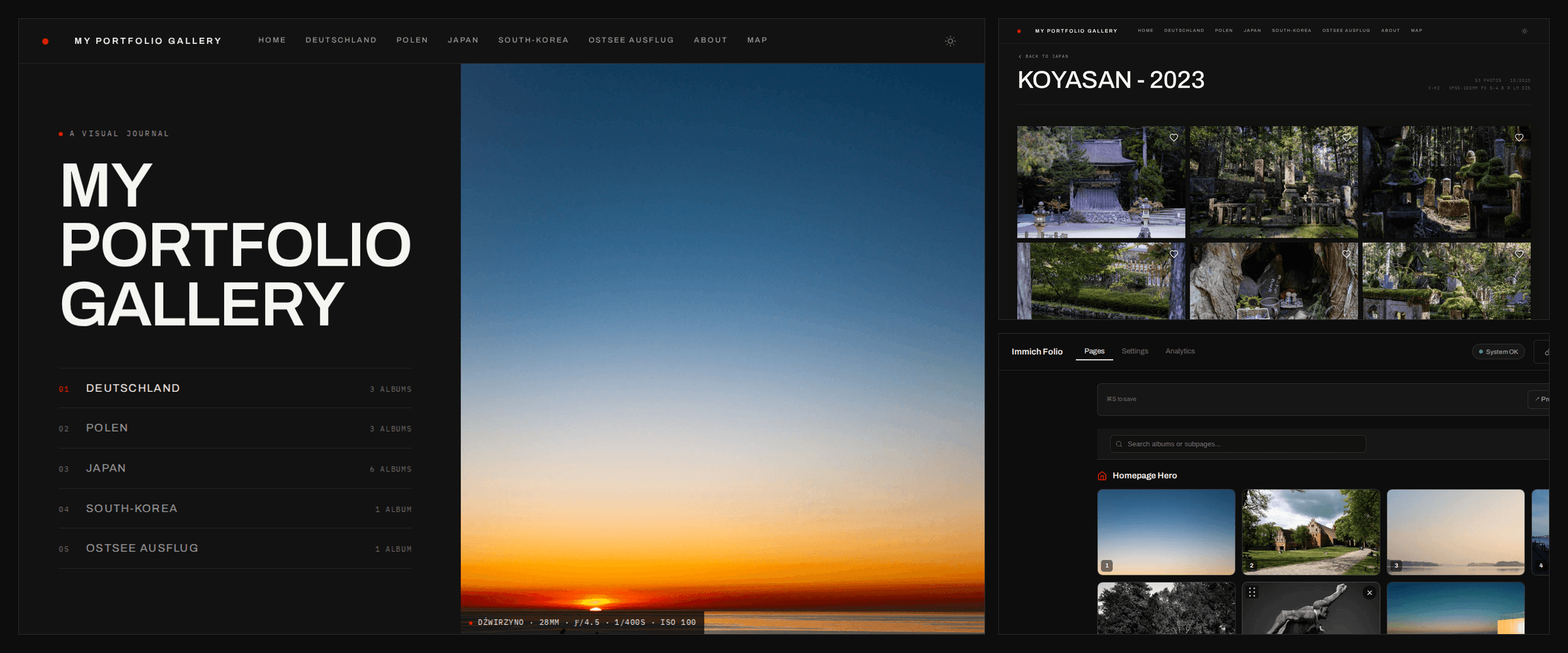
A self-hosted portfolio powered by Immich. It acts as a secure reverse proxy between your visitors and your private Immich instance: your Immich server stays on your local network, completely invisible to the outside world, while your albums are published as a gallery you control.
Contents
Guides: Gallery Configuration · Theming · Journal & Photo Essays · Admin Panel · Deployment
Features
Gallery & Layout
- Configurable hero layouts — split, fullbleed, minimal, stacked (image + thumbnail strip), typographic (text-only), or mosaic (multi-image grid)
- Hero image carousel — single image or crossfade carousel of multiple Immich assets
- Masonry photo grid — responsive layout with natural aspect ratios and configurable columns, gap, and aspect ratio
- Uniform grid mode — switch to a fixed-aspect uniform grid per-subpage or globally
- Showcase / filmstrip / editorial-flow layouts — featured hero + grid, horizontal scroll strips, or alternating full-width and paired images
- Justified rows (experimental) — every row fills the width at one shared height, aspect ratios intact, nothing cropped
- Per-subpage grid overrides — each subpage can define its own columns, gap, aspect ratio, and layout mode, and individual albums can override that again (experimental)
- Cover focal points (experimental) — decide which part of a cover survives the crop
- Fullscreen lightbox — keyboard and swipe navigation, EXIF panel, adjacent image preloading
- EXIF metadata on hover — camera body, lens, focal length, aperture, shutter speed, ISO shown directly on the grid
- ThumbHash placeholders — instant blurred previews while full images load
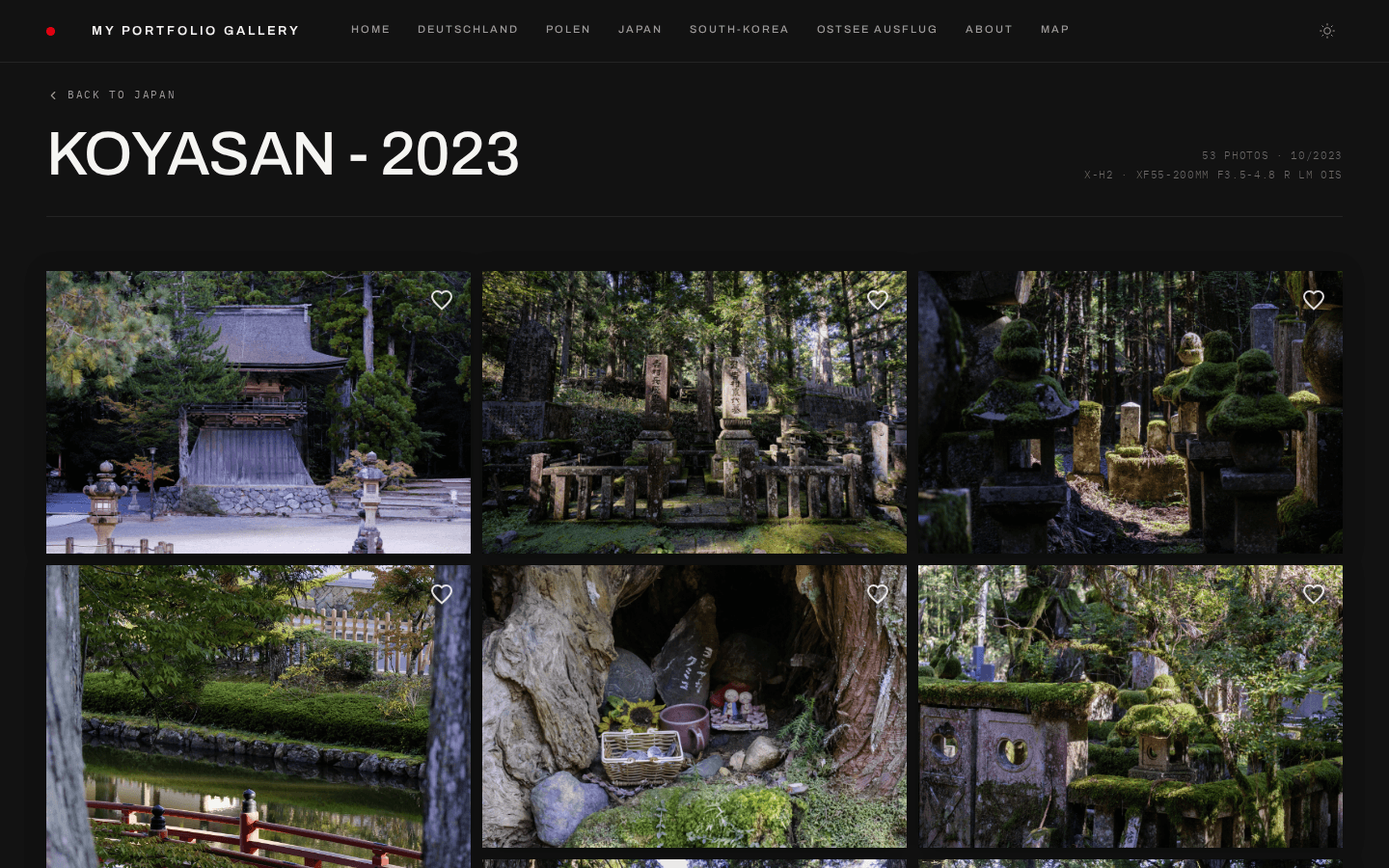
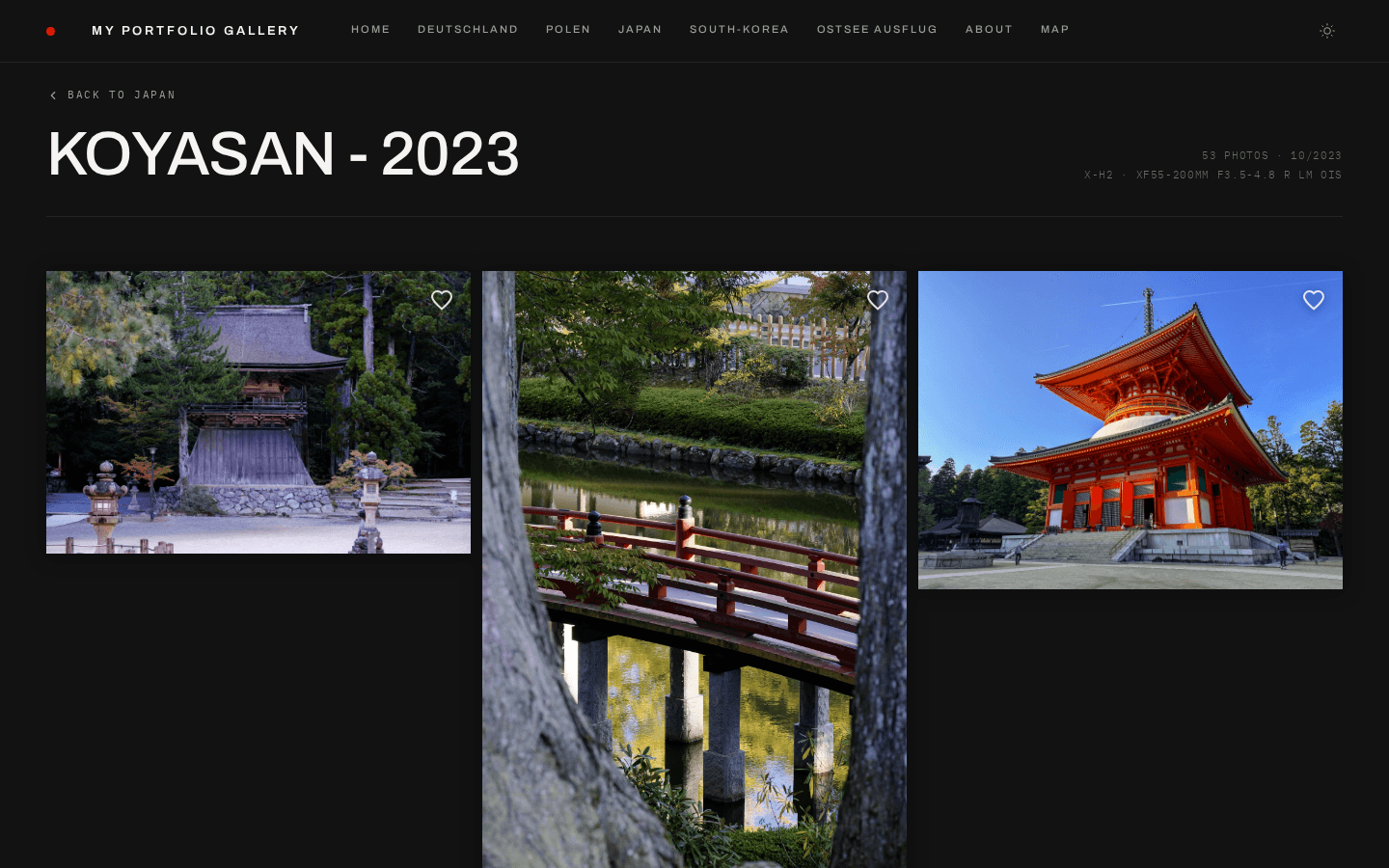
Masonry and showcase, both in Studio Modern — the same album, a different grid layout.
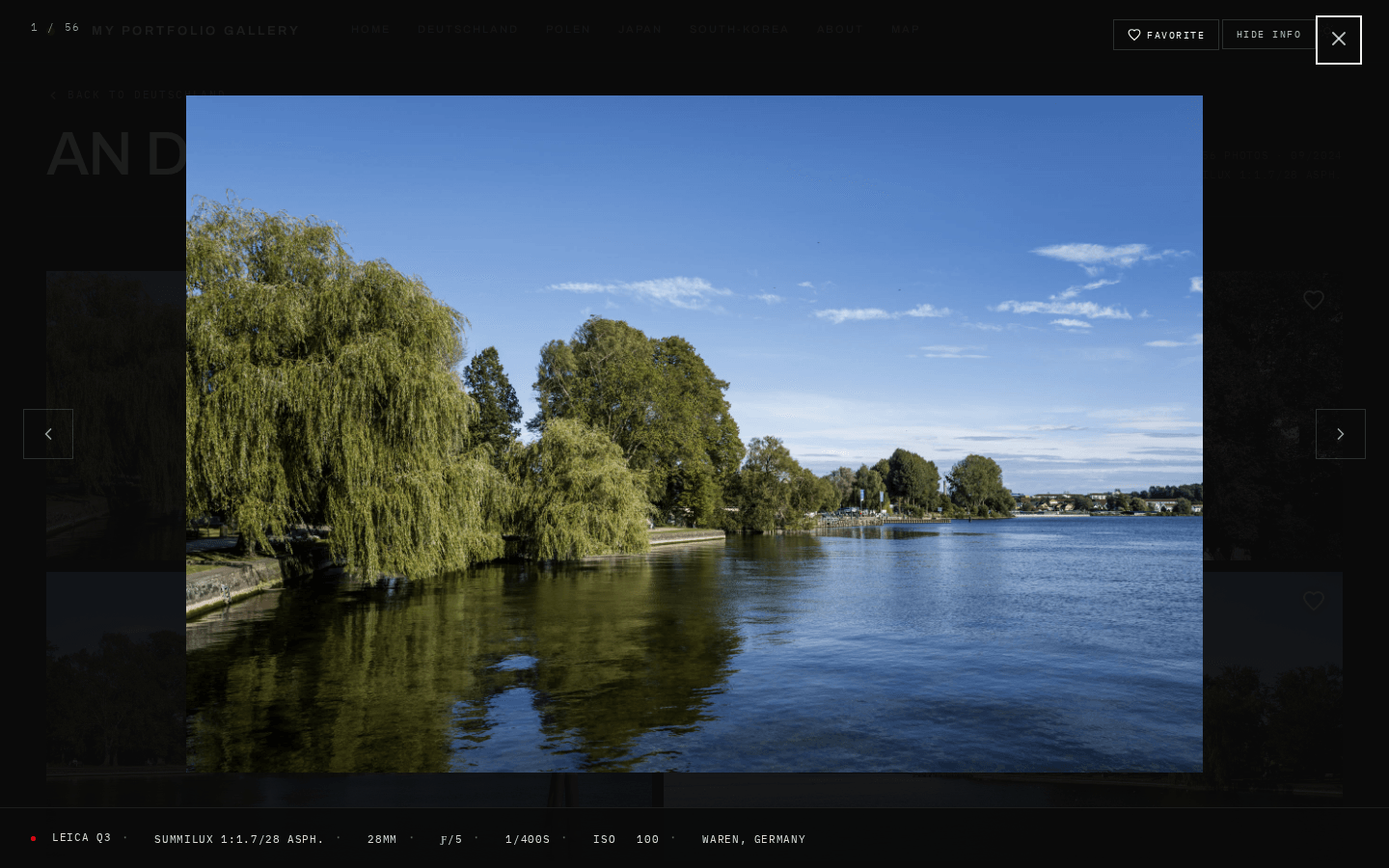
The fullscreen lightbox with the EXIF panel — camera, lens and exposure for the frame on screen.
Content & Organization
- Subpage grouping — organize albums into named collections (e.g.
/japan/tokyo-2023) - Auto-generated slugs — URL slugs derived from album names automatically
- YAML gallery config — all gallery structure defined in a single
content/gallery.yamlfile - Markdown about page —
content/about.mdwith frontmatter for portrait, name, location, and gear list, editable from the admin panel - Journal — photo essays and travel stories at
/journal, with drafts, per-entry passwords, cover images and reading times; new entries can start from a template (wedding, hiking, travel, …) - Photo Essay mode — long-form storytelling pages alternating text with fullbleed, paired and grid image layouts, facts lists, a slice of an album, and a map with the pins you choose — typed places, or photos placed by their GPS
- Unlisted subpages (experimental) — reachable by direct link, absent from the navigation
- Subpage on/off toggle — take a page offline without deleting it
- External navigation links (experimental) — point the header at a shop, a blog, or a social profile
- Client proofing — clients favorite photos and export the selection; picks are encoded in the URL, nothing is stored server-side
- Originals delivery — per-album opt-in lets visitors download a whole album or their proofing selection as a ZIP of the originals
- Lightbox watermark — configurable overlay on fullscreen images
- Privacy-friendly analytics — cookieless view counts, no third parties, can be switched off
- Dynamic OG images — auto-generated social preview images per album
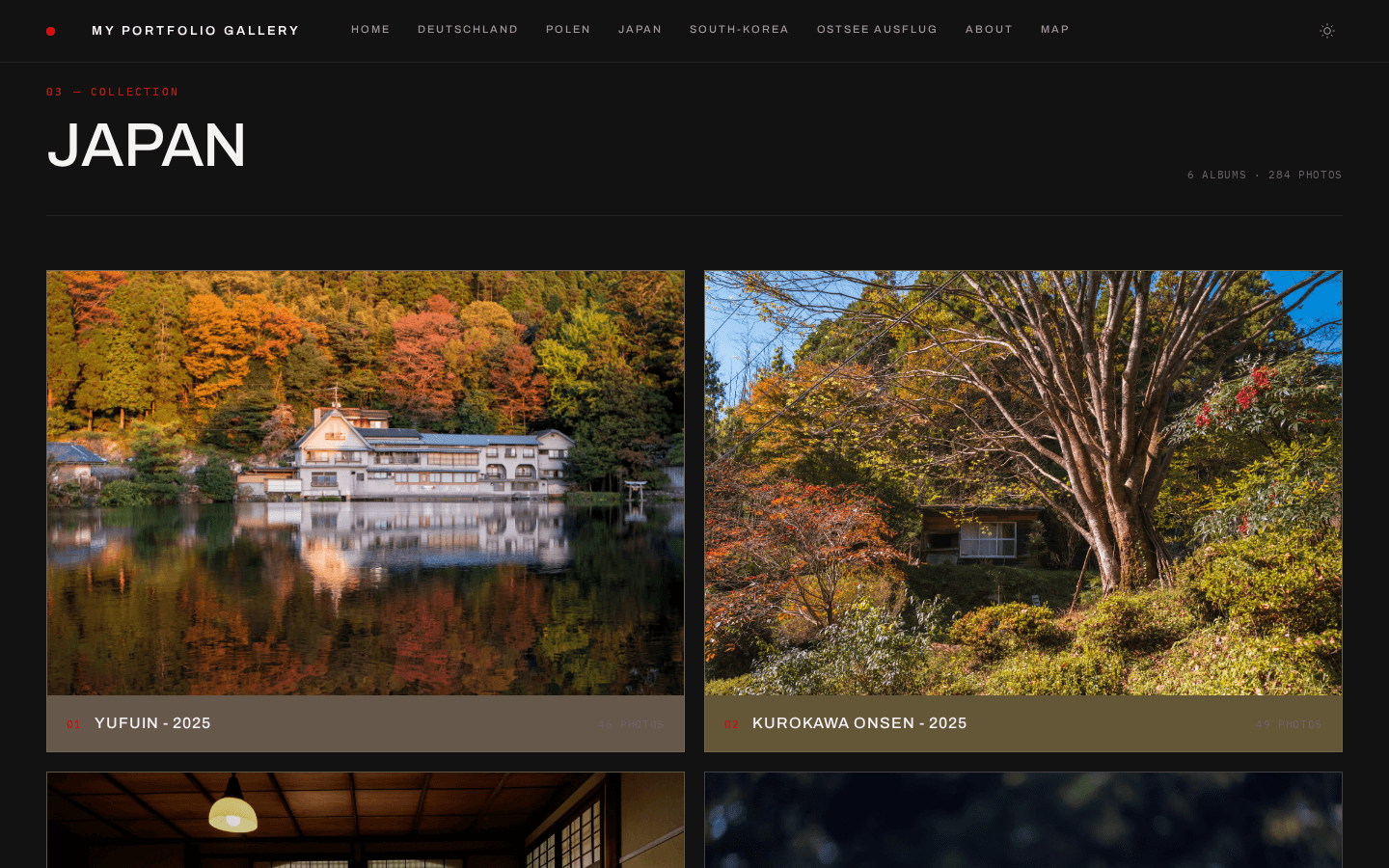
A subpage grouping several albums into one collection.
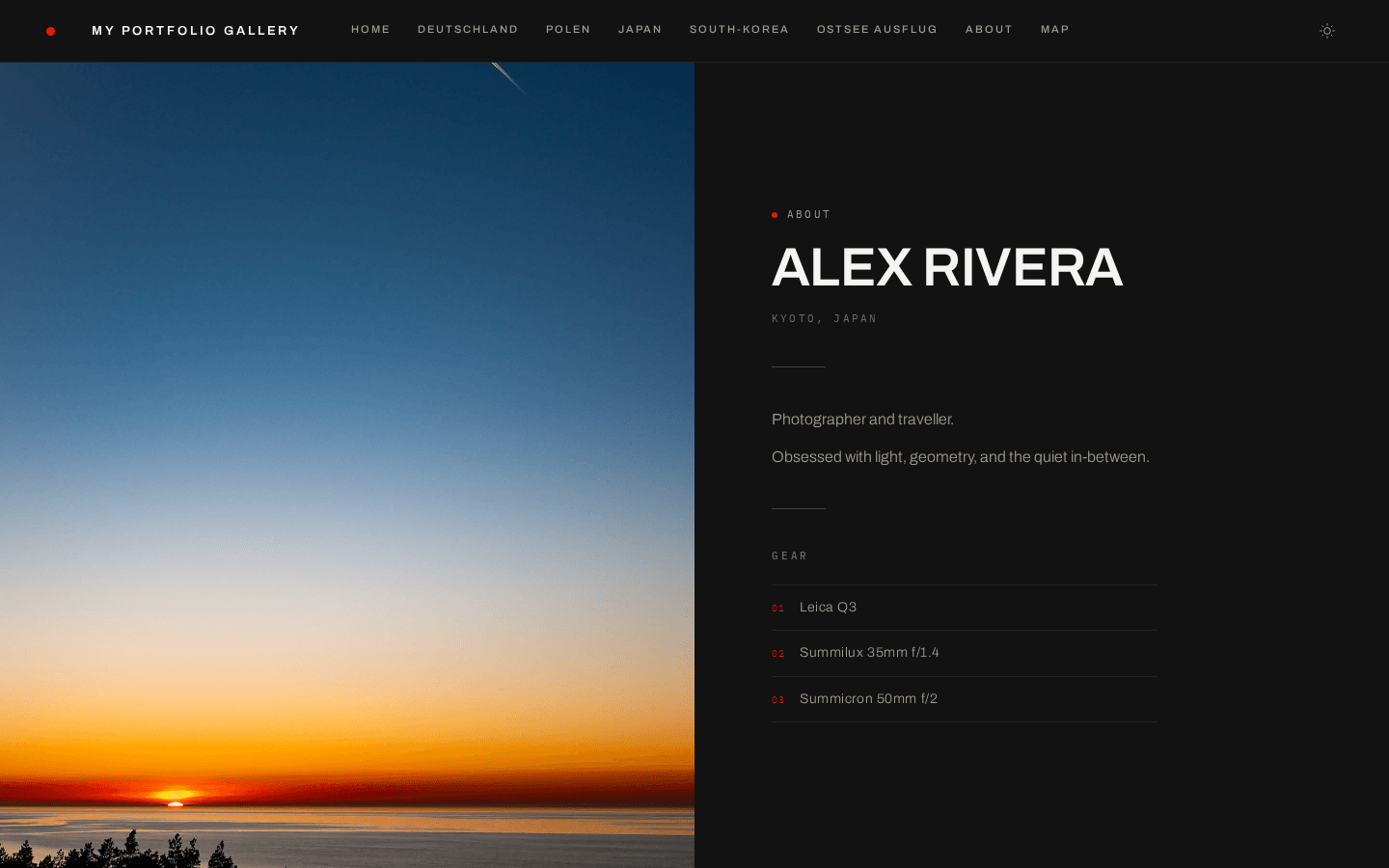
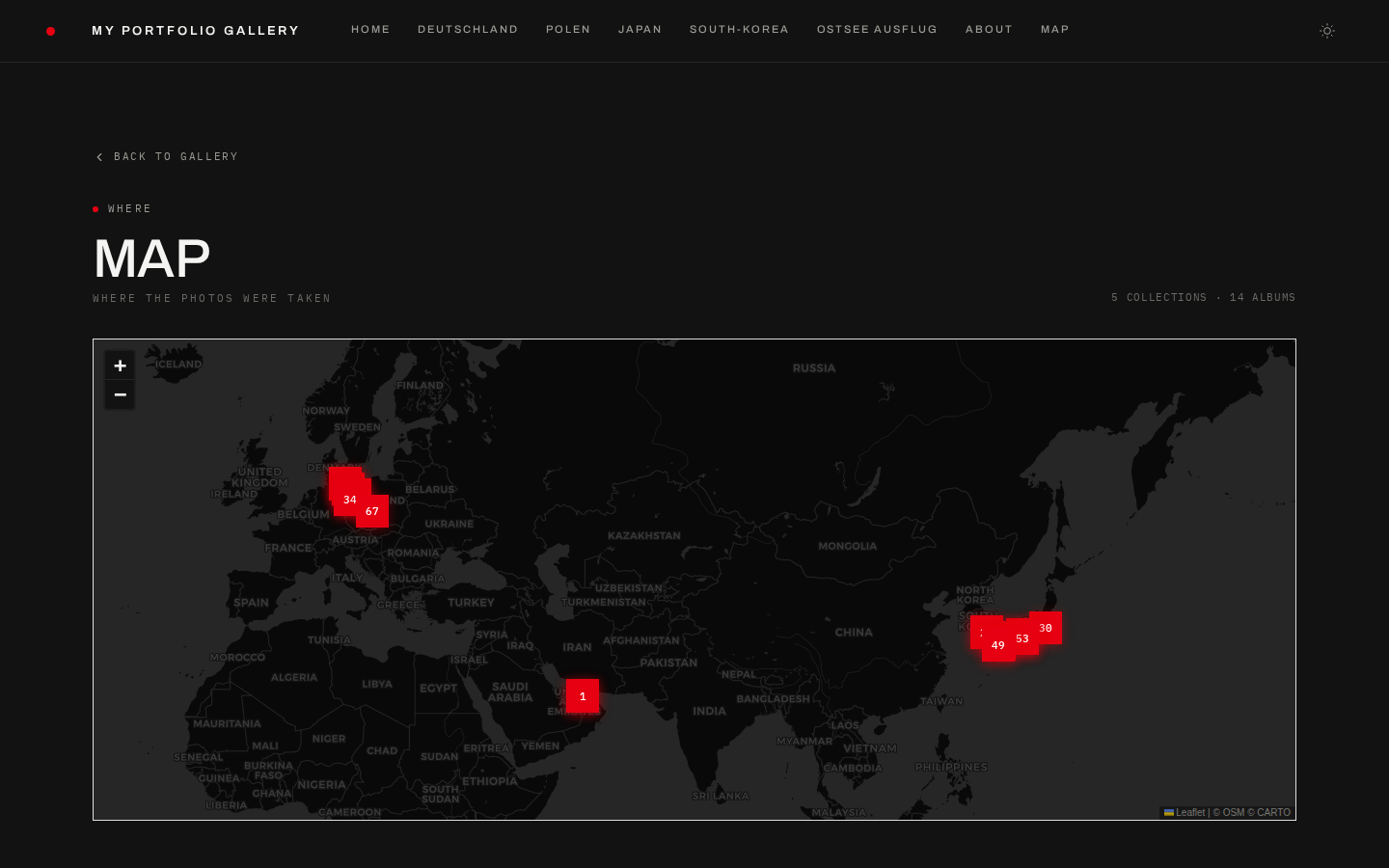
The Markdown about page and the GPS map, both generated from your Immich data.
Admin Panel
- Visual page builder — drag & drop interface to manage hero images, standalone albums, subpages, and sections
- Album picker — browse all shared Immich albums with search, see photo counts, and add them with one click
- Settings editor — configure theme, grid layout, footer, legal/impressum, SEO, image protection and the about page from a visual UI
- Visual previews everywhere — grid layout, theme, photo frame, hero style and the Google search snippet are picked from preview cards instead of text fields
- Journal Studio — split-screen block editor with a live preview of the real page; start from a template, drag blocks into order
- Essay block editor — assemble photo essays block by block without touching Markdown
- Unsaved edits survive — leave the page builder or the journal editor mid-edit, and your changes are waiting when you come back
- Diagnostics — a page that checks the Immich connection, config and security settings, and links every finding to its fix
- Photo order editor — drag & drop a hand-picked opening sequence for any album
- Favicon upload — give the site its own icon in the browser tab
- Backup manager — every save is backed up automatically; restore any of them with one click
- Live YAML sync — changes are written directly to
gallery.yamlandsettings.yamlwith automatic backups - Password protected — secured with its own admin password, separate from album passwords
Security & Infrastructure
| Concern | Protection |
|---|---|
| Server exposure | Immich URL never leaves your network — all requests proxy server-side |
| API key | Stored only in .env.local, never in client code |
| Asset IDs | Immich UUIDs encrypted (AES-256) into opaque tokens |
| Album scope | Only albums in gallery.yaml are accessible |
| Password protection | Per-subpage password support |
| Rate limiting | Per-IP sliding-window rate limiter (configurable RPM) |
| Vulnerability scanning | Docker image scanned with Trivy on every release, results in the GitHub Security tab |
- Health check endpoint at
GET /api/health - In-memory caching with configurable TTL
- Standalone Docker image — multi-stage, non-root, ~150 MB
- Dependencies kept current via Dependabot (npm + GitHub Actions, weekly)
Requirements
- Immich 3.0 or newer. Immich 3.0 changed how album assets are retrieved; earlier versions are not supported as of v0.9.0. On an older server, albums render with the correct title but no photos, and the map stays empty — the app logs a warning naming this as the likely cause.
- Node.js 20+ (or just use the Docker image)
Quick Start
git clone https://github.com/ralksta/immich-folio.git
cd immich-folio
npm install
npm run dev
Then open http://localhost:3000/install and let the setup wizard connect you to
Immich — see First-Run Setup below. It needs a token from the
server log, which is printed on first access.
Prefer to configure by hand?
The wizard writes the same files you would write yourself, so the manual route remains fully supported:
cp .env.local.example .env.local
# Edit .env.local with your Immich server URL and API key

cp content/gallery.yaml.example content/gallery.yaml
# Edit gallery.yaml with your album UUIDs

npm run dev
Something not coming up? npm run doctor checks the configuration from the
terminal — no running app and no admin password needed. See
Config Doctor.
First-Run Setup
A deployment with no gallery.yaml and no Immich credentials serves a setup
screen. The wizard at /install fills both in from the browser: it connects
to Immich, lets you pick albums (optional — you can add them later in /admin),
and names the site. Nothing is written until your credentials have been verified
against your Immich server, so a typo cannot leave you with an "installed" site
that loads no photos.
The wizard is gated by a one-time token printed to the server log on first access, because a fresh deployment is reachable before it has any configuration — and without the gate, whoever finds the URL first could configure it:
══════════════════════════════════════════════════════
  Immich Folio — First-run setup token
══════════════════════════════════════════════════════
  Token:  PTmUKFIdce2DwuqBG71RAExH7tVxceXX
Read it from your container logs (docker logs immich-folio, or
docker compose logs lightbox — immich-folio is the container name, lightbox
the service) and append it to the URL:
http://your-site/install?token=PTmUKFIdce2DwuqBG71RAExH7tVxceXX
The token is stored in content/.setup-token (mode 0600) so it survives a
restart, and is deleted once setup completes. From then on /install redirects
to the gallery and its API routes refuse to run again.
The wizard writes gallery.yaml, settings.yaml and content/install.json —
the last of which holds your Immich API key. Environment variables override
everything in it, so credentials can be rotated without touching the file, and
setting them all up front means the wizard never appears at all.
→ What the wizard writes, and environment precedence
Configuration
Environment Variables (.env.local)
# Required
IMMICH_API_URL=http://your-immich-server:2283
IMMICH_API_KEY=your-api-key

# Optional
SITE_TITLE=My Photography            # default: "Gallery"
SITE_SUBTITLE=A visual journal        # default: empty
CACHE_TTL=300                          # seconds, default: 300
STALE_MAX_AGE=86400                    # seconds an expired cache entry survives during an outage, default: 86400 (24h), 0 disables
IMMICH_TIMEOUT_MS=15000                # Immich response wait, default: 15000
IMAGE_CACHE_VERSION=1                  # bump to bust browser image caches, default: off
RATE_LIMIT_RPM=1500                    # requests/min/IP for images, default: 1500
AUTH_SECRET=long-random-string        # required in production
TRUSTED_PROXY_HOPS=1                   # reverse proxies in front, default: 0
ADMIN_PASSWORD=your-secure-password   # enables /admin panel
WEBHOOK_SECRET=long-random-string     # enables POST /api/webhook cache invalidation
Login and setup endpoints have their own, much lower limits that
RATE_LIMIT_RPMdoes not raise — see Rate Limiting.
Behind a reverse proxy, set
TRUSTED_PROXY_HOPSto the number of proxies in front of the app (nginx/Traefik/Caddy = 1; Cloudflare in front of nginx = 2). Without it the client IP is read from a header the client itself can set, which defeats the brute-force limits on the password endpoints. See Trusted Proxies.
Immich API Key Permissions
Create a dedicated API key in Immich under Account Settings → API Keys. Immich Folio only needs read access — it never modifies your library.
| Permission | Required | Used for |
|---|---|---|
album.read |
✅ Yes | List and fetch album metadata & photo lists |
asset.read |
✅ Yes | Fetch asset metadata, EXIF data, thumbnails, previews, and originals |
asset.view |
✅ Yes | Stream image/video files (thumbnail, preview, video playback) |
No write permissions needed.
album.create,asset.upload,asset.delete, etc. can all be left off.
Tip (Admin Panel): The Admin Panel also uses
POST /search/metadatato browse your full library for the hero image picker. This is covered byasset.read— no additional permission required.
Gallery Config
All gallery structure — hero images, albums, subpages, grid layout, footer — is defined in content/gallery.yaml.
Journal & Photo Essays
Long-form storytelling with fullbleed photos, side-by-side pairs and grids, quotes, facts lists, a map of the entry's own geotagged photos and captions — as a standalone /journal section, or as a single essay on one subpage. New entries can start from a template.
→ Journal & Photo Essays Guide
Theming
Seven built-in presets with distinct visual identities — or mix and match with fine-grained control over colors, fonts, corners, photo frames, hero layout, and grid style.
Studio Modern is the default: Leica precision rebuilt around the Archivo grotesque, with IBM Plex Mono for every piece of photographic metadata, hairline rules, zero radius, and red as signal only.
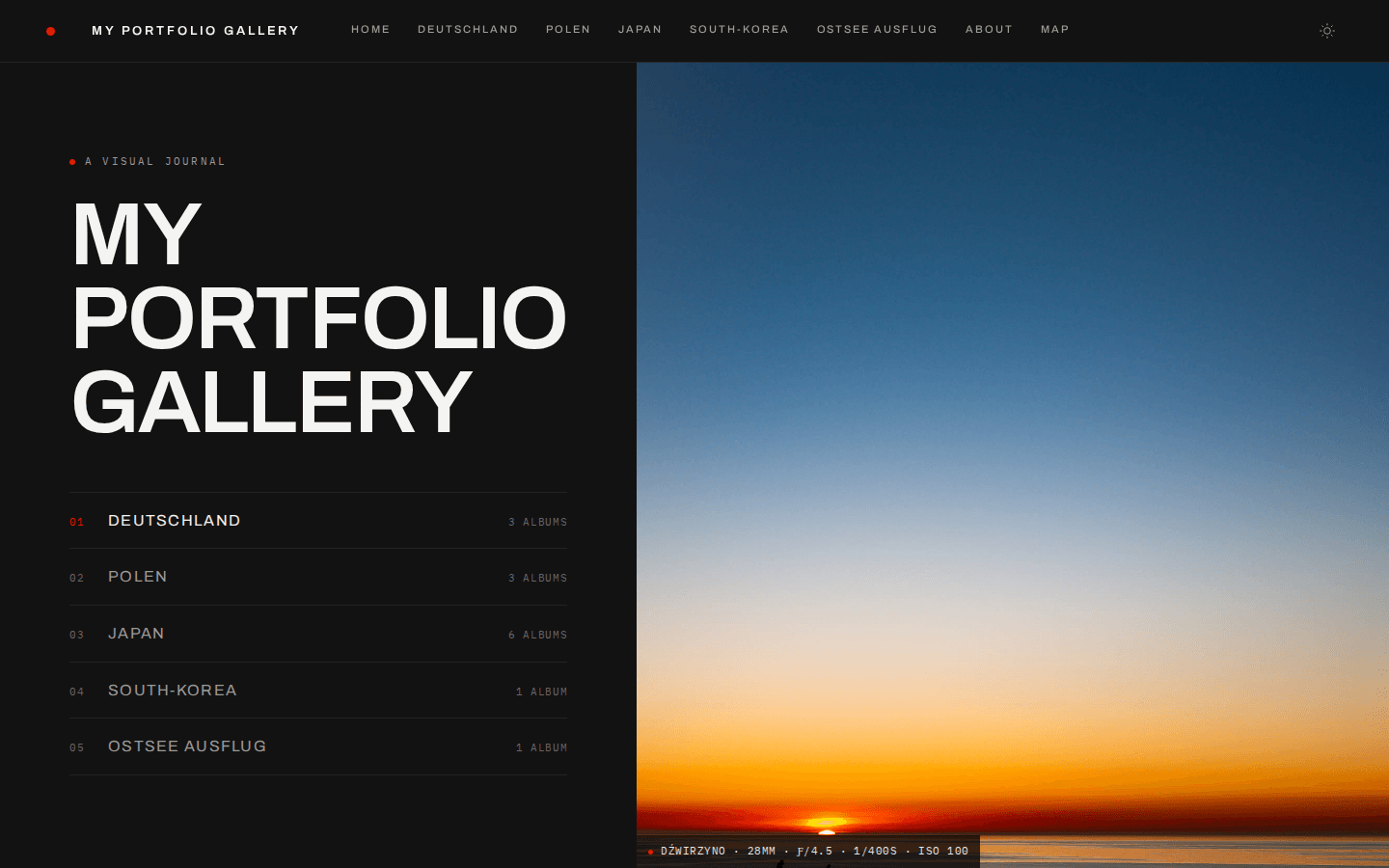
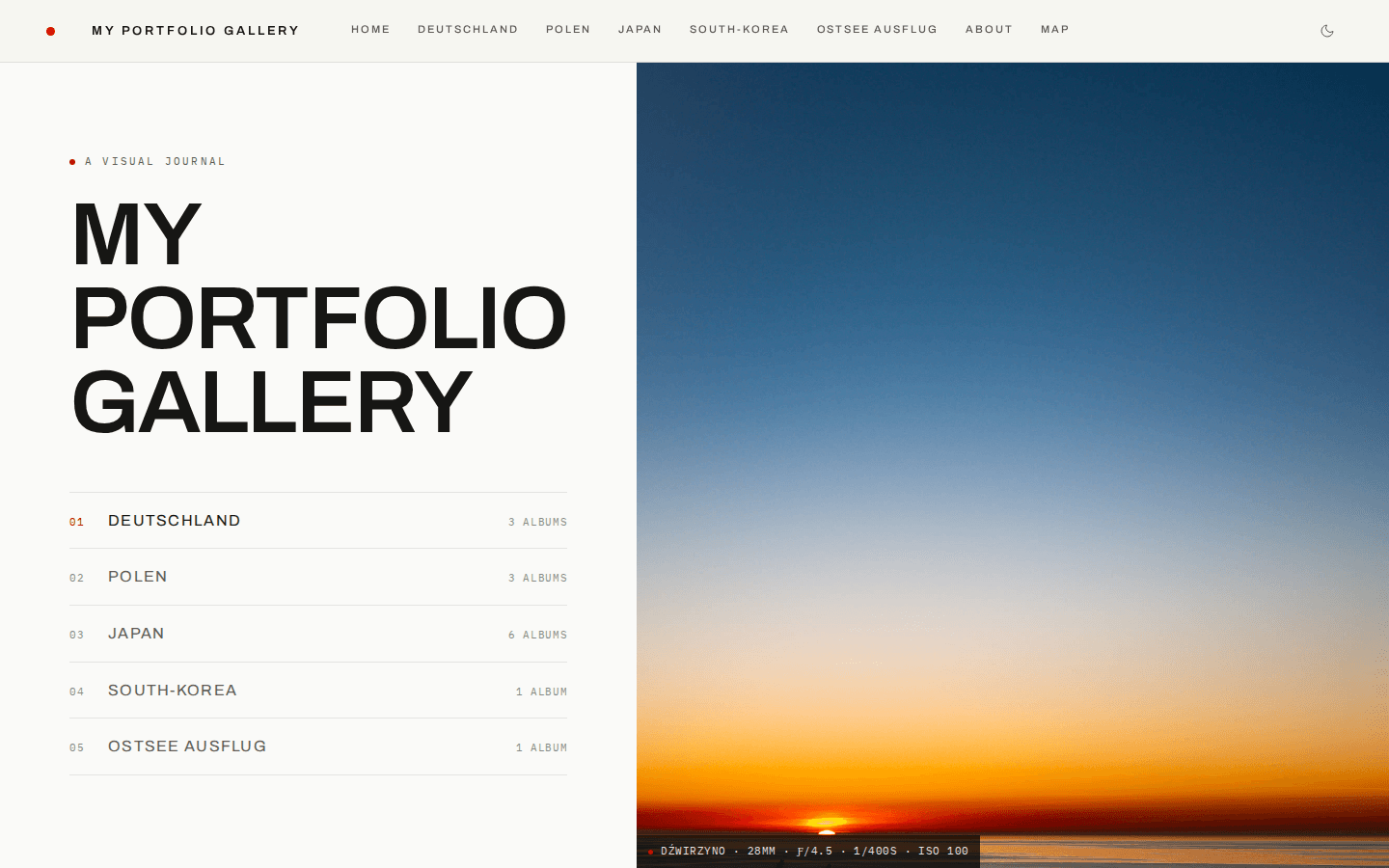
Studio Modern, dark and light — every preset ships both, and visitors switch with a toggle in the navigation bar.
theme: studio-modern # or: studio, minimal, editorial, classic, noir, monograph
→ View all Themes & Configuration Guide
Docker
Docker Compose (recommended)
services:
  lightbox:
    build: .
    container_name: immich-folio
    restart: unless-stopped
    ports:
      - '7211:7211'
    env_file:
      - .env.local
    volumes:
      - ./content:/app/content
Run with:
docker compose up -d
The gallery will be available at http://localhost:7211.
The
content/volume must be read-write — the setup wizard, the admin panel, the journal and the backup rotation all write into it. A:romount leaves the wizard unable to complete and the admin panel unable to save.
For standalone docker run, the health check, TLS behind a reverse proxy, and
what the gallery does while Immich is unreachable:
Admin Panel
A built-in visual editor at /admin lets you manage your gallery without editing YAML files manually.
Enable it by setting ADMIN_PASSWORD in your environment:
ADMIN_PASSWORD=your-secure-admin-password
Or set the password in the setup wizard, which stores it as
an scrypt hash rather than in your environment. An ADMIN_PASSWORD variable
takes precedence over the stored one if both are present.
Then navigate to http://your-site/admin and log in. The panel is protected by its
own password, separate from any album passwords, and writes straight to
gallery.yaml / settings.yaml with automatic backups.
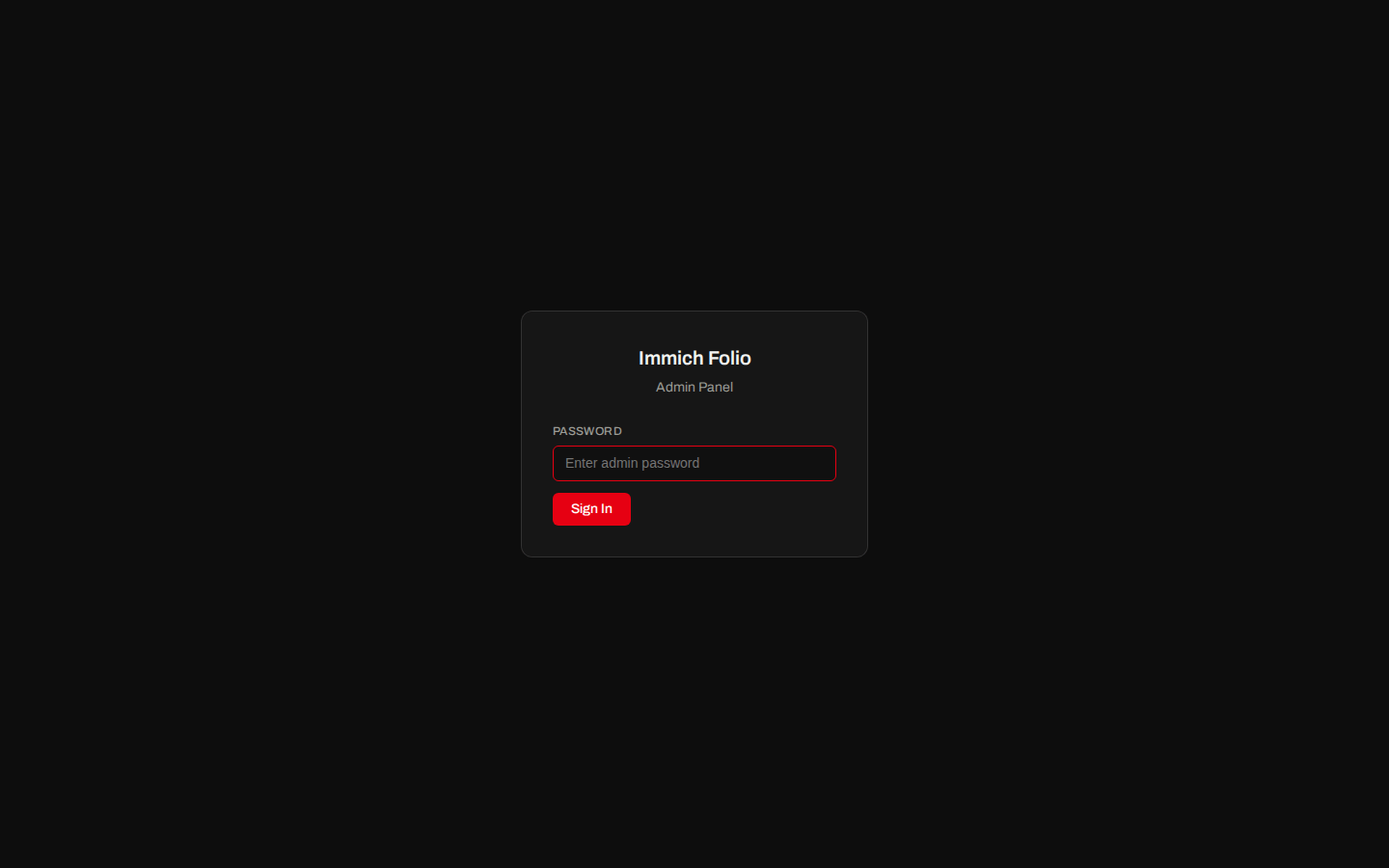
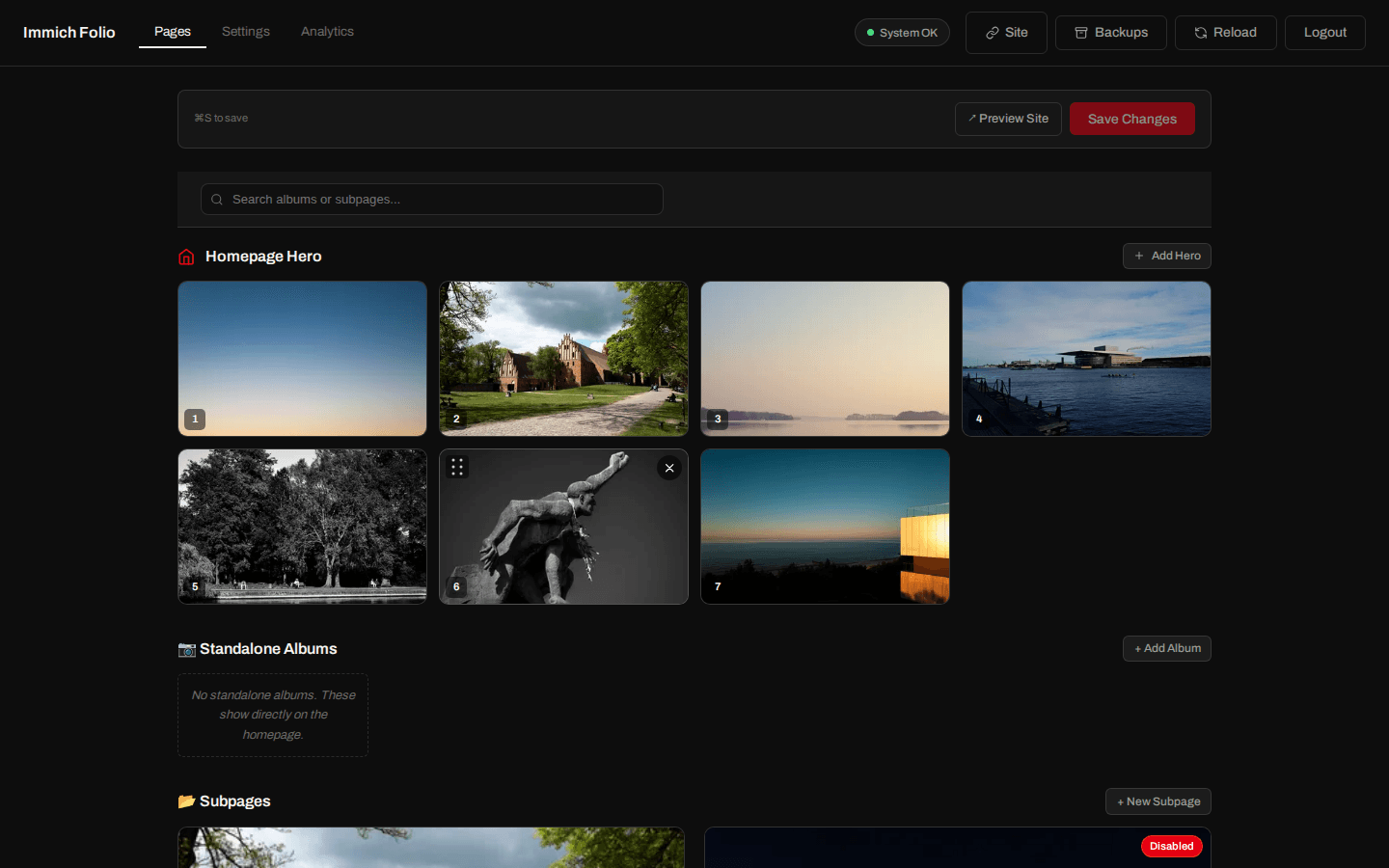
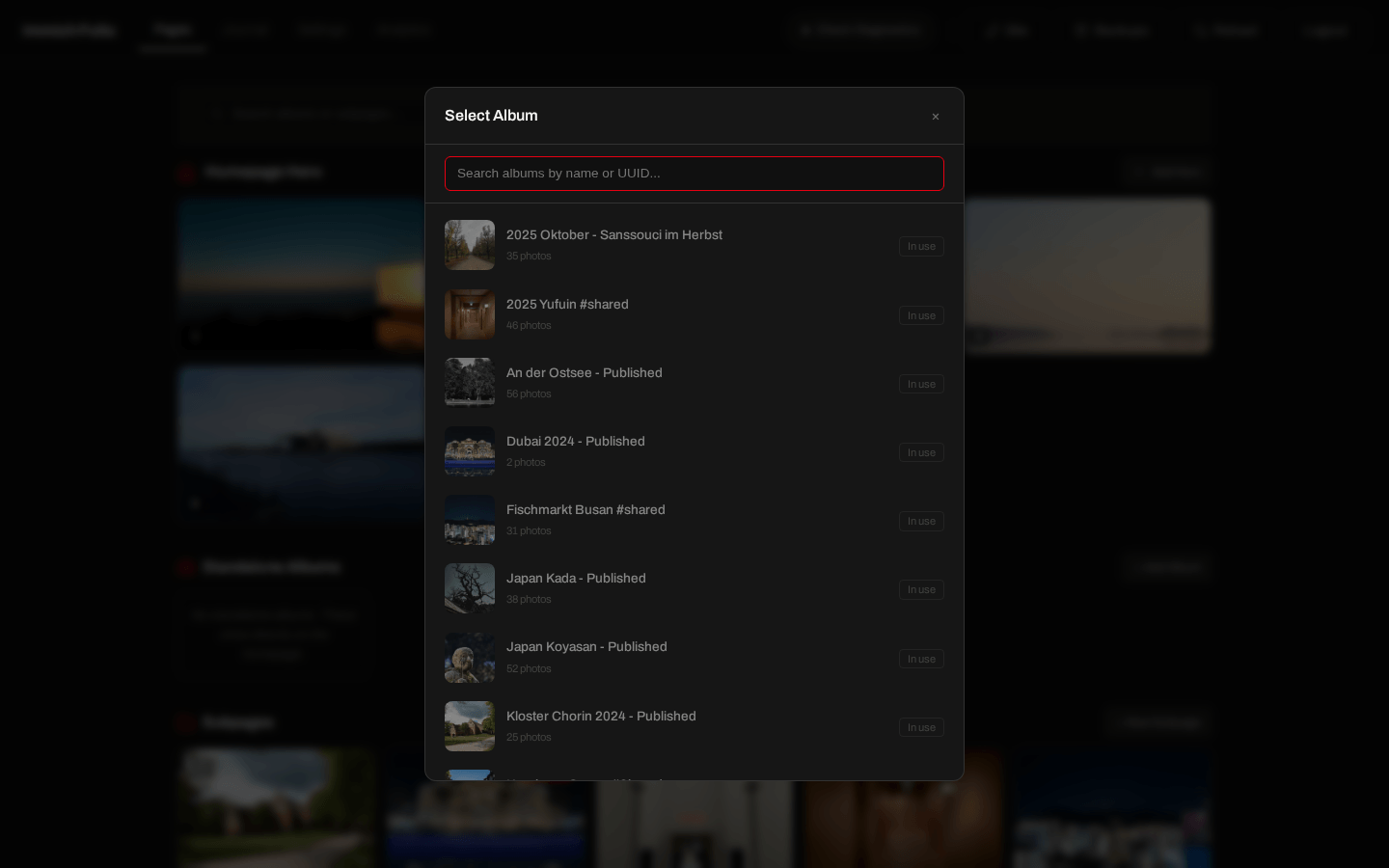
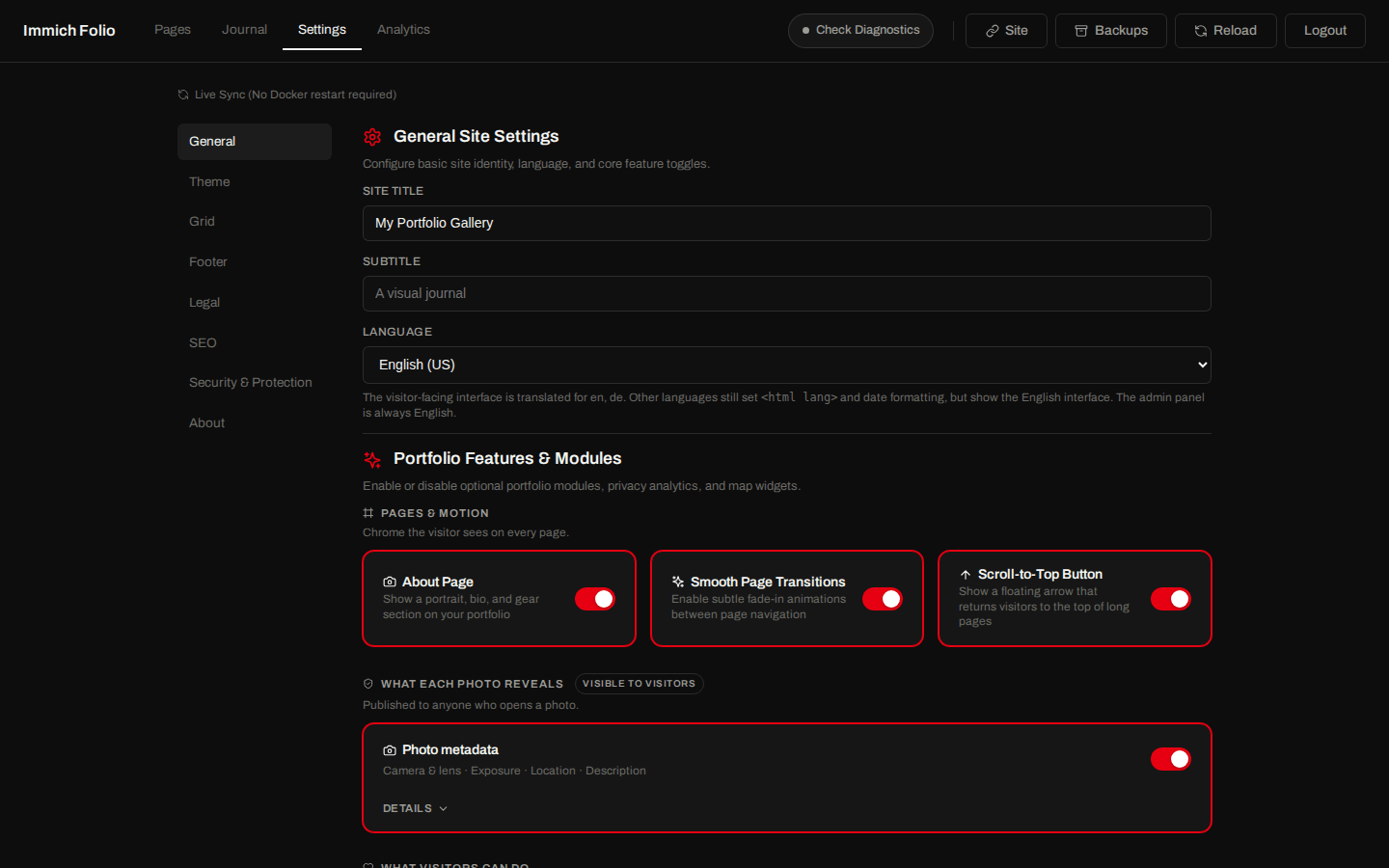
Login · page builder · album picker · settings editor
What's New
v0.17.0 — originals as a ZIP, and a richer journal:
- Download originals as a ZIP — a whole album, or just the photos a client picked in proofing, as one archive of the originals. Opt-in per album; contributed by @lancetm714
- Journal templates — start a new entry from eight structures, from a wedding to a hiking trip
- New journal blocks — photo grids, facts lists, a map with the pins you choose, and a slice of an album; reorder blocks by dragging → Journal guide
- Unsaved admin edits survive navigation — switching tabs or reloading no longer throws your changes away
- Plain-HTTP installs — admin login and gallery passwords now work at
http://host:7211
Upgrade note: visitors' proofing favourites from before v0.17.0 are not carried over. Nothing else to migrate.
Security fixes ship in normal releases, so running the latest release is the recommended baseline.
→ Full history in CHANGELOG.md and the GitHub releases
Tech Stack
- Next.js 16 (App Router, standalone output)
- React 19
- TypeScript
- Vanilla CSS (no framework)
Contributors
Immich Folio is maintained by @ralksta and made better by the people below. Thank you — every one of these made the project easier to live with.
- @lancetm714 — built the setup wizard that turns a fresh install into a few clicks in the browser instead of hand-written config files. Also added custom favicons, so your portfolio gets its own icon in the browser tab, and made a gallery with no albums yet a perfectly valid starting point rather than an error. In v0.15.0, made client proofing work properly: the selection bar floats again with page transitions on, and it is readable in light mode. Also brought links to journal quote attributions. In v0.17.0, built the ZIP download: a whole album, or just the photos a client picked, as one archive of the originals — streamed, so even a large shoot arrives complete.
- @ImScheinox — found and fixed portrait photos rendering as landscape tiles, because the grid ignored the camera's EXIF orientation flag. That brought the masonry layout's stagger back for anyone whose camera records portrait frames that way, which is most of them.
- Jules — an automated reviewer that has been quietly hardening the project in the background: better screen-reader support in the photo grid, and a series of fixes keeping the public endpoints from being overwhelmed by traffic.
- Dependabot — keeps every dependency current, which is most of the reason security fixes land here quickly.
Contributions are welcome — see CONTRIBUTING.md to get
started. Pull requests target the dev branch.
License
MIT License — free to use and modify for the Immich community.
Install immich-folio on Unraid in a few clicks.
Find immich-folio in Community Apps on your Unraid server, review the template, and click Install. Unraid handles the Docker app or plugin setup from the published template.
Categories
Related apps
Explore more like this
Explore allDetails
ghcr.io/ralksta/immich-folio:latestRuntime arguments
- Web UI
http://[IP]:[PORT:7211]- Network
bridge- Shell
sh- Privileged
- false
Template configuration
Port to access Immich Folio (Internal and External: 7211)
- Target
- 7211
- Default
- 7211
- Value
- 7211
Storage location for gallery configuration and content (where the setup wizard saves its data).
- Target
- /app/content
- Default
- /mnt/user/appdata/immich-folio/content
- Value
- /mnt/user/appdata/immich-folio/content
Required! Provide a long, random string (e.g., a 32-character secret) used for session security.
- Target
- AUTH_SECRET
- Value
- PleaseEnterALongRandomStringHere12345!
Optional. Leave blank on initial setup (you will create your password in the Setup Wizard). Use this variable later if you need to reset your admin password.
- Target
- ADMIN_PASSWORD