
HAMAL
Docker app from ilker's Repository
HAMAL is a fast, lightweight, self-hosted file and text sharing server for your local network. Send files, photos, documents, and text between computers, phones, and tablets using…
Overview
Send files, photos, documents, and text between computers, phones, and tablets using a web browser. No client installation, cloud storage, or third-party account is required.
Create a temporary sharing room, then let other devices join instantly by scanning its QR code or opening the room link. Optional PIN protection and automatic room expiration help keep every transfer private and temporary.
HAMAL runs on your own Unraid server. Your files and shared text stay on your local network and are stored in your configured appdata directory.
Readme
View on GitHub

What is HAMAL?
HAMAL (Turkish for porter / carrier) is a lightweight, self-hosted web application for temporary file and text transfers between devices on the same LAN / Wi-Fi network.
The idea is simple: create a temporary room, share the generated QR code or local link, and move digital cargo between devices without a cloud upload, account system, advertising, or telemetry.
HAMAL is built around short-lived transfer rooms rather than permanent storage. Rooms expire automatically, and their temporary files and text follow the room lifecycle.
How it works
- Create a temporary room.
- Optionally protect it with a PIN.
- Scan the QR code or open the local room link.
- Transfer files or send temporary text between connected devices.
- Let the room expire automatically, or close it manually from the creator dashboard. Only the room creator can close a room.
Screenshots
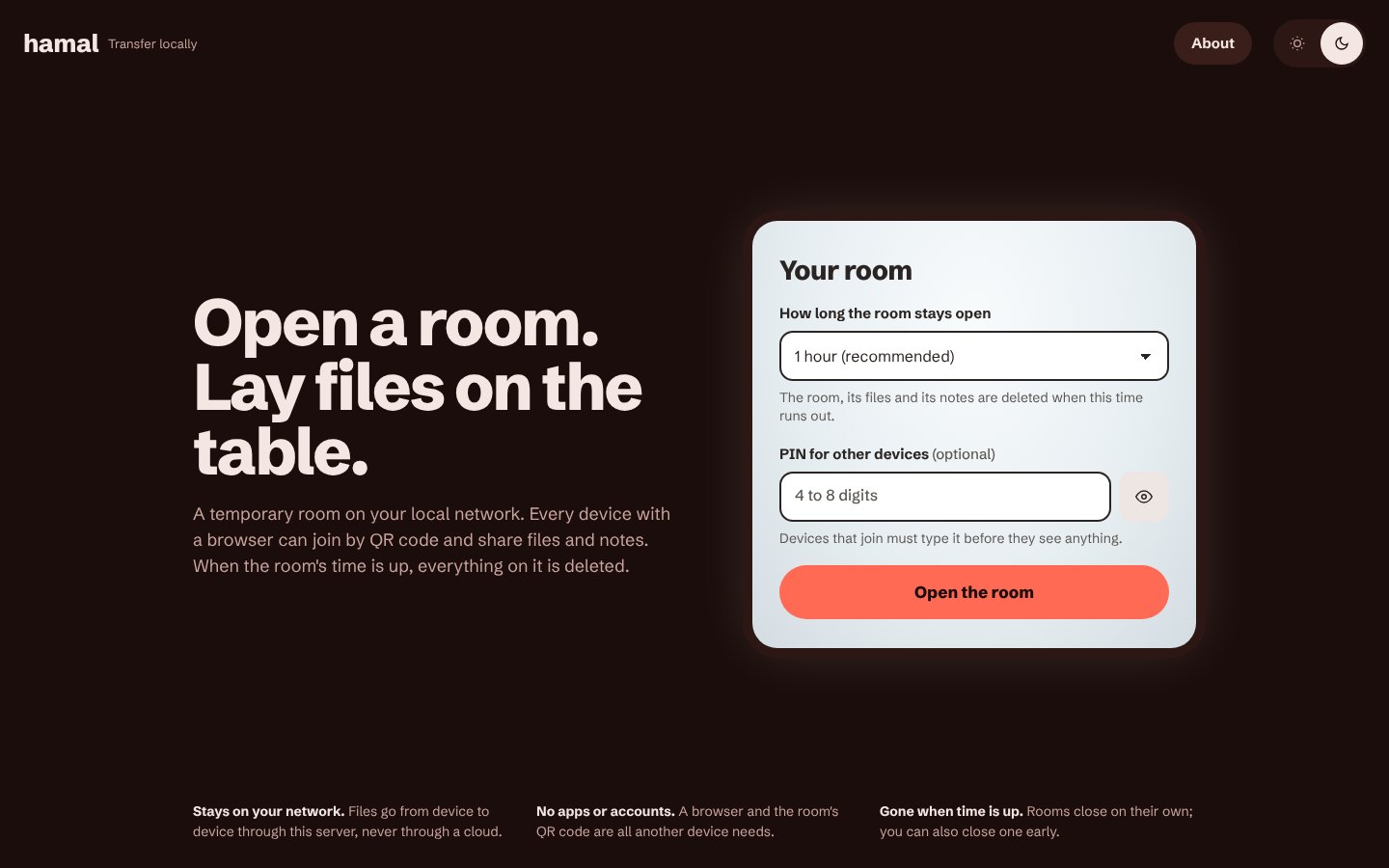
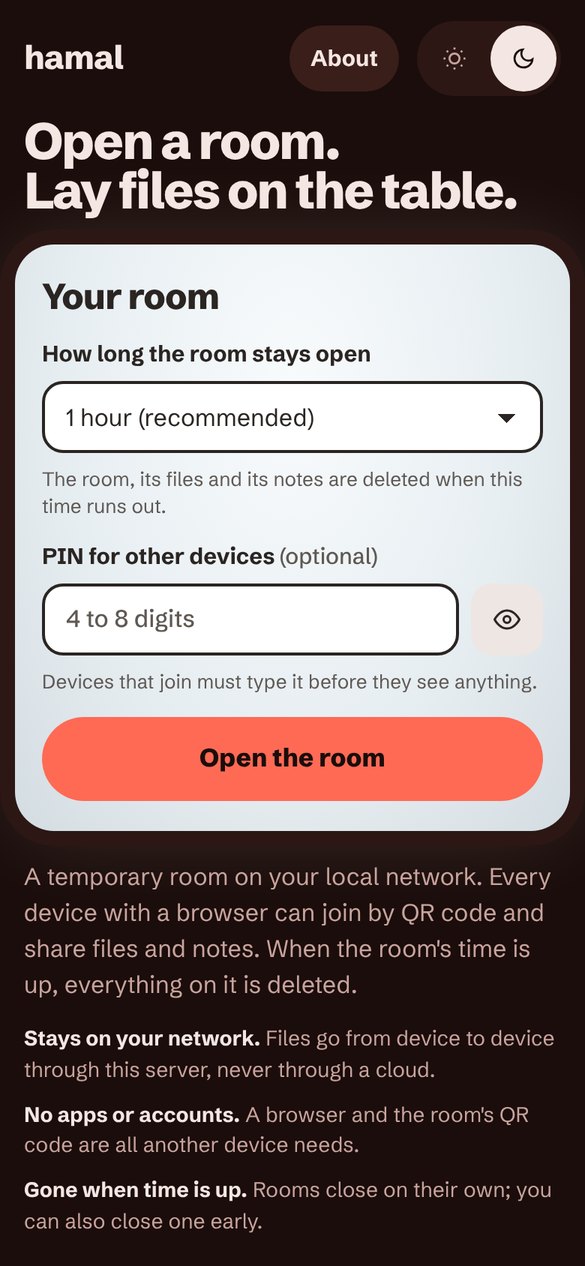
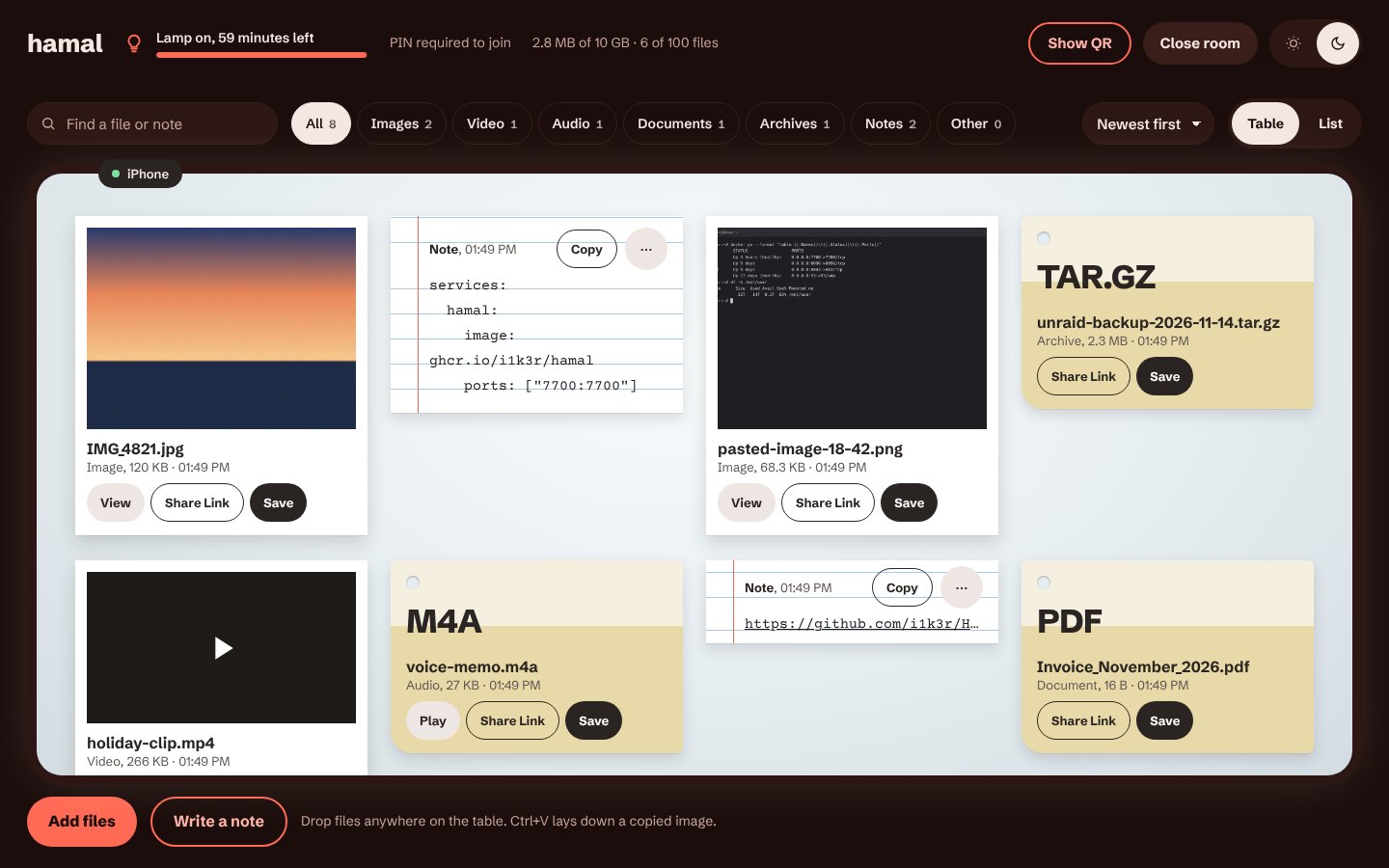
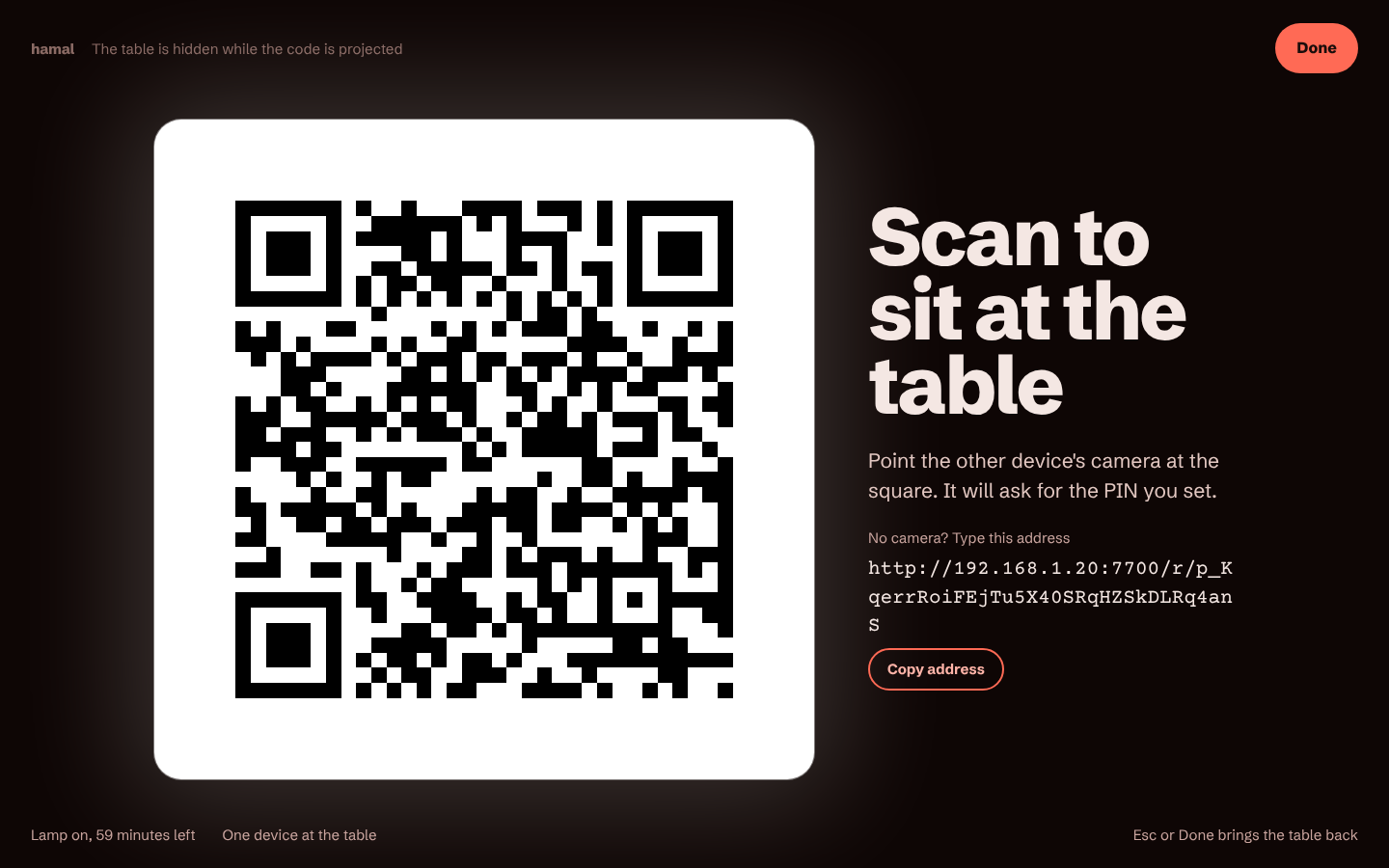
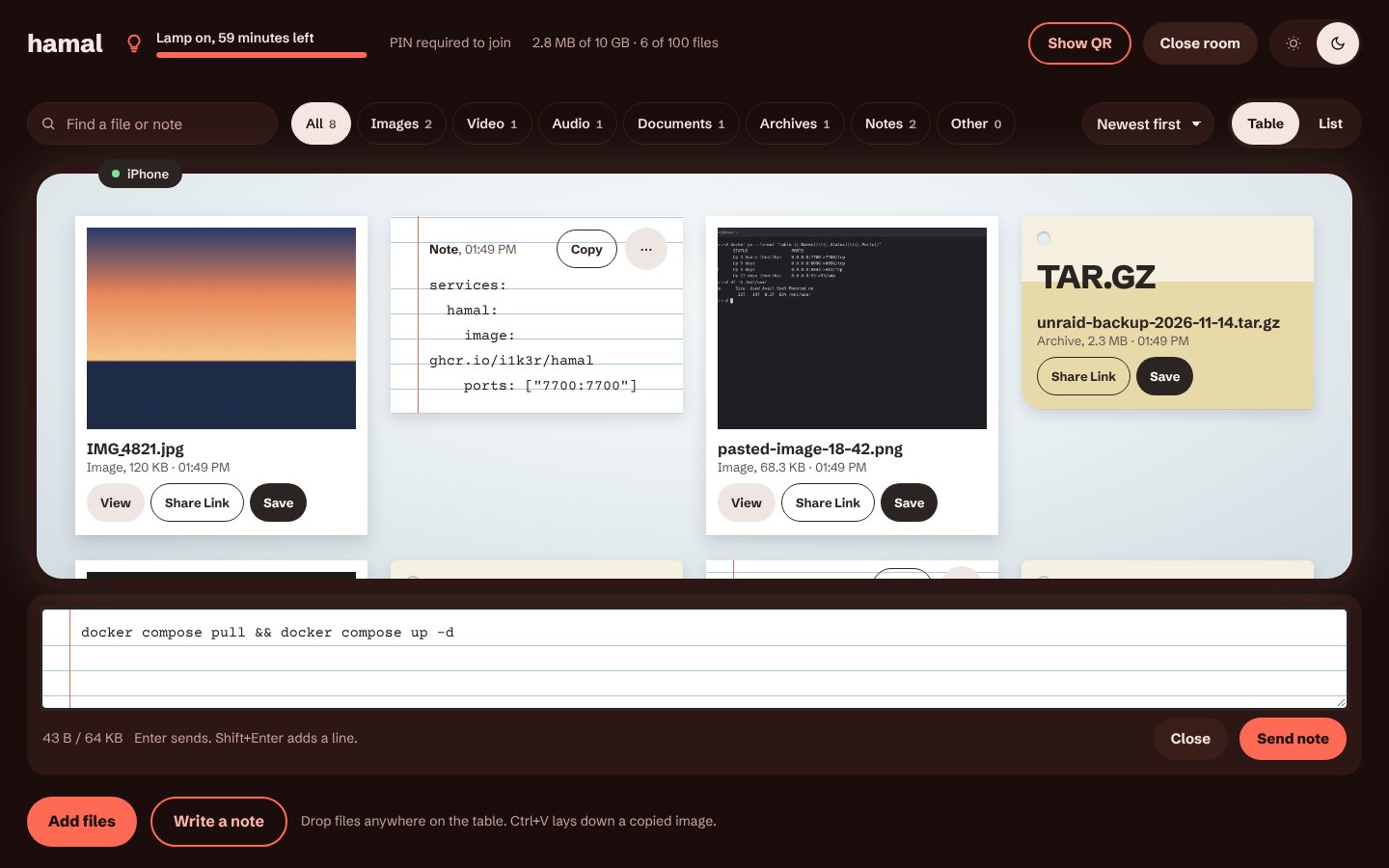
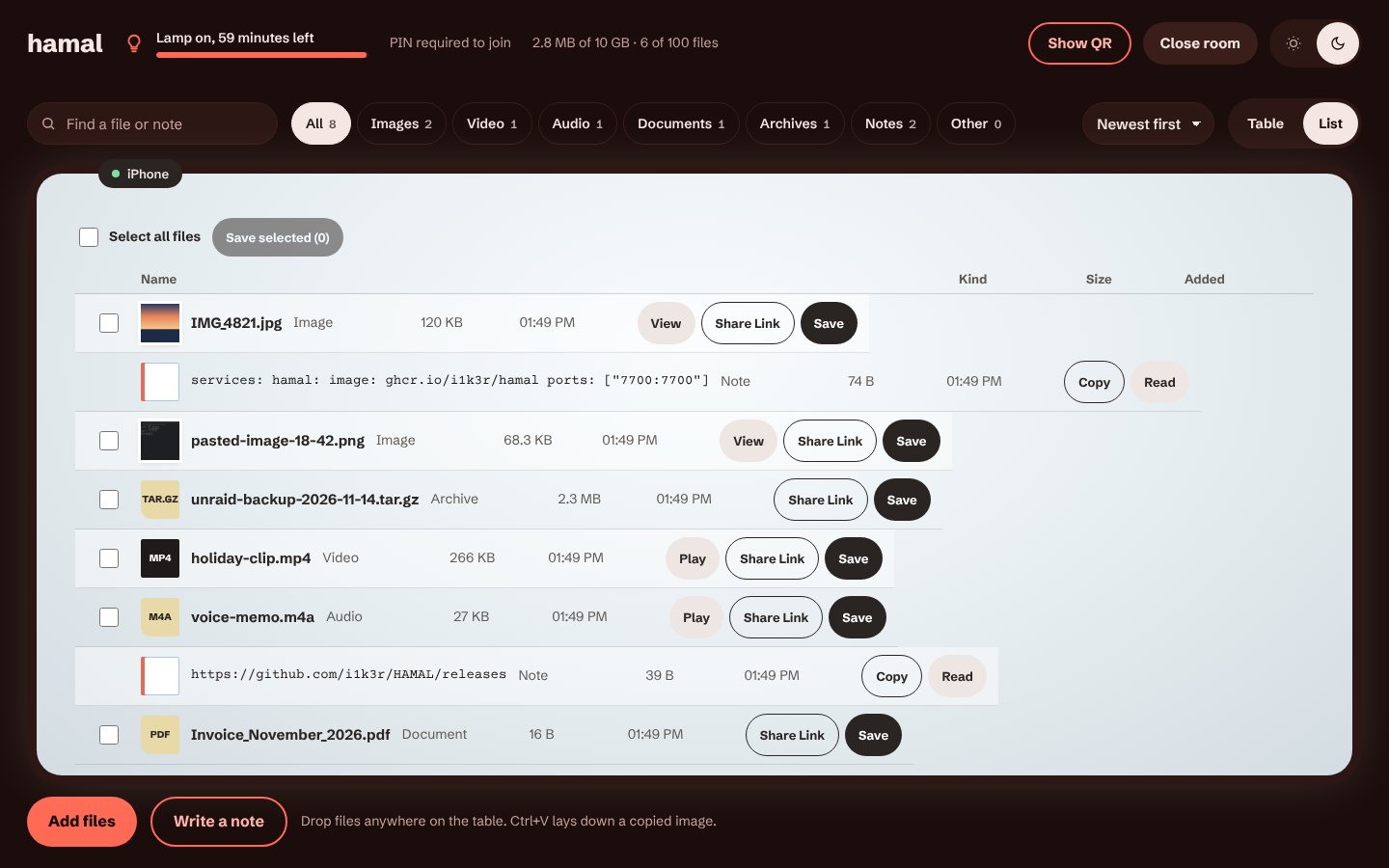
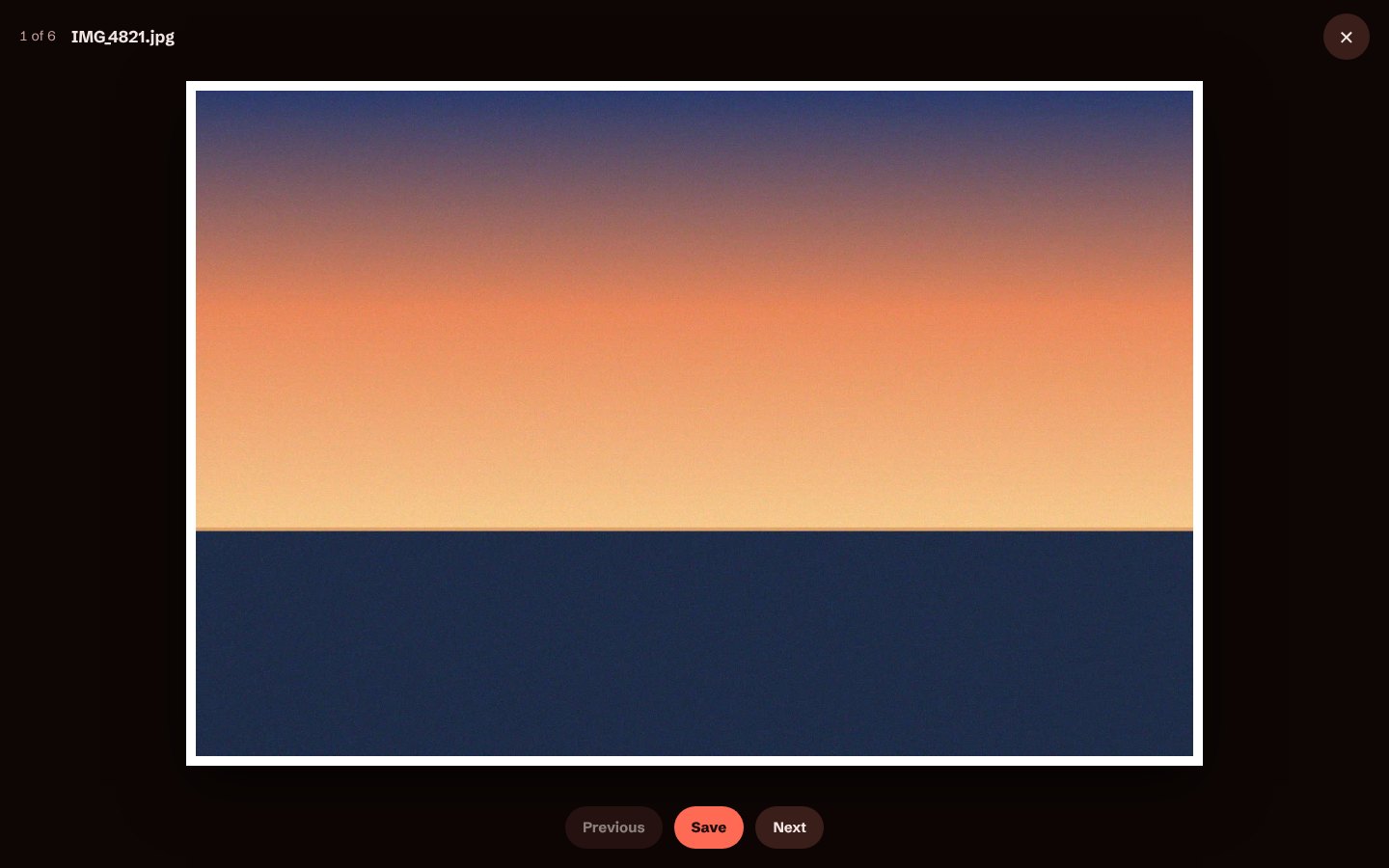
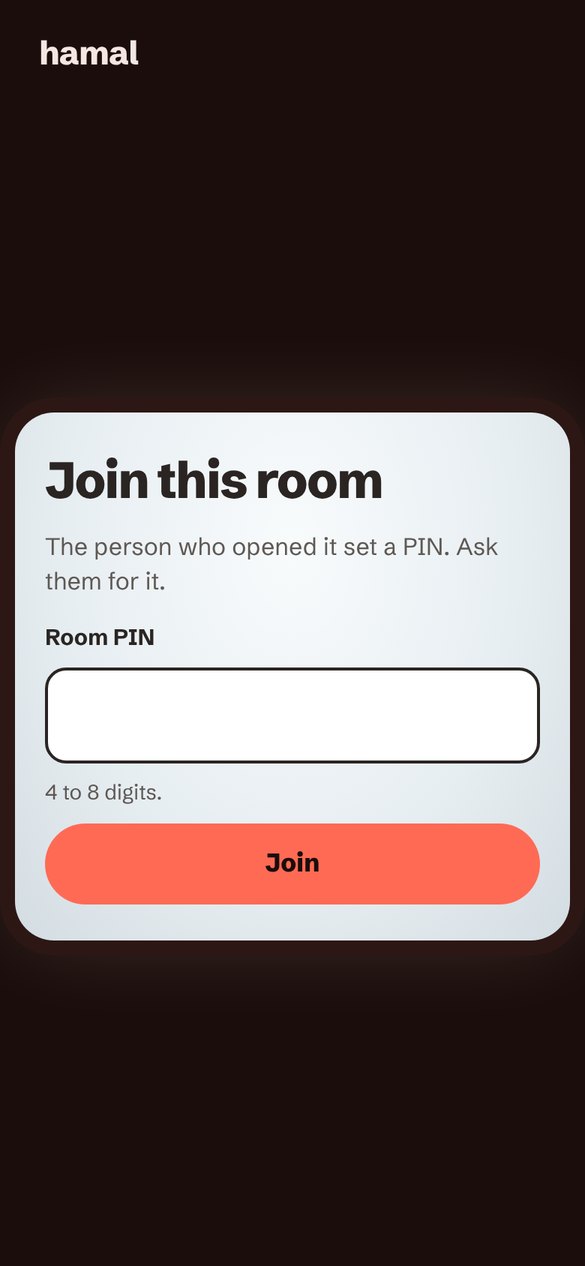
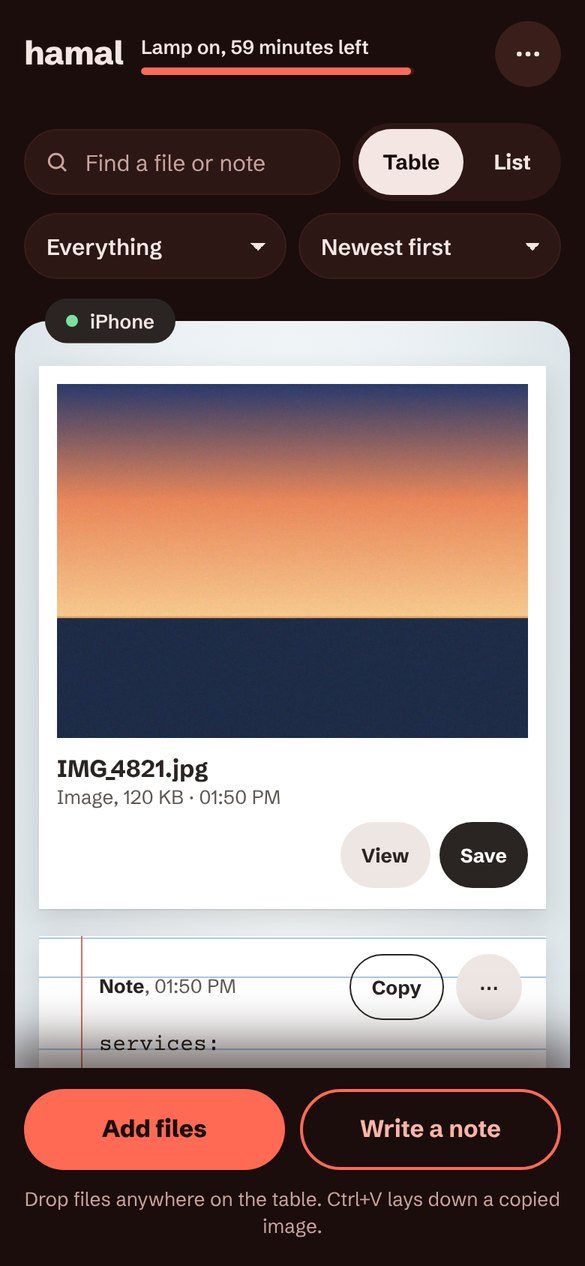
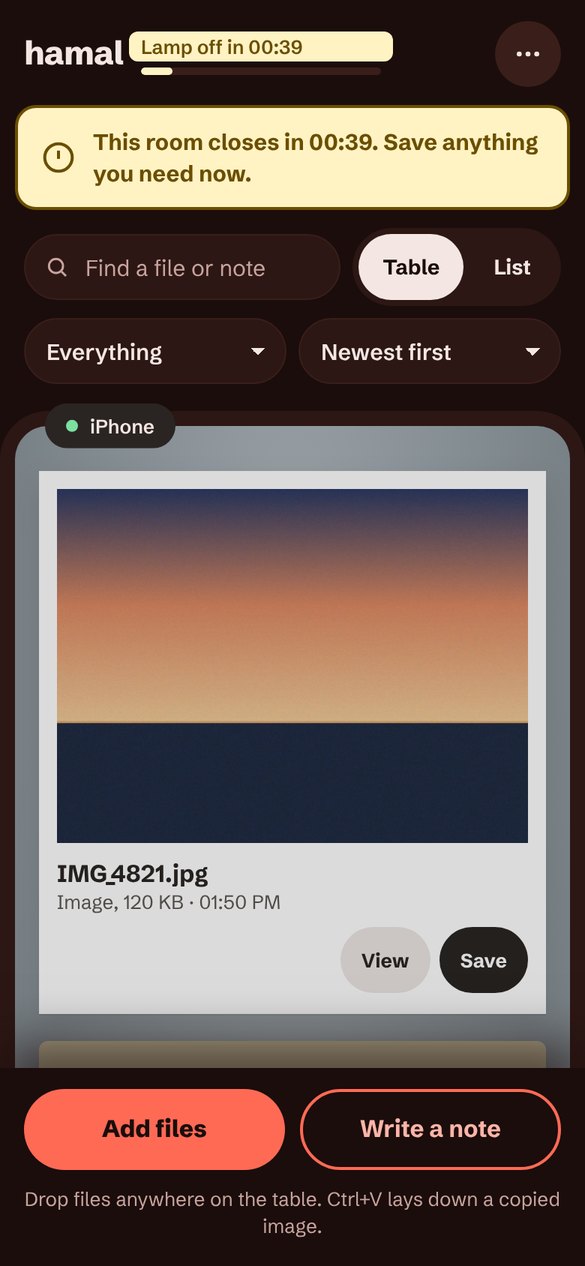
HAMAL uses the Light Table design throughout, from opening a room to joining one and opening a public share link: a darkroom frame around a lit table, where photos lie as prints, documents and audio as manila slips, and notes as index cards. The lamp at the top shows how long the room has left. Screens below are captured from the running application with demo data.
Open a room — desktop and phone
Room — creator, desktop
Inviting a device — QR projection
Notes and the composer
List view and media viewer
Public share link — desktop and phone
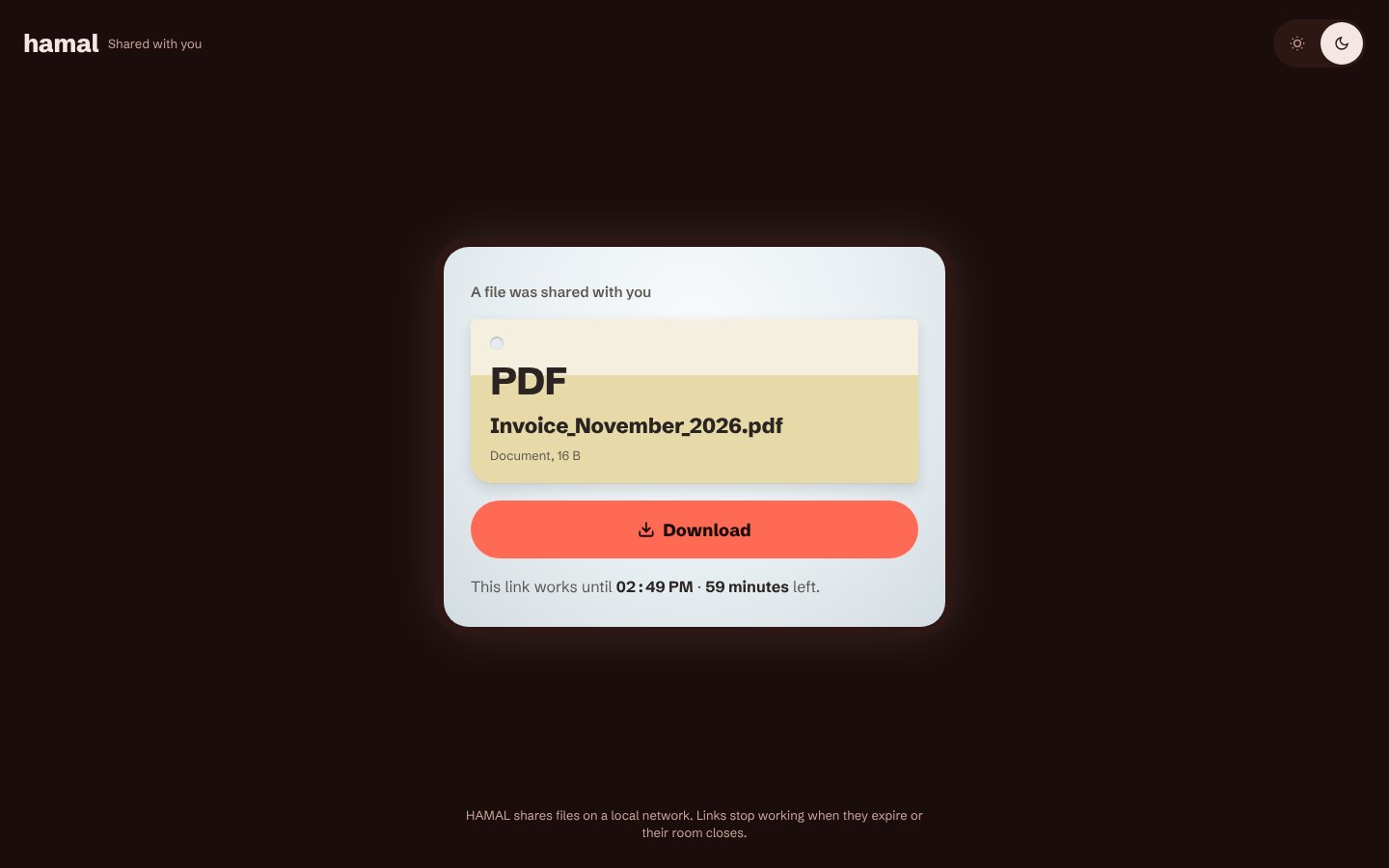
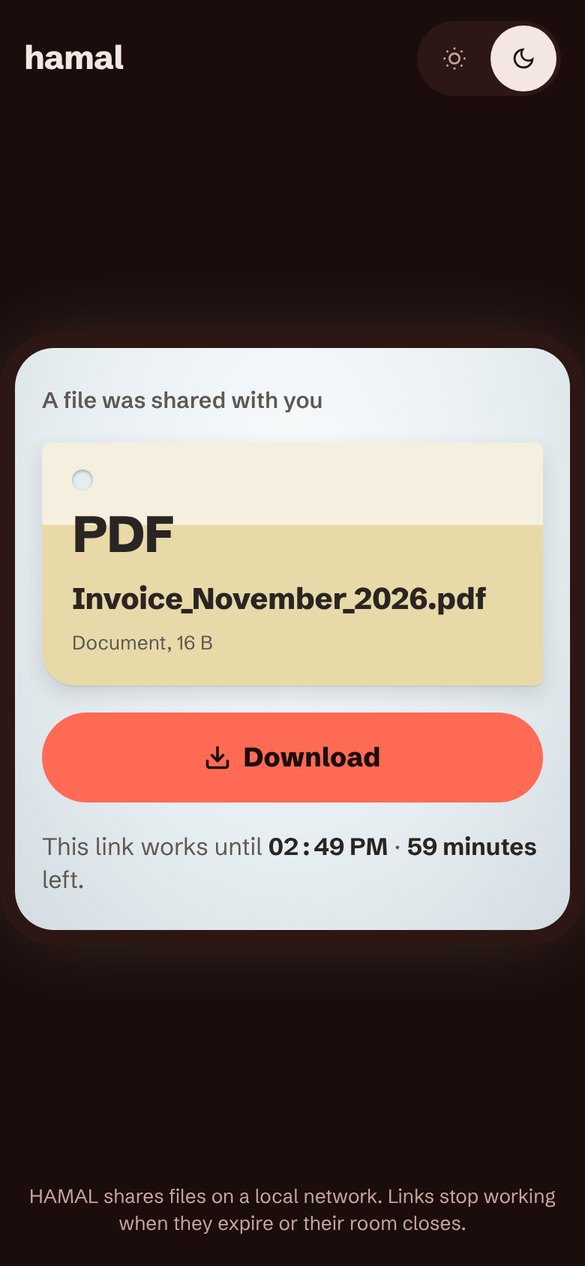
Phone — joining with a PIN, the table, and the last two minutes
Key Features
- 📋 Temporary Text / Clipboard: Send plain text, commands, logs, JSON/YAML, URLs, configuration snippets, and other technical text through the same temporary room.
- 🔄 Two-Way CLIENT ↔ CLIENT Text Sharing: Both devices can send text through the same room. Messages are labelled CLIENT and system activity is labelled SERVER.
- 📎 One-Click Copy: Every shared client message can be copied as the original plain text, preserving multiline content and formatting.
- 🚀 Zero Setup for Participants: Scan a QR code or open a local link to immediately upload/download files or use the temporary Text / Clipboard channel.
- ⏱️ Auto-Expiring Rooms: Rooms automatically expire and clean up temporary content after a configurable TTL.
- 🔒 PIN Protection: Optional 4–8 digit PIN with exponential backoff and lockout to prevent brute-force attacks.
- 📦 True Streaming I/O: Multi-gigabyte transfers stream directly to disk without exhausting server RAM.
- 🎨 Responsive HAMAL UI: Dark-first interface with warm amber accents, plus a preserved light theme for users who prefer it.
- 🔍 Interactive QR Lightbox: One-click smooth zoom for scanning QR codes from across the room.
- 🛡️ Self-Hosted & Private: Zero cloud dependencies, zero external analytics, zero tracking. All assets, including fonts, are served by your own instance; pages make no third-party requests.
Text messages are temporary and scoped to their room. They are removed with the room lifecycle; the text channel is a technical clipboard rather than a permanent chat application. Each message is limited to 64 KB (LAN_DROP_MAX_TEXT_SIZE), with up to 200 messages per room (LAN_DROP_MAX_TEXTS_PER_ROOM). System messages (labelled SERVER) share that capacity but never block user text: when a room is full, the oldest system messages are removed first. Text is stored exactly as sent, including leading indentation.
Security model
- Rooms are protected by unguessable links. The creator link controls the room; the participant link (the QR code) can upload, download and exchange text, but cannot close the room.
- The optional PIN is 4–8 digits. Until a participant has entered it, files, text and the list of connected devices are not disclosed.
- HAMAL does not encrypt files or text at rest, and it serves plain HTTP. On an untrusted network, put it behind an HTTPS reverse proxy. Files live under
/datauntil their room expires or is closed.
Quick Start
Using Docker Compose (Recommended)
Clone the repository:
git clone https://github.com/i1k3r/HAMAL.git
cd HAMAL
Copy the sample environment file:
cp compose.example.env .envStart the container:
docker compose up -dOpen your browser and navigate to:
http://localhost:7700
Unraid Installation
- Place
unraid-template.xmlinto/boot/config/plugins/dockerMan/templates-user/on your Unraid flash drive. - Go to the Docker tab in Unraid and click Add Container.
- Select HAMAL from the template list.
- Set your preferred web UI port and appdata directory path (
/mnt/user/appdata/hamal), then click Apply.
No permission setup is needed. On first start, a new empty appdata folder is handed to Unraid's nobody:users (99:100); only that folder itself, never its contents.
Data folder permissions
The container starts as root only to choose a non-root identity, then runs HAMAL (and its health check) without root, keeping --read-only and no-new-privileges:
- Existing data: HAMAL runs as the owner of the data it finds (for example 10001:10001 from older images and named volumes, or 99:100 on Unraid). Existing files are never chowned.
- New, root-owned folder (what Docker creates for a missing host path): only that directory is given to 99:100.
--user: if you start the container with--user, it runs as that user exactly as before.PUID/PGID(optional): force a specific UID and/or GID. Each one replaces only its own half (PUID alone keeps the detected GID, PGID alone keeps the detected UID). Values must be whole numbers from 1 to 4294967294; 0 (root) is refused.LAN_DROP_DATA_DIR/LAN_DROP_DB_PATHare honoured the same way as by the server. A missing data directory is created for the runtime user; the database's directory must already exist.
If something is still not writable, the log lists each path with its owner and mode instead of a bare "permission denied".
Manual Binary Build (Go)
Prerequisites: Go 1.23+, GCC / CGO (for SQLite support).
# Clone the repository
git clone https://github.com/i1k3r/HAMAL.git
cd HAMAL

# Run tests
go test ./...

# Build the executable
go build -o hamal ./cmd/lan-drop

# Run HAMAL
./hamal
Configuration
HAMAL is configured via environment variables:
| Variable | Default | Description |
|---|---|---|
LAN_DROP_LISTEN_ADDR |
:7700 |
Address and port to bind the HTTP server |
LAN_DROP_DATA_DIR |
/data |
Root directory for SQLite DB, temporary files, and secrets |
PUID / PGID |
(auto) | Docker image only, optional. UID / GID to run as (1–4294967294, each independent); by default the owner of existing data, or 99:100 for a new folder |
LAN_DROP_DEFAULT_TTL |
1h |
Default room lifetime |
LAN_DROP_MIN_TTL |
5m |
Minimum allowed room lifetime |
LAN_DROP_MAX_TTL |
24h |
Maximum allowed room lifetime |
LAN_DROP_MAX_FILE_SIZE |
10737418240 (10 GB) |
Maximum size of an individual file |
LAN_DROP_MAX_ROOM_SIZE |
10737418240 (10 GB) |
Maximum aggregate file storage per room |
LAN_DROP_MAX_FILES_PER_ROOM |
100 |
Maximum number of files per room |
LAN_DROP_MAX_TEXT_SIZE |
65536 (64 KB) |
Maximum size of a single text message; the web UI uses the same limit |
LAN_DROP_MAX_TEXTS_PER_ROOM |
200 |
Maximum number of text messages kept per room |
LAN_DROP_CLEANUP_INTERVAL |
1m |
Frequency of background room and orphan file sweeps |
LAN_DROP_LOG_FORMAT |
json |
Log format (json or text) |
LAN_DROP_LOG_LEVEL |
info |
Log verbosity (debug, info, warn, error) |
LAN_DROP_SECURE_COOKIES |
auto |
Cookie security (auto, true, false) |
LAN_DROP_TRUSTED_PROXIES |
(empty) | Comma-separated trusted proxy IP addresses or CIDR ranges (for example 192.168.1.5,10.0.0.0/8). When using an HTTPS-terminating reverse proxy, configure this or set LAN_DROP_SECURE_COOKIES=true so session cookies receive the Secure attribute. |
Official Desktop Applications
HAMAL is available as a native, zero-cloud desktop application for multiple platforms:
- HAMAL for Windows: Native Windows desktop client packaged with MSIX and Microsoft Store distribution support.
- HAMAL for Linux: Native Linux desktop application and Snap package with WebKit2GTK engine and 20-language support.
Brand Assets
Official HAMAL vector logos and icons are available in the brand/ directory:
brand/hamal-logo-dark.svg(Horizontal dark-mode wordmark)brand/hamal-logo-light.svg(Horizontal light-mode wordmark)brand/hamal-logo-stacked.svg(Stacked badge wordmark)brand/hamal-app-icon.svg(Square container icon)brand/hamal-monochrome.svg(Monochrome asset)brand/hamal-path-mark.svg(Vector path symbol)
License
HAMAL is source-available software licensed under the HAMAL Source-Available Organizational Use License.
Organizations may freely use, modify, fork, and deploy HAMAL for their own internal operations, including commercial business operations.
Commercial redistribution, resale, productization, and offering HAMAL or derivative works as a commercial service require separate permission from the copyright holder.
The bundled UI fonts (Inter, JetBrains Mono and Caveat) are third-party works licensed under the
SIL Open Font License 1.1; their license texts are in
internal/app/static/fonts/.
Categories
Related apps
Explore more like this
Explore allLinks
Details
ghcr.io/i1k3r/hamal:latestRuntime arguments
- Web UI
http://[IP]:[PORT:7700]- Network
bridge- Privileged
- false
- Extra Params
--read-only --tmpfs /tmp --security-opt no-new-privileges:true
Template configuration
Web interface port
- Target
- 7700
- Default
- 7700
- Value
- 7700
Persistent storage directory for SQLite database, uploaded files, and server secrets. A new, empty folder is set up automatically for Unraid (99:100). Existing data keeps its owner and is never changed. HAMAL always runs without root privileges.
- Target
- /data
- Default
- /mnt/user/appdata/hamal
- Value
- /mnt/user/appdata/hamal
Container timezone
- Target
- TZ
- Default
- Europe/Istanbul
- Value
- Europe/Istanbul