
All apps · 0 apps
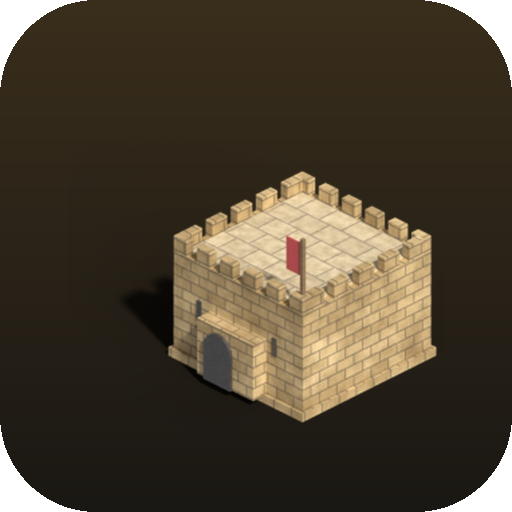
fiefdom
Docker app from fiefdom_castlebuilding's Repository
Overview
Readme
View on GitHubFiefdom
An isometric castle-builder in the spirit of Stronghold Crusader, running in the browser. Named for what the game is actually about: holding land, working it, and defending what it produces.
Licence and where the assets come from
AGPL-3.0-only — see LICENSE.
Worth being precise about the art, since this repository is public:
- Every sprite is generated, not sourced. The buildings, ground, cliffs,
vegetation, goods piles, siege engines and the gazelle are all built from
procedural geometry by the scripts in
tools/renderand rendered through one shared Blender rig. Nothing is downloaded from an asset pack. - The human and animal motion comes from Mixamo clips applied to a
procedural body. The
.fbxsource files are not redistributed — they are gitignored — and only the rendered 2D output is committed, which is what Adobe's terms allow. - Screenshots of the original Stronghold Crusader live in
reference/as visual reference and are gitignored. They are Firefly Studios' copyright and are not ours to redistribute.
The name is Fiefdom, not Stronghold, for the same reason: Stronghold is Firefly Studios' mark for a game in exactly this genre. Where the README and the code comments name it, they are describing an influence.
Running it on a server
Packaged as a container and an Unraid Community Applications template — see docs/INSTALL.md.
docker run -d --name fiefdom -p 8080:80 \
  -v /mnt/user/appdata/fiefdom:/data \
  ghcr.io/halvar20000/fiefdom:latest
or docker compose up -d with the docker-compose.yml
in this repository.
The container is a small dependency-free Node server (docker/server.mjs)
serving dist/: the simulation, the pathfinding, the AI lord and the rendering
all happen in the visitor's browser, so the server sits near zero CPU. Its one
server-side job is storage — saved games and custom maps are kept under
/data, so map that to a host folder and they outlive every update.
Two details that matter:
index.htmlis served uncacheable while the sprites are cached hard. The atlas is ~1300 PNGs and wants aggressive caching, but ifindex.htmlis cached too, a browser goes on loading the previous build's fingerprinted script after the container is updated and the game silently stays on the old version. The server reproduces exactly the cache policy the old nginx config carried, per-path.- Saves and custom maps live on the server, in
/data. Map it to appdata and they survive container updates and are the same in every browser. If the volume is left unmapped the game still runs — it falls back to keeping saves in the browser'slocalStorage, as it did before this server existed — but then they are per-browser again and a container recreate can lose them, so map the volume. On first run against a fresh/data, any saves a browser already held are copied up automatically, so upgrading loses nothing. - Accounts, kept by the server itself. A username, an email and a password,
hashed with scrypt into
/data/accounts.json, and a session cookie signed with a key beside it. No mail is sent — the email identifies a player and nothing else, so there is no SMTP server to stand up and no verification link to wait for. Registering makes your saves private (/data/users/); everyone who has not shares alocalprofile, exactly as before. Single-player never asks. This replaced an optional Cloudflare Access integration, which asked every self-hoster to stand up a Zero Trust application before two people could have separate saves, and which could never supply the thing multiplayer actually needs: names in a lobby. - Multiplayer, two to four players. One map, one castle each, allied or every lord for himself, with AI lords filling the empty seats. Every castle is simulated by its own player's browser and described to the others eight times a second; the server is a switchboard that never looks inside a message. That is why a match costs the host tens of kilobytes a second and no CPU — and why a player who edited their own client could lie about their own castle, which is a fair trade for a game you host for people you know and a bad one for strangers. See docs/INSTALL.md.
CI publishes amd64 and arm64 — plenty of home servers are ARM, and an x86-only image fails at install time with a message nobody can act on.
Feedback and ideas
The game is shaped by the people who play it, and there are not many of them yet, so one message carries weight.
- Something broken? Report a bug at the bottom of the main menu or the pause menu opens a bug report with the version, build, map, browser and renderer already filled in. Add what you did and what happened.
- Want something? Say so in Discussions → Ideas, or 👍 an idea already there — the roadmap thread lists what is being considered, and the votes decide the order.
- A question, a castle to show off, a custom map? Discussions has a place for each.
Start menu and map choice
The game opens on a title screen listing twelve maps. Nothing is generated until you pick one, so the choice shapes the terrain rather than being applied to a world that already exists.
A map is a set of BIASES on the one generator, not hand-drawn terrain:
{ seed, green, rock, marsh, trees, river, lords, difficulty,
  relief, grain, lakes, coast, dunes }
A Crusader map is characterised by what it is short of — one is green and
wooded, another bare rock, another half bog — and biasing thresholds says that
in a few numbers where hand-drawn terrain would say it in a megabyte. green
shifts the moisture cut-offs, rock the outcrop threshold, marsh the bog
threshold, trees multiplies vegetation density, river is the half-width of
the water in the wadi.
The first six maps differ only in cover: the same tiered ground, dressed green or bare or boggy. The second six differ in shape, which needed five more knobs on the same generator rather than a second one:
| what it changes | what it makes | |
|---|---|---|
relief |
height of the tiers | 0.34 a plain you can see across; 1.42 tablelands whose tops clamp flat |
grain |
frequency of the elevation noise | 0.6 few broad landforms; 2.1 a gullied badland |
lakes |
standing water in hollows, away from the wadi | pools with a flat shore, and pitch seams along it |
coast |
a sea along the southern edge | a wandering shoreline with bays and headlands, and a strand |
dunes |
ridges laid over the land after quantisation | rank on rank of whole-step crests |
All five are optional and default to the old behaviour, so the original six maps generate exactly the ground they always did — which matters, because a save is a diff against the world its seed regenerates.
The knobs are measured, not guessed. Composition over the whole 200x200 map, and how much of it a keep can stand on:
| knob | rock | water | cliff | 5x5 keep sites | |
|---|---|---|---|---|---|
| The Green Wadi (default) | — | 24.6% | 5.3% | 3.5% | 2,144 |
| The Salt Pan | relief 0.34 |
22.6% | 12.9% | 0.0% | 3,553 |
| The High Tables | relief 1.42 |
44.9% | 9.1% | 5.4% | 2,330 |
| The Broken Country | grain 2.1 |
22.3% | 5.5% | 2.9% | 1,264 |
| The Dune Sea | dunes 1.15 |
17.1% | 9.0% | 1.6% | 974 |
| The Lake of Reeds | lakes 0.09 |
14.2% | 26.0% | 2.0% | 3,057 |
| The Salt Coast | coast 0.22 |
12.8% | 25.1% | 1.0% | 3,107 |
The Salt Pan has no cliff on it anywhere; the Dune Sea offers under a third of the keep sites the Salt Coast does. The pips on the cards are not flattering the maps.
Water is level ground, and that broke two things once there was a lot of
it. isBuildable reads corner heights and nothing else, so a lake was the
flattest country on the map: findStartSite scored it as open building land
and put the player's keep in the middle of one, and the placement screen's
"farthest point from every other seat" was reliably the middle of the sea —
where the game then refused to build, losing the lord. Both now test the
ground type as well as the height. Water in reach still earns a small
bonus — a shore is worth having, a swamp is not.
Verified that the choice is real, not decoration:
| The Tar Pits | The Quiet Valley | |
|---|---|---|
| marsh | 22.8% | 8.2% |
| green | 28.7% | 32.7% |
| trees | 3,642 | 7,295 |
| opposition | lord active | 0 buildings, 0 soldiers after 400s |
The pip ratings are derived from the generator numbers, never typed in by hand, so a card cannot promise a map something the generator will not produce.
lords: 0 gives a pure builder's game. Rather than making every call site
handle a null lord, the map still constructs one and marks him defeated from
the start — cheaper and far less error-prone.
The menu appears instantly, before any sprite loads. That matters: the atlas is 1300-odd PNGs and on a cold cache the wait is real, so the player gets something to read and a decision to make while it happens.
Game speed
Pause / Slow / Normal / Fast, as a segment at the top of the settings panel,
Space to pause, , and . to step a notch either way. It is
GameState.speed, an index into SPEED_LEVELS; the only code that reads it is
the frame loop, which scales the dt it hands the simulation.
This is not the Esc menu. That stops the frame outright — nothing ticks and nothing but the last drawn image is on screen. Speed Pause stops only the world: the camera, the build ghost, the tooltips and the whole HUD stay live, so a paused settlement is one you can turn around, read, and plan a quarter of before letting the clock run again. A banner under the resource bar says PAUSED, because a game frozen without a word looks like a game that has hung.
Three decisions worth keeping:
- Pause is a multiplier of 0, not a second flag. One number to read, and no
way to end up paused and ticking at once.
togglePausereturns to the last running speed, so pausing out of Fast and back resumes at Fast rather than dropping you to Normal. - Fast forward runs more steps, not longer ones.
advanceSimslices the scaled time into pieces of at mostMAX_SIM_STEP(0.1s — the same clamp the loop has always put on a slow frame's dt) and callssimulateStepfor each. Everything that moves integrates asspeed * dt, and one 0.3s stride is long enough to carry a man through a wall that three 0.1s steps stop him at. - Nothing is announced while paused. A notice expires on game time
(
elapsed - at < 6), which at Pause is not running — so a "Paused" notice would have sat on the screen until the world started again. The banner says it instead, because a banner can be taken away. - The banner is anchored to the measured bar, not to a constant.
top: 52pxlooked right until the resource bar wrapped onto a second line, which it does between roughly 1100 and 1500 pixels wide — and there the banner sat on the bar's lower edge.update()reads the bar's real bottom while paused and writes the offset only when it moves. Found by measuring the two rectangles at five widths, the same way the panel clashes in "HUD layout" were.
simulateStep is now the single place the world advances. The console harness
__game.stepSim(seconds) goes through it too, so the fixed-step test path and
real play can no longer disagree about what one tick does — which they had
quietly begun to: the harness never ran checkStanding, so a game driven from
the console could not be won or lost, and it never refreshed the store sprites,
so a stockpile grown under it drew at its old height.
Saving, loading and the pause menu
Esc pauses and opens the in-game menu: resume, save to a new slot or over an old one, load or delete a save, or quit to the title screen. There is no fixed number of slots — a new save takes the lowest free number. With a building in hand Esc cancels the building instead — it means "back out of what I am doing", and that is the building before it is the game.
A save is a diff, not a dump
The terrain, the ground types and even the scatter of trees are deterministic functions of the map seed — vegetation is hashed from tile position. Storing them would mean writing down forty thousand tiles the game can recompute in a second. A save therefore records only what changed: buildings, units, animals, stores, the lord's economy, and which trees have been felled. 10.5 KB for a developed settlement.
Loading regenerates the world from the seed and lays the diff back on top.
Workers are deliberately not saved
Their in-flight state is a tangle of paths, claims and half-finished production
cycles, and every bit of it is recoverable: workers.sync() puts a man back in
each staffed building and he starts his cycle again. The cost is one trip's
progress. The alternative is serialising the most mutable structure in the game
and getting it subtly wrong.
Reload rather than rebuild in place
Loading a save and quitting to the menu both go out through location.reload()
with an intent in sessionStorage. Rebuilding takes about a second on a local
disk; unwinding three.js buffers, listeners, timers and the sprite atlas by hand
is a reliable source of leaks nobody notices until the fifth load.
Two bugs the round-trip test caught
- Peasants vanished on every load. The saved
idlecount already excludes staffed workers, and the restore calledassignWorkerson top — deducting them a second time. 25 idle in, 21 out. Staffing is now restored from the save rather than recomputed. - Workers doubled.
sync()drops workers whose building is gone but keeps any that are idle — correct during play, wrong on load, where they are orphans of a world that no longer exists. It then staffed the restored buildings on top of them: 4 workers in, 8 out. The pool is now cleared first.
A full in-memory round trip now matches on all fourteen tracked fields — gold, stores, buildings, staffing, worker count, soldiers, felled trees, live animals and the lord's economy.
A measurement that proved nothing
I first "verified" that pausing stops the simulation by checking elapsed did
not advance while the menu was open. It did not — but neither did it advance
after resuming, because the Claude browser pane freezes requestAnimationFrame
when hidden. Both readings were measuring a stopped frame loop, not the pause
flag. The flag is now exposed and tested directly.
The approach, in one paragraph
Terrain is real 3D geometry; everything standing on it — buildings, trees, peasants — is a flat sprite that was pre-rendered in Blender. That is the same technique the original used, and it is why the game looks "2D but somehow 3D". The look does not come from the models. It comes from one shared Blender lighting rig that every asset is rendered through, so all the sprites sit together as if photographed in the same place at the same hour.
Tuning that one hour of light
Because the light lives in a single rig, the whole game's mood is a few numbers
in rig.py. The 1.15 pass warmed them — a more golden SUN_COLOR and a warmer
SKY_COLOR ambient — and that is why every sprite had to be re-rendered at once:
a sprite lit under the old cool key sitting beside a warm one looks like it was
cut from a different photograph, which is the exact failure the shared rig exists
to prevent. The other half of the pass was contrast within that light — grass
pulled from dry olive to a saturated green (1.14), building plaster lifted from a
dull tan to cream white so the dark timber framing reads, and a second tree, the
oak, added to props.py so the land is not one repeated silhouette. The rule
holds: a look change is a rig or material change plus a full re-render, never a
per-sprite touch-up.
Layout
tools/render/      the Blender pipeline (this is the important part)
  rig.py           THE shared camera + sun + render settings. Everything uses it.
  materials.py     procedural stone/timber/thatch/ground. No image textures.
  geom.py          mesh primitives built at true size
  buildings.py     parametric buildings
  props.py         palms, oak, scrub, deadwood
  render_*.py      drivers: buildings, ground tiles, animated units
src/engine/        iso projection, camera, terrain mesh, sprite batching, loaders
src/game/          map generation
public/assets/     rendered output (PNG + JSON manifests)
reference/         Stronghold Crusader screenshots used to calibrate the look
Conventions that must not drift
- Projection is 2:1 dimetric: azimuth 45°+90°k, elevation 30°. Not
atan(0.5)— that is the angle of the diamond edge on screen, a different thing.src/engine/iso.tsandtools/render/rig.pyboth hard-code this and must be changed together. - 1 Blender unit == 1 map tile.
- The sun is fixed in world space, so rotating the camera genuinely shows
lit and shadowed faces of a building. Its direction is duplicated in
iso.ts::SUN_DIRECTIONso terrain slope shading matches the baked sprites. - Buildings need 4 renders (one per camera rotation). Units need 8 — eight world-space facings, and camera rotation just re-indexes which one is shown. Rendering units 8×4 would produce 24 exact duplicates.
- The furthest zoom level may never exceed the sprite render scale.
SPRITE_RENDER_SCALEiniso.tsand inrig.pyare the same number written twice, and the last entry ofZOOM_LEVELSmust not be larger than it. Past that point one sprite texel is stretched over more than one screen pixel, and no camera change recovers detail that was never baked. - Anything randomised in a builder must be seeded from its own name. Every
asset is rendered four times, once per camera rotation, and those four
renders have to be the same building.
geom.rng_for(name)exists for this; a barerandomcall makes a roof reshuffle its thatch as the player rotates the map.
Rebuilding assets
OUT="$PWD/public/assets/sprites"
blender -b -P tools/render/render_buildings.py -- --out "$OUT" --samples 96
blender -b -P tools/render/render_ground.py    -- --out "$PWD/public/assets/tiles"
blender -b -P tools/render/render_units.py     -- --out "$OUT" --body peasant --only idle,walk,dig,mine
for b in spearman archer swordsman engineer tunneler \
         pikeman maceman crossbowman \
         slave slinger arabian_swordsman assassin ladderman lord \
         fire_thrower; do
  blender -b -P tools/render/render_units.py   -- --out "$OUT" --body "$b"
done
blender -b -P tools/render/render_mounts.py    -- --out "$OUT"
blender -b -P tools/render/render_wildlife.py  -- --out "$OUT"
blender -b -P tools/render/render_siege.py     -- --out "$OUT"
python3 tools/render/trim_sprites.py           --out "$OUT"
The last line is not optional and not a tidy-up. It crops every sprite to the pixels the shader can actually draw and moves its anchor to match, which is what keeps the single texture the whole scene is drawn from inside the 8192 limit. Skipping it costs a third of the atlas in transparent air. It is idempotent, so running it after a one-body re-render is the normal thing to do.
About forty minutes for the whole set on twenty-four cores. The --only lists
are not decoration: carry, chop, fish, death and the trade clips
(farm, pick, milk, feed, slaughter, butcher, craft) come from
the 0 A.D. motion set via render_0ad.py, which writes the same clip keys, so
rendering those clips from Mixamo as well silently replaces a hand-picked
woodcutting swing with a baseball bat.
Units render from the Mixamo rig in assets/source/mixamo/. --body peasant
(default) generates a hooded-tunic body onto that skeleton; --body ybot uses
Mixamo's own mesh instead. Six clips -- idle, walk, carry, dig, mine, chop --
are mapped to worker state and building type, so a hauler walks differently from
an empty-handed labourer and a miner swings rather than stands.
A SOLDIER body renders three of them: idle, walk and attack. Those are the only
three the army draw loop can ask for, and a soldier has no worker state to be
digging in. The renderer drops the other two itself, so --body archer with no
--only is now the correct full run rather than 128 sprites of a bowman
swinging a pick at nothing.
Root motion is stripped at render time by re-centring the hips each frame, so it does not matter whether a clip was exported with Mixamo's "In Place" ticked.
The knight, the horse archer and the war dog do NOT come from that rig, because
there is no horse in the Mixamo set and no dog, and retargeting a biped's walk
onto four legs is not a thing that works. mounts.py builds them the way the
gazelle and the siege engines are built -- primitives with a few parts posed
per frame from a phase in 0..1 and no armature at all. The rider is part of the
mount rather than a peasant standing on one, because the one thing a rider must
never do is slide about on the saddle.
Everything in mounts.py is authored facing +Y and turned half a turn at render
time (BASE_YAW_DEG = 180). The Mixamo body faces -Y, and a mounted unit is
drawn through the same code path as a foot soldier -- same ${type}_${clip}
keys, same direction index -- so facing 0 has to mean the same thing for both or
the cavalry rides backwards. The gazelle predates that rule and compensates in
main.ts instead; do not copy it.
Movement
Units path with 8-connected A* on the tile grid (src/game/pathfind.ts), with
string-pulled smoothing so they do not staircase along diagonals.
Cliff faces
Tiles whose corners differ by two or more height steps render with a dedicated
cliff texture instead of the flat top-down rock one. This is render-only
— groundType still reports rock, so quarry and iron-mine placement is
unchanged (a 2-step face fails the level-ground test anyway).
Two things that had to be right for it to look like rock:
- Brightness. The terrain shader applies a lambert term, and a 2-step face turned away from the sun lands at shade 0.50. A texture that looks correctly cliff-dark flat in Blender renders as near-black mud in game, so the cliff albedo is kept as bright as the plateau stone. The face reads as rock through its structure, not its dimness.
- Block tone from voronoi
Color, notDistance.Distancedomes towards each cell centre, shading every block identically — measured lower contrast than the plateau it was meant to beat.Coloris random per cell and gives distinct blocks. Cliff now measures sd 22.5 against rock's 15.7.
The material is deliberately direction-free: tiles pick one of four UV orientations at random, so bedding planes would point four ways along one cliff.
A tile you cannot build on is a tile nobody walks over. There are still two
grids -- occupied decides where you may BUILD, paths.blocked where units may
WALK -- but buildings, water, trees, bushes and rocks are in both, and
markScatter() is the one place that writes either.
Scatter used to be passable, on the argument that a blocking palm grove is a maze. The cost of that was worse than the maze. A boulder standing in a wall line is ground you may not build on and the enemy may walk through, so a castle with a rock on its perimeter could never be closed -- and a rock, unlike a tree, can never be cleared. The hole was invisible, permanent, and on exactly the tile the player had planned a wall for.
The maze never turned up either. Across the twelve shipped maps the thickest
woodland (Cedar Ridge, trees: 1.9) covers 16.7% of the flat ground, well under
the ~40% where an 8-connected grid stops percolating. Flood-filled with scatter
solid, the largest walkable region loses at most 0.2 points of the map's open
ground and the trees fence off at most 56 tiles, usually none -- and the maps
that are cut into pieces are cut by their rivers, which they already were.
ensureKeepsConnected() now clears trees as well as draining water when it
carves a route, so a lord walled in by his own woodland cannot happen either.
Two things this needed:
- Woodcutters stand a tile back.
standBesideused a 0.35-tile offset, which is inside the trunk's own tile. With the tile solid,snapOpenshunted the man to whatever it found first -- often round the far side, chopping with his back to the tree. 0.8 puts him in the neighbour he arrived from. Measured over ten minutes on three maps with three huts: 102/174/146 wood before, 104/176/148 after. The extra step costs nothing. - The seal-off trial must put back what it found.
wouldSealSomethingOffmarked its tiles impassable and handed them back cleared, and every caller cleared them again -- right only when the ground was open to begin with. Trial a wall over a boulder or the edge of a lake and the pair of them silently unblocked a tile that had been solid since the map was made. It now snapshots and restores, and the callers do nothing.
Three things make it actually work, and each was a separate bug:
- Destinations are building doors, not centres.
approach()returns a tile just outside the footprint. Routing to the centre sent every worker through a wall on the last leg of every journey. - Targets must be reachable. The grid keeps connected-component labels, so a spot sealed inside a courtyard is rejected instantly rather than discovered as a failed search. Work spots and doors are chosen in the worker's own region.
- No straight-line fallback. When a route genuinely does not exist the worker waits and the player is told. Falling back to straight-line movement is precisely what made units walk through buildings.
Placement refuses anything that would wall a building or a worker off
("That would block the way"), checked on commit rather than on hover -- it needs
a full connectivity rebuild, far too costly to run under the cursor every frame.
rescueStuckWorkers() nudges anyone already trapped back onto open ground.
There are two lists of figures on screen: workers.workers (employed) and
wanderers (idle townsfolk). Both need pathing, both need rescuing, and any
measurement must sample both. Before any production building exists every
figure on screen is a wanderer, so testing only workers measures a population
the player cannot yet see.
Measured across both lists: time spent standing inside a building fell from 55% to under 0.3%, with the opening townsfolk at 0 of 9,600 samples. The remainder is momentary corner-clipping during turns.
Zooming in
The camera used to stop at twice tile scale, and it stopped there for a reason
rather than out of taste: SPRITE_RENDER_SCALE was 2, so at that zoom one
sprite texel was exactly one screen pixel. A third zoom step would not have
shown more of the building — it would have stretched the same texels wider and
gone soft, and no amount of filtering invents detail that was never rendered.
So the ceiling moved by re-rendering rather than by changing the camera.
SPRITE_RENDER_SCALE is 3 in iso.ts and in rig.py, ZOOM_LEVELS gained a
matching entry, and every sprite in the catalogue was baked again. A tile is 96
screen pixels across at full zoom, a peasant stands about seventy pixels tall,
and a 3×3 keep is better than five hundred wide.
What that exposed
Two-and-a-bit times the linear detail is two-and-a-bit times the room for
nothing to be there, and most of these buildings had been modelled for a
sixty-pixel silhouette. A wall was one plaster box. A roof was one smooth
prism. A cow was five cuboids. All of it survived at 64 pixels a tile and none
of it survives at 96, so the modelling vocabulary in geom.py grew to match:
timber_frame— half-timbered walls, a plaster core caged in posts, rails and diagonal braces. The members stand proud of the panel rather than flush with it, which is the difference between a wall that looks built and a wall that looks painted: a proud member throws its own shadow across the panel beside it, and that shadow survives the two camera rotations where the wall is in shade. Passwall=for an open-fronted shed and the infill is built as separate panels on the named sides only, so the shed genuinely has a hole in it.shingle_roof— overlapping courses of split boards, staggered half a shingle so the vertical joints never line up into a stripe.thatch_roof— a deep mattress of straw bundles with rolled eaves, a rolled ridge and hazel rods pinning it down.stone_footing,rafters,plank_door,shuttered_window,barrel,crate,ladder,log_stack,stalks.
Both roofs are geometry, and the first attempt at thatch is the argument for why. It was a smooth prism swollen by a straw thickness, trusting the material's directional bump to do the work, and it rendered as two flat panels of pale plywood. What the eye reads on a real thatch is not surface roughness, it is a deep stack of separate layers each shadowing the one below, and a bottom edge thick and ragged enough to break the roofline. Bump does not change a silhouette. The second attempt lays real bundles and looks like straw.
The bundles are laid edge to edge, incidentally, not spaced. Giving them a gap and a half-bundle stagger — exactly what the shingles want — made the roof look tiled, a grid of pale rectangles. Straw has no vertical joints; what it has is a ragged bottom edge, so the bundles butt up against each other and vary only in how far down the slope they reach.
Everything must be seeded
Every one of those builders jitters something, and every asset is rendered four
times, once per camera rotation. A shared global RNG makes each of those four
renders a different building, and the symptom is a hovel that reshuffles its
thatch as the player rotates the map. geom.rng_for(name) seeds from a CRC of
the piece's own name, which is stable across processes in a way Python's
hash() of a string is not.
One mesh, not many
A shingled roof is a few hundred slabs. Built as individual objects each one
would pay for a bmesh normal pass and, far worse, a bpy.ops.uv.cube_project,
which toggles edit mode. geom._Batch accumulates into a single mesh and
finishes once, which turns minutes of operator overhead into milliseconds.
The atlas was twice the size it needed to be
Sprites shelf-pack to almost exactly the 4096-pixel limit. The packer then added its padding and rounded the result up to a power of two, so 4098 became 8192 and half of a very large texture was transparent margin. We are WebGL2 only — the sprite shader is GLSL3 — and there non-power-of-two textures mipmap like any other, so the rounding bought nothing. Sizing the canvas to fit more than paid for the sprites getting bigger.
Sprites carry only the pixels that can be drawn
Every sprite is framed ONCE per body or building, from a box measured over all its poses and facings, and that frame is reused for every animation frame and every direction. Reframing per pose would make a figure swim around its own feet, so the single frame is right — but it means each sprite carries the margin of the worst pose in its set plus the soft tail of a cast shadow. Measured across the catalogue, a unit sprite was 36% drawable pixels and 64% air.
That air is charged for at the only place it hurts: everything packs into ONE texture, because the scene is drawn as a single back-to-front batch and sprites in two batches cannot be sorted against each other. One texture means one hardware limit — 8192 on a good deal of hardware — and the catalogue was 8192x6588 with nothing new in it.
tools/render/trim_sprites.py crops each PNG to its own content and moves its
anchor by exactly the amount cropped. The anchor is what positions a sprite, so
that is an identity: 8192x6588 became 8192x4272 and no pixel the shader draws
moved by so much as a texel. What counts as content is not "alpha above zero" —
the shadow catcher covers the whole frame in faint pixels, so that bbox finds
99.9% of it occupied — but alpha above 5, which is the point below which
sprites.ts discards the texel outright and never draws it at any zoom.
The crop keeps a three-pixel band of those undrawable pixels around the content. The atlas mipmaps, and a coarse level averages across frame boundaries; cutting flush would let a neighbour bleed into a sprite's edge when the camera pulls back.
Run it after any render. It is idempotent — a second pass finds the content already sitting three pixels from every edge and rewrites nothing.
Sprites may differ in scale
Frame.scale is per frame, not per atlas, and the renderer draws each sprite at
the scale it was baked at. This is not hypothetical tidiness: the 0 A.D.
motion clips can only be re-rendered against source files that are not
vendored here (see docs/THIRD-PARTY.md), so when everything else moved to
scale 3 they stayed at 2 until 1.65.0 re-rendered them. Reading one
atlas-wide scale for all of them would have drawn a carrying peasant half
again the size of a walking one. The mechanism stays: any clip rendered at a
scale of its own is drawn at that scale.
More frames must not mean slower
Animation is sampled about half again as finely — a walk cycle is twelve frames
where it was eight. That is only an improvement because each clip now carries
its own fps in units.json. Every clip used to be stepped at a flat ten
frames a second, so sampling a walk more finely did not make it smoother, it
made it longer: twelve frames at ten a second is a 1.2 second stride, and the
peasant's legs stop keeping up with the speed he is actually crossing the
ground at. Each clip's duration in the render scripts is exactly what it played
at before, so the sampling density is now a pure quality knob. A clip whose
manifest entry has no fps falls back to ten, which is what keeps the older
0 A.D. sprites playing at precisely their old speed.
Sprite anchoring — the axis flip
rig.py puts the Blender camera at -cos(az) on Y, while iso.ts puts the
engine camera at +cos(az) on Z. The mapping between the two is therefore
engine_x =  blender_x
engine_y =  blender_z
engine_z = -blender_y        <-- note the sign
Building models are authored extending into Blender +X / +Y from their origin, so their +Y extent lands on engine -z: the sprite is drawn on the tiles behind its own footprint. For a 3x3 keep that is (+96, -48) screen pixels at zoom 2 -- three whole tiles.
spriteAnchor(x, z, d) returns [x, z + d] to slide it back on. Units need no
shift because their model is centred on its origin, which is exactly why units
looked fine while buildings did not.
This masqueraded as a movement bug for a long time. Units path correctly around the real footprint, but the building is painted three tiles away from it, so they visibly walk through the drawn building. No amount of measuring logical positions against the footprint can detect this -- that only ever compares logic to logic. Trees showed the same fault at half-tile scale (their trunk sits at model centre), which is why woodcutters appeared to chop beside a tree rather than at it.
If sprites ever look displaced again, turn on the G overlay: it paints every movement-blocked tile. A building must sit exactly on its own patch.
Two further faults in the same area
The rig framed sprites in the wrong space. frame_object read
cam.matrix_world before Blender had evaluated it, so the matrix was still
identity and the crop was computed from Blender world X/Y instead of camera
space. The tell was that all four rotations produced an identically sized
sprite -- impossible for anything not rotationally symmetric. rig.py now calls
view_layer.update() before reading the matrix. Verified with
tools/render/_markers.py, which renders emissive cubes at known Blender points
and checks their pixel offsets against the analytic prediction.
The depth bias must be measured from the ANCHOR, not the footprint centre.
The anchor is (x, z + d), so the footprint corners relative to it are
(0,0) (w,0) (0,-d) (w,-d) and the bias is the nearest of those along the view
direction: max(0, w*cx) + max(0, -d*cz). Getting this wrong does not move the
sprite, it clips it: every sprite is drawn at one uniform depth, and on flat
ground a constant-depth plane meets the terrain along a line of constant
screen-y, so an under-biased building is sliced off by its own ground in a hard
horizontal line.
Sprite draw order
Every sprite is drawn in ONE back-to-front stream with alpha blending and no
depth writes, so painter's order is the only thing holding the scene together.
depthKey() must therefore exactly match the ordering of
dot(point, cameraDirection):
| rotation | azimuth | key |
|---|---|---|
| 0 | 45 | x + z |
| 1 | 135 | x - z |
| 2 | 225 | -x - z |
| 3 | 315 | z - x |
Rotations 1 and 3 were the negation of this for a long time. While sprites still wrote depth the z-buffer covered for it; the moment depth writes were removed (needed so building shadows stop occluding people) those two rotations began painting front-to-back, and figures behind a building appeared standing on its roof.
A logical-position metric cannot catch this. Counting how often a unit stands inside a building footprint says nothing about the order its sprite is painted in. The test that does work compares the emitted draw order against true camera closeness -- see the pairwise check in the commit history, which reports 0 inversions across 4,550 sprites at all four rotations.
The campfire
A campfire is placed automatically at map generation, directly out from the
keep's door. The door is modelled on the Blender -Y face and engine_z is
-blender_y, so it faces +z: the fire goes at about (kx + 1, kz + 4), one
clear tile out from the wall. It is not buildable and blocks both building and
movement, so nobody stands in the flames.
Every unemployed peasant takes a place around it and stays there, facing the fire. Three details matter:
- Standing places are found by searching outward for open ground, not laid
out geometrically. A fixed ring cannot cope: at radius 2.45 the circle reaches
into the keep's own footprint, so those places had to be shunted and the crowd
bunched -- with 20 idle two peasants ended up 0.32 tiles apart. Searching also
makes the gathering grow outward on its own and flow around anything built
nearby.
rebuildFirePosts()re-runs whenever the scenery changes. - They do not wander off. With only a handful idle, one strolling away is a quarter of the crowd gone, and the fire exists to show at a glance how many people have no work.
- The drawn crowd caps at
IDLE_WANDERERS(48). Past that the Unemployed figure keeps counting but the gathering stops growing.
Measured with the search-based layout: 8 / 20 / 40 idle all reach their place, closest pair 0.91 / 0.82 / 0.77 tiles, ring radius growing 2.2 -> 3.4 -> 4.0, none standing inside a building.
Note updateWanderers() is a named function called from BOTH the render loop
and stepSim(). An update that lives only inside the frame loop is invisible to
every headless test -- that mistake has now been made twice here (tree regrowth,
then this).
HUD layout
The right-hand side is one panel with a dropdown, showing a single view at
a time: Food & Ale, Popularity, Production, or Market. Everything used to be on
screen at once, and each new stat block squeezed the others -- the market ended
up one row tall. M jumps to the market (and hides the panel if already there),
T hides or shows it.
Views are built once and shown or hidden, never re-created. The market's buttons carry real click handlers, so re-rendering it as innerHTML each frame would throw them away; only the visible view's text is refreshed.
Panels are otherwise laid out by flow, not by hand-tuned offsets:
- Everything on the right (stats, market, rations/taxes) lives in
#rightcol, a flex column. Any panel growing pushes the next one down instead of landing on top of it. The market had a hard-codedtop: 250pxand the moment the ale block made the stats panel taller than that, the two overlapped. - The resource bar is anchored between the side panels (
left: 214px; right: 282px) and wraps. Centring it with acalc(100vw - N)max-width is fragile: N has to be re-derived whenever a side panel changes width, and it fails silently.
Checked by measuring every pair of panel rectangles for intersection with the market both open and closed -- eyeballing missed two of the three clashes.
Why popularity is what it is
The stats panel (T) itemises every contribution: starting goodwill, rations,
taxes, food variety, ale coverage, hunger and overcrowding, then the target it
is heading for. Positives green, negatives red, zeroes dimmed.
popularityBreakdown() is the calculation -- tickEconomy sums that list
rather than repeating the arithmetic, so the number the player reads can never
drift from the one the simulation applies. Verified by asserting the sum of the
displayed factors equals popularityTarget exactly.
Hunger is eased (0..1) rather than switched. A binary "no food" penalty flipped on and off every time the last loaf was baked and instantly eaten -- 19 flips in 300 seconds, which made popularity thrash and the panel unreadable. Easing turns a momentarily empty granary into a small dip and sustained famine into the full -40. Flicker measured afterwards: 1.
The food chains
Four foods reach the granary, and variety is what pays: the popularity bonus
is FOOD_VARIETY_BONUS indexed by how many different kinds are in store, so a
fourth chain is worth +4 popularity on top of the calories.
Wheat Farm  -> Mill -> Bakery        -> bread
Pig Farm    -> Slaughterhouse        -> meat
Dairy Farm                           -> cheese
Apple Orchard                        -> apples
FOOD_VARIETY_BONUS must have an entry for every possible count. Adding meat
made four possible, so the table grew to [0, 0, 4, 8, 12] and the lookup now
clamps to table.length - 1 rather than a hard-coded 3 -- otherwise the next
food added would silently read undefined and poison the popularity sum.
Ale: the second happiness lever
Hops Farm (green land) -> Brewery (hops -> ale) -> Inn. The inn employs a
drayman who walks to the stockpile, loads four barrels and carries them
home; the inn serves from what he has actually delivered, not from the
stockpile at large. Coverage therefore depends on the ale having physically
arrived, which is the difference between a supply chain and a spreadsheet.
Stocking is a separate worker behaviour from producing (BuildingDef.stocks,
handled by WorkerPool.updateStocker). A producer turns inputs into an output;
a stocker only keeps a good on the premises. Splitting them kept the producer
path free of null recipes rather than threading an optional through every case.
- One inn serves
INN_CAPACITY(20) people, drinkingALE_PER_PERSON_PER_MIN(0.12) each -- 2.4 ale a minute per inn. - Coverage is
served / population, and popularity gainsALE_POPULARITY_MAX(10) times that. Half the town drinking is +5. - Coverage is eased rather than snapped, so running dry shows as happiness sliding away over a few seconds instead of falling off a cliff.
- Coverage is
min(population, innCapacity) / population, so a growing town visibly outgrows its inns -- 100% at 17 people fell to 63% at 32, and the fix is a second inn.
The point is that ale is optional, which makes it a real decision: food keeps people alive, ale is labour you choose to spend on making them happy.
Balance note: the drink rate started at 0.05 and one brewery then supplied 80 drinkers -- +10 popularity for a fraction of what feeding those people costs. 0.12 makes a fully-served town of 40 need roughly one hops farm and one brewery.
Verified end to end: hops 4/min -> ale 4/min; +5 popularity at 50% coverage;
and when the stock hits zero, coverage collapses and popularity drops by 8 at
83% coverage, exactly 10 x 0.83.
Both stores are painted areas, not sheds
The stockpile and the granary are each a set of separate 1x1 buildings carrying
storeFor, not one 3x3 shed. The player paints more squares from the Stores
menu; each must orthogonally touch an existing square of the same store, so
a granary bay cannot annex the yard and each store stays one place you can read
at a glance.
One StoreLayout in stores.ts drives both. They differ only in which goods
they accept, how much a square holds and which sprites they draw — and a second
copy of that logic would be the obvious place for the two to quietly drift apart.
| squares at start | per square | goods | sprite prefix | |
|---|---|---|---|---|
| Stockpile | 4x4 = 16 (800) | 50 | the nine raw goods | pile_ on stockpile_deck |
| Granary | 3x3 = 9 (360) | 40 | the four foods | bin_ on granary_bin |
A granary bay holds less because food is spent continuously rather than hoarded: the bay count is a buffer measured in minutes of eating, and a big number would make the granary a thing you build once and forget.
Things this pulled on that were not obvious:
- Walkable.
BuildingDef.walkablemarks both, andmarkSolidis skipped. Left solid, a player painting a big store builds an accidental wall through their own settlement, and the carriers whose whole job is to walk onto it would path around the edge. It also lets the seal-off test be skipped, so painting a store never trips "that would block the way". - Producers stop rather than spill. A workshop will not begin a cycle whose
output has nowhere to go. Without that check it keeps working and walks each
load to a full store, burning labour and inputs every cycle — and the player
sees the DOWNSTREAM workshop "waiting for materials" (the bakery, when it is
really the mill that cannot store flour) with no way to trace it back.
depositstill clamps as a backstop, and a part load spills: the carrier is already standing on the square with the goods in its arms. - Assignment is persistent, not recomputed. Squares are reserved per good and released before new claims each pass. A fresh allocation in resource order looks identical most of the time and then reshuffles the whole store the moment an early good shrinks by one square, so a settlement that is merely spending wood appears to be frantically rearranging itself.
syncStoresmust not use||. It short-circuits, and the granary would stop being laid out on any tick the stockpile happened to change first.
sync() returns whether what is drawn changed, so the static sprite list is
rebuilt a few times a minute rather than every frame. It compares packed
(x, z, good, level) ints against an Int32Array: exact and allocation-free.
A numeric hash would be cheaper still, but a collision silently skips a redraw
and a store showing the wrong good is precisely the bug this exists to prevent.
Why the yard starts at 4x4
Measured on a natural build order with a 3x3 yard: 300 of 450 units are spoken for before the player has done anything, the amber warning is on almost at once, and by minute 15 wheat has hogged three squares, the flour has nowhere to go and the bakery has starved. Sixteen squares opens at 37% and still needs expanding once four or five chains are running — which is the pressure the feature is for, just not in the first quarter of an hour.
The sprites
Nine goods and four foods, three fill levels each, four rotations: 160 sprites
from tools/render/piles.py. Square and load are baked into one sprite per
level, so there is nothing to depth-sort against itself and peasants still walk
over the top of both.
Two calibrations that mattered more than expected:
- The building palette is one warm sandstone family, right for architecture and wrong here — rendered with it, logs, cut stone, wheat and flour all came out the same tan. The pile materials pull hard apart in hue on purpose.
- The granary kerb is 0.085 high, not 0.13. At 0.13 it hid a level-1 load completely and a bay with three loaves in it looked empty, which defeats the entire point of being able to see the store.
Standing trade orders
The market (M) carries a standing order per good with two independent
levels, as in Stronghold: buy whenever the stock falls below one, sell
whenever it rises above the other. Wood set to buy below 30, sell above 100
holds itself anywhere in that band and only acts at the edges. Either half can
be switched on alone.
GameState.tickTrade settles orders every TRADE_INTERVAL (2s) in batches of
TRADE_BATCH (4), so a surplus visibly drains rather than vanishing in one
frame, and a large purchase is something you watch your gold pay for.
Rules worth keeping:
- Trading of any kind requires a market building -- standing orders and the one-off buttons alike.
- The levels may never cross.
setTradeLevelkeeps themTRADE_MIN_BANDapart. If buy ever rose above sell, the good would be bought and sold on alternate ticks and the market's spread would quietly drain the treasury. - Only one side acts per tick per good, so a single tick can never both buy and sell the same thing.
- A buy order never overdraws: it buys
min(batch, shortfall, affordable)and says so when it cannot afford even one. - Orders settle to the level exactly and then stop dead -- verified at zero gold drift over 180 simulated seconds.
- Trades go through the ledger, so the stats panel (
T) counts bought goods as production and sold goods as consumption.
It lives inside tickEconomy, which means the headless stepSim path exercises
it identically to the game.
Workers only fetch what exists
A building with input goods (mill, bakery) checks the stockpile before setting off. Without that check the worker walks to the stockpile, finds it empty, walks home and immediately repeats -- an endless there-and-back that reads as a broken unit to anyone watching, and wastes the trip.
Worth noting how this hid: by every state-machine measure those workers were
healthy. Their cycle was idle > toFetch > returning > idle > ..., all legal
transitions, no stuck states, no failed paths. It only looks wrong when you
watch it. Some faults are only visible to a human.
The ox tether actually hauls
The tether shipped as a licence rather than a building. A quarry needed one within fourteen tiles or its men would not cut -- and that was the whole of it: the quarrymen then carried every block to the stockpile themselves, and the ox was a picture baked into the tether's sprite, standing at its post for the length of the game. It looked exactly like a broken building, because it was one.
Now the ox does the job the building is named after. The quarry's men stay at
the rock face and stack what they cut in its own yard (needsHauler
buildings put their output in b.held instead of walking it anywhere); the
tether's worker is a hauler -- a def with {resource, range, batch} -- which
walks to the fullest yard in range, takes a sledge-load of four blocks, carries
them to the nearest drop, and comes home.
Three details that are not incidental:
- Fullest yard, not nearest. The ox is the bottleneck, so the yard closest to stopping its own cutters is the one worth emptying.
- The yard is capped at twelve. Full, the cutters stop with a warning naming the reason. Silently voiding the block they just cut would be worse, and a backlog on the ground is the visible sign that one ox is not enough.
- A part load comes home.
state.depositspills what a full store cannot take, which is right for a man with an armful and wrong for a sledge. The ox deposits what fits and keeps the rest in the tether's own yard for the next trip.
Measured over ten simulated minutes, one quarry of three men, one tether:
Medians of fifteen runs, because a worker's walking speed is randomised a little at birth and a single run of this is worth about five stone either way:
| stockpile distance | before | after | with a second tether |
|---|---|---|---|
| 6 tiles | 81 stone | 107 | 107 |
| 14 tiles | 58 | 105 | 105 |
| 22 tiles | 44 | 94 | 104 |
| 30 tiles | 36 | 71 | 103 |
Two things fall out of that table. Stone comes in faster than it did -- the cutters no longer spend most of their cycle walking -- and where you put the stockpile now matters, which it barely did before. At thirty tiles the ox is the constraint, says so, and a second tether fixes it.
The ox had to become a unit
A hauler that is a picture on a building cannot walk, so the animal was rebuilt
in mounts.py beside the horses and the war dog: a posable quadruped with a
sledge on two shafts, ox_idle / ox_walk / ox_haul, eight facings each.
The block rides the sledge on the way to the stockpile and not on the way back,
which is the same distinction the peasants' carry and walk draw and the one
the player actually reads.
Three passes were needed, and each failure is worth recording because none of them is about polygon count:
- Daylight under the belly. The first cut had a deep body on short legs and read as a hippo. The body is shallower than a horse's and the legs longer than they look like they should be.
geom.boxturns about its minimum corner. Horns laid out along X and tilted did not rotate in place, they slid. Built with_forwardand swung instead -- pitched up, then swept out, which is the order Blender's XYZ euler applies.- The shafts have to be outboard, not merely clear. At two centimetres wider than the flank a thirty-degree camera draws one bar straight across the animal. Set well outside it, they read as a harness down each side.
The tether's own sprite lost the ox painted into it -- two oxen on one tile, one of them a photograph, is the outcome worth avoiding -- and is now the post, a spare yoke on the rail, a water trough and blocks waiting in the yard.
Water is level ground, and a lake is not a yard. The same class of bug as
the maps: isBuildable reads corner heights, so nothing stopped a keep being
seated in a lake. Here the equivalent was findStartSite; see the map section.
M2, part one: the curtain wall
Wall is a paintable 1x1 building costing 3 stone; gatehouse and tower are 2x2.
BuildingDef.paintable keeps the tool in hand after each placement — laying a
twenty-tile wall while re-selecting between every tile is not a decision, it is
an obstacle. Stores use the same flag.
A wall is dragged, not clicked twenty times
Keeping the tool in hand was only half of it: a twenty-tile wall was still twenty clicks, each one aimed at the tile beside the last. Press where the run starts and release where it ends, as in Stronghold. Mouse and pen only — on a phone the one-finger drag is the only way to pan, and taking it over would strand anyone laying a long wall with no way to see where it is going.
- Any 1x1 paintable building, so moat, pitch ditch, killing pit, oil pot and the two store squares all drag too. Anything larger is a decision per placement rather than a stroke.
- The run turns one corner. It follows whichever axis the drag covers more of and then the other, so a straight drag lays a straight wall and a diagonal one lays two sides of a bailey. A straight line would throw away half of every diagonal drag; a filled rectangle would put a hundred tiles of wall inside the courtyard.
- Every tile is ghosted, tinted by its own verdict — including where the
stone runs out, since a run spends as it goes.
planRun()walks the stroke in order once per frame and both the ghost and the cursor label ("Wall × 12 · 36 stone") read the result, so the two cannot disagree. - A tile that cannot take it is skipped, not fatal. Dragging twenty tiles
across a boulder gives nineteen tiles of wall and a boulder — and since the
boulder is solid ground now, the line is still closed. Measured:
asked 20, built 19, refusal "Something is in the way", all 20 tiles impassable. One warning for the whole stroke, not one per tile. - A plain click is a run of one.
buildRun()is the only path into placing a building; the console's__game.build()calls it too, so a test cannot pass against code the game does not run.__game.buildLine()drives the drag.
A wall segment is crenellated on all four sides. A 1x1 segment has no idea which way the run goes — it is placed tile by tile and the player may turn a corner anywhere — so merlons running one way only would be wrong on half the wall. Where segments abut, the joint merlons interpenetrate, which at 45 px per tile reads as one continuous battlement. Checked on a 50-segment ring.
The gatehouse is pierced on all four faces. Buildings here do not rotate, only the camera does, so a gate with one fixed passage would be unusable on three sides of a castle.
What the seal-off guard actually protects
Worth being precise, because the obvious story is wrong. wouldSealSomethingOff
refuses a wall that cuts a building off from the keep — verified: ring a
hovel, leave one gap, and closing that gap is refused with "would block the
way", leaving the tile passable.
It does not stop you enclosing your entire settlement with no gate at all,
because everything inside stays connected to everything else. That is a legal
castle, and the guard has no opinion on it. What breaks is the jobs that reach
outside the wall — woodcutters, the hunter, farms on land you walled out. Those
fail loudly rather than silently: goTo finds no route and notifies
" cannot reach its work". The gatehouse is how you avoid that, not how
you satisfy the guard.
M2, part two: soldiers
Gold buys the man; the armoury arms him. Recruiting costs gold, a peasant
out of the idle pool, and one item of kit off the rack — and nothing else.
population and idle are independent counters, so idle -= 1 is the whole
accounting; the soldier is off the roll but was never free.
| Recruit | Gold | Kit |
|---|---|---|
| Spearman | 20 | 1 spear |
| Archer | 40 | 1 bow |
| Swordsman | 80 | 1 sword + 1 armour |
No timber and no iron are charged at the barracks, because the workshop that made the spear already spent them — charging for both would be charging twice for the same spear. Siege engines are the exception and still cost materials directly: an engine is built at the camp out of beams, not issued from a store.
See the weapons chain for the four workshops and the armoury behind that table.
Army is deliberately separate from WorkerPool. Workers are driven BY their
building through a production state machine and have no will of their own;
soldiers are driven by the player and have no building. Folded together, every
worker would carry an unused selection flag and every soldier an unused
production cycle.
Controls: click a soldier to select, shift-drag to box select, right-click to move. Left-drag already pans and taking that away would break the control everyone has been using, so the box lives on shift. Right-click is a move order when troops are selected and only falls back to cancelling a placement when they are not. Move orders spread over a block around the click — a dozen soldiers routed to one tile arrive, find it occupied by each other, and mill about.
Selected soldiers are brightened in place via the sprite tint rather than given a marker sprite.
No two men stand on the same spot
orderMove spreading its targets over a block was the only thing in the game
that did. Every other order aims at a POINT — a rally flag, a barracks door, a
foe's tile — and a dozen units all given the same point all arrive at it.
Measured: twenty archers recruited to one rally flag, all 190 pairs at a
distance of zero. They drew as one archer, and the player could neither
count them nor click any of them apart. Only selecting them and marching them
somewhere revealed how many there were.
Army.separate() fixes it once, at the end of every tick, rather than by
spreading each caller's target: a spread target is a guess about ground that may
be full, and the alternative was writing the same fix into recruitment, the
rally flag, the lord's musters and every order added afterwards. The same twenty
now sit 0.62 tiles apart at the closest, inside a 2-tile circle.
- A fraction of each overlap per tick (
SEPARATION_RATE), so a crowd settles over about half a second instead of exploding apart. - Each axis is tried on its own against
world.blocked, so a man shoved against a wall slides along it rather than through it. Verified: twelve men pressed into a wall line, none crossed it. - Two men exactly on top of each other take their push direction from their ids, so it is the same every tick and the pair separates instead of shivering.
- Garrisoned men are exempt.
postToalready lays out their places on the wall; nudging them would walk them off the parapet. - Bulk is per unit type — 0.33 for a man, 0.42 for a horse, 0.6 for an engine — so a cart does not sit inside a spearman.
It runs every tick for every unit, so it is written to be cheap: one pass bucketing the men into tiles as linked lists over scratch typed arrays that live between ticks, then a half-neighbourhood sweep that visits each pair of tiles exactly once. Measured over 30 seconds of simulation: 40 men 48 → 59 ms, 100 men 64 → 97 ms, 300 men 196 → 350 ms. At 300 that is 0.17 ms per tick, against a 16 ms frame.
The rally flag also aims recruits a little off the flag rather than at it. Separation would unpack the pile on arrival anyway, but a company that lands on one tile and then visibly sorts itself out looks like a bug.
Pointer handlers must ignore non-left buttons. pointerdown and pointerup
fire for the RIGHT button too. Letting them through broke move orders entirely
and in a way that looked like the feature was simply missing: right-click's
pointerup ran the selection code, found no soldier under the cursor, cleared
the selection, and by the time contextmenu arrived there was nothing left to
order anywhere. Both handlers now return early unless e.button === 0, which
also makes the fix independent of platform — macOS fires contextmenu on mouse
DOWN and Windows after mouse up, and either order used to lose the selection.
Test the real event path, not just the function underneath it. orderMove was
verified directly and worked perfectly; the bug was entirely in the wiring
between the mouse and it.
Box select must be tested in SCREEN space
The first version took the two corners of the dragged box, converted each to a world point, and selected everything inside the world-space axis-aligned box between them. That is a different region. A rectangle drawn on screen is a rotated diamond in world space, so the world box built from its diagonal corners covers a sliver that in practice contained nobody — the marquee drew correctly over five archers and selected zero.
IsoCamera.worldToScreen projects each soldier and the test happens in the space
the player drew in. Army.selectWhere takes a predicate rather than a rectangle
so the geometry stays with the camera, where it belongs. Verified 8 of 8 at all
four camera rotations, which the world-space version could never have been.
Discoverability
Box select existed and worked from the day it was written, and the player still asked how to select more than one unit — because the only mention of it lived in the Barracks panel, which there is no reason to have open while commanding troops. The troop controls are now in the always-visible controls panel, and double-clicking a soldier takes every one of his kind, which is the idiom people reach for first.
Kit is bound to bones, not parented
peasant.build takes a kit, and each piece — helmet, spear, sword, bow,
shield — is bound to a BONE's vertex group. A spear bound to RightHand then
swings with the arm through every frame of every clip without a line of
animation code. Kit is authored in the rest pose; the arms are out to the sides
there, so a shaft drawn vertically THROUGH the hand stays vertical relative to
the hand.
The bug that would have shipped
The renderer scaled the mesh so its z extent equalled the unit height — and the
spear is part of the mesh. Measured: a spearman's body plus spear is 0.624 where
the body alone is 0.520, so scaling to include the spear shrinks the man to
0.433, seventeen per cent shorter than the peasant he was recruited from —
with no cause a player could ever work out. peasant.build now records
body_z_extent before fitting the kit and the renderer scales by that.
That fix then broke the frame: at a full 0.52 the spear tip reaches 0.624, past
the fixed frame top of 0.614, and would have been sheared off. The frame now
takes max() of the peasant's numbers and the body's own, which is deliberate —
an unarmed body keeps exactly the 80x66 frame it always had, so every peasant
sprite already on disk stays valid. Spearmen render at 90x74.
M2, part three: combat
Both sides live in one Army.soldiers list with a side field, because combat
is symmetric — target acquisition, cooldowns and damage are identical whoever is
swinging, and two lists would mean writing all of it twice and letting the
copies drift. The player-facing methods filter to side === 'player' so an
enemy can never end up selected and taking orders.
Enemies are the same three bodies under a red tint rather than three more palettes: 288 sprites to say "not yours" is a poor trade, and side reads faster from colour than from costume.
Resolution is simultaneous, and it has to be
A single pass over the unit list is not fair. Whoever is processed later sees positions the earlier units have already updated this tick, enters attack range a tick sooner, and swings while its opponent is still walking. Everything else being symmetric, that one tick decides the entire fight.
Measured before the fix: the second-created side won 16 duels out of 16 and 12 even 3v3s out of 12 — while dealing exactly the same 25 blows per 30 seconds. The rate was identical; the ordering was everything. The initial random cooldown made no difference at all, because both sides' cooldowns run well negative during the walk to contact and are washed out by the time blades meet.
Now every unit decides and swings against the same start-of-tick snapshot, all blows land together, and only then does anyone move. Two units that kill each other on the same tick both die, which is the honest outcome.
After the fix, measured: even 1v1 and 3v3 both sides annihilate (no bias), 1-vs-3 loses 6/6, 3-vs-1 wins 6/6, and a swordsman beats a spearman 6/6 from either side of the fight — the check that the bias is actually gone.
Damage carries a +/-15% spread. Without it, simultaneous resolution means two identical units ALWAYS die on the same tick: correct, but every even fight plays out identically and reads as the simulation being stuck rather than fair.
Archers actually work
Verified across opening distances, 8 duels each: at 3 tiles a spearman kills the
archer 8/8, at 6 and 10 tiles the archer wins 8/8, and at 16 neither notices the
other (correct — outside aggro, which is range + 4.5). Range is a real
advantage that has to be set up, not a stat that wins on its own.
The animation clock must run for everyone
phase drives which frame of a clip is drawn, and it used to be advanced inside
the movement pass -- which skips anyone standing still or in contact. So idle
soldiers were frozen on a single frame, and the attack animation, the entire
point of having one, never played at all: a unit in contact is by definition not
moving. Wiring up a proper archery clip is what surfaced it, because there was
suddenly something worth looking at.
It now ticks for every living unit. Verified: an archer in a fight cycles through 9 of its 10 attack frames, and a soldier standing idle advances 3.0 seconds of phase over 3 seconds.
A related gotcha when checking a newly imported clip: retarget_action reported
0 channels for Standing Draw Arrow where every other clip reports 520. That
turned out to be benign -- Mixamo's bone prefix varies per download, and this one
already matched -- but "0 channels" is also exactly what an empty action looks
like. The check that settles it is comparing rendered frames to each other: 80
to 186 changed pixels between frames, against 166 to 216 for a clip known good.
Raids
The first comes at 8 minutes, then every 5, growing and hardening — spearmen
only for the first two waves, then archers and swordsmen. They spawn on a random
edge and march on the keep. __game.setNextRaid(Infinity) turns them off.
There is no building damage yet, so an unopposed raider loots instead: gold off the treasury and popularity off the town while he stands in your keep. Without a consequence, losing a battle costs nothing and combat is decoration.
A test contaminated by its own feature
The first combat measurements said the player lost 20 duels out of 20. Raids had
just been added, stepSim runs them, and 20 x 30 seconds of simulated time is
long enough for several waves to spawn and swarm the lone test subject. The
combat bug turned out to be real and underneath it — but the number that
revealed it was wrong for a completely different reason first.
A map editor, and where a painted map has to live
The shipped maps are generator biases -- a seed and a handful of numbers -- and a saved game is a diff against the world that seed regenerates. A hand-painted map has no seed that would reproduce it, so it is the one thing in the game that has to carry its own tiles.
That turns out to be cheap, because the data is enormously repetitive: 40,000 ground types over six values and 40,401 corner heights over six levels. Run-length encoded at three bytes a run, a worked 200x200 map came out at 550 bytes — against the ~5MB localStorage allows. Stored raw it would have been 80KB before base64; still affordable, but pointless for data this flat.
Painted maps are embedded in the save that uses one, not referenced by id, so deleting a map cannot orphan a game you are in the middle of.
What the editor is, and is not
You start on bare flat desert, exactly as asked, and paint: six ground types,
raise/lower for hills and cliffs, five brush sizes. Everything writes straight
into the same Terrain the game uses, so the editor is not a preview of the
map -- it is the map.
Two things fall out of that for free. Raised ground picks up the broken-rock
cliff texture on its own, because the slope >= 2 test that chooses it is the
same line of code in both places. And vegetation is not painted at all: the
scatter is a hash over ground type, so painting a meadow grows palms on it
without the editor placing a single tree.
The brush interpolates between sampled pointer positions. Without that a quick drag delivers a handful of positions metres apart and paints a dotted trail of separate blobs rather than a stroke — which is exactly what the first version did.
The view moves on arrows or WASD, the same keys the game uses, with right-drag as a second way. The first cut shipped with neither: only right-drag panned, and the drag had its Y inverted against the game's convention. On a 200-tile map showing perhaps thirty tiles at a time, that meant you could only ever paint the middle — reported as "the view is static", which is exactly what it was.
Saving runs an audit and warns about farmland, flat rock and level ground, because a map with nowhere to farm opens on a settlement that can never produce anything, and that reads as the game being broken rather than the map being harsh. It warns rather than blocks; a cruel map is a legitimate thing to make.
Placing the keeps, and why they used to huddle
Pick You, Red, Blue or Violet and click the map. A coloured post and pad mark the spot, the rival count follows how many you have seated, and saving warns if two keeps are closer than 45 tiles.
The automatic siting that came before this was worse than it looked. Rivals
were placed at player ± 72 tiles and then clamped to the map bounds -- so
a start near a corner collapsed the intended separation and both keeps landed
in the same quadrant, which is how a painted map ended up with the enemy
castle in plain sight of the player's own. Candidate directions are now tried
farthest-first. Deliberately a sort and not a minimum-distance filter: a filter
can empty the list on a cramped map and lose the lord altogether, which is
worse than a near neighbour.
Hand-placed positions are taken as an instruction, with only ±8 tiles of search to find buildable ground under the keep. Placed at the four corners of a 200x200 map, the game seated them at (35,35), (166,36), (36,166) and (166,166) -- asked for 35 and 165, nudged at most one tile.
Both fields are optional, so maps painted before the tool existed still load and fall back to the automatic siting rather than being rejected. A version bump would have thrown away every map already saved.
The asset cache, and a bug that lied
Reported: painting water produced sand, and the fisherman's hut drew nothing at all. Both on the server build; both fine in development.
One cause. The game's own assets live under /assets/tiles and
/assets/sprites, which share a URL prefix with Vite's bundles — and nginx was
serving that whole prefix as immutable, 1 year. Vite's bundles are
fingerprinted so that is right for them. The game's are not: tiles.json,
buildings.json and the PNGs beside them keep fixed names and change whenever
the Blender pipeline runs.
So a browser that had visited before kept last build's manifests forever, and both failure paths are silent by design:
layerOf()returns 0 for a ground type it has never heard of, and layer 0 is sand. Painted water therefore rendered as desert.rebuildStatic'spush()skips any sprite with no frame in the manifest, so a building the manifest predates simply does not draw.
Neither logs anything. Both look like a broken feature rather than a stale file, which is exactly how they were reported.
The half of the fix that never shipped
The cache fix went out and the bug stayed. The server was provably right —
tiles.json listed water, and the headers said must-revalidate — and water
still drew as sand.
The Dockerfile copies files by name, and vite.config.ts was not on the list.
It was added for the build id and never added there. Vite then ran with
defaults, __BUILD_ID__ was never defined, and every asset URL shipped
unversioned. The build did not fail; nothing warned.
That is what made it survive the fix. A browser holding tiles.json under
immutable, max-age=31536000 does not re-ask for a year, so the server's
new must-revalidate header never reaches it. Only a changed URL gets through —
and the changed URL was the half that did not ship.
Reproduced rather than assumed: building with vite.config.ts puts ?v=<sha>
in the bundle and eliminates the warning branch as dead code; building without
it yields no versioned URL and leaves the warning in. Asset URLs now log an
error if the define is missing, so this cannot ship quietly again.
A third fix matters more than either: the game now says so. On load it
compares GROUND_TYPES against the tile manifest and the building list against
the atlas, and if the manifests are behind the code it puts a banner on screen
naming what is missing and telling the player to hard-refresh. A deployment
problem should never present as a broken feature.
Two more fixes, belt and braces. The client now appends ?v=<build id> to every
asset URL, so a new build asks for URLs no cache has seen. And nginx serves
/assets/(tiles|sprites)/ with must-revalidate instead of immutable — one
conditional request against a failure mode that renders the wrong world in
silence.
The regex location is placed before the PNG rule, because nginx takes the first matching regex, not the most specific one.
A greener landscape
The grass was dry olive -- the README long admitted it read "flatter and
browner than the reference." The tile's palette is shifted toward a saturated
green: green now leads red by about thirty points where it led by six, with a
little blue in the shadows and a wider light-to-dark spread for variation. Lush
grass (under trees) deepened to match, and scrub -- the sand-to-grass
transition -- was greened the same way so a field is not olive at its edge and
emerald in its middle. It is the same noise and the same shininess; only the
colour ramp changed, in materials.py.
This is the first step of a visual pass toward the reference look. The next candidates are the town buildings -- more plaster-and-timber contrast against the uniform sandstone -- but the ground was the largest single gain.
Popularity levers: faith, beauty, fear
Three town buildings beyond food and ale, following Stronghold and confirmed against Stone Kingdoms' popularity model (which, like ours since 1.6.0, treats popularity as a rate accumulated toward 0-100):
- Church — a coverage lever like the inn, but with no consumable: faith
needs no barrels. Popularity rises with the fraction of the town within reach
of a church (
RELIGION_POPULARITY_MAXat full coverage). - Garden — aesthetic. Its bonus is capped and erodes with population
(
sum(beauty) - floor(population / BEAUTY_PER), clamped to[0, BEAUTY_CAP]), so gardens are not place-and-forget; a growing town keeps needing more. This scaling is lifted from Stone Kingdoms' good-buildings rule. - Gallows — the counterpart: popularity falls, but a fear multiplier raises gold from tax (measured 12 to 19 over a minute at fair tax, the 1.6x it promises). The catch is emergent — the popularity it costs drives people out, shrinking the tax base it feeds, so fear pays less the harder you lean on it.
All three are in defs.ts as data plus a Blender sprite; the maths lives in
state.ts alongside ale, itemised in the popularity panel like everything else.
Touch controls
On a phone or tablet a thumb bar appears along the bottom: rotate, zoom, build, menu, and a Move toggle. One finger drags the map and taps to select; two fingers pinch to zoom. The desktop game is a mouse and keyboard -- right-click to order, letters for everything -- and none of that exists on glass, so the bar supplies the actions that were keys and the Move toggle supplies the one that was the right button: with it on, a tap orders the selected troops (march, or man a wall) instead of reselecting.
Every button routes through the same handler the mouse uses -- the order tap
calls the exact function right-click does -- so touch and desktop can never
become two different games. It appears only on a genuine coarse-pointer device
or with ?touch=1; a desktop with a mouse never sees it ((pointer: coarse)
and not (pointer: fine)). src/ui/touch.ts.
The feature-detect and the page-gesture lock follow the Dadud/fiefdom fork's touch.ts; the pad, the pinch handling and the tap-to-order wiring are ours.
Walls need stairs
A curtain wall has no way up. A stretch of wall can be manned only if its
walkway connects, tile by tile, back to a tower or gatehouse -- the buildings
with stairs inside. A bare ring of wall is an obstacle, not a firing line,
until a tower anchors it. This is a breadth-first search from the stair-bearing
tiles across four-connected wall tiles (a corner joined only diagonally does
not count, which is its own reason to put a tower there); src/game/access.ts.
The rival lords obey the same rule, so they no longer march men toward a wall they could never climb. The idea is from the Dadud/fiefdom fork's castle.ts, reimplemented against our building model.
Why Unraid detects updates
The image is published as a Docker schema-2 manifest list with provenance
and SBOM attestations turned off (oci-mediatypes=false, provenance: false,
sbom: false in the workflow). This is not cosmetic: Unraid's update checker
reads schema-2 -- the format every Docker Hub multi-arch image uses -- but not
GHCR's default OCI image index, so with the default build it always reported
"up to date" and every update had to be forced by hand. The attestations also
add platform: "unknown" manifests to the index that confuse the digest
comparison. media-vault hit and fixed exactly this.
Projectiles
Ranged attacks now throw something you can watch. An archer's shot is a pale arrow, the fire ballista's and the catapult's a glowing bolt; each arcs from shooter to target and fades along its length. Melee troops and the ram, which strike at contact, throw nothing — the shot is fired only for attacks whose reach is actually ranged.
The damage stays instantaneous and simultaneous; the projectile is a flourish over the top, not the thing that deals the hit. Tying the hit to the arrow's arrival would make effective range a function of frame rate, which is a worse bargain than a hit that very slightly precedes its arrow.
They are drawn as short camera-facing ribbon quads in world space, one triangle
mesh for the whole volley. A GL line was the obvious choice and the wrong one:
LineBasicMaterial is always one physical pixel wide, which on a 2x backbuffer
scaled down to a screenshot is sub-pixel and invisible. A quad has real world
width. It is made to face the camera by offsetting its long edges along
cross(flightDirection, viewDirection) — perpendicular to the flight and to
the line of sight at once — so it keeps a constant apparent width at any shot
angle and any of the four camera rotations.
Verified by instrumenting the launch: a melee duel fired nothing, an archer fired arrows, the ballista fired bolts; and a frozen volley rendered 15 streaks radiating from the keep, 90 vertices, on-camera.
Borrowed animation: 0 A.D.
Eleven worker and soldier animations are 0 A.D.'s, by Wildfire Games, under
CC BY-SA 3.0 — the woodcutter's chop, the carrying walk, the fisherman, a
death, and since 1.65.0 a trade's own motion for the rest of the workforce:
hoeing for the wheat farm, reaching into the branches for the orchard and the
hops, milking, scattering feed, the hunter's knife, the slaughterhouse's
dressing of a carcass, and a mallet at the bench for the fletcher, the tanner
and the armourer. They are retargeted onto Fiefdom's own character and
rendered through the same pipeline as everything else, so they match in
scale, palette and lighting. The clip list and its sources are CLIPS in
tools/render/render_0ad.py; the source files come from
binaries/data/mods/public/art/animation/biped/ in the 0 A.D. tree, and
--src is a flat directory holding just those.
Because they are an adaptation of CC BY-SA 3.0 work they cannot be relicensed
under this project's AGPL-3.0, so they sit in public/assets/sprites/0ad/ with
their own LICENSE.txt and the rest of the repository is untouched. The tools
that read and retarget COLLADA (tools/render/collada_anim.py,
tools/render/retarget.py) are ours; only the baked sprites carry the second
licence. See docs/THIRD-PARTY.md.
The retargeting aims each of our bones where the source's bone points, rather than copying orientations between two skeletons that do not share a rest pose. That is robust to the difference; the cost is that twist along a limb's own axis is lost, which is invisible at 80x66. It took three tries to get right — a world-space delta folded the figure into a contortion, and two sign and frame-of-reference mistakes laid it flat on the ground — all recorded in the commit that added the tools.
Every trade its own motion, and the farm worked from inside (1.65.0)
A peasant had four things he could do with his hands — dig, swing a pick,
swing an axe, cast a line — and every trade was drawn with the least wrong of
them, so the miller and the dairy hand both stood beside their buildings
digging. workClip now names a motion per trade (see the table in
render_0ad.py), and three trades whose whole job is indoors — the mill, the
bakery, the brewery — set workInside instead: the hand walks to the door and
is not drawn until the cycle is over, the way a Stronghold baker steps into the
bakery. The mill's sails are its animation.
Farms are worked from inside the footprint. workOn is a list of spots on the
building's own ground — the middle furrow, between the hop poles, the cow's
flank, beside the trough — and openFrom says which footprint rows are open
ground: every farm here is modelled house-at-the-back, field in front, so the
house row is solid and the field rows are walked over (by the hand, and by
anyone else cutting across, which is also how Stronghold's farms behave). The
whole footprint is still occupied, so nothing is built on the field. Both
follow the building's turn through turnPoint and solidBox, since farms
turn now too. The rival lords' farmhands stand in the same spots.
Per-object ambience
What is on screen is what you hear. The river laps, quarries and iron mines ring with picks, a woodcutter chops, a mill groans, a brewery bubbles, the pens complain, markets and inns murmur, and lit pitch crackles.
One voice per KIND, never one per building. Forty hovels and a dozen quarries would be fifty oscillators fighting over the same few hundred hertz — noise rather than atmosphere — and nobody can hear the difference between four quarries and five anyway. Presence is a weight, and the weight moves one voice. Several kinds deliberately share one: a quarry and an iron mine are both a pick on rock, a market and an inn are both a room full of people.
Continuous kinds are beds; the rest are struck at intervals, because a quarry is not a drone — it is a chink every couple of seconds, and the intermittence is most of what makes it read as work being done. Gains are ramped over a third of a second: a gain that jumps as a building scrolls into view clicks, and the click is louder than the sound it introduces.
Only staffed buildings are heard. Water and fire come from the ground rather than from buildings, so they are sampled on a coarse screen grid — 96 probes against 40,000 tiles.
The weight curve needed measuring
At n/3, one woodcutter came out at 0.0125 peak against a wind bed of
0.005 — present in the mix and inaudible in practice. One building now starts
at half rather than a third, and the gains went up with it: the same chop now
peaks at 0.032, eleven times the bed, four distinct strikes in nine
seconds. The curve still saturates fast, because the interesting difference is
none-versus-some rather than three-versus-eight.
Sound, synthesised rather than sampled
Every sprite here comes out of Blender rather than an asset pack, and the audio follows the same rule for the same reasons: nothing to licence in a public repository, nothing added to the download, and one file deciding how the whole game sounds.
The vocabulary is three primitives — a struck tone, a band of filtered noise, and an envelope — and every effect is those in different proportions. A castle is wood, stone and rope hitting each other, which is what those are for. The decay is exponential rather than linear throughout: a linear tail reads as a synthesiser cutting out, an exponential one as something that was struck.
Messages are spoken as well as written, through the browser's own
synthesiser. That means no audio to ship and no recording session when a new
message is added — it reads whatever the game writes. Anything already queued
is dropped rather than queued behind, because notices arrive in bursts and a
voice still working through the backlog thirty seconds later is describing a
situation that has already changed. The de-duplication notify already did for
the screen turned out to do the same job for the voice.
A quiet wind runs underneath, because a desert with no sound at all reads as broken rather than as quiet.
Audio cannot start before a user gesture, so the context is created on the first click, key or scroll rather than at load.
Measured on the master bus, since "it does not throw" is not "it makes a sound": the wind bed peaks at 0.005, a recruit at 0.087, a building collapsing at 0.132, and muted at 0.004.
Popularity: a rate, not a score
Reported as too hard: feeding the town and charging nothing sat at 51, and reaching 70 needed extra rations. That was a model problem rather than a tuning one.
The modifiers were summed into a target and popularity eased toward it, so
50 base + 0 rations + 1 no-tax = 51 and there it stayed forever. Crusader
accumulates instead: the modifiers say which way the town is drifting and how
fast, so a positive net climbs all the way to 100.
So they are rates now — points per minute — and the base 50 stopped being a listed factor, because 50 is where popularity begins, not a force acting on it. Measured:
| Net | |
|---|---|
| Fed, no taxes, one food | +6/min — 50 to 100 in twelve minutes |
| Fed, no taxes, three foods | +12/min |
| Fed, low taxes | −4/min |
| Fed, fair taxes | −12/min |
| Extra rations, three foods, fair taxes | +2/min |
| No rations | −36/min |
That last-but-one row is the trade the economy exists for: fair taxes cost 14 a minute and a well-fed, well-varied town more than earns it back.
Two things fell out of the change. Overcrowding at −6 exactly cancelled a fed and untaxed town's +6, so a settlement at its housing cap could never pass 67 however well it was run — it is a −2 nudge now, and the population cap is the real pressure to build anyway (Stronghold has no such penalty at all). And people leave 2.5× more slowly: popularity now travels the whole scale rather than parking, so a town dips below 45 on the way somewhere better, and at the old rate a dip to 30 emptied eight people in forty seconds — a death spiral rather than a warning.
Stopping at the map edge
The clamp kept the camera's centre on the map, which is not the same thing as keeping the map on screen: at the border you got half a screen of void.
The fix measures the four screen corners projected onto the ground and pushes the target back by whatever hangs over the edge. An analytic version came first — reach along each world axis from the zoom, rotation and foreshortening — and it was arithmetically correct and still left two tiles of void at the top corner, because the target is not the centre of what you can see: it projects 32px below it. Rather than hunt that offset down and hard-code it, the clamp now reads the corners it is actually trying to keep on screen, so it cannot disagree with what is drawn.
One correction pass is exact, since moving the target translates the whole view by the same amount; the second pass only confirms. When the map is narrower than the view there is no legal position at all, so it centres instead of pinning to a corner.
Verified at all four corners, all four rotations and all three zoom levels: every view box lands exactly on 0 and 200 with no overshoot anywhere.
The camera that would not stop
Reported: pick something from the panel dropdown at the top right, press an arrow key, and the view scrolls away forever with no way to steer it back.
Held keys drive the camera every frame, so a key that never gets its keyup
pans the map into a corner and stays there. A native <select> popup eats
the keyup while it is open — the keydown reaches the window and is recorded,
the release never does, and the game goes on believing the key is down for the
rest of the session.
Three fixes, because there are three ways in. Keys are ignored entirely while a
select, input or textarea has focus, since that control owns the keyboard
and the game has no business recording them. The dropdown blurs itself on
change, so the arrows drive the camera again the moment you have chosen.
And every held key is dropped on window blur, which covers alt-tabbing away
mid-key — the same guard the map editor already had and the game did not.
Buttons are deliberately excluded from that list. Arrow keys mean nothing to a button, and a HUD button keeps focus after it is clicked, so treating them the same way would stop the camera dead the moment anyone pressed Rations.
The Fire Ballista
The ram and the catapult both break stone, so a third wall-breaker would have been a price tier rather than a decision. This one shoots men, nine tiles out — further than any archer, and much harder — and cannot touch a wall at all. It answers a column of soldiers or somebody else's catapult.
That needed splitting one flag into two. siege meant both "is a wheeled
engine" (slow, cannot man a wall, never advances on its own) and "attacks
buildings", which were only ever the same thing by accident. targetsUnits
now says what an engine shoots at, and a ballista is every bit as much an
engine as a catapult while wanting none of the same targets.
It keeps the standing-still rule: it never goes hunting, it holds where you put it and covers the ground in front. That is the whole point of owning one.
The flame had to be a light source, not a lit surface. Modelled first with an orange cloth material, it came back at 1% fiery pixels against the ram's 1% baseline — the fire was not visible at all. Emissive, with tongues larger than looked right in the viewport, it reads at 23%. The same lesson the pitch fires taught, and one worth writing down twice: at 45 pixels a flame that is the right size is three pixels.
Verified: killed a spearman six tiles away, never moved a tile while doing it, and left every building's hit points untouched at 2,940.
The minimap
A top-down canvas above the controls, at the map's own 200x200 resolution and scaled by CSS, so the picture is one pixel per tile whatever size the box is drawn at. Ground colours are the editor's own brush swatches, shaded by elevation — a flat colour map of a tiered world reads as a paint chart, and the shading is what makes the plateaus and the wadi legible.
The view outline is the real thing, not an estimate: the four screen corners projected onto the ground. Deriving it from the camera target and zoom would have been an approximation that drifts from what is actually visible; a diamond, because a screen rectangle is a diamond in an isometric world.
It turns with the camera in ninety-degree steps, and click or drag sends the view there. The forward and inverse mappings are the same rotation, so where you click and what you get cannot disagree.
Two layout consequences, both found by measuring rather than guessing. At 620px tall the new panel squeezed the right-hand view to an 18px stub, so that now has a floor of 140px; the controls beneath it then overflowed the window, so they shrink and scroll instead — rations and taxes stay put and the key hints scroll.
Water on every map
Every shipped map now runs a river down its wadi. The wadi was always a dry
riverbed — a river half-width per map puts water back in the bottom of it.
The channel floor is flattened to zero rather than merely lowered, because a
bed that still steps up and down where it crosses higher ground gives a chain
of ponds rather than a river.
Pitch marsh seeps along the banks, and that rule deliberately ignores the map's marsh bias. Pitch used to be a fertile-belt feature only, so Dust and Stone and The Long Drought — which bias marsh down hard, because dryness is their character — had none at all, and a pitch rig that could never be built anywhere. A fixed threshold at the water guarantees every map a usable seam while the bias still shapes everywhere else. The Long Drought now has 747 tiles of water and 1,324 of marsh and is still unmistakably a drought.
Naming what the cursor is over
Forty buildings in the same sandstone palette get hard to tell apart at a glance. Hovering now names whatever is under the cursor and adds the detail that matters for that kind: workers and output for a workshop, what is sitting on a store square, how many a hovel houses, and hit points on anything damaged.
Written as one function over both sides, so a rival's barracks describes itself exactly as yours does. Two code paths for "what is this" would drift into two different answers, and a player scouting an enemy castle wants the same facts they get at home.
It is kept separate from the placement ghost even though both follow the cursor. The ghost answers "may this go here" and this answers "what is that"; they are never wanted at the same moment, and folding them together would put a mode flag inside the one thing whose job is to be glanced at. It does show while the wrecking tool is armed — reading "Pull down the Iron Mine", because that is the moment the answer is worth most.
Saying why a building is idle
Lay down an iron mine with nobody left to work it and, until now, nothing on screen told you which of your forty buildings was the empty one. A notice flashed once and scrolled away.
A marker now floats over any understaffed building for as long as it stays
understaffed: "no worker" when it is empty, "short 2" when it is partly
crewed. It is a DOM overlay positioned from worldToScreen, the same way the
placement ghost already works — no new sprite to render, and crisp at every
zoom. Elements are pooled between frames, because recreating a handful of nodes
sixty times a second to say the same thing is churn for nothing.
Two limits are deliberate. Off-screen buildings are culled before anything else is computed, since on a 200-tile map most buildings are nowhere near the viewport. And at most twelve markers show at once: if the whole town is unstaffed the player has one problem, not forty, and the population figure already says so.
Versions
package.json holds the version number and nothing else does. Vite stamps it
into the bundle alongside the git sha, so the line in the corner of the title
screen, the number in package.json and the tag on the container image cannot
drift apart.
Both halves of that line earn their place. The version says what feature set you have; the sha says which build, and two builds of "1.0.0" are otherwise indistinguishable — which matters a great deal when the question is "did my container actually update", as it has been more than once.
Click it, on the title screen or in the pause menu, for the release notes. A gold dot marks a version this browser has not read yet.
src/game/changelog.ts is the only copy of those notes. There is deliberately
no CHANGELOG.md: two copies of a changelog are two copies that disagree by
the third release. It also sits under src/, which the Dockerfile copies
wholesale — a root-level file would need adding to that COPY list by hand, and
forgetting exactly that shipped a half-broken image once already.
Tagging v1.0.0 publishes ghcr.io/halvar20000/fiefdom:1.0.0 and :1.0
beside :latest, so a version can be pinned rather than tracked.
Holding ground
Soldiers default to aggressive: a findFoe over the aggro radius picks up any
enemy nearby and, if it is out of reach, sends the man to close on it. The
defensive stance is one flag on the soldier, hold, and one gate on that pursuit
— else if (!s.moving && !s.garrison && !s.hold). A holding man still acquires
and strikes whatever comes into his reach; he simply never takes the step that
would close the gap, so he stays exactly where he was put. It sits beside the
rule that already kept a garrisoned man from climbing down to chase — same idea,
now available to any soldier, not only one on a wall.
army.setHold flips the whole selection and clears any chase already under way
(the order means "stop here", so a man mid-run turns and stands). H toggles it,
as does a stance button that appears at the foot of the screen only while troops
are selected — one control that reads its state from army.allHolding, so it
covers mouse and touch without a second key. Held men wear a cool steel tint so
the standing guard is legible on the map, and the flag rides in the save. An
explicit move or garrison order still moves them; only the automatic pursuit is
what "hold" holds back.
The rally flag
Recruitment is global — it draws from your first barracks or siege camp — so the
rally point is one flag, not one per building. "Set rally point" in the Barracks
panel arms a placing tool (placingRally); the next map click plants
rallyPoint, a click on the barracks itself clears it, and Esc cancels. The
click is intercepted at the very top of the canvas handler, before selection or
orders, so while the tool is armed a tap is always the flag. When a unit is
recruited it is send-ordered to the flag and marked ordered so it marches
there instead of wandering; the flag itself is a fixed DOM marker reprojected
each frame rather than a sprite, so it needs nothing from the atlas. It rides in
the save (an optional field, no format bump) so loading a game keeps it.
A soldier stops being a citizen
Recruits used to stay on the population roll: still a mouth to feed, still occupying a bed. Crusader does the opposite, and it is the better rule — arming a man takes him out of the town.
So a recruit now leaves population, not merely the idle pool. Three things
follow, none of which needed separate code because they all read the same
number: he eats nothing (foodDemandPerMin is population * rate), he pays no
tax, and his bed comes free — so the ordinary growth drift walks a new peasant
in behind him. That is the "unemployed drops by one and immediately comes
back" the original is known for.
The replacement is deliberately left to that drift rather than spawned on the spot. An instant refill would let an army be raised at any popularity at all, and severing recruitment from popularity removes the one cost that keeps the economy worth playing.
The same rule applies to the rival lords, in lord.ts. The whole point of them
is that they run the player's economy under the player's constraints.
A Soldiers row now sits in the stats panel, shown only when you have some. Without it, recruiting reads as people simply vanishing.
Measured: recruiting two archers took population 8 to 6 and idle 8 to 6; a minute later at popularity 70 the town had refilled to 10 with the two soldiers still standing, and food consumption read 5.0/min for 10 people rather than the 6.0 twelve would have eaten.
Building within your lands
A settlement is a place, not a sprawl. Building is limited to your lands: two
tile grids computed in main.ts, territory (where anything may go) and
territoryEdge (that plus a margin). recomputeTerritory stamps a disc of
R_KEEP (22) around the keep and a disc of R_EXT (12) around every wall, tower
and gatehouse, so the buildable area is the union of those discs -- and the one
way to grow it is stone. territoryOk in the placement world tests the footprint
against territory, except for a border piece (wall/tower/gatehouse), which is
tested against territoryEdge and so may be planted up to EDGE_REACH (6) past
the current border -- which is how you push the line outward one wall at a time,
exactly as a Crusader castle claims ground. The grids are recomputed only when a
keep or a border piece is added or removed (a cheap union of discs), and the
existing build-mode overlay -- terrain.setOverlay(x,z => placement.check().ok)
-- now paints the lands for free, adapting to whichever building is in hand.
Demolition, and knowing what you already have
Two small things that were conspicuously missing.
Demolish (X, or the button under the category bar) arms a wrecking tool:
click a building and it comes down. It stays armed, because clearing a
misplaced row is several clicks; Esc or the button disarms it. The keep is
refused outright.
It gives back half the build cost. Not nothing and not all: nothing punishes a misclick harder than the mistake deserves and pushes the player to reload rather than adapt, while a full refund turns the build menu into a free sketchpad and drains any weight from deciding where things go.
The teardown is deliberately the same code siege destruction uses — evict the garrison, free the tiles, resync the workers — because a building removed two different ways is a building that ends up half-removed by one of them.
A count on each build tile shows how many you already have, top-right. It is blank at zero rather than showing "0": a grid of zeroes is noise, and the number only starts being interesting once there is one to count.
Checked end to end: pulling down a hovel took the count 4 to 3, returned 3 of its 6 wood, dropped the population cap from 40 to 32, freed the tiles for movement, and left the badge reading 3.
The storehouse
A Storehouse (2x2, 15 wood, nobody to staff it) is a store. Not a drop-off with a carrier: a store, in the sense Anno's warehouses are stores. Whatever is unloaded there is the town's stock the moment it lands, exactly as at the yard, and whatever the town holds can be collected there. A pig farm beside one storehouse and a slaughterhouse beside another are each three tiles from their store, and nobody carries anything between the two. One pool of goods, several doors to it.
It used to be a relay. Producers delivered to whichever was nearer, the yard or the shed, and the shed's own carrier walked the loads on in batches, and fetched back the inputs of the workshops around it. That parallelised the walking — one man did the long haul while the workings kept producing — and it was measured to work. It also put a shelf of goods outside the town's stock, with one man as the only way on or off it, and every way that man could fail became a way for the goods to vanish: a dead carrier, a full yard he kept bringing his load back from, a workshop a tile too far to be "served". "Slaughterhouse is waiting for materials" with six pigs in the storehouse was that design working as written. The relay is gone; the shed holds nothing of its own.
Capacity. Each storehouse adds a shelf of 48 to the town, shared by
every kind: goods, food and weapons overflow onto it once their own store is
full, so a town can even open with a storehouse and no granary. The HUD shows
the shelf as a Storehouses row once there is one. roomFor in state.ts
is a good's own room plus the shelf's; what is on the shelf is the sum of
every store's overflow, counted per good — two yard squares holding wood and
stone are "half empty" by the totals and still have nowhere for a pig, and
that pig is on the shelf.
Loading an old save. A shed's pile is folded into the stock, over the capacity if need be, so nothing is lost; its carrier goes back on the idle roll.
Fish, and the fisherman's hut
Water earns its keep: a Fisherman's Hut (2x2, 20 wood, one worker) lands 2 fish every 15 seconds straight into the granary, and fish is a food the town eats like any other.
It must stand within three tiles of water, measured from the footprint's edge rather than its centre so a hut with its back to the bank counts the same as one facing it. Three rather than one because demanding the footprint actually touch the water turns siting on a ragged imported coastline into a pixel-hunt, and nobody will quarrel with a jetty three tiles long.
The refusals are separated deliberately. On the lake map's shore: 934 tiles legal, 177 refused for trees in the way, 156 refused with "You cannot build on water" — three different answers to three different problems, rather than one vague "cannot build here".
Two things measurement caught
The fish were invisible. The first bin sprite used apple-sized lumps in a naturalistic silver and came back with 1% of the bin's pixels reading blue at all — at 45 px there was simply nothing there. Bigger bodies and a colour pushed hard toward blue, exactly as the water tile needed, brought it to 13% against meat's 0%.
The resource bar is not data-driven. Fish was produced, delivered, stored,
painted into granary bins and eaten correctly while being completely absent
from the top bar, because that list is ordered by hand in hud.ts so it
reads raw goods then food. Everything else in the economy is data; that one
list is not, and a new resource has to be added there too.
A note on siting
A fishery far from its granary is slow, because the worker walks its catch there every cycle — 2 fish per four minutes when the lake is fifty tiles out, against a cycle time of fifteen seconds. That is not special to fish; every building pays it. The granary is paintable, so the answer is to grow it toward the water rather than to expect the hut to carry further.
Water
A seventh ground type, and the only one that is impassable in itself. Marsh merely slows a column down; nothing in this game swims.
It must never wall the enemy off
Because water is the only impassable ground — cliffs do not block a unit, only
water and buildings do — a river can slice the map into two islands and put a
rival keep on the far one, with no crossing anywhere. That is a game you can
neither win nor lose. After the keeps are placed (for a new game, and again after
a load, since terrain is regenerated from the seed and the ford is not stored),
ensureKeepsConnected checks that walkable ground actually joins your keep to
each rival's, comparing the land beside the keeps rather than the keep tiles
themselves — a keep is a building, so its own tile has no region and would read
as falsely connected. Where a keep is stranded, shortestFord runs a 0-1
breadth-first search from your side — land free, water one — to the cheapest
crossing, and those water tiles are turned to sand: a ford across the river.
The other half of the fix was in the pathfinder. find had an 8,000-node
ceiling, and a route that funnels through a one-tile ford makes A* fan out across
the entire near-side region before it discovers the way through — far past 8,000,
so it returned "no path" over a ford that plainly existed. Since find already
rejects a genuinely unreachable goal for free by comparing regions first, the
ceiling now defaults to the whole grid: the only searches that ever get
expensive are long routes that truly exist, and an unreachable enemy is the worse
bargain. Verified: on a river map that stranded a lord, a 4-tile ford was carved
and a spearman marched the length of the map, across it, to the enemy's keep.
Getting the colour right needed measuring, not judging. The first render came back at luma 163 against sand's 168 — as bright as the desert it is meant to sit in, so it read as pale ice rather than water. The ground rig's lighting lifts the material values a long way. Set low enough to land at 119, beside marsh's 117, it now carries the same visual weight as the other dark tile while being the only genuinely blue thing in the set. That distinction matters at zoom-out: a player must never have to work out which dark patch is bog he can trench and which is water he cannot touch.
Water marks itself in both occupancy grids at load, before any building
exists — occupied so nothing is ever scattered onto it, paths so nothing
walks across it. That ordering has one consequence worth knowing: water reaches
the "something is in the way" test before the ground rules, so it needed its
own message, or a lake would report itself as a tree.
GROUND_TYPES is now append-only by contract. A painted map stores the ground
index, not the name, so reordering that array would silently rewrite every
map already saved.
Verified on an imported lake of 5,436 tiles: every sampled tile blocked, zero decorations scattered on it, all four building kinds refused with "You cannot build on water" — including the pitch rig, which is the one thing a bog accepts — and a path requested straight across the lake routed around it instead.
Water arrived on the shipped maps late, and carefully. Their terrain is regenerated from a seed and a save is a diff against that world, so every change to the generator moves the ground under existing saves: the river was added with a one-off drain of any water a restored building stood in, and the lake and coast knobs were made optional so that no map that predates them generates a single tile differently.
Reading a map out of a picture
Import image… fits a picture inside the map preserving its aspect ratio and classifies every tile by nearest colour, with green weighted up because the green channel is what actually separates fertile ground from sand and rock in a top-down view. The margins are left as sand; stretching a wide image to a square map would distort every feature on it, which defeats the point of importing.
It reads ground only. Elevation cannot be inferred from colour with any confidence, so hills stay yours to paint, and the import is a starting point to paint over rather than a finished map.
Water has no entry in the palette because the game has no water. The nearest thing it owns is marsh, so lakes and sea import as bog — impassable-ish and unbuildable, which is a better lie than turning a lake into open ground.
Verified against a synthetic 200x200 of known colours: 10,000 sand, 9,200 grass, 9,200 rock and 11,600 marsh, with a deliberate water stripe landing in the marsh count exactly as intended.
Room to farm (1.66.0)
A farm is a level 3x3 of grass or lush ground within 22 tiles of the keep, and nothing else will do. The editor's audit used to count green ground over the whole map, so a map could be a third meadow and still seat your keep in a desert with nowhere to grow a loaf — which is what "Rache" did. The audit is now per keep once one is placed: it packs disjoint flat 3x3 sites greedily within reach and reports room for so many farms, and whether there is flat rock to quarry.
Where a keep is short, the editor lays the ground itself: a 12x12 meadow of grass, levelled to whatever height most of its corners already were, and a 6x6 rock outcrop, on the cheapest dry patch six to twenty-two tiles out — cost being the tiles and corners it has to change, so a half-painted meadow is finished before a fresh one is dug, and water and marsh are never taken. It runs when a keep is set down, after an image import, and from a Room to farm button; the warn box says what was laid, and it is ordinary ground to paint over. Sixteen sites for eight farms wanted, because the scatter puts trees on a tenth of any grass and the starting hovels land on level ground near the keep.
Measured on a bare-desert map with the keep at the centre, "Some" vegetation: six wheat farms and a quarry went down on the laid ground with the starting stock of wood.
Still not in this version: hand-placing individual trees, for which there is a density setting instead.
The siege camp had no art at all
Surfaced by giving the build menu sprite icons: the siege camp was placeable,
cost 40 wood and 10 stone, and was the only source of rams and catapults --
and it had no builder in buildings.py and no frames in the atlas, so
rebuildStatic's push() found no key and drew nothing. You could buy it and
then never see it.
It is modelled as an open workshop yard rather than a shed: a pitched shelter across the back over a workbench and stacked timber, a catapult on the stocks with its arm cocked, a sawing trestle and a pile of shot. Open on three sides deliberately -- a closed shed reads as one more barn at 96px, and the point of the building is that you can watch a machine being built in it.
Two pipeline checks worth keeping: the manifest went 296 to 300 entries rather
than being replaced, which is what a partial --only render must do; and the
four rotations frame to 240x174, 270x174, 240x202 and 270x186. Four different
sizes is the tell that framing happened in camera space. Identical sizes across
all four would mean frame_object read a stale matrix_world.
The build menu, and how much screen a HUD is allowed
Every building was listed at once down the left edge. That wanted 729px of column — taller than most windows — so it ran up over the stats panel, and the four buildings you actually reach for were buried under a scroll.
Now it works the way Crusader's does: a bar of six categories with one open
at a time. Digits 1-6 open a category, B reopens the last one, and
clicking the open category closes it. The tallest category is 233px against the
old 729px, and closed it is a 40px bar.
The icons are the game's own sprites, pulled from the atlas at load. This is the point of doing it that way rather than drawing a second set of icons by hand: a hand-made icon set silently stops matching the day a building is re-rendered. Scaling is contain-but-never-upscale, so a wall reads as smaller than a barracks instead of every icon being stretched to a uniform size.
Two stores have no building sprite of their own — they are painted yards
assembled from pile and bin sprites — so they alias to stockpile_deck and
granary_bin. 25 of the 26 menu entries draw a real sprite. The exception is
the siege camp, which has no art at all: it is not in buildings.py, so
the world draw call finds no frame and skips it. The building is invisible on
the map. That is a pre-existing gap, not something the menu introduced.
The controls hint block folds away too. It is ten lines of key bindings that were on screen permanently; it starts open, because box select spent a while undiscovered behind a hidden hint, and collapses to reclaim 195px once the keys are in your fingers.
The same HUD on a phone: panels become sheets
All of the above still assumes a screen wide enough to wear four panel columns at once. A phone is not. At 375px the stats box, the economy panel, the minimap and the build menu together left a letterbox of actual game — the map was the smallest thing on screen.
So a phone (detected by its smallest viewport edge, not its width, so the choice survives being turned on its side — a tablet's short edge is still wider than any phone's) gets a different arrangement of the same elements. The positioned columns are emptied — their panels keep their ids and every handler, so only where they sit changes — into three bottom sheets: Build, Info (the summary box, the economy panel and the rations/taxes/sound controls, stacked and scrolled) and Map. One opens at a time, over a dimming scrim, raised by a thumb-bar button and dropped by the scrim or the sheet's grab handle. The only permanent chrome is a slim, swipeable resource strip along the top — led by population and popularity, the two numbers you watch constantly — and the thumb bar along the bottom.
Two touches make it feel like a game rather than a form. Picking a building (or arming demolition) closes the build sheet on its own, because the very next thing you do is place it on the map the sheet was covering. And the thumb bar's buttons light to match the open sheet even when a sheet is closed by tapping the scrim, because the bar cannot assume its own taps are the only thing that moves that state. A tablet or desktop is wide enough for the columns and keeps them untouched; none of this code runs there.
Selecting troops had the same shape of problem. Grouping soldiers on desktop is a shift-drag box or a double-click for "all of this kind" — both need a key or an event a touchscreen does not have, so every tap simply replaced the selection and only one soldier could ever be posted on a wall. On touch a tap now adds a soldier to the group (tapping him again drops him), a tap on bare ground clears it, and a hand-detected double-tap takes his whole kind. Then the Move button flips to Ordering and a tap on the tower sends the whole group up. Mouse and keyboard keep their box and their real double-click.
Rival lords, and why they must not all march on you
A map now carries 0-3 rival lords. Side stopped being 'player' | 'enemy'
and became a faction number — 0 is the player, 1.. are rivals. That one
change is what makes rivals hostile to each other for free: every check that
matters asks whether two sides differ, not whether one of them is the player.
Each faction owns its own buildings, keep, wall ring, gate, colour and Lord.
His castle has people in it
The lord's economy was always real — the same building defs, production rates,
input chains, rations and tax tables the player runs on, so his mill genuinely
needs wheat and his bakery genuinely needs flour, and razing either has always
stopped his bread. What was abstract was labour: each building carried a
staff count and no bodies, so his castle looked deserted and the economy you
were fighting was invisible.
enemyworkers.ts puts a figure on every staffed, producing job. It is a
representation, not a second economy — the lord still computes his own
production — but the figures are bound to his real buildings: a woodcutter with
two staff gets two men, and razing it turns them out. They walk between the
workplace and the nearest of his own stores in his faction colour (the same
peasant body the player's workers use, tinted), so his castle now visibly runs,
and breaking a link in a chain is something you can watch take effect. They
re-derive from staff on the same one-second beat the player's workers sync on,
so they need not be saved.
He also farms for variety, not one crop: apple orchards and dairy and pig farms join wheat where the ground allows, the second-tier farms the player has. A one-crop enemy died the instant his single chain was cut; his food is now spread. The build plan skips any of them that has no legal green site rather than stalling, the same rule every other terrain-bound building already followed.
And they can be killed. A soldier with no enemy soldier in range will cut down
an enemy lord's labourers standing near him — civilianTarget on the army world
returns the nearest one already in reach (no chase, so a march is not derailed
and a wall archer keeps his post). A kill costs the lord the man and the
staffed slot on the building he worked, via Lord.loseWorker — and since a
building produces nothing below full staff, the job halts until he can spare
someone to fill it. Measured: four archers dropped among his workers took twelve
to zero and his population from 18 to 9 in twenty seconds, and held the site
empty. Soldiers are always chosen before labourers, so this never pulls a fighter
off an actual battle. It cuts one way so far — the player's own workers are still
immune to enemy soldiers; symmetry is a later step.
This is the first slice of making the lord play the whole player's game. The ale/faith/market buildings wait on giving him a popularity model (he has none today — his growth is housing-and-food only), and his haulage is still notional: destroying a building stops him, but blocking the road between two of them does not, yet.
Nearest-keep targeting is wrong, and not subtly
The player starts near the middle and rivals ring the map, so the player is nearest to all of them. Measured on a three-lord map: 104 against 145 and 110, 42 against 145 and 92, 81 against 110 and 92. Three lords all beelining the player is one lord tripled — strictly worse for the player than having a single opponent, and none of the three-cornered war that is the entire reason to want more than one.
So the player's distance is weighted up, heavily at first and decaying: ×2.6 at the start, ×1.0 by thirty minutes. The resulting arc, verified:
| Red | Blue | Violet | |
|---|---|---|---|
| at start | → Violet | → Violet | → Blue |
| at 10 min | → Violet | → player | → Blue |
| at 30 min | → player | → player | → player |
Early they carve each other up while you build; late they turn on you. Confirmed in simulation with the player holding zero soldiers, so every casualty had to be rival-on-rival: 26 deaths (Red 12, Violet 14) and 79,246 ticks of rivals targeting rivals, with all 28 player buildings untouched.
Colour has to be pushed unevenly
Sandstone is warm, so warming it further reads instantly but cooling it only neutralises. The blue rival at the same numeric distance from neutral as the red one came out as grey, not blue. Blue and violet are pushed harder to land at the same apparent distance from the player's own stone.
Save format
Bumped to v4: enemyBuildings became a factions array. Saves from v3 are
rejected with "from an older build" rather than loaded into a world whose
shape no longer matches them.
Winning, and the tally
The war used to end with a line of text and nothing else — the enemy's town
simply froze in place, standing but unreachable. endGame(win) runs once (a
gameEnded latch), triggered when the last rival keep falls (all factions
defeated) or the player's own keep does. On a win it puts every rival building
to the torch — a fire dropped at each footprint's centre, the tiles razed and
freed — routs their leaderless soldiers (army.soldiers filtered to the player)
and clears their workers, so the field really is emptied rather than left as a
frozen enemy settlement. Then showGameOver renders a Stronghold-style tally.
The tally reads from cheap running counters kept in the sim loop: peakPop and
peakGold (peaks, because a town cut back from forty was still a town of forty),
and an enemyKilled / troopsLost split tallied each tick from
army.lastFallen. Time, popularity and buildings-standing are read straight off
the state at the end. The screen offers "Return to title" (the same boot-intent
reload the pause menu quits through) or "Survey the field", which just removes the
overlay so the player can pan across the ruins they made.
Greatness, and being the greatest lord
The standing that drives the "greatest lord" message and the title ladder is one
score, greatness(side), applied identically to the player and every rival — the
only honest way to compare them. It reads the four things both a player and a
Lord actually keep: population * 8 + armyWorth * 0.6 + buildings * 5 + gold * 0.02, where armyWorth is the summed gold-cost of that side's living troops so a
small veteran force outweighs a rabble. People and army lead, holdings follow,
gold barely registers — roughly how a Crusader map is judged.
Two readings come off that one number. Title is absolute — titleFor maps the
player's own score onto Lord → Knight → Baron → Earl → Duke → Prince → King, and
it only ever climbs (an earned honour is not taken back), so it gives a sense of
rising even on a map with no rival to measure against. "Greatest in the land"
is comparative — true when the player's score beats every undefeated rival's — and
it can be lost, so it carries hysteresis: claimed only at a tenth clear ahead,
surrendered only when back under a twentieth, which stops two close lords trading
the title every few seconds. Both are checked on a six-second beat in the main
loop and both feed the end tally, where a win reads as "Greatest lord in the land"
by right of survival and a loss ranks the player Nth of M by score.
M2, part four: the enemy lord
A second castle stands across the map — keep, barracks, hovels and a walled compound, built from the player's own building set and washed red. He raises troops at his barracks, holds five back as a garrison, and marches the rest at your keep in waves that grow as the game goes on.
Measured over twelve minutes against a fifteen-strong garrison: 36 troops raised, four waves sent at 7, 8 and 9 strong, and the player ground from 15 defenders down to 9 while the lord climbed to 20 — because the player stopped recruiting and he did not.
He runs a real economy, on the player's own rules
He starts with a keep and one hovel and builds everything else himself,
paying for it out of production. BUILD_PLAN is a running target per building,
so a name appearing twice reads as stages. A measured run:
| t | what appears |
|---|---|
| 50s | woodcutter |
| 80s | stockpile squares |
| 170s | granary |
| 220s | hunter |
| 280s | quarry, then an ox tether beside it |
| 310s | wheat farm |
| 360-380s | mill, bakery |
| 390s | barracks — the first military building |
| 490s | iron mine |
| 560s | curtain wall |
| 1010s | siege camp |
Nothing military exists until the food and timber chains are running, which is the point: he has to earn an army the way the player does.
He uses the SAME numbers throughout — the same BUILDINGS defs and production
rates, the same input chains (his mill needs wheat, his bakery needs flour), the
same RATIONS and TAX_LEVELS tables, the same building costs, the same
storage capacities, the same terrain rules, and the same 14-tile ox-tether test
for quarries. End state at 25 minutes: 83 buildings, population 72 of 72
housing, 186 food, no starvation, 24 troops.
What is abstracted: labour and haulage. His workers are a headcount, not figures walking to and from a stockpile, and his storage capacity is pooled across goods rather than reserved per square. Simulating either would double the cost of the game loop to animate people nobody is looking at. Everything that affects the outcome is real.
And it is attackable. Kill his woodcutters and his timber stops dead (measured: -4 wood over two minutes instead of climbing). Kill his barracks and recruitment stops. Kill his keep and he is finished.
Three things that had to be fixed before any of that worked
- A greedy plan starves its own expensive step. He skipped anything he could not afford and moved to the next item — so with a gatehouse at 15 stone and a wall at 3, every stone he earned went into wall segments and he never accumulated 15 in his life. Measured: 37 walls and no gatehouse at twenty minutes. He now SAVES for a step he cannot afford, and only skips one whose ground is wrong (no amount of saving fixes that), with patience running out after 150 seconds so he cannot deadlock.
- Ox tethers must be built beside the quarry, not the keep. Placed from the keep like everything else they landed in the courtyard while the quarries sat on whatever rock the map offered, usually past the 14-tile haul range. Two quarries, two tethers, and two stone in the bank after half an hour.
- The terrain gate was missing.
isBuildableonly checks that ground is LEVEL, so without an explicit check he would have put wheat farms on sand and quarries on grass — the sort of quiet exemption that makes an opponent feel like it is cheating.
He runs unaided, and needs nothing from the player
He starts on his own 90 seconds in — measured: 0 troops at 80s, 1 at 120s, 10 at 300s, with the player doing nothing at all. There is no switch to throw.
His castle grows
enemyBuildings starts as a keep and one hovel and is added to as he can afford
things. He does not repair damage.
He depends on his own buildings
Knocking out his barracks stops recruitment dead — measured 7 recruits in 120 seconds with it standing, 0 in 240 seconds without. Destroying his keep ends him entirely; troops already on the field fight on, but nothing more comes.
That gate was missing at first: muster() returned a position cached at
worldgen, so he cheerfully went on conjuring troops out of the rubble of his own
barracks. It is checked live now, because flattening the barracks is the first
thing any player tries once they own a catapult.
His buildings are not in state.buildings
Everything in that list feeds the player's economy — housing, storage, worker
slots — so putting an enemy keep in it hands the player its beds and its
granary. The lord's castle is a separate list that is marked in occupied and
in the path grid, and drawn through the same static sprite stream with a tint.
Checked after placing it: player housing still 24, unchanged.
Two tints, not one
A soldier is twenty-odd pixels and must read as hostile at a glance, so his tint is heavy. A castle covers a third of the screen, and that same heavy tint over that much stone stops reading as a banner colour and starts reading as a broken render. Buildings get a softer wash.
Pick the gate, then build the wall
The first version cut a gap in the player-facing wall and placed the gatehouse
in it. On this map that exact spot was never level, three fallback offsets all
failed too, and the castle came out with an open breach and no gate. Choosing
the side by Math.sign() on both axes independently also cut a second gap
whenever the player was diagonally opposite.
Now every position on the ring is a candidate, sorted by distance to the player, and the first that will take a 2x2 gets the gate; the wall is then built around whatever the gate occupies. Verified the castle interior, the gate and the open map are all one path region, so his troops can actually get out — which is easy to get wrong and produces an opponent who never attacks.
A castle that closes (1.65.0)
The ring above was never finished. Measured at thirty minutes on Normal: 26
of 56 tiles walled, no gate, no tower, and his town spread twelve tiles out
with the wall fragments in the middle of it. Three causes, all in
planCastle / lordBuild:
- His own buildings sat on the line. Everything spiralled out from the
keep, straight across the ring. The plan's tiles — ring, gate, four corner
towers — are now reserved before his first hovel goes down, and
findEnemySitesites what belongs inside (houses, stores, barracks, workshops) inside while there is room, and what is tied to the ground (OUTLYING: farms, quarries, mines, woodcutters, the hunter and fishery) strictly outside. - The plan asked for fewer walls than the ring had, and kept two tiles
either side of the gate clear on purpose. The wall step now runs until
ringOpen()is zero, the gate takes exactly its own two tiles, and the corners are walled first and rebuilt as towers when the twenty stone is there, rather than left open while he saves. - The line broke at every slope, because his placement held walls to level
ground the player's do not need. It uses
onRoughGroundnow, and trees on the line are felled when he is seated.
The ring is the largest of 9, 8 or 7 whose tiles are dry ground, a third
quarry goes in before the wall does, and he drops his portcullis when hostile
soldiers come within GATE_ALARM_RADIUS of the gate and raises it again when
they leave (never while a column of his own is setting out). Measured: ring
closed with four towers and a gate at 35 minutes on Normal.
He lays siege to a sealed castle
A player who walled his keep in was never attacked again: the route to the
keep failed, send refused every man, and the column never left. march now
asks siegePoint for the reachable ground nearest the keep — the foot of
whatever wall is in the way, on the face nearest his own gate — and sends the
column there. Engines batter what is in reach, archers shoot the wall, and
press walks the column in the moment a way through opens. Measured: column
halts at the wall, a breach is opened, and the keep is being sacked fifteen
seconds later.
M2, part five: siege engines and destructible buildings
A Siege Camp builds two machines: a battering ram (120g + 25 wood, tough, reach 1.7) and a catapult (200g + 30 wood + 10 iron, fragile, reach 7.5). Priced well above troops on purpose — a catapult is the answer to "how do I ever beat the lord", and it should cost a real part of an economy.
Only siege engines damage buildings. That is what makes them worth their price and worth escorting: an engine ignores enemy soldiers completely and will stand there being cut to pieces without swinging back.
An engine under orders marches; it does not fight. The siege blocks in
army.update now bail out the moment s.hold || (s.ordered && s.moving) is true,
before they look for a target. Without that guard a ram clamped onto the first
enemy wall it passed within reach of, cleared its own path, and set moving
false again the very next tick -- so a move order was undone before it could
take a step and the ram read as "stuck and unmovable". Now it only ever batters
what you PARK it at: it ignores everything while walking to where it was sent,
attacks whatever is in range once it arrives and the order clears, and H (hold)
stops it firing where it stands.
Buildings carry hp, defaulted from the footprint by buildingHp so adding a
building never silently creates an indestructible one. Keep 900, tower 420,
gatehouse 340, wall 130. When one falls its tiles are freed in both the
occupancy grid and the path grid — verified: a destroyed wall tile becomes
walkable, which is the whole point of breaching one.
Destroying the lord's keep wins. Measured: two engines against his south wall took it down in under 30 seconds and the tile opened; parked at the keep they brought it down in 70 and fired the victory notice. It works both ways — an enemy ram destroyed a player hovel in 30 seconds and housing dropped from 24 to 16 as the beds went with it.
The lord fields his own engines after ten minutes. Without them he can kill every peasant you own and never take a single stone of your castle, so a walled player eventually becomes untouchable and the war just stops.
They are Soldiers
Engines reuse the whole unit system — SOLDIER_TYPES entries with siege: true,
so movement, selection, orders, tinting and the draw path all work unchanged.
The one constraint that buys: the rendered clips must be named
${type}_${idle|walk|attack} exactly, which is why siege.py emits
ram_walk, catapult_attack and so on rather than anything tidier.
Measure to the footprint's edge
distToFootprint clamps the engine's position onto the building's rectangle.
Measuring to the CENTRE instead would have a catapult judge itself out of range
by half a keep and stop short of a building it was standing against — and a ram,
with reach 1.7 against a 3x3 keep whose centre is 1.5 tiles inside it, would
never connect at all.
Modelling note
The ram was first built with a full-length roof, which covered the log completely: the one part that says "battering ram" was invisible and it read as a covered wagon. The shelter now stops short so the iron head projects past it, which is how a real one is built anyway.
M2, part six: manning the walls
Right-click one of your own walls, towers or gatehouses with troops selected and they walk to the foot of it and climb on. A posted man:
- stands on the walkway — heights come straight from the Blender models (wall 0.92, tower 1.65, gatehouse 1.41 tiles)
- reaches 2.5 tiles further — an archer goes from 6.5 to 9
- cannot be touched by melee. That is the whole bargain, and the whole point of a wall. Only attackers with reach 3 or more can hit him
- holds his post. He never climbs down to chase, and a move order is also the order to come down
When the thing under him falls he drops rather than dies, at 60% health. Killing the garrison outright would make a breached wall an instant massacre and punish the player twice for the same event. Verified: tower destroyed, 0 still posted, 4 survivors on the ground at 16 hp from 26.
The lord mans his own battlements the same way, spread across gatehouse, towers and wall segments rather than piled on one spot.
Three things this needed before it worked
- A one-shot check at recruitment posts nobody. The lord raises his first garrison around the six-minute mark and his wall does not go up until nine, so every man checked for a post, found none, and never looked again — 24 troops and an empty wall at twenty-five minutes. He re-checks every 8 seconds.
- The post cap has to count men still walking there. Counting only those already mounted assigned an entire garrison to the same gatehouse in one tick, before any of them had arrived.
- Pooled storage starved him of stone. His capacity was shared across goods rather than reserved per good as the player's yard does, so 316 wood filled 498 of his 500 raw capacity, stone never rose above 2, and he could not afford a single 20-stone tower all game while his quarries ran flat out with nowhere to put the output. One good starving another is exactly what the player's per-square allocation prevents, and the lord now uses the same rule. After the fix: 66 stone in the bank and two towers built.
Not done yet
Enemies cannot climb walls or use ladders, so a fully walled player is safe from everything except the lord's siege engines. Siege still cannot be aimed at a chosen building.
Siege engines hold position. An engine never goes looking for a target: it fires at whatever is already inside its reach and otherwise waits to be told where to go. Auto-advancing meant a catapult trundled off across the map the moment it was built, which made it impossible to keep one at home for defence. Verified: 0 tiles moved over 150 seconds unordered, 8+ tiles on an order, and still fires when parked beside enemy stone.
Siege cannot be aimed. An engine attacks the nearest enemy building in range, so you breach the outer wall and work inwards rather than choosing a target. Right-clicking a building to assign it is the obvious fix and is not built.
Engines die alone. Twice while testing, a lone catapult sent at the lord's
castle was cut down by his garrison before it broke anything — which is the
design working (an engine ignores soldiers and never defends itself) but is
worth stating plainly: they need an escort, and a test that forgets one measures
nothing.
Archers use a real "Standing Draw Arrow" clip. It samples 10 frames where
the melee swings use 6: a draw is slow and then sudden, and six evenly spaced
samples land almost all of them on the slow part and miss the loose entirely.
SOLDIERS[body].attack_frames overrides the count per body.
Pitch marsh: ground as a weapon
A sixth ground type. Boggy grey-green land where tar seeps up, seeded INSIDE the fertile belt rather than out in dead sand — sitting on the good land it costs something to own, which is the point.
It does three things:
- It is the only place a pitch rig will stand. The rig used to sit on any open sand; now pitch has a home and a location decision.
- Nothing else can be built on it. Not a hovel, not a wall.
- It halves movement, and all but stops siege. Foot at 0.48, wheels at 0.26. Measured over six tiles: spearman 5.95 dry against 3.27 in the bog, catapult 1.80 against 0.47. A marsh across the approach means siege goes the long way round or does not come at all.
Speed is sampled per step from the tile underfoot, not fixed when the order is given, so a column slows entering the bog and recovers leaving it — which is what makes the ground readable and worth routing around. Peasants wade too: a marsh between a woodcutter and the stockpile is an economic cost as well as a military one.
It has to be visible to matter
First render sat only six points cooler than grass_dark and read as just more
dark grass. A hazard the player is expected to route AROUND has to be
identifiable in one glance at full zoom-out. Pushed grey, the gap doubled —
warmth (R−B) of +5.7 against grass_dark's +18.2 and sand's +59.8, the coldest
tile in the set by a distance.
A guard in the wrong place
The marsh rule went into terrainAllows, which looked right and did nothing:
check() only called that function when def.terrain !== 'any', so hovels,
markets, walls and most of the game skipped the ground rules entirely and could
be built straight over a bog. The terrain test now runs for every building —
'any' means any DRY ground, and terrainAllows is what knows that.
What pitch is for
Pitch ditches. 4 pitch each, laid like wall segments, walkable — and that is the trick: the enemy crosses without a thought. Press F and every ditch with an enemy standing in it catches, then the fire spreads through the connected trench, which is what makes laying a line worth the pitch rather than dotting single tiles about.
Burning pitch does 14 a second for 12 seconds: a spearman dies in three, a swordsman in seven. Verified tick by tick — 95, 81, 67, 53, 39, 25, 11, 0.
It burns friend and foe alike. Fire does not check banners, and a player who has to pull his own men clear is making a decision rather than pressing a free win button.
Damage must not stack across overlapping fires
Burn radius is 1.6 tiles and ditches sit one tile apart, so the radii overlap heavily. Applying damage per fire meant a man in the middle of a trench took triple damage and five spearmen died in under four seconds — a line of ditches was not a longer trap, it was a hotter one. Each man now burns once per tick however many fires he stands in, so a longer line buys a bigger AREA to deny, which is the trade that should be on offer.
Iron ore: a seam, not any rock
An eighth ground type, and the one Crusader players will have missed. The iron mine used to go on any flat rock, the same rock the quarry goes on, so "where is the iron" was never a question the map asked. Now it is: ore is its own rust-red ground, laid in seams, and the mine goes on the seam and nowhere else. The quarry keeps its rock.
Seams are laid as deposits, not as another band of the ground noise. A noise
threshold was tried first and made speckle — ore only exists where rock is,
rock is itself a noise threshold, and the meeting of two noise edges is a
fringe of single tiles with no level 3×3 in it anywhere, which is the one
thing a seam must have, since that is a mine. So laySeams in worldgen.ts
picks centres on level rock, hashed from the seed and at least twelve tiles
apart, and paints a rounded patch of twenty to forty tiles around each, held
to rock at the centre's own level. Some thirty seams on a 200×200 map, about
850 tiles of ore against many thousands of rock. It is carved out of rock
that would have been there anyway, so a map's stone does not change.
findStartSite wants a seam within the keep's reach as firmly as it wants
green and rock — a start that has to trade for every bar of iron is a start
with no armoury — and will not put the keep on one. Every built-in map has a
mine site in reach of its start; tests/worldgen.test.ts checks that. A
painted map has an Iron ore brush (key 8), the "Room to farm" button lays
a seam beside a keep that has none, and the audit says which keep is short.
The rival lords take the same rule as the player: a lord with no seam in
reach skips his mine, as he already skipped a quarry with no rock.
The tile is the plateau stone with rust in it — the same rubble as the rock
tile, so a seam sits in an outcrop as a stain and not as a different
material, with veins picked by a distorted noise and dark nuggets of ore in
the veins. Rendered through render_ground.py --only iron; the minimap and
the menu preview show it in the same red.
Wildlife and the hunter
Gazelle graze the open land in fifteen herds of three to six, seeded deterministically from the map seed — wildlife that moved on every reload would make any measurement of a hunter's output unrepeatable. Herds are kept off rock, apart from each other, and at least sixteen tiles from the keep, since gazelle in the courtyard read as a bug.
Animals are deliberately not decorations. Decorations are static and live in the pre-sorted scenery list; anything that moves has to join the per-frame figure stream with the workers, or it gets depth-sorted once and then walks through everything it was sorted behind.
A marked animal freezes. When a hunter picks its quarry the animal stops and goes on grazing — it has not noticed him. That is what lets the hut reuse the ordinary walk-to-a-fixed-spot machinery the woodcutter already uses, instead of needing a chase and a moving-target path. Measured: 16 samples of a marked animal, zero drift.
The prey mark is Worker.prey, kept separate from Worker.claim rather than
overloaded onto it: one indexes the static scatter list, the other a live herd
whose members come and go, and a single field would silently mean two different
things depending on the job.
Balance, measured over 600 s with one hut beside a herd: 17 kills, 0 failed
takes, 15 respawns, about 3.4 meat/min. The herd sustains itself at that rate
(RESPAWN_SECONDS = 110). Against the pig farm and slaughterhouse at roughly
13 meat/min, the hunter is the slow option that needs no green ground — which is
the point on a desert start.
Two traps in measuring this
- Counting dead animals is not counting kills. With a 110 s respawn the dead
count returns to its baseline, so a 600 s window that contained 17 kills read
as zero and looked exactly like a hunt that was producing meat out of thin air.
Instrument
Herd.take, not the population. - Meat is food, so the stock barely moves. It is eaten as fast as it arrives;
the stockpile figure said 1 while production was healthy. Read
ledger.producedPerMin, which is a 60-second rolling window.
The gazelle sprites
160 sprites from tools/render/wildlife.py and render_wildlife.py: walk (10
frames), graze (6) and idle (4), each in 8 world-space facings. No armature —
a quadruped walk is four legs swinging in diagonal pairs, which is a handful of
Euler angles. _limb moves the mesh below its origin so the pivot is the hip;
geom.box would otherwise put the origin at the hoof and swing the whole animal's
foot in a circle round the ground; _forward and _upward do the same for a
neck and for a horn.
Three calibrations: the neck angle was inverted at first (a negative rotation of the +Y neck points it at the ground, so the alert pose looked like a permanent graze and the graze clip had nowhere to go); the first build was far too stocky — leg length carries the whole silhouette at 16 px; and the second build was a slab on four posts with a straight tube for a neck, which is worth spelling out because the fix is not what "more detail" would suggest.
Three things made it read as an animal, in descending order of how much they bought:
- Markings, not geometry. A dark band down the flank, pale under it and a pale rump. None of it costs a vertex in silhouette and it is what makes a tan animal on tan ground legible at all. Cheapest of the three by a distance and by some way the most effective.
- A break in the line. The head sits across the end of the neck with the
muzzle dropped below it — the chess-knight arrangement
mounts.pyalready used for the horse. Before that, head and neck had the same cross-section and nothing in the silhouette said where one ended. The head is a posable part of its own too, so the graze clip hangs it off the bottom of the neck instead of pointing the whole animal at the grass like a compass needle. - A bend in the leg. Two segments with the hind pair folded at the hock. Four straight posts is the one thing that reads as furniture. The shank's length is solved from the rest angles rather than authored, so the hoof still lands on z = 0 when either angle is touched.
The horns are three chained segments swept back and then eased forward, because a single upright spike at this size is an aerial rather than a horn.
render_wildlife.py and render_units.py share units.json and both MERGE into
it. render_units.py used to overwrite it outright, which would have deleted
every animal the moment anyone re-rendered one peasant clip — the identical bug
that once wiped buildings.json.
Woodcutters and the forest
Woodcutters are the one job whose destination is a real thing on the map, so
they get special handling in workerWorld.workSpot:
- Each worker claims its own tree. Without the reservation every hut sends its man to the same nearest trunk and they stack on one tile.
- The worker stands 0.8 tiles from the trunk on the side facing home, which also leaves its walk heading pointing at the tree, so the chop animation faces what it is cutting. It has to be past 0.5, because a tree is solid ground and 0.35 put him inside the trunk's own tile.
- Finishing a cycle fells the tree: it disappears, the tile becomes
buildable and walkable, and it regrows after
TREE_REGROW_SECONDSunless something was built there meanwhile — or unless somebody is standing on the spot, since a trunk that blocks the way must not close over a worker. Felling is what makes the wood visibly come from somewhere. - No tree within
TREE_SEARCH_RADIUSmeans the worker waits and warns, rather than miming the job at thin air.
Note stepSim (the headless test path on __game) must run the same steps as
the frame loop. It once omitted regrowForest, which made regrowth look broken
in tests while working fine in the game.
Add --only keep,hovel to re-render a subset; the manifest merges rather than
being replaced. All assets render in a single Blender process because Cycles
spends over a minute compiling Metal kernels on first use — warm renders are
under a second each.
Which way a unit faces
Both renderers turn the MODEL by +d * 45 degrees about Blender's +Z and hold
the camera still, and Blender's +Y is the engine's -Z (see cameraDirection).
So a model spun one slot anticlockwise in Blender comes out one slot clockwise
in world heading — and unitDirectionIndex therefore indexes off -heading,
not +heading.
It used to index off +heading, which mirrors every facing about the x axis.
That is right for a unit walking along +x or -x, ninety degrees out on the
diagonals, and the exact opposite way along +z and -z — which is why a
catapult would stand with its back to the wall it was breaking. The camera term
keeps its sign: a 90-degree azimuth step moves the camera clockwise round the
map, which is two slots either way.
The model's own rest facing is then added on top, and it is not the same for everything:
| Body | Modelled facing | Rest slot |
|---|---|---|
| Peasant, soldier, siege engine | Blender -Y | DIRECTION_OFFSET = 2 |
| Gazelle | Blender +Y | GAZELLE_DIRECTION_OFFSET = 6 |
The peasant's -Y is Mixamo's export, and it is confirmed by the model itself:
peasant.py hangs the shield on the outside of the left forearm at y-0.06 and
puts the bowstring at +y, both of which only make sense with the front at -Y.
The siege engines were built to match (the ram's head is at y-0.47). The gazelle
was not — wildlife.py says in a comment that it assumes the peasant faces +Y,
and it does not. Rather than re-render the whole herd, the engine adds the extra
half-turn. Turning BASE_YAW_DEG to 180 and dropping
GAZELLE_DIRECTION_OFFSET is the other half of the same fix; do one without
the other and the herd walks backwards.
Cheapest way to check any of this without launching the game: the sprites on
disk. gazelle_idle_0_0.png shows the animal facing screen up-right, which is
world -z, which is exactly what h = atan2(-cos(d*45), -sin(d*45)) predicts for
a +Y model at d=0. All eight slots agree.
M6: the weapons chain
Recruiting used to be a gold sink with a token bill of goods. It is now the end of a real production chain, which is the part of Stronghold worth copying: an army is limited by how fast your workshops turn out gear, not by how fast the treasury fills.
wood ──> Poleturner's ──> spears ─┐
wood ──> Fletcher's   ──> bows   ─┤
iron ──> Blacksmith's ──> swords ─┼──> ARMOURY ──> barracks
iron ──> Armourer's   ──> armour ─┘
Four workshops, one store, four new goods in WEAPON_RESOURCES. Each workshop
draws its raw material from the stockpile through the ordinary toFetch path
and delivers its output to the nearest armoury, so nothing in WorkerPool
needed a special case — only isFood(x) ? 'granary' : 'stockpile', which was
written out longhand in three places, became one storeOf(r).
The armoury is a shed, not a yard. The stockpile and the granary are painted
a square at a time because their contents are bulk — you buy room by the tile,
and each good reserves its own squares so one flood cannot starve every other
chain. Kit is not bulk: it is made in ones and twos and spent in ones and twos,
so an armoury is a whole 3x3 building with ARMOURY_CAPACITY pooled across all
four kinds. That distinction is expressed once, in STORE_SPRITES: a store with
an entry there is painted and draws its contents, one without draws its own
sprite. Nothing needed a second flag.
Gating is automatic and needs no new check. A weapon can only exist in stock
if it was delivered to an armoury, so "the corresponding weapon must be in the
weapon store" falls out of canAfford(def.cost) — the same call that used to
check the iron. The only work was the message: "Not enough bows" sends a
player to the market, so recruit() says "No bows in the armoury" when
everything short is kit, and "You need an armoury" when there is nowhere for kit
to be.
The rival lord runs the same chain on the same defs. His BUILD_PLAN gains an
armoury and a poleturner immediately after the barracks — spears are the
cheapest thing that puts a man on a wall, needing one shed and some timber
rather than ore and two workshops — a fletcher beside it, and the smith and the
armourer together late, because a blacksmith on its own makes swords for
swordsmen he has no mail for. Measured over a 30-minute headless run he still
reaches his army cap at the same minute as before, with the same mix of
spearmen and archers; the chain gates him exactly as it gates the player.
The tanner is deliberately absent. The reference sheet has one, but in Stronghold leather armour exists to equip crossbowmen and pikemen, and this game has neither. A workshop whose output nothing consumes is worse than a missing building, so it waits for the unit that needs it.
Buildings with no sprite yet
The five new buildings have Blender models in buildings.py but the PNGs only
exist once somebody runs Cycles. push skips any sprite with no frame, so
without help they would be invisible on the map and blank in the menu — which
reads as a broken feature rather than as an un-run render. SPRITE_STANDIN maps
each to a same-footprint neighbour to draw meanwhile, and missingSprites still
names them in the stale-asset banner so the stand-in is never mistaken for the
finished art:
blender -b -P tools/render/render_buildings.py -- \
  --only armoury,poleturner,fletcher,blacksmith,armourer
Delete the entries from SPRITE_STANDIN afterwards; the two store entries stay,
because a painted yard has no building model to render.
Running
npm install && npm run dev
R / E rotate, wheel zooms, drag or WASD pans.
?view=1100x760 overrides the projected area (useful for screenshots in a
small window). ?noterrain / ?nosprites isolate a layer when profiling.
Status
M0 (look test) and M1 (the economy) are built: terrain with cliff faces, 45 buildings, vegetation, Mixamo peasants, 4-way rotation, A* pathfinding, the full food/ale/meat chains, the weapons chain and its armoury, painted stockpile and granary, standing trade orders, gazelle herds and a hunter.
M2 is next: walls, towers, soldiers, an AI lord.
Known gaps:
- No save/load. A settlement does not survive a reload. The most valuable missing thing, and it gets harder every session the state model grows.
- No sound at all — not one file, not one line. Deferred until after M2. Web Audio synthesis is the plan (matching the generated-asset approach everywhere else); it cannot do voices or music.
- Ground is flatter and browner than the reference over large stretches.
- Frame rate has not been measured since sprites went to alpha blending. Draw calls went 4 -> 2; it was 120 fps before.
Keep this section honest. It sat here claiming "M0 is built, no gameplay yet, there is no pathfinding" for several milestones after all three stopped being true, while the technical sections below were kept current.
Two fixes worth not regressing
Sprite depth against terrain. A sprite is a flat quad drawn at ONE depth,
taken from its tile origin -- which at most rotations is the footprint's
farthest corner. Every ground tile under the building is then nearer and wins
the depth test, so terrain draws over the building's base and it looks
half-buried. footprintDepthBias() in iso.ts pushes each sprite to the depth
of its nearest footprint corner. A 3x3 keep needs ~3.7 world units of bias;
a token nudge is nowhere near enough.
Mixamo does not use the same bone prefix across downloads. The Y Bot
character rigs as mixamorig:Hips; every animation from the same session rigs
as mixamorig1:Hips. Assigning such an action binds cleanly, reports success,
and animates nothing -- the figure renders in a flawless T-pose, which reads as
a posing bug rather than a naming one. render_units.py::retarget_action
rewrites the channel paths. Note also that Blender 5.x removed Action.fcurves:
actions are slotted, and fcurves live in action.layers[].strips[].channelbags[].
Never silence an unused GLSL uniform with void(x);. That is a TypeScript
idiom; in GLSL void is a type and cannot be constructed. It fails the fragment
shader compile, three.js falls back, and the terrain renders solid black -- which
looks like a lighting or overlay bug and sends you tuning colours that were
never the problem. Delete the uniform instead. Check the console for
Shader Error before theorising about anything visual.
Fill light. Every building is seen from four sides and the two facing away
from the sun must stay readable -- the original's sprites never go to black
silhouette. The rig therefore runs a deliberately strong warm bounce
(BOUNCE_STRENGTH = 1.45) standing in for light off hot sand. It must stay
warm: raising the blue sky fill instead greys the sandstone, which was an
earlier wrong turn.
Requirements
Categories
Related apps
Explore more like this
Explore allDetails
ghcr.io/halvar20000/fiefdom:latestRuntime arguments
- Web UI
http://[IP]:[PORT:80]- Network
bridge- Shell
sh- Privileged
- false
Template configuration
Port the game is reached on.
- Target
- 80
- Default
- 8080
- Value
- 8080
Where saved games, custom maps and player accounts are kept. Leave it on appdata: this folder holds the accounts and the key that signs their sign-ins, so losing it means everyone has to register again.
- Target
- /data
- Default
- /mnt/user/appdata/fiefdom
- Value
- /mnt/user/appdata/fiefdom