
All apps · 0 apps

Crustation
Docker app from Judd's Repository
Overview
Readme
View on GitHubCrustation
Run your Minecraft servers from a web page. One Rust binary supervises the servers and serves the interface, so there is one container to deploy and one SQLite file to back up.
Crab, Rust, shells. The name wrote itself.
Built with AI, directed by a human. Most of the code here is written by an AI assistant working to decisions I make: the architecture, the API contract in docs/API.md, and the order of work in docs/ROADMAP.md.
This is not prompt-and-ship. Nothing merges that fails
cargo fmt,clippy -D warnings, the test suite or the interface build, and features are exercised against a running panel before they go out. It runs on your hardware, so you should know how it was made.
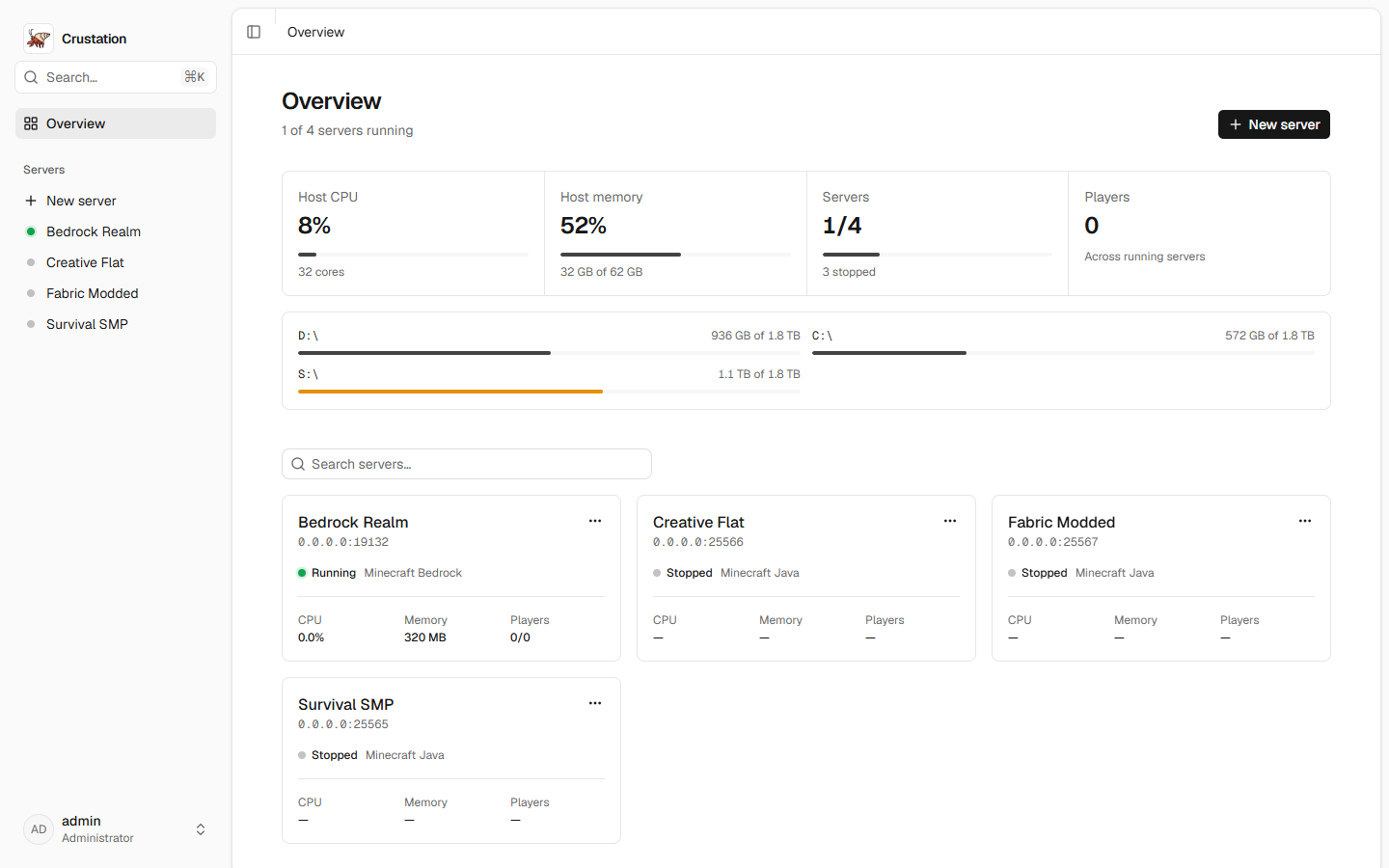
What works today
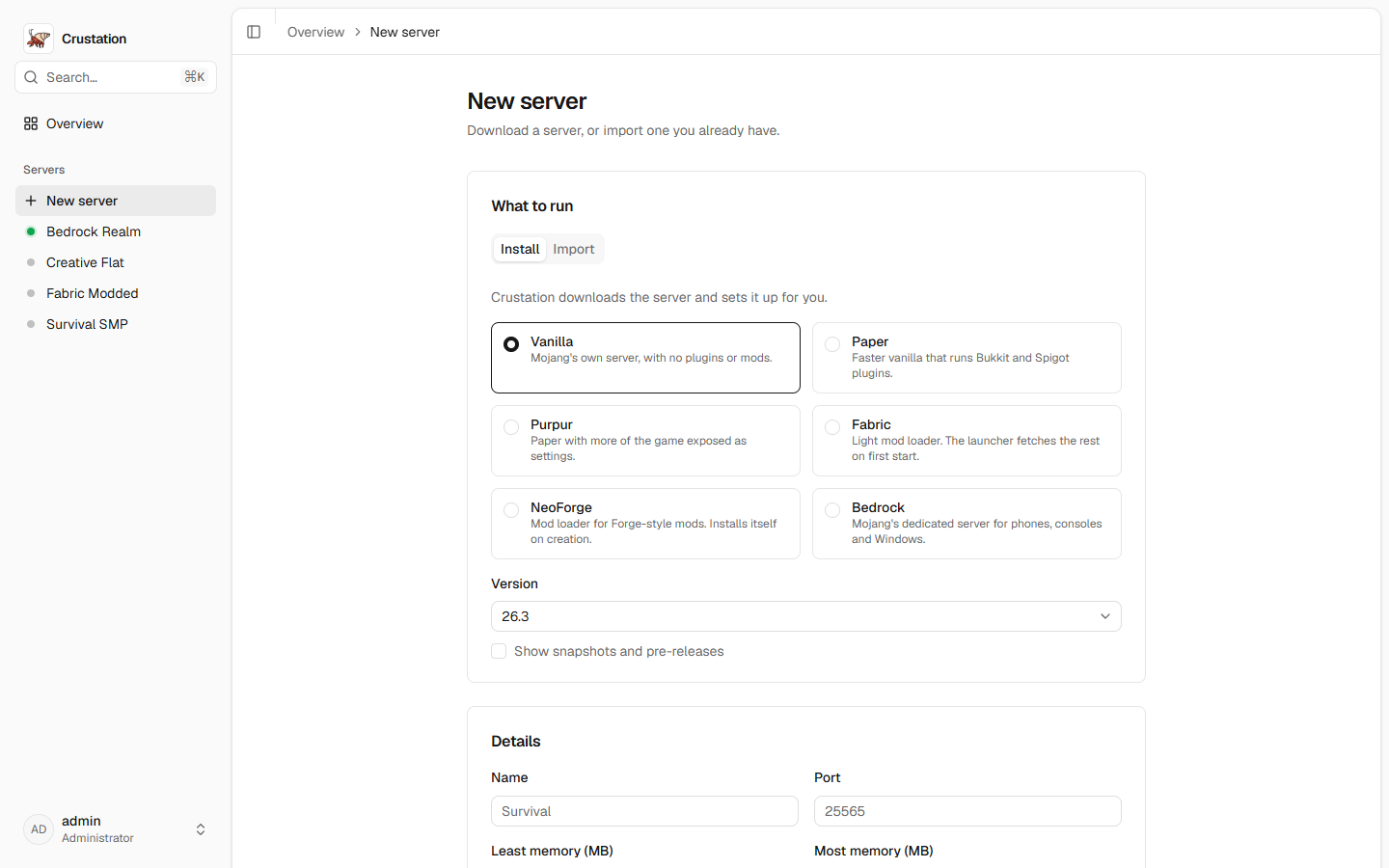
- Create a server from Vanilla, Paper, Purpur, Fabric, NeoForge or Bedrock. Crustation downloads it, accepts the EULA, sets the port and picks a Java version that suits it. Choose the seed, world type, difficulty, game mode and slots while you are there.
- Import a server you already have, from a zip, a folder on the host, or a download link.
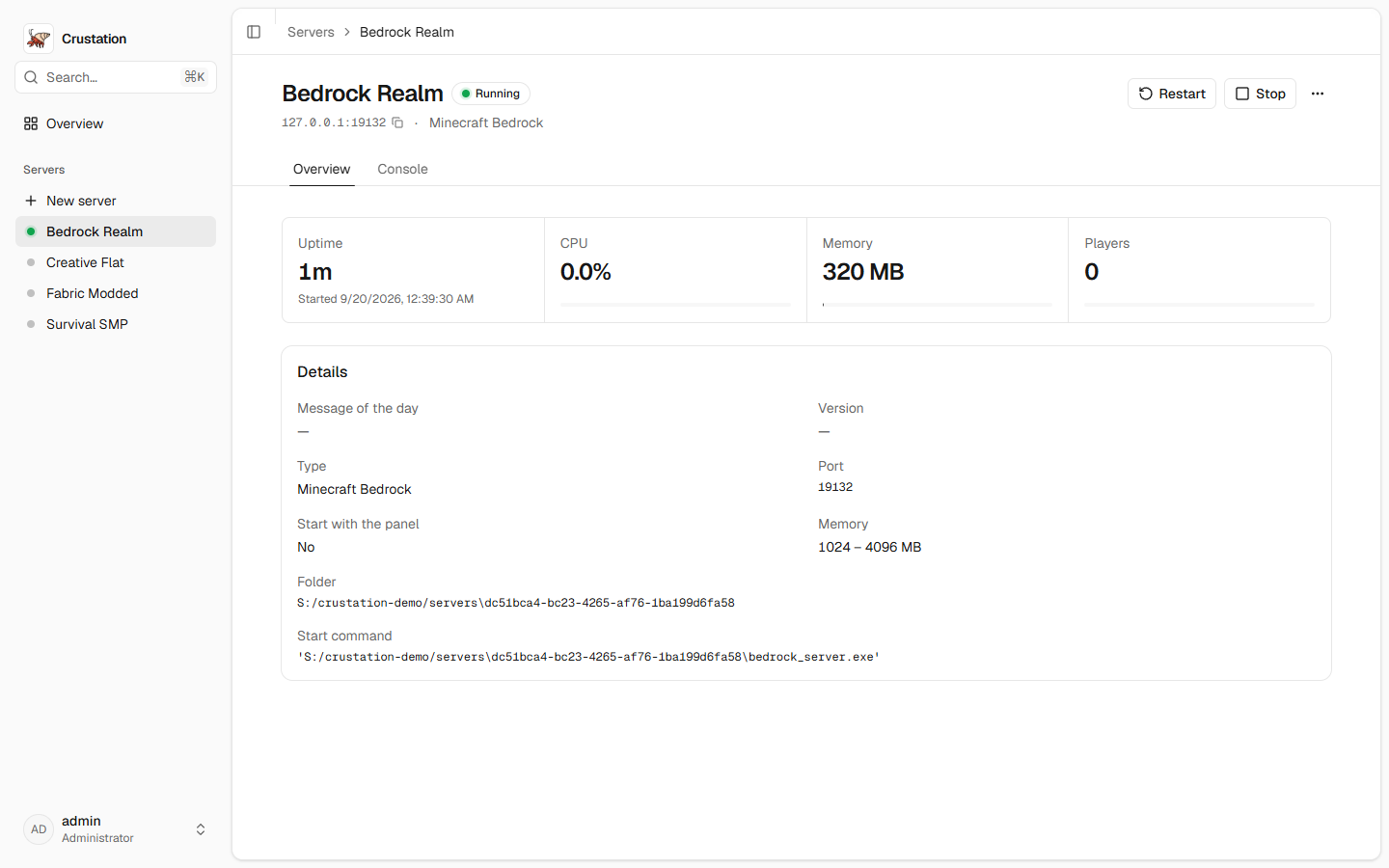
- Start, stop, restart and kill, with crash detection and restart on boot.
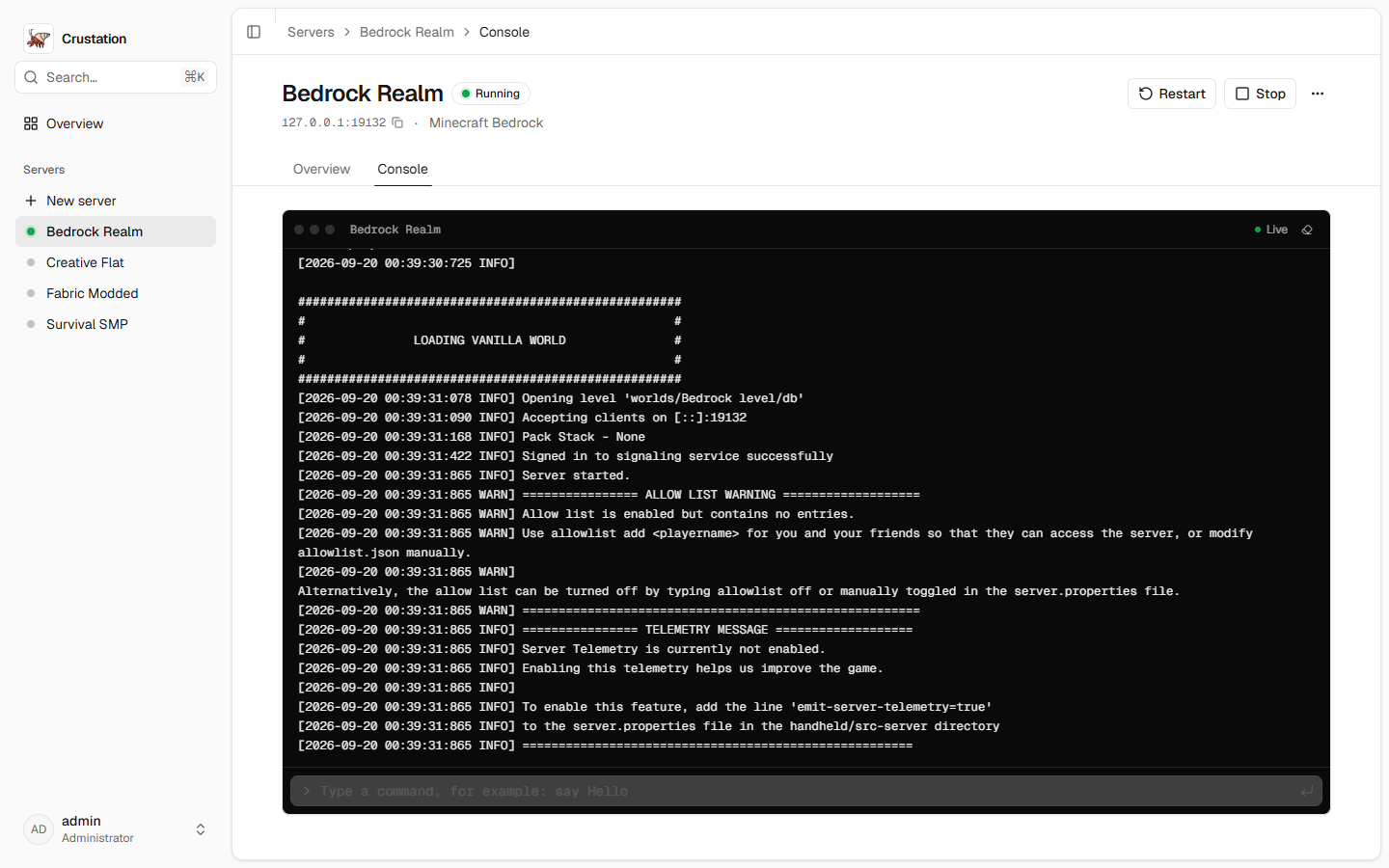
- A live console you can type into. Commands go over RCON when a Java server has it set up.
- Stats for the host and for each server process, with history.
- Users, roles and API keys, with per-server permissions.
- Add-ons and worlds on their own tab: install a .mcaddon or .mcpack and it is unpacked where
the server reads it and switched on for the world you pick; import a .mcworld and it lands under
worlds/under the name it gives itself. - An MCP server at
/mcp, so an assistant can read a console and act on a server through the same permissions an API key already has. See docs/API.md.
Not there yet: files, backups, schedules, player lists, webhooks, and the screens for managing users. docs/ROADMAP.md has the order they are coming in.
Install
Docker
docker run -d --name crustation \
  -p 8080:8080 -p 25565:25565 -p 19132:19132/udp \
  -v /srv/crustation/config:/config \
  -v /srv/crustation/servers:/servers \
  -v /srv/crustation/backups:/backups \
  -e PUID=1000 -e PGID=1000 \
  ghcr.io/juddisjudd/crustation:latest
docker-compose.yml does the same thing. The image carries Java 8, 11, 17, 21 and 25, and each
server starts on whichever one its version asks for.
Unraid
The template lives in juddisjudd/unraid-templates, the repository Community Applications already indexes. Two ways to add it:
- Docker → Add Container → Template URL, then paste https://raw.githubusercontent.com/juddisjudd/unraid-templates/main/templates/crustation.xml
- Community Applications → Additional Repositories, then add that repository
It maps config, servers and backups as three shares and honours PUID and PGID, so files stay
owned by your Unraid user rather than root.
From source
cd web && pnpm install && pnpm build && cd ..
cargo run --release
Data lands in ./config, ./servers and ./backups. For interface work, run pnpm dev in
web/; Vite proxies the API and the WebSocket to the panel on port 8080.
First sign-in
Open http://localhost:8080. The panel creates an administrator the first time it starts.
Set CRUSTATION_ADMIN_USERNAME and CRUSTATION_ADMIN_PASSWORD to choose your own. Otherwise
Crustation generates a password and writes it to config/first-login.txt. Change it after signing
in, then delete that file.
Configuration
config/crustation.toml appears on first start and can be edited. Environment variables override
it, which is how the container is configured.
| Variable | Meaning |
|---|---|
CRUSTATION_PORT, CRUSTATION_ADDRESS |
Where the panel listens |
CRUSTATION_PUBLIC_URL |
External address behind a reverse proxy; turns on secure cookies |
CRUSTATION_CONFIG_DIR, CRUSTATION_SERVERS_DIR, CRUSTATION_BACKUPS_DIR |
Data locations |
CRUSTATION_ADMIN_USERNAME, CRUSTATION_ADMIN_PASSWORD |
First administrator |
CRUSTATION_LOG |
Log filter, for example debug |
CRUSTATION_MCP_ENABLED |
Set to false to stop serving the MCP endpoint at /mcp |
Why another one
Crafty Controller has the right idea and I ran it for a while. Crustation is the same tool on different foundations: one binary and one SQLite file to deploy, an API built for a single-page interface, and a WebSocket that re-checks permissions on every event it sends.
Contributing
src/            the panel: http, auth, supervisor, providers, installs, stats, events
migrations/     SQLite schema
web/            the Svelte interface
docker/         container entrypoint
docs/           architecture, API contract, roadmap
docs/ARCHITECTURE.md covers how the pieces fit together. docs/API.md is the contract between the panel and the interface; change one side without the other and things break quietly.
Before opening a pull request:
cargo fmt --check && cargo clippy --all-targets -- -D warnings && cargo test
cd web && pnpm check && pnpm lint && pnpm build
Licence
AGPL-3.0-or-later. Run a modified copy as a service and you owe the world your changes.
Install Crustation on Unraid in a few clicks.
Find Crustation in Community Apps on your Unraid server, review the template, and click Install. Unraid handles the Docker app or plugin setup from the published template.
Requirements
Categories
Related apps
Explore more like this
Explore allDetails
ghcr.io/juddisjudd/crustation:latestRuntime arguments
- Web UI
http://[IP]:[PORT:8080]/- Network
bridge- Shell
bash- Privileged
- false
- Extra Params
--restart=unless-stopped --stop-timeout=60
Template configuration
Port for the Crustation web interface.
- Target
- 8080
- Default
- 8080
- Value
- 8080
Default port for a Minecraft Java server.
- Target
- 25565
- Default
- 25565
- Value
- 25565
Default port for a Minecraft Bedrock server.
- Target
- 19132
- Default
- 19132
- Value
- 19132
Port range for additional game servers.
- Target
- 25500-25600
- Default
- 25500-25600
- Value
- 25500-25600
Database, settings and the first-login file.
- Target
- /config
- Default
- /mnt/user/appdata/crustation/config
- Value
- /mnt/user/appdata/crustation/config
Where game server files live. Put this on a share with room to grow.
- Target
- /servers
- Default
- /mnt/user/appdata/crustation/servers
- Value
- /mnt/user/appdata/crustation/servers
Where backup archives are written.
- Target
- /backups
- Default
- /mnt/user/backups/crustation
- Value
- /mnt/user/backups/crustation
Username for the first administrator. Only used on the first start.
- Target
- CRUSTATION_ADMIN_USERNAME
Password for the first administrator, at least 10 characters. Leave empty to have one generated into first-login.txt.
- Target
- CRUSTATION_ADMIN_PASSWORD
Timezone for logs and schedules, for example Europe/London.
- Target
- TZ
- Default
- Etc/UTC
- Value
- Etc/UTC
User id that owns the files. 99 is nobody on Unraid.
- Default
- 99
- Value
- 99
Group id that owns the files. 100 is users on Unraid.
- Default
- 100
- Value
- 100
Full external address when behind a reverse proxy, for example https://panel.example.com. Turns on secure cookies.
- Target
- CRUSTATION_PUBLIC_URL