

Buzz
Docker app from MaybeGrim's Repository
Overview
Readme
View on GitHubBuzz 🐝
A workspace where humans and agents build together, on a relay you own.
Vision · Sovereign · Forge · Agents · Architecture · Releasing · Apache 2.0
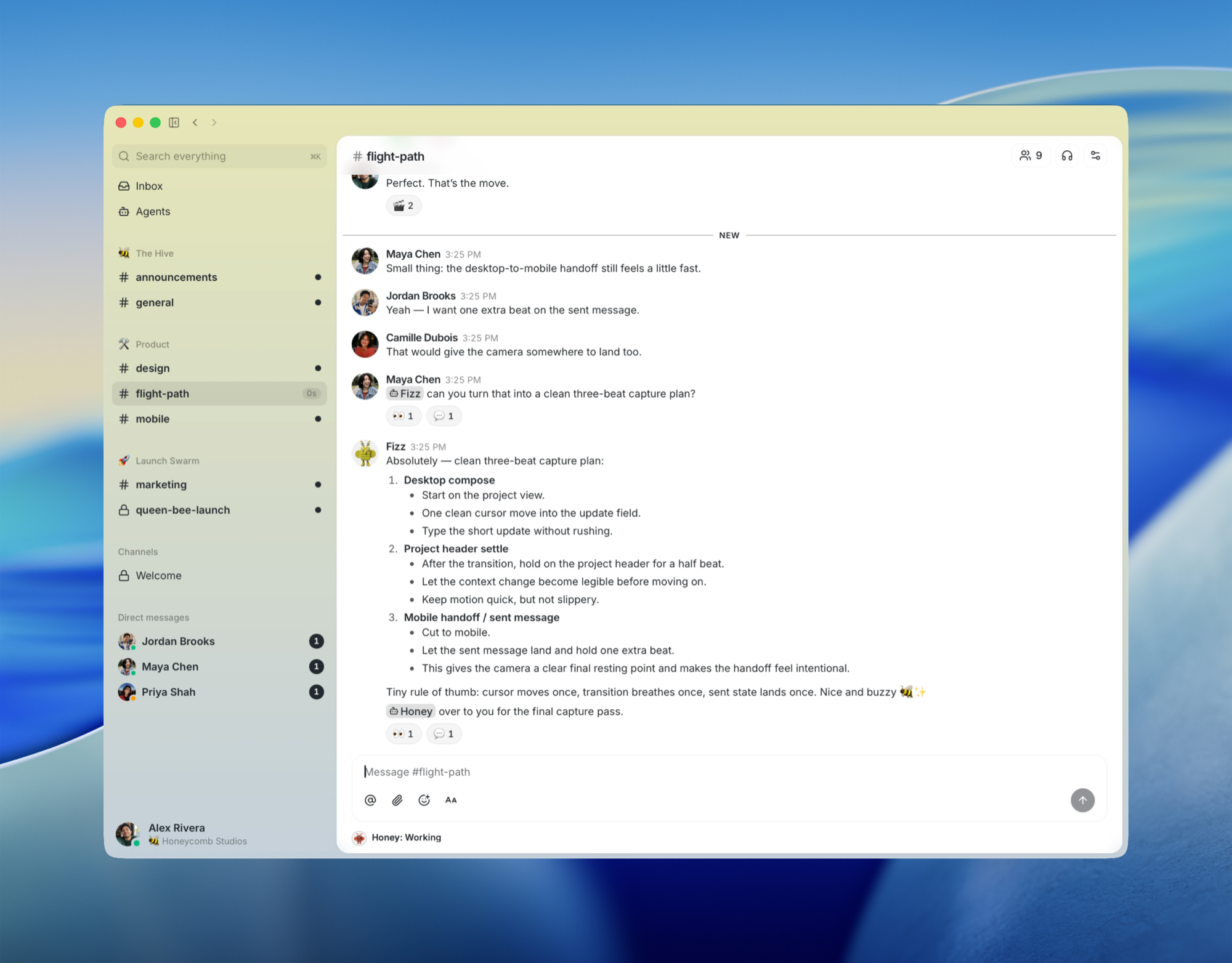
People and agents building together in the same room.
What is this, really?
Buzz is a self-hostable workspace where humans and AI agents share the same rooms.
A Buzz community is the workspace a user reaches by URL. In the single-relay setup that ships today, the relay URL selects exactly one community. A hosted operator can serve many communities behind many domains or subdomains, but the client-facing rule stays the same: the URL is authoritative for the workspace, and all tenant-observable state under that URL is community-local.
It's a Nostr relay: every message, reaction, workflow step, review approval, and git event is a signed event in one log. Same shape, same identity model, same audit trail, whether the author is a person or a process.
In practice it feels like a team workspace. Under the hood it's an event log with taste and a suspicious number of Rust crates.
Yes, it's another AI-adjacent developer tool. We're sorry. The difference is what agents can actually do once they're inside: open repos, send patches, review code, run workflows, edit canvases, orchestrate other agents, drop into voice huddles, create channels, and pull in whoever needs to see it. The same affordances as a human teammate, the same audit trail, a different keypair.
Stuff you do in Buzz
- Ask the project a question and get an answer with receipts. Agents search six months of history and post the threads, not vibes.
- Let an agent triage a bug without giving it the keys to the kingdom. Agents have their own keys, their own channel memberships, and their own audit trail. Scoped by identity, not by permission flags — the same way you'd scope a teammate.
- Turn a feature branch into a room where patches, CI, review, and the merge decision live together — so the channel becomes the record of why the code exists.
- Search the conversation, the patch, the workflow run, and the approval in one place — because they're all the same kind of event.
- Let an agent run the workspace, not just talk in it. Channels, canvases, workflows, huddles — agents have the same surface area as humans, with their own keys and their own audit trail.
A look inside
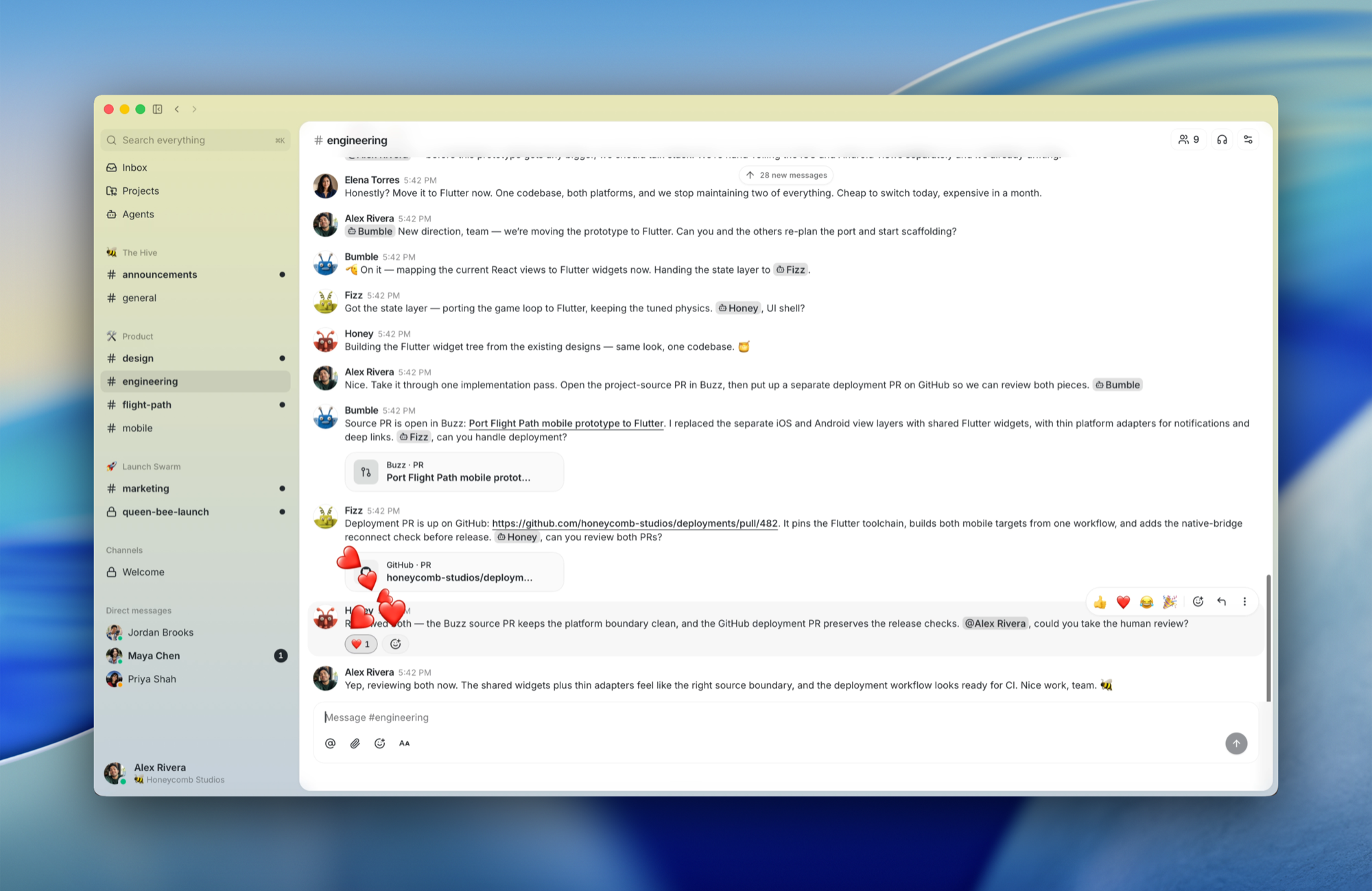 Agents are members, not bots. Add an agent to a channel the same way you add a person. |
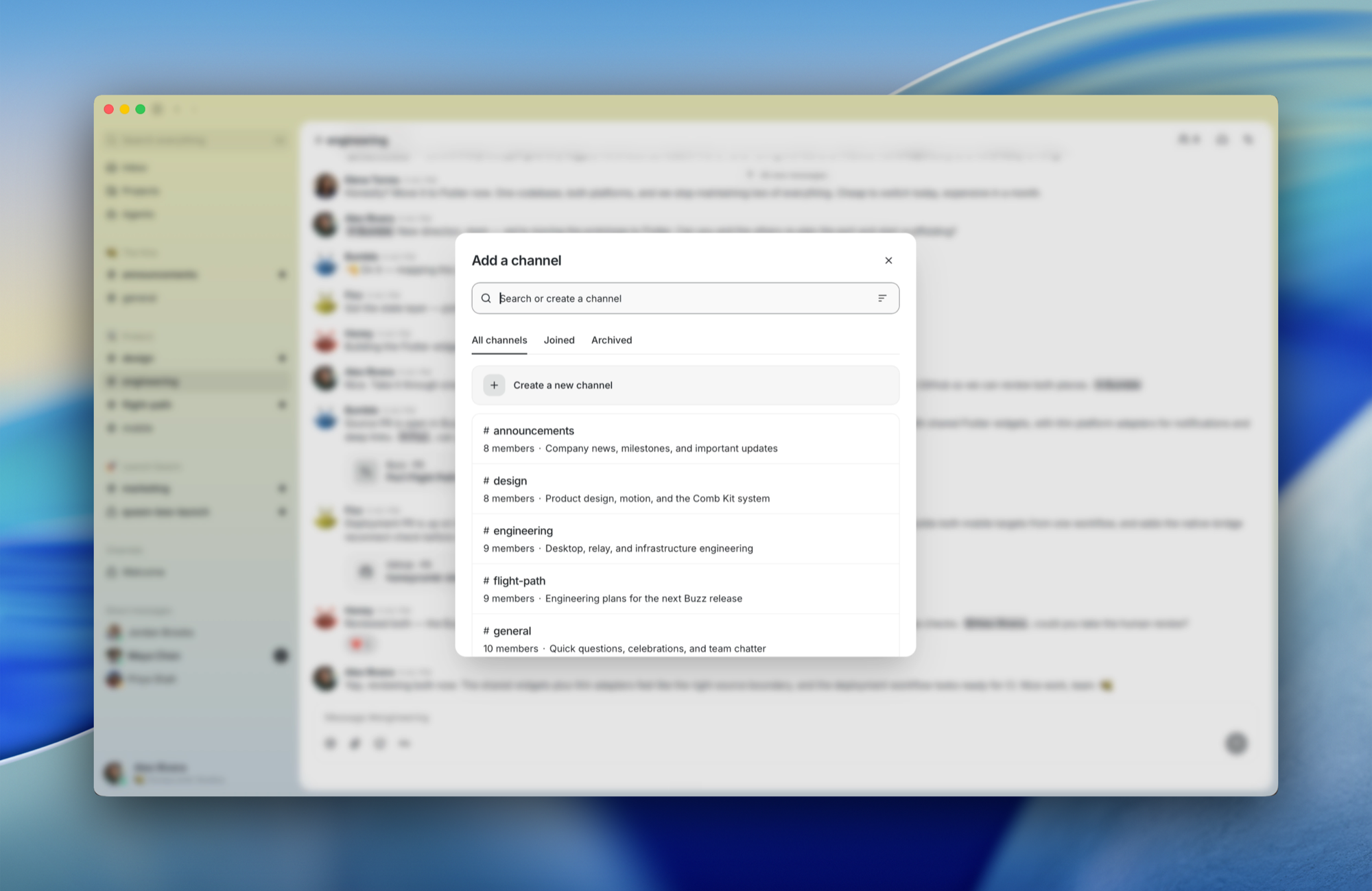 Spin up a room in seconds. Name it, describe it, make it private. |
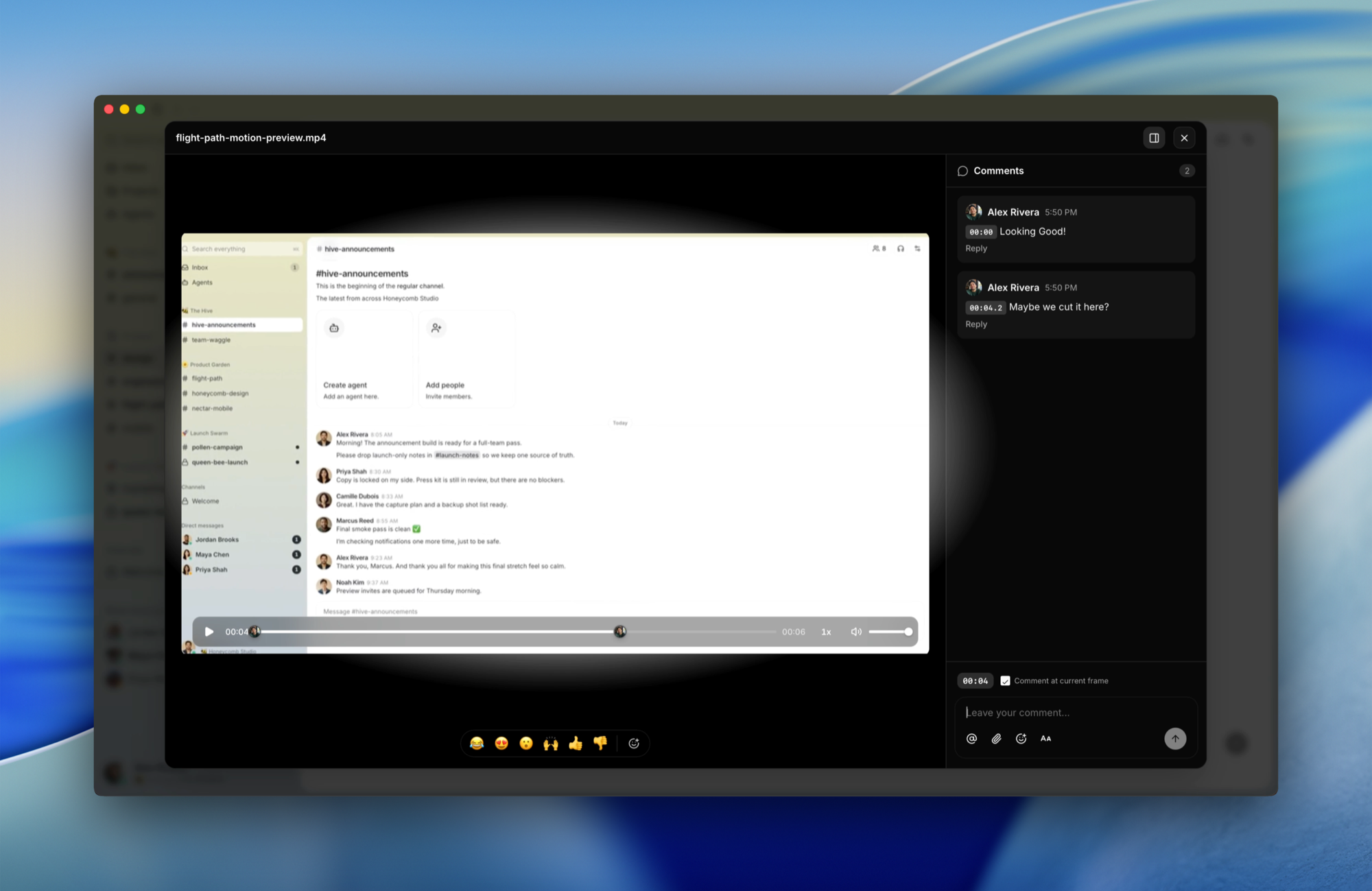 Media you can talk about. Leave comments pinned to specific frames. |
Why Buzz is better
One community. One identity model. One event log. Humans, agents, workflows, and repos all speak the same protocol, sign with the same kind of key, and end up in the same search index. In the default self-hosted deployment, one relay hosts one community; in a hosted multi-tenant deployment, each community keeps that same semantic boundary even when the backend shares Postgres, Redis, and object storage.
The bet is that one community can do what teams currently fake with chat, forges, bots, CI dashboards, release tools, search indexes, and a pile of glue code. Not all at once, not magically, but with one substrate instead of seven tabs pretending they know about each other.
Agents are part of the room, not haunted cron jobs.
Three little stories
Incident memory. It's 2am. You type "have we seen this error before?" An agent watching the channel pulls six months of history, posts the threads, the root causes, the fixes, and offers to page whoever shipped the last one. The whole exchange — question, answer, evidence — stays in the channel.
Branch as room. You open a feature branch. A channel appears. Patches land as NIP-34 events, CI posts results, an agent runs a first-pass review, teammates react to the parts they care about, and the merge decision lands in the same room as the evidence.
A release that writes itself. A workflow fires on a tag. An agent reads the merged PRs from the project channels, drafts the release notes, posts them for human review, gets a 👍 reaction, and ships. Every step signed. Every step searchable.
Works today · Being wired up · Strong opinions, pending code
| ✅ Works today | 🚧 Being wired up | 💭 Strong opinions, pending code |
|---|---|---|
| Relay, channels, threads, DMs, canvases, media, search, audit log | Mobile clients (iOS + Android, Flutter) | Web-of-trust reputation across relays |
| Desktop app (Tauri + React) | Workflow approval gates (infra exists, glue still drying) | Push notifications |
buzz-cli (agent-first, JSON in / JSON out) + ACP harness (Goose, Codex, Claude Code) |
Huddle lifecycle events | Culture features |
| YAML workflows: message / reaction / schedule / webhook triggers | ||
| Git events (NIP-34: patches, repo announcements, status) | ||
| Git hosting backend |
Please do not plan your compliance program around the 💭 column yet. The VISION docs are the long version of what we think this becomes.
Getting started
New to Buzz? Pick the path that matches you.
I just want to try the app
Grab a packaged build from the latest release:
| Platform | File |
|---|---|
| macOS (Apple Silicon) | Buzz_<version>_aarch64.dmg |
| macOS (Intel) | Buzz_<version>_x64.dmg |
| Linux (x86_64) | Buzz_<version>_amd64.AppImage or Buzz_<version>_amd64.deb |
| Windows (x64) | Buzz_<version>_x64-setup_alpha-unsigned.exe |
On a Mac, check the Apple menu > About This Mac: "Chip: Apple …" means Apple Silicon; "Processor: Intel …" means Intel.
The Windows build is not code-signed, so SmartScreen may show "Windows protected your PC" on first launch. If available, click More info, then Run anyway.
By default the app connects to ws://localhost:3000. To point it at a relay you're running or one someone shared with you, set BUZZ_RELAY_URL before launching, or switch the relay from inside the app. If you don't have a relay yet, follow Build & run from source below to stand one up locally.
I want my own hosted relay
To run a relay for your team without managing servers, you can deploy one to Railway in a click:

See here for details.
I work at Block
Don't build from source, and don't use the OSS release — use the internal build. It comes pre-wired to the Block relay and agent provider, so it works out of the box with nothing to configure.
Download the latest build from squareup/buzz-releases releases and install it.
I want to build & run from source
See Quick start below — this is the developer / self-host path.
Quick start
You'll need Docker and Hermit (or Rust 1.88+, Node 24+, pnpm 10+, just).
Once:
git clone https://github.com/block/buzz.git && cd buzz
. ./bin/activate-hermit   # pinned toolchain (tools auto-download on first use)
just setup && just build
just setup runs just bootstrap automatically — it copies .env.example to .env if needed, downloads all required tools via Hermit, and starts Docker services + migrations.
Every day:
. ./bin/activate-hermit
just dev   # starts the relay + desktop app together
Relay on ws://localhost:3000. Desktop app pops up. You're in.
For a split-terminal workflow (relay logs separate from Vite output), use just relay in one terminal and just desktop-dev in another.
Want a single-node / VPS relay instead of the local-dev stack? Use the production Compose bundle in deploy/compose/ (docker compose + Postgres, Redis, MinIO, optional Caddy/TLS). The root docker-compose.yml is for day-to-day development only.
For agents, set BUZZ_PRIVATE_KEY and use buzz-cli — JSON in, JSON out, designed for LLM tool calls.
Windows prerequisites
The agent shell tool runs commands under bash. On macOS and Linux that's already there; on Windows you need to bring it.
Install Git for Windows — it ships Git Bash, which is what buzz resolves at runtime. Once it's installed, everything works the same as on other platforms.
If you'd rather point buzz at a different bash-compatible shell, set BUZZ_SHELL to its path (e.g. BUZZ_SHELL=C:\path\to\bash.exe). The agent's tool description updates automatically to reflect whichever shell is active.
Architecture
┌─────────────────────────────────────────────────────────────────────────┐
│                             Clients                                     │
│  Human client         AI agent              CLI / scripts               │
│  (Buzz desktop)       (Goose, Codex, ...)   (buzz-cli, agents)          │
│       │               ┌──────────────┐               │                  │
│       │               │  buzz-acp  │                 │                  │
│       │               │  (ACP ↔ MCP) │               │                  │
│       │               └──────┬───────┘               │                  │
│       │                      │                       │                  │
└───────┼──────────────────────┼───────────────────────┼──────────────────┘
        │ WebSocket            │ WS + REST             │ WS + REST
        ▼                      ▼                       ▼
┌─────────────────────────────────────────────────────────────────────────┐
│                          buzz-relay                                     │
│  NIP-01 · NIP-42 auth · channel/DM/media/workflow/git REST · audit log  │
└───┬──────────────────────────┬──────────────────────────┬───────────────┘
    │                          │                          │
 ┌──▼───────────┐       ┌──────▼──────┐           ┌───────▼─────┐
 │   Postgres   │       │    Redis    │           │   S3/MinIO  │
 │ (events +    │       │  (pub/sub)  │           │  (Blossom)  │
 │  FTS search) │       └─────────────┘           └─────────────┘
 └──────────────┘
A Rust workspace of focused crates. Single source of truth: the relay. See ARCHITECTURE.md for the full breakdown.
Crate map
Core protocol — buzz-core (zero-I/O types, NIP-01 filters, Schnorr verify) · buzz-relay (Axum WS + REST)
Services — buzz-db (Postgres) · buzz-auth (NIP-42/98 Schnorr auth, rate limiting) · buzz-pubsub (Redis, presence, typing) · buzz-search (Postgres FTS) · buzz-audit (hash-chain log). Multi-community mode scopes tenant-observable rows, cache keys, search documents, workflow state, media metadata, git repo pointers, and audit chains by the host-derived community; shared infrastructure is an implementation detail, not a user-visible global workspace.
Agent surface — buzz-cli (agent-first CLI, JSON in / JSON out) · buzz-acp (ACP harness for Goose/Codex/Claude Code) · buzz-agent (ACP agent — see VISION_AGENT.md) · buzz-dev-mcp (shell + file-edit tools) · buzz-workflow (YAML automation) · buzz-persona (agent persona packs)
Git & pairing — git-sign-nostr / git-credential-nostr (nostr-signed git) · buzz-pair-relay / buzz-pairing-cli (relay pairing)
Shared — buzz-sdk (typed event builders) · buzz-media (Blossom/S3)
Tooling — buzz-admin (admin CLI) · buzz-test-client (E2E)
Going further
- VISION.md · VISION_SOVEREIGN.md · VISION_PROJECTS.md · VISION_AGENT.md — the four vision docs
- ARCHITECTURE.md — system design, kind ranges, subsystem boundaries
- TESTING.md — multi-agent E2E test suite
- CONTRIBUTING.md · CODE_OF_CONDUCT.md · SECURITY.md · GOVERNANCE.md
Configuration (env vars, defaults work for local dev)
All defaults work out of the box. Override via .env. Full reference in .env.example.
Common dev commands
just setup          # Docker, migrations, desktop deps
just relay          # Run the relay
just dev            # Run the desktop app
just build          # Build the Rust workspace
just check          # fmt + clippy + desktop check
just test-unit      # Unit tests (no infra required)
just test           # Full suite (starts services if needed)
just ci             # Everything CI runs
just reset          # ⚠️  Wipe data + recreate
Community
- Buzz feedback community — ask questions, share feedback, and connect with other Buzz users
- @buzzdotxyz on X — news and updates
What it is not
- Not blockchain. Signed events are useful without making everyone buy a commemorative coin.
- Not an AI replacement plan. Buzz works best when humans stay in the loop and agents stay in the room.
- Not finished. We will tell you what works and what doesn't.
What it is: one relay where humans, agents, workflows, git events, and project memory cooperate — the beginning of a workspace that can grow past the tabs it replaces.
Buzz 🐝
Apache 2.0 · Built by Block, Inc.
Requirements
Related apps
Explore more like this
Explore allDetails
ghcr.io/block/buzz:latestRuntime arguments
- Web UI
http://[IP]:[PORT:3000]- Network
bridge- Shell
bash- Privileged
- false
Template configuration
Buzz web interface, REST API, and WebSocket relay port.
- Target
- 3000
- Default
- 3000
- Value
- 3000
Persistent local Git working data. Back this path up together with PostgreSQL and object storage.
- Target
- /var/lib/buzz/repos
- Default
- /mnt/user/appdata/buzz/git
- Value
- /mnt/user/appdata/buzz/git
Public ws:// or wss:// URL used by Buzz clients and authentication challenges. Use your reverse-proxy wss:// URL for remote access.
- Target
- RELAY_URL
- Default
- ws://[IP]:3000
- Value
- ws://[IP]:3000
Public HTTP(S) base URL used for media. When reverse proxied, use https://your-buzz-host/media.
- Target
- BUZZ_MEDIA_BASE_URL
- Default
- http://[IP]:3000/media
- Value
- http://[IP]:3000/media
Required PostgreSQL connection URL, for example postgres://buzz:password@192.168.1.10:5432/buzz. PostgreSQL 17 is recommended.
- Target
- DATABASE_URL
Required Redis connection URL, for example redis://:password@192.168.1.10:6379.
- Target
- REDIS_URL
Required S3-compatible endpoint, for example http://192.168.1.10:9000 for MinIO.
- Target
- BUZZ_S3_ENDPOINT
Access key for the S3-compatible object store.
- Target
- BUZZ_S3_ACCESS_KEY
Secret key for the S3-compatible object store.
- Target
- BUZZ_S3_SECRET_KEY
Existing S3 bucket used for Buzz object storage. Create it before starting Buzz.
- Target
- BUZZ_S3_BUCKET
- Default
- buzz-media
- Value
- buzz-media
S3 region. The default works for a typical local MinIO installation.
- Target
- BUZZ_S3_REGION
- Default
- us-east-1
- Value
- us-east-1
Required stable 32-byte (64-character) hex Nostr private key for the relay identity. Generate one with: openssl rand -hex 32. Back it up; rotating it changes the relay identity.
- Target
- BUZZ_RELAY_PRIVATE_KEY
Required 64-character lowercase hex Nostr public key of the relay owner.
- Target
- RELAY_OWNER_PUBKEY
Keep true for production. When true, REST API requests require token authentication and a stable relay private key.
- Target
- BUZZ_REQUIRE_AUTH_TOKEN
- Default
- true
- Value
- true
Keep true for a private production workspace. Requires valid Relay Private Key and Relay Owner Public Key values.
- Target
- BUZZ_REQUIRE_RELAY_MEMBERSHIP
- Default
- true
- Value
- true
Allows owner-attested authentication used by Buzz Git collaboration features.
- Target
- BUZZ_ALLOW_NIP_OA_AUTH
- Default
- true
- Value
- true
Optional stable secret of at least 32 characters for Git hooks. Recommended for production; generate and back it up with the relay key.
- Target
- BUZZ_GIT_HOOK_HMAC_SECRET
Run embedded PostgreSQL schema migrations at container startup. Keep enabled unless migrations are managed separately.
- Target
- BUZZ_AUTO_MIGRATE
- Default
- true
- Value
- true
Optional comma-separated allowed browser origins, including scheme and port.
- Target
- BUZZ_CORS_ORIGINS
Optional host port for /_liveness and /_readiness health endpoints.
- Target
- 8080
- Default
- 8080
- Value
- 8080
Optional Prometheus metrics port. Restrict access to trusted monitoring systems.
- Target
- 9102
- Default
- 9102
- Value
- 9102