
All apps · 0 apps

Analysarr
Docker app from SEC844's Repository
Overview
No configuration file needed: on first launch, create the administrator account and follow the setup wizard.
Important: mount your data share exactly like in Emby/Jellyfin, your torrent client, Sonarr and Radarr (same host path, same container path), otherwise hardlinks cannot be detected.
Readme
View on GitHub

Analysarr
The health dashboard for your media stack.
Emby or Jellyfin · Sonarr · Radarr · qBittorrent, Deluge or Transmission · Seer · cross-seed





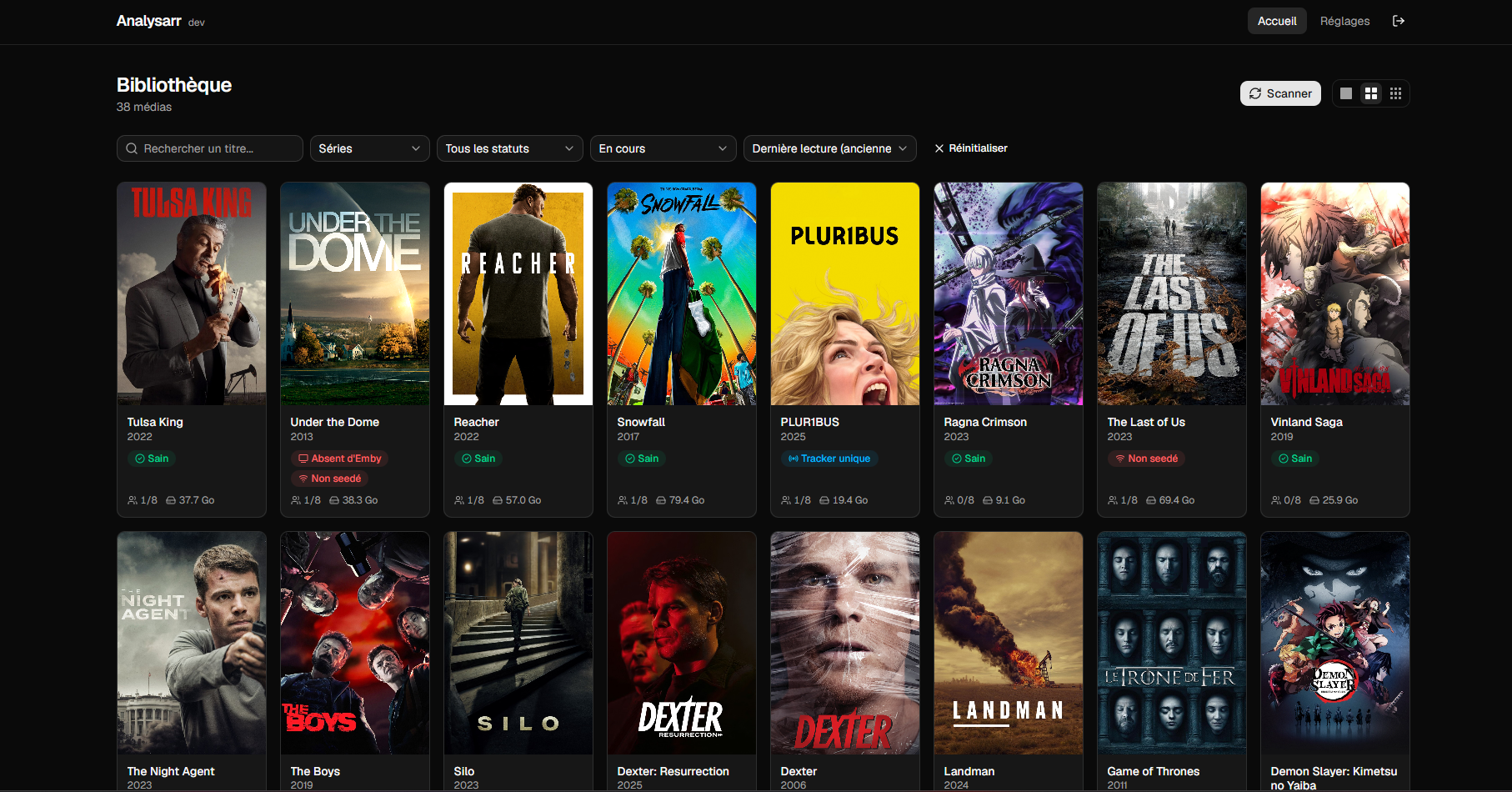
Analysarr shows, for every movie and series, its state across your whole stack — and lets you act on it in a few clicks instead of juggling four web interfaces.
- Is this movie still seeding, and is the torrent protected by a hardlink to the library?
- Which files are duplicates left behind by a Sonarr/Radarr upgrade?
- Which torrents are orphans (old quality, nothing links to them anymore)?
- Who watched it, who requested it, and how much space would deleting it really free?
Like Analysarr? Give it a ⭐ on GitHub: it helps other people find the project and keeps it moving.
Features
Detection
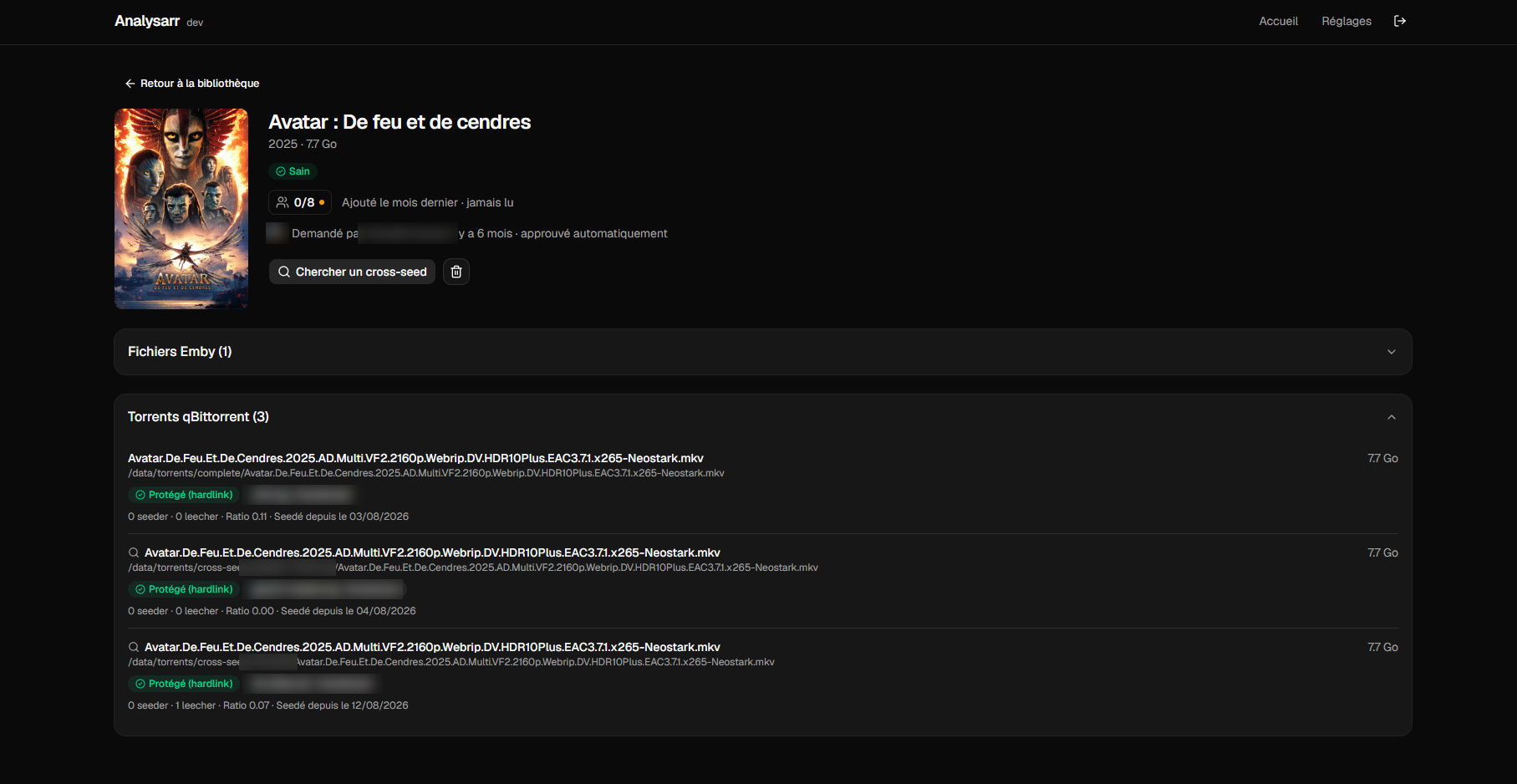
- Duplicates, orphan torrents, missing hardlinks, content seeded on a single tracker, media missing from the media server or not seeded at all.
- Torrent ↔ media matching by inode first (works for cross-seed copies living outside Sonarr/Radarr folders), then Sonarr/Radarr history, then title similarity.
- Trackers per torrent, with passkeys hidden.
Actions — always with a preview and an explicit confirmation
- Cascade cleanup of duplicates and orphans.
- Selective deletion (torrents, episodes, seasons, whole series or movie) with the real disk space freed, hardlinks accounted for.
- Optional removal from Sonarr/Radarr and Seer (never added to exclusion lists).
- One-click hardlink repair, with a symbolic link fallback across filesystems.
- Targeted cross-seed search per episode, season or whole series.
Decision support
- Watch activity per user (
3/10watched it, progress on hover), last played date, date added. - Seer requests: who asked, when, who approved.
- "Cleanup candidates" sort: big files nobody watched for a long time.
Everyday comfort
- Scheduled scans, scan history, path diagnostics that pinpoint a missing Docker mount.
- qBittorrent, Deluge or Transmission: the torrent client is a setting, everything else works the same way.
- Several Sonarr and Radarr instances (e.g. a dedicated 4K Radarr): each media stays linked to the instance tracking it, and a version tracked by another instance is never treated as a duplicate.
- Library files are matched to Sonarr/Radarr even when containers mount the library at different paths.
- Connection status of every service in the settings, with an alert in the header as soon as one becomes unreachable.
- Read-only dashboard widget (
/api/status) for Homepage, Homarr or any JSON-capable tool. - Rich notifications on Discord, ntfy or Gotify (poster, space freed, result of every step). Several channels, each with its own events: scan finished, scan failed, orphans detected, deletion, cleanup, hardlink repair, cross-seed search, automation.
- Optional automations: on orphans, duplicates or non-hardlinked torrents, clean up, repair, search a cross-seed or just notify — with conditions (seed time, ratio, media type, reclaimable space), a simulation mode and a cap per run.
- Action history: every deletion, cleanup, repair and cross-seed search, with its detailed result.
- English and French interface, dark/light theme, display preferences.
- Update notification when a new version is released.
Compatibility
| Service | Supported | Required |
|---|---|---|
| Emby | 4.x | One of Emby or Jellyfin |
| Jellyfin | 10.9 or newer | One of Emby or Jellyfin |
| Sonarr | v3, v4 | Yes |
| Radarr | v3 or newer | Yes |
| qBittorrent | 4.1 or newer (WebUI API v2) | One torrent client |
| Deluge | 2.x (web interface) | One torrent client |
| Transmission | 3.0 or newer (RPC) | One torrent client |
| Seer (Overseerr, Jellyseerr, Seerr) | Current versions | Optional |
| cross-seed | Daemon mode | Optional |
Quick start
Docker Compose
services:
  analysarr:
    image: ghcr.io/sec844/analysarr:latest
    container_name: analysarr
    restart: unless-stopped
    ports:
      - "1818:1818"
    environment:
      DATABASE_PATH: /config/analysarr.db
    volumes:
      - ./analysarr:/config
      # Same host path AND same container path as in your media server,
      # qBittorrent, Sonarr and Radarr (see "Paths and hardlinks").
      - /mnt/data:/data
Unraid
Search for Analysarr in the Apps tab (Community Applications).
Without Community Applications: Docker → Add Container → paste this template URL:
https://raw.githubusercontent.com/SEC844/unraid-templates/main/templates/analysarr.xml
First launch
Open http://<host>:1818, create the administrator account, then follow the setup wizard: media server, Sonarr, Radarr, torrent client, folder paths, then cross-seed and Seer if you use them (both optional). A final summary shows what is ready and what is still missing.
There is no configuration file to edit: everything is configured from the interface, with a Test connection button for every service and a Browse button for every path. Once the wizard is done, run a first scan from the library.
Paths and hardlinks
This is the one thing to get right. Analysarr compares the files seen by your media server and by your torrent client from inside its own container. It must therefore see exactly the same paths as those containers:
| Container | Host path | Container path |
|---|---|---|
| Emby / Jellyfin | /mnt/data |
/data |
| qBittorrent / Deluge / Transmission | /mnt/data |
/data |
| Sonarr / Radarr | /mnt/data |
/data |
| Analysarr | /mnt/data |
/data |
This is the layout recommended by the TRaSH Guides. If your containers use other paths, mirror them in Analysarr. Settings → Paths → Path diagnostics tells you immediately if a mount is missing, and which folder.
Write access to the data share is only used when you delete media or repair hardlinks, always after a confirmation.
Dashboard widget
Generate a key in Settings → Configuration → Widget, then query http://<host>:1818/api/status with the X-Api-Key header (or Authorization: Bearer). The response only contains counters: media total, movies, series, healthy media, media per status, reclaimable space, last scan and service status. Example for Homepage:
- Analysarr:
    href: http://analysarr:1818
    widget:
      type: customapi
      url: http://analysarr:1818/api/status
      headers:
        X-Api-Key: YOUR_KEY
      mappings:
        - field: { media: total }
          label: Media
        - field: { statuses: doublon }
          label: Duplicates
        - field: reclaimable_bytes
          label: Reclaimable
          format: bytes
Updating
Pull the new image and recreate the container. Your settings and cache live in /config and are kept. The interface shows a notification when a new version is available (Settings → Application, can be disabled).
Upgrading from a version older than 0.19.0? The default port changed from 8000 to 1818. Update your port mapping (1818:1818, or the container port on Unraid), or set the PORT=8000 environment variable to keep the previous port.
Security
- A single administrator account; passwords hashed with bcrypt; login locked for 15 minutes after 5 failed attempts.
- Optional two-factor authentication (TOTP authenticator app) with single-use recovery codes.
- Automations never run unless you create a rule: new rules start in simulation, every run is capped, and they reuse the manual actions — a protected or repairable torrent is never deleted.
- The widget endpoint requires its own key (stored hashed, accepted in a header only), exposes counters only (no titles, paths or service addresses) and never triggers requests to your services.
- Sessions stored server-side, sent as an
httpOnlycookie. - API keys and passwords of your services stay on the server: they are never sent back to the browser.
- The only outbound connections are the services you configure (notification channels included), plus an optional update check against the GitHub API (sends only the Analysarr version).
- Notification webhooks and tokens are write-only too; only official Discord webhook URLs are accepted, and test notifications only go to saved channels.
- Analysarr can delete files: do not expose it directly to the internet. Put it behind a reverse proxy with HTTPS, or keep it on your local network / VPN.
Found a vulnerability? Please report it privately, see SECURITY.md.
FAQ
Will Analysarr delete something on its own? No. Scans are read-only. Every deletion or repair shows a preview first and waits for your confirmation.
Torrents show as "not evaluated" or paths are unreachable. A mount is missing or differs from your other containers. Run Settings → Paths → Path diagnostics: it shows the folder that is not visible from Analysarr.
The connection test says "the server at this address is Jellyfin, not Emby". Choose the right media server at the top of the media server card in Settings.
Do I need Seer or cross-seed? No. Both are optional and fully hidden until you enable them.
Contributing
Contributions are welcome — read CONTRIBUTING.md first.
License
GNU AGPL-3.0. You may use, modify and share Analysarr; any modified version you distribute or run as a service must stay open source under the same license.
Install Analysarr on Unraid in a few clicks.
Find Analysarr in Community Apps on your Unraid server, review the template, and click Install. Unraid handles the Docker app or plugin setup from the published template.
Categories
Related apps
Explore more like this
Explore allDetails
ghcr.io/sec844/analysarr:latestRuntime arguments
- Web UI
http://[IP]:[PORT:1818]/- Network
bridge- Shell
sh- Privileged
- false
Template configuration
Port of the web interface.
- Target
- 1818
- Default
- 1818
- Value
- 1818
Share holding your library and downloads. Use the SAME host path and the SAME container path as in Emby/Jellyfin, your torrent client, Sonarr and Radarr (e.g. TRaSH Guides layout: /mnt/user/data mounted on /data everywhere). Write access is only used when you delete media or repair hardlinks, always after a confirmation.
- Target
- /data
- Default
- /mnt/user/data
- Value
- /mnt/user/data
Database, settings and poster cache.
- Target
- /config
- Default
- /mnt/user/appdata/analysarr
- Value
- /mnt/user/appdata/analysarr
SQLite database location inside the container. Keep it inside the Appdata path so it survives updates.
- Target
- DATABASE_PATH
- Default
- /config/analysarr.db
- Value
- /config/analysarr.db